August Updates
Aug. 31
 New York Times, In Trump’s Federal Work Force Cuts, Black Women Are Among the Hardest Hit, Erica L. Green, Aug. 31, 2025. President Trump has cut hundreds of thousands of jobs from the federal work force, disproportionately affecting Black employees.
When President Trump started dismantling federal agencies and dismissing rank-and-file civil servants, Peggy Carr, the chief statistician at the Education Department, immediately started to make a calculation.
She was the first Black person and the first woman to hold the prestigious post of commissioner of the National Center for Education Statistics. As a political appointee, she knew there was a risk of becoming a target.
But her 35-year-career at the department spanned a half dozen administrations, including Mr. Trump’s first term, and she had earned the respect of officials from both parties. Surely, she thought, the office tasked with tracking the achievement of the nation’s students could not fall under the president’s definition of “divisive and harmful” or “woke.”
But for the first time in her career, Dr. Carr’s data points didn’t add up.
On a February afternoon, a security guard showed up to her office just as she was preparing to hold a staff meeting. Fifteen minutes later, the staff watched in tears and disbelief as she was escorted out of the building.
“It was like being prosecuted in front of my family — my work family,” Dr. Carr said in an interview. “It was like I was being taken out like the trash, the only difference is I was being taken out the front door rather than the back door.”
While tens of thousands of employees have lost their jobs in Mr. Trump’s slash-and-burn approach to shrinking the federal work force, experts say the cuts disproportionately affect Black employees — and Black women in particular. Black women make up 12 percent of the federal work force, nearly double their share of the labor force overall.
For generations, the federal government has served as a ladder to the middle class for Black Americans who were shut out of jobs because of discrimination. The federal government has historically offered the population more job stability, pay equity and career advancement than the private sector. Following the passage of the Civil Rights Act of 1964, the federal government aggressively enforced affirmative action in hiring and anti-discrimination rules that Mr. Trump has sought to roll back.
The White House has defended Mr. Trump’s overhaul of the federal government as an effort to right-size the work force and to restore a merit-based approach to advancement. In July, the Supreme Court ruled that Mr. Trump could continue with mass firings across the federal government.
In a statement, Harrison Fields, a White House spokesman, said that Mr. Trump was “ushering in an economy that will empower all Americans, just as it did during his first term.” He added that “the obsession with divisive D.E.I. initiatives reverses years of strides toward genuine equality.”
“The policies of the past that artificially bloated the public sector with wasteful jobs are over,” he said. “The Trump administration is committed to advancing policies that improve the lives of all Americans.”
But economists say that Black women are being hit especially hard by Mr. Trump’s policies, which are also rippling through the private sector as corporations have abandoned their diversity, equity and inclusion practices and related jobs, many of which were held by Black women.
Global News
New York Times, Videos Contradict Israel’s Rationale for Deadly Gaza Hospital Attack, Christoph Koettl, Sanjana Varghese, Natalie Reneau and Aric Toler, Aug. 31, 2025. The strikes on Nasser Hospital in Gaza killed at least 20 people.
A Times visual analysis calls into question what the Israeli military was initially targeting there, and why its troops attacked a second time, killing first responders and journalists.
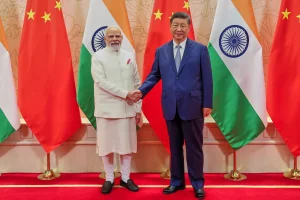
Prime Minister Narendra Modi of India, left, and President Xi Jinping of China on Sunday on the sidelines of the Shanghai Cooperation Organization summit in Tianjin, China, in a photo released by Mr. Modi’s office (Photo via Indian Prime Minister’s Office and Associated Press).
New York Times, Xi Uses Summit, Parade and History to Flaunt China’s Global Pull, David Pierson, Mujib Mashal and Nataliya Vasilyeva, Updated Aug. 31, 2025. With the leaders of Russia and India visiting, China’s president will show how he can use statecraft, military might and history to push for global influence.
Xi Jinping could hardly have scripted a more favorable moment. This weekend, the leaders of India  and Russia joined him at a security summit in China — one leader pushed away by President Trump’s tariffs, the other brought out of isolation by his embrace.
For Prime Minister Narendra Modi of India, U.S. tariffs on Indian goods have raised doubts about leaning too heavily on Washington. For President Vladimir V. Putin of Russia, his red-carpet treatment in Alaska by Mr. Trump blunted Western efforts to punish him for the invasion of Ukraine.
At the center is Mr. Xi, turning America’s alienation of India into an opportunity, and finding validation for his own long alignment with Mr. Putin.
The summit of more than 20 leaders, mostly from Central Asia, followed by a military parade in Beijing showcasing China’s newest missiles and warplanes, is not just pageantry. It shows how Mr. Xi is trying to turn history, diplomacy and military might into tools for reshaping a global order that has been dominated by the United States.
“The success of Xi’s foreign policy strategy is reflected in the parade of leaders traveling to China,” said Jonathan Czin, a fellow at the Brookings Institution who previously worked at the C.I.A. analyzing Chinese politics. “Indeed, Xi today probably feels more besieged by visiting heads of state than encircled by the United States and its allies and partners.”
Mr. Xi, Mr. Putin and Mr. Modi are attending the summit of the Shanghai Cooperation Organization, a Eurasian security group led by China and Russia, in the eastern city of Tianjin on Sunday and Monday.

New York Times, Judge Temporarily Blocks U.S. Efforts to Deport Guatemalan Children, Miriam Jordan and Ali Watkins, Aug. 31, 2025. The ruling came hours after some shelters were directed to prepare children to be sent back to Guatemala. A hearing was scheduled for Sunday afternoon.
A federal judge temporarily blocked the Trump administration from deporting 10 Guatemalan children back to their home country, and scheduled an emergency hearing on Sunday to determine whether the deportations were legal.
Judge Sparkle L. Sooknanan, of U.S. District Court for the District of Columbia, issued the order after the National Immigration Law Center filed an emergency request in federal court to stop the deportations. The lawyers argued that the government had violated the children’s right to due process and had ignored special protections for minors who cross the border alone.
The court forbade the administration from deporting the children, who are between the ages of 10 and 16, for 14 days. An emergency hearing was scheduled for Sunday afternoon.
The order could temporarily hamstring the federal government’s attempts to send back hundreds of other unaccompanied minors whom it said had entered the country illegally from Guatemala.
While the ruling was temporary, it marked the second setback for President Trump’s immigration policies since Friday, when another judge blocked the administration from carrying out rapid deportations far from the border, a cornerstone of the White House’s immigration policy.
The lawsuit was filed after staff members at shelters holding the children were notified by email that they should prepare some children to be sent back to Guatemala. Lawyers representing some of the children received a similar email.
In its 25-page complaint, the National Immigration Law Center said that the children had active cases before immigration courts across the country, and that their repatriation would violate the law and Constitution. It called the government’s actions “unlawful and reckless.”
Some of the children, identified in the lawsuit only by their initials, have expressed a fear of returning to Guatemala to judges in immigration courts where they have pending cases.
The number of unaccompanied minors entering the United States has plummeted since Mr. Trump took office for his second term this year. But the migrant children have posed a particular challenge to the Trump administration because they are entitled to special protections.
Hundreds of thousands of children, mainly from Central America, have crossed the southern border into the United States in the last decade, often seeking to join friends or family members. Many of the minors have won the right to remain in the United States permanently by proving that they were abandoned or persecuted in their home countries.
The move to repatriate the Guatemalan children has the backing of the Guatemalan government. On Friday, Guatemala’s minister of foreign affairs, Carlos Ramíro Martínez, said that his country had been coordinating with the United States and expected to receive more than 600 minors, following a plan outlined by Kristi Noem, the Homeland Security secretary, on a recent visit to Guatemala.
Most of the children whom the government intends to remove from the United States have been living in government shelters, where they remain until they are released to sponsors or guardians.
Lawyers fighting the removal of unaccompanied minors have cited the Trafficking Victims Protection Reauthorization Act, which provides unique protections for unaccompanied minors seeking refuge in the United States, including the opportunity to have their cases adjudicated by a court.
New York Times, America Closed Malls, but China Kept Building Them. Now It Has Too Many, Keith Bradsher, Aug. 31, 2025. The first closing of an Apple Store in mainland China hints at broader troubles facing the country’s shopping malls as developers open more of them despite a glut.
Across the United States, one in six shopping malls has closed since the sector peaked in 2013. But China has been on a frenetic construction boom, with its number of malls doubling since 2013 to 6,700.
Many retailers in China are now feeling the consequences of that overbuilding. While some Chinese malls are thriving, others are withering from lack of customer traffic.
New York Times, Historians See Autocratic Playbook in Trump’s Attacks on Science, William J. Broad, Aug. 31, 2025. Authoritarians have long feared and suppressed science as a rival for social influence. Experts see President Trump as borrowing some of their tactics.
The war on science began four centuries ago when the Roman Catholic Church outlawed books that reimagined the heavens. Subsequent regimes shot or jailed thousands of scientists. Today, in such places as China and Hungary, a less fearsome type of strongman relies on budget cuts, intimidation and high-tech surveillance to cow scientists into submission.
Then there is President Trump, who voters last year decisively returned to the White House. His blitz on science stands out because America’s labs and their discoveries powered the nation’s rise in the last century and now foster its global influence.
Just last week, Mr. Trump fired the newly confirmed director of the Centers for Disease Control and Prevention. Her lawyers said the move spoke to “the silencing of experts and the dangerous politicization of science.”
In rapid bursts, Mr. Trump has also laid off large teams of scientists, pulled the plug on thousands of research projects and proposed deep spending cuts for new studies. If his proposed $44 billion cut to next year’s budget is enacted, it will prompt the largest drop in federal support for science since World War II, when scientists and Washington began their partnership.
Few if any analysts see Mr. Trump as a Stalin, who crushed science, or even as a direct analog to this era’s strongmen leaders. But his assault on researchers and their institutions is so deep that historians and other experts see similarities to the playbook employed by autocratic regimes to curb science.
For instance, despots over the ages devised a lopsided way of funding science that punished blue-sky thinkers and promoted gadget makers. Mr. Trump’s science policies, experts say, follow that approach. He hails Silicon Valley’s wizards of tech but undermines the basic research that thrives on free thought and sows the seeds of not only Nobel Prizes but trillion-dollar industries.
“Despots want science that has practical results,” said Paul R. Josephson, an emeritus professor of history at Colby College and author of a book on totalitarian science. “They’re afraid that basic knowledge will expose their false claims.”
Letters from an American, Historical Commentary: Aug. 30, 2025 [Trump’s War On Wind, Clean Energy Options], Heather Cox Richardson, right,  Aug. 31, 2025. Just days before Labor Day, a holiday designed to celebrate the importance and power of American workers in the United States, the Transportation Department cancelled $679 million in funding for offshore wind projects, and the Department of Energy announced it is withdrawing a $716 million loan guarantee to complete infrastructure for an offshore wind project in New Jersey.
These cancellations reflect President Donald J. Trump’s apparent determination to kill off wind and solar power initiatives and to force the United States to depend on fossil fuels. He refers to climate change as a “hoax,” says that windmills cause cancer, and falsely claims that renewable energy is more expensive than other ways to generate power. Former president Joe Biden made investing in clean energy a central pillar of his administration; Trump often seems to construct policies mostly to erase the legacies of his predecessors.
Reversing the shift toward renewable energy not only attacks attempts to address the crisis of climate change and boosts the fossil fuel industry on which some of Trump’s apparent allies depend, but also undermines a society based on the independence of American workers. In 2023, about 3.5 million Americans worked in jobs related to the renewable energy sector, and jobs in that sector grew at more than twice the rate of those in other sectors in what was a strong U.S. labor market. The production of coal, which Trump often points to as an ideal for American jobs, peaked in 2008. Between then and 2021, employment in coal mining fell by almost 60% in the East and almost 40% in the West, leaving a total of about 40,000 employees.
Another cut last week sums up the repercussions of the administration’s attack on renewable energy. On August 22 the Interior Department suddenly and without explanation stopped construction of a wind farm off the coast of Connecticut and Rhode Island that was 80% complete and was set to be finished early next year. As Matthew Daly of the Associated Press noted yesterday, Revolution Wind was the region’s first commercial-scale offshore wind farm. It was designed to power more than 350,000 homes, provide jobs in Connecticut and Rhode Island, and enable Rhode Island to meet its goal of 100% renewable energy by 2033.
The Board of Directors of the Chamber of Commerce of Eastern Connecticut expressed their dismay at the decision, noting that Revolution Wind employed more than 1,000 local union workers and is part of a $20 billion investment in “American energy generation, port infrastructure, supply chain, and domestic shipbuilding and manufacturing across over 40 states” by Ørsted, a Danish multinational company.
“Stopping this fully permitted, important project without a clear stated reason not only seriously undermines the state’s efforts to work towards a carbon neutral energy supply but equally important it sends a message to investors from all over the world that they may want to rethink investing in America. The message resulting from the President’s action is a lack of trust, uncertainty, and lack of predictability,” they wrote.
Connecticut governor Ned Lamont and Rhode Island governor Dan McKee, both Democrats, are working together to save the project. In a statement, Lamont said: “We are working closely with Rhode Island to save this project because it represents exactly the kind of investment that reduces energy costs, strengthens regional production, and builds a more secure energy future—the very goals President Trump claims to support but undermines with this decision.”
“It’s an attack on our jobs,” McKee said. “It’s an attack on our energy. It’s an attack on our families and their ability to pay the bills.”
The Trump administration launched this attack on renewable energy at a time when electricity prices are bouncing upward. According to Ari Natter and Naureen S. Malik of Bloomberg, electricity prices jumped about 10% between January and May and are projected to rise another 5.8% next year. Trump has tried to blame those rising costs on renewable energy, but in the country’s largest grid, which stretches from Virginia to Illinois, nearly all the electricity comes from natural gas, coal, and nuclear reactors.
More to the point is that the region also has the world’s highest concentration of AI data centers, driving power demand—and costs—upward. At the same time, according to Natter and Malik, the infrastructure for transmission is too outdated to handle the amounts of electricity the data centers will need.
Trump’s cuts are adding stress to this already overburdened system. Over the next decade, they are projected to reduce additions to the electric grid by half compared to projections from before his cuts. In July, Ella Nilsen of CNN reported that cuts to renewable power generation, as well as to the tax credits that encouraged the development of more renewable power projects, are exacerbating the electrical shortage and driving prices up.
The Trump administration claims that relying on fossil fuels will jump-start the economy, but higher costs for electricity are already fueling inflation, and in the longer term, more expensive power will slow economic growth. In contrast, China has leaped ahead to dominate the global clean energy industry. Cheaper electricity there is expected to make it more attractive for future investment.
Renewable energy is crucial to addressing the existential crisis of climate change, but as former president Joe Biden emphasized, developing the sector was also key for building a strong middle class. Well-paying jobs, in turn, help to protect democracy.
Historically, a system in which local economies support small businesses and entrepreneurs promotes a wide distribution of political power. In contrast, extractive industries support a system that concentrates wealth and power in the hands of a few individuals. The extractive systems in the pre–Civil War American South, where cotton concentrated power and wealth, and later in the American West, where mining, cattle, and agribusiness did the same, nurtured political systems in which a few men controlled their regions.
As president of the Massachusetts AFL-CIO Chrissy Lynch said in July after the Republicans passed the budget reconciliation bill cutting clean energy tax credits: “Working families shouldn’t have to purchase energy from billionaire oil tycoons and foreign governments or let them set the price of our energy bills.”
Her observation hit home earlier this week, when Joe Wallace, Costas Paris, Alex Leary, and Collin Eaton of the Wall Street Journal reported that the comments of Russian president Vladimir Putin and Trump at their meeting in Alaska on August 15 in which they talked about doing more business together were not vague goodwill. ExxonMobil and Russia’s biggest energy company, Rosneft, have been in secret talks to resume a partnership to extract Russian oil, including in the Arctic, that had been severed by Russia’s attack on Ukraine in 2022.
Lou Antonellis, the business manager of the Massachusetts International Brotherhood of Electrical Workers Local 103, added that the cuts to renewable energy projects in the U.S. were not just cuts to funding. “[Y]ou’re pulling paychecks from working families, you’re pulling apprentices out of training facilities, you’re pulling opportunity straight out of our communities. Every solar panel installed, every wind turbine wired, every EV charger connected, that’s a job with wages, healthcare, and a pension that stands for dignity for the American worker. You don’t kill that kind of progress: you build on it.”
Aug. 30
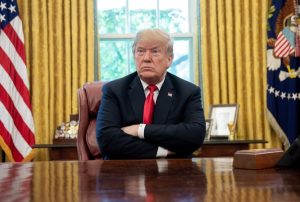
Letters from an American, Historical Commentary: Aug. 29, 2025 [Trump-Ordered Disruptions At Disease Control, Social Security, EPA Centers], Heather Cox Richardson, right, Aug. 30, 2025. Chaos continues at the Centers for Disease Control and Prevention (CDC), where President Donald J. Trump stepped in on Wednesday night to support Health and Human Services Secretary Robert F. Kennedy Jr. in his crusade to fire recently-confirmed Susan Monarez when she refused to rubber stamp his attack on vaccines.
With her ouster, three top scientists at the CDC resigned: Chief Medical Officer Debra Houry, National Center for Immunization and Respiratory Diseases director Demetre Daskalakis, and National Center for Emerging and Zoonotic Infectious Diseases director Daniel Jernigan. “The CDC you knew is over,” Daskalakis said. “Unless someone takes radical action, there is nothing there that can be salvaged.”
On Thursday, CDC staff and supporters rallied outside the agency’s Atlanta headquarters, whose windows are still pocked with bullet holes from a terrorist who had become convinced the coronavirus vaccine had injured him, to honor the resigning leaders.
In place of Monarez, the White House has appointed as acting CDC director Jim O’Neill, a biotech investor close to billionaire Peter Thiel and a former speechwriter at the Department of Health and Human Services during the presidential term of George W. Bush. O’Neill has no training in either medicine or the science of infectious diseases. As Maanvi Singh and Robert Mackey of The Guardian reported, O’Neill supported the use of ivermectin and hydroxychloroquine to treat covid despite no evidence that they worked. He also has embraced conspiracy theories about covid online.
The administration’s chaos extends to the Social Security Administration (SSA), where the 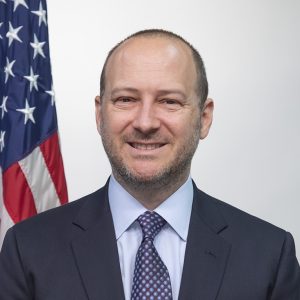 administration forced Chief Data Officer Charles Borges, right, to resign today. Borges had acted as a whistleblower for the agency when he identified serious data breaches that leave more than 300 million Americans at risk of identity theft and loss of benefits. In his resignation letter, Borges noted that he was leaving involuntarily after the administration had made it impossible to perform his duties legally and ethically and had caused him “serious attendant mental, physical, and emotional distress.”
 In his letter, Borges noted that he has “served this Country for almost my entire adult life, first as an Active-Duty Naval Officer for over 22 years, and now as a civil servant. I was deployed during 9/11, decorated for valor in combat during Operation Iraqi Freedom, and graduated from US Naval Test Pilot School. As a civil servant, I have served as a Presidential Innovation Fellow, in the Centers for Disease Control during COVID, within [the Office of Management and Budget] on the Federal [Chief Information Officer] Data Team, and now serve as the SSA Chief Data Officer. I have served in each of these roles with honor and integrity.”
Makena Kelly and David Gilbert of Wired reported that less than 30 minutes after Borges’s resignation hit the in-boxes of SSA staff, it disappeared.
The removal of dedicated civil servants for trying to protect the public extends to the Environmental Protection Agency, where tonight the Trump administration fired at least seven employees for  signing a letter criticizing the agency’s leadership for undermining “the EPA mission of protecting human health and the environment.” The firings are, Amudalat Ajasa of the Washington Post noted, “an escalation of the administration’s effort to clamp down on dissent within the federal bureaucracy.”
“The Environmental Protection Agency has a zero-tolerance policy for career officials using their agency position and title to unlawfully undermine, sabotage, and undercut the will of the American public that was clearly expressed at the ballot box last November,” an EPA spokesperson said. But, increasingly, it seems obvious that the administration is claiming a mandate for policies that voters did not intend to endorse.
That includes the outing last week of an undercover intelligence officer, which has in the past been enough to lead to an indictment of an administration official. Director of National Intelligence Tulsi Gabbard released the name of a senior undercover Central Intelligence Agency (CIA) officer when she published a list of 37 current and former officials from whom she was stripping security clearances. Brett Forrest of the Wall Street Journal reported that Gabbard did not consult with the CIA before posting the list on X. At the time, Gabbard said she was acting on Trump’s orders.
Andrew Egger of The Bulwark took a step back today to look at the general operating system of the Make America Healthy Again (MAHA) part of the Trump administration and noted that it has always operated by throwing out wild conspiracies while actual scientists try to do the work of protecting America’s public health. Now, he notes, Kennedy and MAHA are the dog that caught the car. Faced with creating the new system that they promised voters would keep them healthier, they are flailing. Their key public-health report relied on fake studies concocted by AI, and Kennedy has slashed through advisory bodies and is currently limiting access to covid vaccines, all while the administration’s budget reconciliation bill is forcing people off health care insurance. Kennedy recently mused wildly about watching children in airports and realizing they have mitochondrial challenges.
Egger’s observation about MAHA fits MAGA as a whole. Trump and his ilk have spent years carping about how poorly the government is working and how much better they would be doing if they were the ones in charge. Voters gave them what they asked for, and now they appear to be unwilling or unable to do the actual work of governing. Instead, Trump and his cronies are simply declaring emergencies and then announcing policies they claim will address those emergencies. When their policies backfire or raise opposition, they claim they are being sabotaged by the deep state or that statistics are wrong.
This morning, the White House budget office announced it was unilaterally cancelling $4.9 billion in foreign aid funding passed by Congress. The Office of Management and Budget is overseen by director Russell Vought, a key author of Project 2025, the plan from right-wing institutions led by the Heritage Foundation designed to decimate the modern U.S. government and replace it with Christian nationalism.
The Constitution gives to Congress alone the power of spending money, and the executive branch has no authority to refuse to spend that money. Vought has argued that because the law permits the president to send to Congress a request to stop spending on certain items and gives Congress 45 days to consider the request, Trump can send a request with fewer than 45 days left before the end of the fiscal year and consider the request rubber stamped.
Both Republican Susan Collins of Maine and Democratic Patty Murray of Washington, who are the top two lawmakers on the Senate Appropriations Committee, reject the move. Collins called it “a clear violation of the law.” Murray called it a “brazen attempt to usurp” the power of Congress.
Another major area in which Trump has simply done as he wished without regard for the law or economic reality is tariffs. The U.S. Constitution gives exclusively to Congress the power to impose tariffs, but in 1977, Congress passed the International Emergency Economic Powers Act, often abbreviated as IEEPA, delegating to the president the power to adjust tariffs in times of national emergency. On February 1, Trump declared such a national emergency to impose tariffs on China, Canada, and Mexico, and on April 2 he again invoked it for new blanket tariffs.
Congress could have ended Trump’s power over tariffs by cancelling the national emergency, a step Democrats were willing to take. But Republicans in the House used a procedural rule to make sure that Democrats could not cancel that emergency. A challenge to the president’s declaration of a national emergency must come to the floor for a vote within 18 days of the challenge. The House defanged that rule by declaring that each day for the rest of the congressional session will not “constitute a day for purposes…of the National Emergencies Act.”
Importers hit by the tariffs sued, along with Democratic-led states, and in May a three-judge panel at the U.S. Court of International Trade ruled that President Donald J. Trump’s sweeping “Liberation Day” tariffs were illegal. The IEEPA has “meaningful limits,” it wrote, and “an unlimited delegation of tariff authority would be unconstitutional.” “Congress manifestly is not permitted to abdicate or to transfer to other the essential legislative functions with which it is thus vested,” the court wrote. It blocked the tariffs Trump imposed under the IEEPA. The administration appealed.
Today, by a 7–4 majority, a federal appeals court upheld the decision, striking down Trump’s use of emergency powers to impose tariffs. “[W]e conclude Congress, in enacting IEEPA, did not give the President wide-ranging authority to impose” sweeping tariffs, noting that such an authorization would mean “Congress had bestowed on a federal agency the taxing power.” Such an authorization would be “a sharp break with our traditions.”
The decision will not take effect until October 14 to allow the administration to appeal to the Supreme Court. For his part, Trump seemed to think the court would bend to his will, which is, in turn, based on an ideology that the last few months have proven demonstrably wrong. Shortly after the decision came down, Trump posted on social media:
“ALL TARIFFS ARE STILL IN EFFECT! Today a Highly Partisan Appeals Court incorrectly said that our Tariffs should be removed, but they know the United States of America will win in the end. If these Tariffs ever went away, it would be a total disaster for the Country. It would make us financially weak, and we have to be strong. The U.S.A. will no longer tolerate enormous Trade Deficits and unfair Tariffs and Non Tariff Trade Barriers imposed by other Countries, friend or foe, that undermine our Manufacturers, Farmers, and everyone else. If allowed to stand, this Decision would literally destroy the United States of America. At the start of this Labor Day weekend, we should all remember that TARIFFS are the best tool to help our Workers, and support Companies that produce great MADE IN AMERICA products. For many years, Tariffs were allowed to be used against us by our uncaring and unwise Politicians. Now, with the help of the United States Supreme Court, we will use them to the benefit of our Nation, and Make America Rich, Strong, and Powerful Again! Thank you for your attention to this matter.”
 New York Times, He Plagiarized and Promoted Falsehoods. The White House Embraces Him, Ken Bensinger, Aug. 30, 2025. Benny Johnson, a right-wing podcaster, has enjoyed rare access and promotion from the Trump administration.
The day after President Trump announced the federal takeover of law enforcement in Washington, the White House invited the podcaster Benny Johnson to sit in what is called the new media seat at the administration’s press briefing. The privilege includes being called on first by the press secretary, Karoline Leavitt.
Mr. Johnson took the opportunity at the briefing to recount what he claimed was his own experience with crime in the nation’s capital in recent years. He said that he had recorded murders on a camera outside his home, and that his “house was set ablaze in an arson.” Any claims that Washington wasn’t dangerous, he said, were “lies.”
“Thank you for making this city safe, because no parent should have to go through what my family went through,” Mr. Johnson told Ms. Leavitt.
In fact, police records show, nobody has been murdered since at least 2017 on the block where Mr. Johnson lived in Washington. And his home was not burned, though his next-door neighbor’s house was “intentionally set” on fire, according to the city’s fire department. Mr. Johnson left Washington permanently in 2021.
Such details didn’t stop Ms. Leavitt from leapfrogging off his comments to promote the president’s federalization of Washington’s law enforcement.
Since taking office, Mr. Trump and his aides have routinely excoriated traditional news outlets for what they call misleading and dishonest reporting about the administration. But the White House has had no such reservations about right-leaning influencers, figures such as Mr. Johnson, who have a documented history of playing fast and loose with the facts.
These new media personalities enjoy rare access and support from the administration. They, in turn, give the White House unwavering cheerleading for the administration’s agenda, blasted out to millions of followers on social media.
Among them is Jack Posobiec, who in 2017 helped spread the debunked “Pizzagate” conspiracy theory and last year stated that his goal was to “overthrow” democracy; Tim Pool, a podcaster who last fall was revealed to have been paid indirectly by Russia as part of a secret political influence operation; and Julie Kelly, a right-wing journalist who helped start the false narrative that the Jan. 6, 2021, riots were an “inside job.”Editors’ PicksFine-Tune Your Feed and Get News You Can UseThis Star Has the Moxie and Acting Chops for a Crime Drama. He’s Also a Cat.21 Cheap, Easy Recipes You Can Cook in Your College Dorm
Even among that group, Mr. Johnson, who has a large following on YouTube, a popular daily podcast and a large X account, stands out for his checkered journalistic record. Over the years, he has been fired from one job for plagiarism and suspended from another for publishing an article containing an unfounded conspiracy theory about Barack Obama that was later retracted. He has been accused of repeatedly propagating false election information and, like Mr. Pool, produced videos that had been secretly funded, via a seemingly legitimate media firm, by Kremlin operatives.
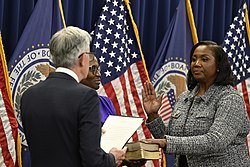
Federal Reserve Bank Governer Lisa Cook, the first Black female ever to hold that office, is sworn in by Bank Chairman Jerome Powell in 2022.
New York Times, Trump Administration Updates: Judge Hears Lisa Cook’s Suit to Block Her Firing From the Fed, Colby Smith, Aug. 30, 2025 (print ed.).
- Cook hearing: A federal judge is considering the lawsuit brought by Lisa Cook, a member of the Federal Reserve’s Board of Governors who wants to stay in her job while the legal battle over President Trump’s firing her proceeds. The case holds major implications for the future of the central bank and its independence. Read more ›
- Secret Service: Mr. Trump has ended the Secret Service protection for former Vice President Kamala Harris, effective Monday, according to a letter obtained by The New York Times. Vice presidents usually receive six months of protection after they leave office, but President Joe Biden had extended Ms. Harris’s coverage. Read more ›
- Transgender students: The Education Department threatened to pull federal funding from Denver’s public schools, charging that the school district had violated students’ civil rights by letting transgender students use bathrooms that align with their gender identity. Read more ›
What Cook’s lawyer is trying to achieve in today’s hearing is to establish in a legal setting that Cook can stay on and do her job as a governor while her lawsuit plays out. “She should not be taken out of her office, she shouldn’t be disconnected from her electronics,” said Abbe Lowell, her lawyer. “She should do all the things that she did a week ago before all this started, because that is the status quo.”
Lawyers representing Lisa Cook and President Trump discussed whether there was sufficient due process granted to Cook when she was fired as a member of the Federal Reserve’s Board of Governors. Trump’s lawyers said in their filing before the hearing started that she had sufficient notice and had not responded to the allegations. Her lawyers contend she did not have a real opportunity to respond.
Legal experts have said that the allegations against Cook are simply pretext and that the president’s real motive is to gain an opening on the Fed’s Board of Governors in order to install another loyalist who supports lower borrowing costs. “Cause can overcome bad motives. A bad motive can illuminate the fact that there was no cause,” her lawyer said.
Another big variable is whether it matters that the allegations against Cook involve actions she is purported to have taken before her time at the Fed. Her lawyer suggested that this was a factor in why this was not “cause,” but not the decisive reason.
The issue of “cause,” and what scope the president has to define what that means, is the thrust of this case. The president is arguing that he has “broad discretion” to determine what meets the mark of “for cause.”
The lawsuit has put the Fed in a difficult spot given that it has a vested interest in the outcome of the case. Because the allegations against Cook involve a personal matter before her time at the central bank, she has had to retain her own lawyers. The Fed is also limited in its ability to file a brief backing her position because its Board of Governors is named as a defendant along with Jerome H. Powell, the Fed chair. Both are included in Cook’s lawsuit in order to prevent them from executing Trump’s orders to fire her.
Until a court rules otherwise, Cook is still a Fed governor. The bank said it would comply with whatever the court decided, suggesting that if she was granted her the temporary restraining order she is seeking today, she would be able to keep doing her job. The Fed next votes on interest rates in mid-September, when it is expected to restart rate cuts that have been paused since January.
New York Times, News Analysis: Will the C.D.C. Survive? Apoorva Mandavilli, Aug. 30, 2025 (print ed.). Robert F. Kennedy Jr.’s assault may have dealt lasting damage to the agency, experts fear, with harsh consequences for public health.
In the six months since Robert F. Kennedy Jr. took office as the health secretary, the Centers for Disease Control and Prevention has withered, losing thousands of employees, about half of its budget and contracts, and much of its authority over the nation’s vaccine policies.
This week, as Mr. Kennedy ousted the agency’s new director and precipitated the resignation of four other leaders, experts in public health began asking questions unthinkable just a few months ago: Is the C.D.C. dying? And if so, what does that mean for Americans?
In interviews, a dozen public health experts, along with seven former high-ranking officials, described the C.D.C. as badly wounded and fast losing its legitimacy. It can still be salvaged, they said, but only if Mr. Kennedy listens to scientists and restores some of its crucial functions.
“It’s got, like, a heart rhythm that’s not viable at the moment,” said Dr. Demetre Daskalakis, who led the C.D.C.’s center for respiratory diseases until he resigned this week. “If it’s not shocked out of it now, it may not survive.”
Some experts acknowledged that the C.D.C. has its faults and needs serious reform. Its reputation was badly damaged during the pandemic, in part by its own missteps and in part because of misinformation spread by detractors.
But Mr. Kennedy “has not been reforming the C.D.C.,” said Dr. Ashish Jha, who served as the Covid czar during the Biden administration.
“He has been breaking it, and breaking it in a way that loses pretty much all the good people within it,” Dr. Jha said.
Asked for comment, Andrew Nixon, a spokesman for the Department of Health and Human Services, pointed to Mr. Kennedy’s message to C.D.C. employees on Thursday night.
“The C.D.C. must once again be the world’s leader in communicable disease prevention,” Mr. Kennedy said in the email. “Together, we will rebuild this institution into what it was always meant to be: a guardian of America’s health and security.”
On Thursday night, Mr. Kennedy announced that a longtime ally, James O’Neill, would be acting director of the agency. Mr. O’Neill is a former biotechnology executive who does not have medical or scientific training.
New York Times, He Plagiarized and Promoted Falsehoods. The White House Embraces Him, Ken Bensinger, Aug. 30, 2025. Benny Johnson, a right-wing podcaster, has enjoyed rare access and promotion from the Trump administration.
The day after President Trump announced the federal takeover of law enforcement in Washington, the White House invited the podcaster Benny Johnson to sit in what is called the new media seat at the administration’s press briefing. The privilege includes being called on first by the press secretary, Karoline Leavitt.
Mr. Johnson took the opportunity at the briefing to recount what he claimed was his own experience with crime in the nation’s capital in recent years. He said that he had recorded murders on a camera outside his home, and that his “house was set ablaze in an arson.” Any claims that Washington wasn’t dangerous, he said, were “lies.”
“Thank you for making this city safe, because no parent should have to go through what my family went through,” Mr. Johnson told Ms. Leavitt.
In fact, police records show, nobody has been murdered since at least 2017 on the block where Mr. Johnson lived in Washington. And his home was not burned, though his next-door neighbor’s house was “intentionally set” on fire, according to the city’s fire department. Mr. Johnson left Washington permanently in 2021.
Such details didn’t stop Ms. Leavitt from leapfrogging off his comments to promote the president’s federalization of Washington’s law enforcement.
Since taking office, Mr. Trump and his aides have routinely excoriated traditional news outlets for what they call misleading and dishonest reporting about the administration. But the White House has had no such reservations about right-leaning influencers, figures such as Mr. Johnson, who have a documented history of playing fast and loose with the facts.
These new media personalities enjoy rare access and support from the administration. They, in turn, give the White House unwavering cheerleading for the administration’s agenda, blasted out to millions of followers on social media.
Among them is Jack Posobiec, who in 2017 helped spread the debunked “Pizzagate” conspiracy theory and last year stated that his goal was to “overthrow” democracy; Tim Pool, a podcaster who last fall was revealed to have been paid indirectly by Russia as part of a secret political influence operation; and Julie Kelly, a right-wing journalist who helped start the false narrative that the Jan. 6, 2021, riots were an “inside job.”Editors’ PicksFine-Tune Your Feed and Get News You Can UseThis Star Has the Moxie and Acting Chops for a Crime Drama. He’s Also a Cat.21 Cheap, Easy Recipes You Can Cook in Your College Dorm
Even among that group, Mr. Johnson, who has a large following on YouTube, a popular daily podcast and a large X account, stands out for his checkered journalistic record. Over the years, he has been fired from one job for plagiarism and suspended from another for publishing an article containing an unfounded conspiracy theory about Barack Obama that was later retracted. He has been accused of repeatedly propagating false election information and, like Mr. Pool, produced videos that had been secretly funded, via a seemingly legitimate media firm, by Kremlin operatives.
New York Times, Targeting Iran’s Leaders, Israel Found a Weak Link: Their Bodyguards, Farnaz Fassih, Ronen Bergman and Mark Mazzetti, Aug. 30, 2025. Israel was able to track the movements of key Iranian figures and assassinate them during the 12-day war this spring by following the cellphones carried by members of their security forces.
The meeting was so secret that only the attendees, a handful of top Iranian government officials and military commanders, knew the time and location.
It was June 16, the fourth day of Iran’s war with Israel, and Iran’s Supreme National Security Council gathered for an emergency meeting in a bunker 100 feet below a mountain slope in the western part of Tehran. For days, a relentless Israeli bombing campaign had destroyed military, government and nuclear sites around Iran, and had decimated the top echelon of Iran’s military commanders and nuclear scientists.
The officials, who included President Masoud Pezeshkian, the heads of the judiciary and the intelligence ministry and senior military commanders, arrived in separate cars. None of them carried mobile phones, knowing that Israeli intelligence could track them.
Despite all the precautions, Israeli jets dropped six bombs on top of the bunker soon after the meeting began, targeting the two entrance and exit doors. Remarkably, nobody in the bunker was killed. When the leaders later made their way out of the bunker, they found the bodies of a few guards, killed by the blasts.
The attack threw Iran’s intelligence apparatus into a tailspin, and soon enough Iranian officials discovered a devastating security lapse: The Israelis had been led to the meeting by hacking the phones of bodyguards who had accompanied the Iranian leaders to the site and waited outside.
Israel’s tracking of the guards has not been previously reported. It was one part of a larger effort to penetrate the most tightly guarded circles of Iran’s security and intelligence apparatus that has had officials in Tehran chasing shadows for two months.
Aug. 29
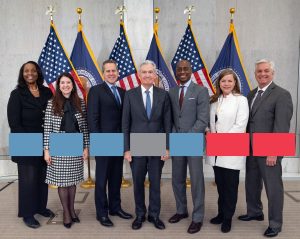
Note: Federal Reserve Bank Chair Jerome Powell, center, was appointed as governor by Obama and nominated as chair by Trump (New York Times graphic).
New York Times, How the Future of the Fed Came to Rest on Lisa Cook, Colby Smith and Ben Casselman, Aug. 29, 2025. President Trump’s effort to oust the Federal Reserve governor has kicked off a landmark legal battle, one that will have far-reaching consequences for the institution’s independence.
Ten days ago, Lisa Cook was one of seven members of the Federal Reserve’s board of governors, playing an important but hardly leading role in the  central bank’s debate over the path of interest rates.
Today, the future of the Fed and whether it will continue to operate as an independent institution or become subject to the whims of the White House rests largely on her shoulders.
Ms. Cook finds herself in that position because of President Trump’s decision on Monday to seek her ouster, and her own decision on Thursday to file a lawsuit challenging her attempted dismissal. Those two actions set the stage for a landmark legal battle, one that is bound for the Supreme Court, over the president’s explicit attempts to take control of the central bank.
 “Governor Cook has been thrust into a role she did not seek and doubtless would prefer to shed — suddenly being cast in a larger-than-life struggle to defend an institution that has helped foster the economic and financial success of the U.S. over the post-World War II period,” said David Wilcox, who is a senior fellow at the Peterson Institute for International Economics and a former leader of the Fed’s research and statistics division.
On Friday, a federal judge in Washington will hold the first hearing in the case, which will focus on Ms. Cook’s request for a temporary restraining order. If the court grants the order, it will allow her to continue serving on the Fed’s board while she contests her firing.
Ms. Cook was not expected to be in this position. Mr. Trump has made no secret of his desire for lower interest rates, or of his anger at central bank officials for refusing to deliver them. But for months Mr. Trump had focused his ire on Jerome H. Powell, the Fed chair, repeatedly threatening to fire him and, at one point, even waving around a letter that purported to do so.
Then, last week, Mr. Trump turned his attention to Ms. Cook after an administration official accused her of mortgage fraud tied to her purchase of two homes in 2021, before she joined the Fed. She has not been charged with any crime.
Ms. Cook, who said from the start that she would not be bullied into resigning, must now defend not only herself but also the Fed as a whole. She must do so without the formal institutional backing of the central bank, which for legal reasons cannot defend her directly. Instead, she will be represented at Friday’s hearing by her own private attorney.
In fact, Ms. Cook’s lawsuit names as a defendant not just Mr. Trump but also Mr. Powell and the Fed’s board of governors. The decision to include her associates at the central bank reflected a need to prevent anybody from executing what the president had demanded before the courts ruled on the case. Still, at least on paper, Ms. Cook is suing two of the world’s most powerful men and one of its most important institutions.
“I can’t imagine how hard this must be, the weight of Fed independence hanging on her decisions,” said Heather Boushey, who was an economic adviser to President Joseph R. Biden Jr. when he nominated Ms. Cook to her post.
If Ms. Cook proves victorious, the president’s capacity to strong-arm officials into leaving the Fed will be seriously curtailed and the central bank’s independence bolstered.
If she loses, it could open the door for Mr. Trump and future presidents to install loyalists at the Fed. That could undermine the central bank’s longstanding and highly prized independence, which has become foundational to the health of the world’s largest economy as well as the smooth functioning of the global financial system.
In the short term, Ms. Cook’s departure would give Mr. Trump his second opportunity in a matter of weeks to appoint someone to the board who is willing to follow his direction. Earlier this month, Mr. Trump said he would nominate a top economic adviser, Stephen Miran, to a governor seat that was unexpectedly available after Adriana Kugler stepped down five months before her term ended.
Mr. Trump’s nominees to the seven-member board would then enjoy a majority, giving them sway over big decisions related to interest rates, the rules and regulations governing Wall Street and internal matters like staffing.
New York Times, News Analysis: Trump Targets Agencies Long Seen as Above Politics. Critics See Big Risks, Luke Broadwater, Aug. 29, 2025 (print ed.). Trump officials say the president is within his rights to fire officials who do not share his agenda.
The Centers for Disease Control and Prevention has long been the place Americans turned to for data-driven information to help make health decisions.
The Bureau of Labor Statistics was the source of nonpartisan jobs numbers by which Americans could judge the status of the economy.
And the Federal Reserve was the independent central bank that often bucked the short-term demands of presidents with an eye toward the country’s long-term economic health.
Now the independence of each of these American institutions is in question after President Trump, in a push to root out pockets of independence of government, has fired or taken steps to fire their leaders.
In doing so, critics say, the Trump administration is risking the credibility of agencies that were long respected as above politics and play a vital role in providing information needed to guide major decisions about the nation’s course.
These places “are not supposed to be partisan,” said Chris Edelson, an assistant professor of government at American University. “The biggest danger is the institution loses credibility, and people can’t count on it.”
In the span of a few weeks, Mr. Trump has fired the head of the Bureau of Labor Statistics after a less-than-flattering jobs report; has sought to remove a Federal Reserve Board governor amid a push to gain control of the board; and has backed his health secretary’s decision to dismiss the director of the C.D.C. over vaccine policy.
Lawyers for Susan Monarez, the C.D.C. director, said she was targeted after she refused to “rubber-stamp unscientific, reckless directives.”
The White House’s efforts represented an intrusion of political warfare into the leadership of federal financial and health policy, which traditionally had been insulated from such interference.
More On Trump Agendas, Power Grabs
New York Times, Defying Congress, Trump Moves to Cut $4.9 Billion in Foreign Aid, Catie Edmondson, Aug. 29, 2025. The White House notified Congress that it plans to use a legally untested maneuver to circumvent lawmakers and claw back more money for foreign aid programs.
The White House has informed Congress it intends to cancel $4.9 billion that lawmakers approved for foreign aid programs, invoking a little-known and legally untested power to slash spending without their approval.
The 15-page notification, sent to Congress on Thursday night and reviewed by The New York Times, is the administration’s first effort to push through what is known as a “pocket rescission.” It is an effort to unilaterally claw back money that has already been appropriated by waiting so late in the fiscal year to make the request that lawmakers do not have time to reject it before the funding expires.
The fiscal year ends on Sept. 30, before the 45-day period in which Congress is required to consider a rescission request from the White House. Republicans could bring the matter to a vote sooner, but party leaders have shown little appetite for resisting the president’s spending demands and asserting their own prerogatives.
The move, the latest chapter in an intensive fight between Mr. Trump and Congress over spending powers, drew swift condemnation from the top Republican on the Appropriations Committee, who called it illegal.
“Any effort to rescind appropriated funds without congressional approval is a clear violation of the law,” Senator Susan Collins, Republican of Maine and the chairwoman of the Appropriations Committee, said in a statement on Friday.Sign up for Your Places: Global Update. All the latest news for any part of the world you select. Get it sent to your inbox.
“Given that this package was sent to Congress very close to the end of the fiscal year when the funds are scheduled to expire, this is an apparent attempt to rescind appropriated funds without congressional approval,” Ms. Collins said.
The maneuver could further complicate lawmakers’ attempts to cobble together a bipartisan funding package to ensure the government does not shut down on Oct. 1. Any spending compromise must win Democratic support in the Senate to pass, and Democrats have said they would be loath to lend their votes to such a package if the White House continued unilaterally cutting congressionally approved funding.
The request largely targets accounts funding the United States’ contributions to the United Nations and soft power programs run by the State Department and the U.S. Agency for International Development, which has already largely been dismantled by the Trump administration.
The single biggest clawback would be a $445 million cut to U.S. funding of peacekeeping operations abroad, including through the United Nations. The request also proposes a $132-million rescission of the $140 million approved by Congress for the Democracy Fund at the State Department. The White House’s proposed budget released earlier this year suggested eliminating that program entirely.l
Like the rescissions package sent to Congress that Republicans approved earlier this year, the White House did not single out specific programs for cuts.
The Government Accountability Office, a nonpartisan oversight body that reports to Capitol Hill, ruled during the first Trump administration that pocket rescissions are illegal. But Russell T. Vought, the director of the Office of Management and Budget, has made the case that the executive branch has broad discretion to use them.
CNBC, Trump housing director Pulte lodges new criminal referral for Fed Governor Lisa Cook, Dan Mangan, Aug. 28, 2025. Federal Housing Finance Agency Director Bill Pulte said he had filed a second criminal referral against Federal Reserve  Board Governor Lisa Cook.
Cook sued President Donald Trump earlier in the day, asking a judge to block his effort to fire her from the Fed. The new allegations relate to a property Cook owns in Cambridge, Massachusetts, and her government ethics filings about various real estate holdings. Pulte has acted as an attack dog for Trump in his efforts to get Fed Chairman Jerome Powell to cut interest rates.
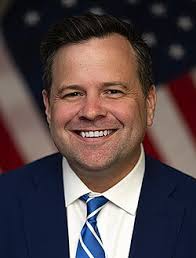 Federal Housing Finance Agency Director Bill Pulte, right, on Thursday night said he had filed a second criminal referral with the Department of Justice against Federal Reserve Board Governor Lisa Cook, whom President Donald Trump is trying to fire.
Pulte said in a post on X that the new referral relates to her mortgage for a condominium in Cambridge, Massachusetts, and alleged misrepresentations about that condo and two homes she owns in government ethics filings during her time as a Fed governor.
“3 strikes and you’re out,” Pulte tweeted about his referral to the DOJ.
His post included images of his letter to Attorney General Pam Bondi and top DOJ official Ed Martin, laying out the allegations about Cook.
The referral implicitly addresses arguments that Trump does not have the power to legally remove Cook from the board for cause because Pulte’s first criminal referral relates to conduct that allegedly occurred before she joined the Fed.
Earlier Thursday, Cook sued Trump, asking a federal judge in Washington, D.C., to block the president from his unprecedented move to boot her from the central bank.
Cook’s lawyer Abbe Lowell, in a statement on Friday morning, called Pulte’s criminal referral “an obvious smear campaign aimed at discrediting Gov. Cook by a political operative who has taken to social media more than 30 times in the last two days and demanded her removal before any review of the facts or evidence.”
“Nothing in these vague, unsubstantiated allegations has any relevance to Gov Cook’s role at the Federal Reserve, and they in no way justify her removal from the Board,” Lowell said.
A Fed spokesperson declined to comment.
Trump earlier in the week cited the first criminal referral Pulte made against Cook, which related to purported false claims on mortgage applications for two homes, in a letter notifying her that he was firing her.
Pulte, who was appointed to lead the FHFA by Trump, has acted as an attack dog on the president’s behalf against the Fed, Fed Chair Jerome Powell and Cook in recent weeks.
CNBC, Core inflation rose to 2.9% in July, highest since February, Jeff Cox, Aug.  29, 2025. The personal consumption expenditures price index showed that core inflation ran at a 2.9% seasonally adjusted annual rate in July, meeting estimates but higher than June. Consumer spending increased 0.5% on the month, in line with forecasts and indicative of strength despite the higher prices. Personal income accelerated 0.4%.
Inflation edged higher in July, according to the Federal Reserve’s preferred inflation measure, indicating that President Donald Trump’s tariffs are working their way through the U.S. economy.
The personal consumption expenditures price index showed that core inflation, which excludes food and energy costs, ran at a 2.9% seasonally adjusted annual rate, according to a Commerce Department report Friday. That was up 0.1 percentage point from the June level and the highest annual rate since February, though in line with the Dow Jones consensus forecast.
On a monthly basis, the core PCE index increased 0.3%, also in line with expectations. The all-items index showed the annual rate at 2.6% and the monthly gain at 0.2%, also hitting the consensus outlook.
The Fed uses the PCE price index as its primary forecasting tool. Though it watches both numbers, policymakers consider core inflation to be a better indicator of longer-term trends as it excludes the volatile gas and groceries figures.
Central bankers target inflation at 2%, so Friday’s report shows the economy still a distance from where the Fed feels comfortable.
Nevertheless, markets expect the Fed to resume lowering its benchmark interest rate when policymakers convene next month. Fed Governor Christopher Waller reiterated his support for a cut in a speech Thursday, saying he would entertain a larger move if labor market data continue weakening.
More On U.S. Culture, Politics, Democracy

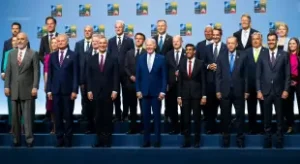
NATO leaders gather at their 2023 annual gathering, with President Bidenat center (New York Times photo by Doug Mills).
Paul Krugman via Substack, Political-Economy Commentary: Decline and Fall of the American Empire, Paul Krugman, right, 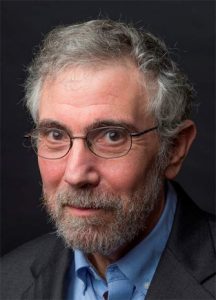 Aug. 29, 2025. Alliances were what made us great.
Last Saturday I posted a conversation with the military historian Phillips O’Brien, much of which was devoted to the war in Ukraine and what has passed for U.S. diplomacy the past few weeks. But we also talked about his new book War and Power, and I was struck by one of his points: The importance of having good allies.
As he noted, Germany lost both world wars in part because it was confronted by powerful alliances while its own allies were “terrible” — Austria-Hungary in World War I, Italy in World War II. He went on to say
The key of the United States has been that it has maintained arguably the most successful alliance system in history since 1945. What the U.S. maintained with NATO, an alliance which kept Europe very much on the American orbit, in the American orbit, both economically and militarily, also with Japan, South Korea, Taiwan and countries in Asia is, they constructed this alliance system which hugely amplified both America’s economic possibilities but also its strategic possibilities.
And Trump is throwing all that away.
I try not to say too much in these interviews — my one weird trick for good discussion is, as far as possible, to shut up and let the interviewee talk. But I couldn’t resist a follow-up here, based on my own observations:
[W]hat always struck me, is that the U.S. had a specialty of creating international organizations that were formally equal, where we were all partners together. Now, everybody understood that the United States was actually in charge, but we went to great lengths to make sure that the World Trade Organization or NATO were alliances of equals, at least on paper. And it was a very effective trick.
O’Brien agreed: “The United States was getting the substance of power but giving up the style.”
For today’s post I thought I would enlarge on this point — and on what we’ve lost, possibly irretrievably, thanks to just a few months of Trumpism.
The Pax Americana that emerged after World War II — and basically ended on January 20, 2025 — was, in many ways, an American Empire. Even after Europe recovered from wartime devastation, the United States retained a dominant economic and military position among non-Communist nations. And we built international economic and military alliances to support a world order in effect designed to U.S. specifications.
But for Europe and Japan the American Empire was a subtle thing, with the United States avoiding crude displays of power and bending over backwards to avoid being explicit about its imperial status.
OK, I’m very aware that the picture I’m painting only applies to U.S. relations with wealthy democracies. U.S. power didn’t look so benign to Mohammed Mossadegh in Iran or Salvador Allende in Chile. Yet in the history of world empires, the Pax Americana nonetheless stands out for its subtlety, restraint — and effectiveness.
You could, I guess, say that formally treating our allies as if they were our equals was hypocritical. But I see it more as a way of showing respect and declaring that we would not abuse our national power.
Now, we squandered a lot of credibility by invading Iraq under false pretenses. And the credibility we lost in Iraq has made it difficult to act against atrocities elsewhere, from the use of chemical weapons in Syria to the terrible things Israel is doing in Gaza.
But in 2024 America was still in a real sense the leader of the free world. And while you can criticize the Biden administration for always delivering too little, too late, it nonetheless did help mobilize a large coalition to help Ukraine defend itself against Russian aggression.
But that was another America.
The current occupant of the White House clearly has no use for subtlety and understatement:
In any case, in just 7 months Trump has completely ripped up the foundations of the Pax Americana. Almost all his tariffs are clearly in violation of the GATT, yet Trump has vandalized the world trading system as casually as he has paved over the Rose Garden. We haven’t yet had a test of whether he would honor our obligations under NATO, but he’s said that his willingness to abide by the most central obligation, the guarantee of mutual defense, “depends on your definition.”
Trump’s foreign policy doctrine appears to be Oderint dum metuant — let them hate as long as they fear — supposedly the favorite motto of the Emperor Caligula. America, he seems to believe, is so powerful that it doesn’t need allies; he can bully the world into doing his bidding.
As Phillips O’Brien told me, history shows that such a belief is always wrong. And it’s especially wrong right now, when America is far less dominant than it once was. Whatever Trump may imagine, the world doesn’t fear us. For example, Trump may have imagined that his tariffs would bring India crawling to him, begging for relief; instead, India seems to be moving to closer ties with China.
In fact, not only does the world not fear us. Increasingly, it doesn’t need us. This is even true for nations that used to depend on U.S. military aid. You may remember Trump berating Ukraine’s president Zelenskyy, declaring “you don’t have the cards.” In reality, even in the Ukraine war Trump has far fewer cards than he imagines. At this point Europe is providing far more aid to Ukraine than we are:
CNBC, Trump housing director Pulte lodges new criminal referral for Fed Governor Lisa Cook, Dan Mangan, Aug. 28, 2025. Federal Housing Finance Agency Director Bill Pulte said he had filed a second criminal referral against Federal Reserve Board Governor Lisa Cook.
Cook sued President Donald Trump earlier in the day, asking a judge to block his effort to fire her from the Fed. The new allegations relate to a property Cook owns in Cambridge, Massachusetts, and her government ethics filings about various real estate holdings. Pulte has acted as an attack dog for Trump in his efforts to get Fed Chairman Jerome Powell to cut interest rates.
Federal Housing Finance Agency Director Bill Pulte on Thursday night said he had filed a second criminal referral with the Department of Justice against Federal Reserve Board Governor Lisa Cook, whom President Donald Trump is trying to fire.
Pulte said in a post on X that the new referral relates to her mortgage for a condominium in Cambridge, Massachusetts, and alleged misrepresentations about that condo and two homes she owns in government ethics filings during her time as a Fed governor.
“3 strikes and you’re out,” Pulte tweeted about his referral to the DOJ.
His post included images of his letter to Attorney General Pam Bondi and top DOJ official Ed Martin, laying out the allegations about Cook.
The referral implicitly addresses arguments that Trump does not have the power to legally remove Cook from the board for cause because Pulte’s first criminal referral relates to conduct that allegedly occurred before she joined the Fed.
Earlier Thursday, Cook sued Trump, asking a federal judge in Washington, D.C., to block the president from his unprecedented move to boot her from the central bank.
Cook’s lawyer Abbe Lowell, in a statement on Friday morning, called Pulte’s criminal referral “an obvious smear campaign aimed at discrediting Gov. Cook by a political operative who has taken to social media more than 30 times in the last two days and demanded her removal before any review of the facts or evidence.”
“Nothing in these vague, unsubstantiated allegations has any relevance to Gov Cook’s role at the Federal Reserve, and they in no way justify her removal from the Board,” Lowell said.
A Fed spokesperson declined to comment.
Trump earlier in the week cited the first criminal referral Pulte, right, made against Cook, which related to purported false claims on mortgage applications for two homes, in a letter notifying her that he was firing her.
Pulte, who was appointed to lead the FHFA by Trump, has acted as an attack dog on the president’s behalf against the Fed, Fed Chair Jerome Powell and Cook in recent weeks.
The Bulwark, Political Opinion, Camelot for Crazies, Andrew Egger, right, Aug. 29, 2025.  RFK Jr. f*cked around. Now we get to find out.
The CDC may be in total meltdown, but Team MAHA isn’t worried. If top officials are being fired or resigning en masse rather than agreeing to implement Robert F.  Kennedy Jr.’s vaccine policies, that’s just proof they’ve been secret Deep Staters all along. They’re probably the ones who have been screwing everything up in the first place!
 “Distrust in the CDC is not because of Secretary Kennedy or President Trump,” MAHA influencer and Kennedy adviser Calley Means wrote yesterday. Instead, he argued, Americans had lost faith in the CDC for a laundry list of other reasons. Its COVID guidance had permitted schools to be closed. It had “spent $900 million on an ad campaign saying the COVID vaccine prevented transmission” and downplayed the myocarditis risk. It “still lists forcing kids to drink fluoride and families having less children as the most important public achievements in modern history.”¹
“It is positive that Americans have a very stark choice,” Means went on. “Do you support the status quo when it comes to our healthcare outcomes, or reform?”
This line of thinking is standard issue among the “heterodox” anti-institutionalists who are the brain trust for Republicanism today. Look at any institution, find five or six critiques of it—big or small, fair or not—and declare that the place is rotten beyond repair. If you don’t want to tear it down and start from scratch, you’re part of the problem. If you do want to tear it down and start from scratch, congratulations, you’re hired: That’s the only qualification you need.
When it comes to the critiques themselves—well, it’s hard to know where to start. Take that canard about the COVID vaccine ad campaign, which is a longtime hobby horse of Republican CDC critics. Last year, Republicans on the House Energy and Commerce Committee released an after-action COVID report grumping about a host of Biden-era pandemic decisions—like the fact that, in early 2021, the CDC issued guidance suggesting that COVID vaccines were so good at preventing COVID transmission that the vaccinated could drop many social distancing measures. “The Biden administration would be forced to correct itself in July 2021,” the report leered, “and explain to the American people that vaccination did not always prevent infection, nor always stop transmission.”
Why was the Biden administration forced to update its guidance between spring and summer of 2021? Not because the science changed, but because the virus did. The COVID Delta variant that emerged that summer was neutralized less effectively by the COVID shots than earlier versions had been, removing much of their protection against infection—though fortunately keeping much of their protection against serious illness or death. Under Biden, public health officials updated their guidance over time to reflect this rapidly shifting reality. Such were the crimes of the pre-RFK CDC.
Meanwhile, what was Kennedy himself up to at this time? He was spreading a host of wild COVID conspiracy theories to anyone who would listen. The disease, he speculated, felt like a deliberate “plandemic,” while efforts to combat it were “a pharmaceutical-driven, biosecurity agenda that will enslave the entire human race and plunge us into a dystopian nightmare.” He wondered whether COVID might have been “ethnically targeted” so as to “attack Caucasians and black people” while going easy on “Ashkenazi Jews and Chinese.”
On the one side, you had a coalition of the nation’s top scientists trying their damnedest to develop good public-health guidance during the unprecedented challenge of a massive, novel pandemic. On the other, you had a #influencer crank spouting off any wild idea that happened to crackle across his worm-eaten brain. In any head-to-head comparison, you’d have to be a maniac to take the latter over the former.
But the trick of today’s populist ethos is never to make that head-to-head comparison. Instead, their arguments rely on an eye-watering double hermeneutic. JVL wrote about this months ago: In the populist mind, “if you’re an expert who gets one thing wrong, it damns you. If you’re a total lunatic crank who gets one thing right, it makes you bulletproof.” Everything is flattened down to Calley Means’s “stark choice”: Status quo, or reform?
The trouble, of course, is that Kennedy and MAHA are now the dog that caught the car. They’re in charge of forging their own status quo, and that has been—to put it mildly—rocky. Can you imagine if the Biden CDC had released a tentpole public-health report that turned out to rely on totally fictional, AI-hallucinated studies? What would be the response if Xavier Becerra spent parts of a press conference musing about how he looks at little kids in airports and sees in their faces that they have mitochondrial challenges?
Kennedy might have prospered had he simply been content to continue slapping a MAHA coat of paint on the good work of the government’s actual scientists. Instead, he seems determined to rip the engine out while the car is hurtling down the interstate. The damage will be far-reaching, and the repairs—if we ever get a chance to make them—will not be quick or cheap.
The Contrarian, Opinion: Three Undaunted Labor Figures, Jennifer Rubin, right,  Aug. 29, 2025. Unions remain critical in the fight for democracy and social justice.
In the run-up to Labor Day, The Contrarian has featured guests and columns on the labor movement all week to underscore the critical role unions play in protecting workers and defending democracy.
 Even if you have never been a union member, you almost certainly have enjoyed the protection of workplace safety rules and benefits that labor unions fought for over decades (e.g., paid vacation, sick leave, overtime). But unions have also been key in battles for civil rights, environmental justice, and the social safety net.
As ALF-CIO President Liz Shuler said in her State of the Unions address this week:
Discrimination was the norm until the labor movement and civil rights movement came together, and fought for the Civil Rights Act and Fair Labor Standards Act. They told immigrants and women workers we had to choose between liberty and getting something to eat. Until in 1912, up in Lawrence, Massachusetts, textile workers said: “We refuse to make that choice.” And the Bread and Roses movement was born.
Just as they have done for over a century, unions again are standing up to powerful robber barons and corrupt government thugs. Unions have litigated dozens of cases against the Trump regime and conducted grassroots organizing nationwide. When ICE began targeting hardworking immigrants, “We trained an entire grassroots army of union activists, organizers, and members so we could exercise our constitutional rights, and fight for their release, and keep them here with their families, where they belong,” Shuler explained.
Three union figures’ legacies speak to the essential role that organized labor plays in nearly every issue that’s critical to Americans. Their biographies remind us that for decades union leaders and members have pushed back against threats, smears, violence, and public skepticism to struggle collectively for a more just society.
No one better personifies this tradition than A. Phillip Randolph, whose crusade for labor and civil rights began with his founding of the Brotherhood of Sleeping Car Porters and Maids in 1925. It took a decade to achieve recognition of the union and win a contract. “A small band of brothers—Black— had stood together and won against a corporation that had said it would never sit down and negotiate with porters.”
In her time, social reformer Jane Addams demonstrated that union advocacy is essential to improve the lives of the workers, immigrants, and all vulnerable people. Her social work at Hull House—which she founded in 1889 to address the hardships caused by industrialization, discrimination, and poverty—by necessity included union organizing.
Decades later, Dolores Huerta began her public activism by founding the Stockton, California chapter of the Community Service Organization that “encouraged Spanish-speakers to participate in civic life,” mounted voter registration drives, supported bilingual political candidates, and lobbied for equal rights for Latinos. Continuing her fight for farm workers’ dignity and economic security, she later co-founded (with Cesar Chavez) the United Farm Workers Association. She then embarked on the UFW’s multi-year crusade for recognition and better working conditions, turning the 1965 grape boycott into a national movement.
Finally, a special shout out this week goes to Susan Monarez from the CDC and Fed governor Lisa Cook, for refusing to be bullied out of their jobs and instead taking the courageous step of going to court to defend our constitutional principles and intellectual rigor. They represent the very best among us.
Michael Cohen via Substack, MAGA Cowards Run From Voters, Michael Cohen, right,  Aug. 29, 2025. As GOP lawmakers flee their own town halls, America finally sees the truth: tough-talking MAGA warriors turn tail when confronted by voters armed with facts, fury, and receipts.
If you want to know what fear looks like, don’t bother looking to Ukraine or Gaza; just pop into a Republican town hall. There you’ll find your elected “warriors,” supposedly tough enough to take on “the radical left,” suddenly reduced to sweaty, stammering wrecks, glancing nervously at the exits like teenagers caught with a joint in Dad’s garage. Forget standing tall for the Constitution or for “their people.” These folks are just trying to survive the evening without being booed into oblivion.
Take Republican Representative Barry Moore of Alabama. The man strutted into his Daphne town hall puffed up like he was auditioning for a role as Trump’s court jester. He bragged about being “accessible,” and for about five minutes it played. Then came the reality check. The crowd; Republicans and Democrats alike, wasn’t there for selfies and slogans. They were there because their groceries cost more, their goods costs more, their lives cost more. And when  Moore started parroting Trump’s fantasy about his “big, beautiful bill,” the mood turned faster than milk left out in the Alabama sun.
Moore tried spinning Trump’s deficit-ballooning giveaway to the wealthy as some kind of blessing for working families. The crowd laughed in his face. Booed him. Shouted “you’re lying!” And then; my personal favorite, hit him with an Econ 101 pop quiz: “Who pays the tariff?” The poor guy stammered that it was shipping companies. The crowd roared back “YES!” when asked if they’d noticed inflation. He looked like a deer in headlights, except this deer was the one who wandered into traffic on purpose, wanting to be hit by a Mack truck.
It only got worse. Immigration. Social Security. Abortion. Every answer revealed Moore not as a leader but as a mouthpiece; regurgitating Trump talking points so divorced from reality that even his own constituents weren’t buying it. The climax came when he declared that only U.S. citizens are entitled to due process. Fifth and Fourteenth Amendments be damned. The crowd erupted into chants of “SHAME,” until Moore scurried out the back door like a cockroach fleeing the kitchen light.
But Moore’s not alone. GOP lawmakers all across the country are finding that the MAGA snake oil doesn’t sell like it used to; especially when people can’t afford their groceries. Elise Stefanik, the party’s designated attack dog, has been ducking and weaving around her district like a fugitive. When she does appear, she sticks to scripted remarks and carefully screened audiences because she knows damn well what happens when she faces a real crowd: the same anger, the same betrayal, the same questions she has no honest answers for.
Make no mistake: the summer of 2025 will be remembered as the season Republican lawmakers stopped pretending they represented their districts. Their town halls became confessionals; not of sins, but of incompetence. And every one of those voters who chanted “shame” meant it. The GOP can either face that shame head on or keep running out the back door. But the people? They’re not going anywhere.
Letters from an American, Historical Commentary: Aug. 28, 2025 [Rise of California’s Mexican-American Chicano Movement], Heather Cox Richardson, right, Aug. 29, 2025. On August 29, 1970, journalist Rubén Salazar died instantly when Los Angeles County Sheriff’s deputy Thomas Wilson fired an 8-inch bullet-shaped tear gas projectile into the back of his head.
Salazar and his colleague Guillermo Restrepo had ducked into the Silver Dollar bar after fighting had broken out between marchers and police officers during the massive National Chicano Moratorium March against the Vietnam War that drew more than 20,000 people into the streets of East Los Angeles.
 At the time of his death, Salazar, left, was the most famous and influential Latino journalist in the United States. Born in Ciudad Juárez, Mexico, in 1928, Salazar grew up in El Paso, Texas. After graduating from high school, he served in the U.S. Army and became a U.S. citizen after his service. He graduated from Texas Western College in 1954 with a degree in journalism and went to work at the El Paso Herald-Post, where his deep investigative work caught the attention of the Federal Bureau of Investigation almost immediately as Salazar exposed corruption and violence in the El Paso City Jail.
By 1959, Salazar was working at the Los Angeles Times where, among other assignments, he covered the Vietnam War. Back in the United States in 1968, he began to focus on the lives of Mexican-Americans, especially those in East Los Angeles. The media largely ignored the Latino community there except when it covered crimes.
In those years, the Mexican American community in the United States was building an exciting new intellectual and social movement: the Chicano Movement. In the introduction to his 2015 book The Chicano Generation: Testimonios of the Movement, historian Mario T. Garza explained that an earlier generation of Mexican Americans had focused on assimilating to Anglo culture, working to break down barriers to jobs, housing, education, the legal system, and voting, and fighting cultural stereotyping.
But in the 1960s, young Mexican Americans, most of whom had been born in the U.S., began to reimagine their community and its position in the United States. Calling themselves “Chicanos,” they called for a new identity based in the understanding that they were not outsiders at all, but rather natives of the northern region of old Mexico, a region that did not become part of the United States until long after the Chicano people—Indigenous Americans mixed with the descendents of Spanish invaders—had settled there.
Chicanos noted that they had not moved into the United States, but rather the United States border had moved over them. The U.S. had taken over the land on which they lived in 1848 after the U.S.-Mexico War. The Treaty of Guadalupe Hidalgo, which had established the new boundary between the two countries far to the south of where it had been before, was supposed to guarantee the land titles of those Mexican landowners over whom the border had moved. But U.S. courts had disregarded the terms of the treaty and refused to recognize the rights of Mexicans, most of whom lost their land.
In the aftermath of Salazar’s death, organizers shifted from demonstrations to political mobilization, building the Raza Unida Party to achieve economic gains, social justice, and political self-determination for Mexican Americans.
When reporter Bob Navarro asked Salazar in May 1970 if he thought the Vietnam War had put the country in danger of a revolution, Salazar answered: “I think we are in a revolution. I think the United States is traditionally a revolutionary country.”
Navarro countered: “But I’m talking about it in the more sinister sense, an attempt to overthrow our more established institutions.”
“I think that’s nonsense,” Salazar replied. “We are going to overthrow some of our institutions, but in the way that Americans have always done it: through the ballot, through public consensus. That’s a revolution. That is a real revolution.”
New York Times, A Tariff Loophole on Cheap Imports Has Closed. How Will It Affect Shoppers? Peter Eavis, Aug. 29, 2025. The end of the “de minimis” exemption — which allowed packages less than $800 to enter the U.S. tariff-free — is leading to confusion.
For many years, American shoppers have been able to buy inexpensive foreign items without paying tariffs and completing complicated customs paperwork.
No more.
On Friday, President Trump closed the loophole that gave rise to that popular flow of goods, known as the de minimis exemption. He said it had allowed fentanyl to be smuggled into the United States and had given foreign businesses an unfair advantage against American companies. Some Democrats supported the repeal of the exemption for the same reasons.
The exemption ended in May for small shipments from mainland China and Hong Kong, and now it has closed for goods from the rest of the world.
Closing the loophole has already roiled supply chains. Many foreign post offices recently suspended shipments to the United States as they grappled with the new rules. Foreign businesses that rely on postal networks currently have no way of getting goods to the United States and now fear for their future.
“It is a stark shift from the way that business has been done for quite a while,” said Ryan Tanner, senior director of compliance at Flexport, a supply chain company.Here’s what you need to know about the changing rules.
When the exemption was in place, a consumer in the United States could receive a foreign shipment valued at $800 or lower without paying tariffs and filling out customs paperwork that detailed the goods. These advantages helped spur an increase in de minimis shipments. Last year, there were over 1.36 billion such shipments, nearly four million a day, up from around 139 million in 2015, according to Customs and Border Protection.
Now, tariffs are imposed on those shipments. They could range from 10 percent of the value of the goods to 30 percent or more, depending on where they were sent from. In many cases, sellers will pass on the cost of the tariffs to the consumer in the form of higher prices.Want to stay updated on what’s happening in China and Hong Kong?
“Ultimately, these are taxes, and they have to be paid,” said Clark Packard, a research fellow at the Cato Institute, a research organization that generally favors free trade.
But those who opposed the exemption say companies abused it by classifying goods as de minimis when the companies should have gone through normal import channels and paid tariffs.Peter Navarro, Mr. Trump’s senior counselor for trade and manufacturing, said on Thursday that ending the loophole would “add up to $10 billion a year in tariff revenues to our Treasury, create thousands of jobs and defend against billions of dollars more lost in counterfeiting, piracy and intellectual property theft.”
Since the exemption was eliminated for goods from mainland China and Hong Kong, Customs and Border Protection has collected $492 million in duties on shipments from those places that would have previously been tariff-free, a senior administration official said on Thursday.
Aug. 28
New York Times, White House Says New C.D.C. Director Is Fired, but She Refuses to Leave, Sheryl Gay Stolberg, Apoorva Mandavilli and Christina Jewett, Updated Aug. 28, 2025. Susan Monarez was said to have refused to adopt Health Secretary Robert F. Kennedy Jr.’s stance on vaccination policy. A lawyer for Dr. Monarez said the firing was “legally deficient.”
The White House said late Wednesday that it had fired Susan Monarez, below right, the  new director of the Centers for Disease Control and Prevention, after a tense confrontation in which Health Secretary Robert F. Kennedy Jr. tried to remove her from her position. A lawyer for Dr. Monarez said in response that she was refusing to step down.
Dr. Monarez, an infectious disease researcher, was sworn in just a month ago by Mr. Kennedy, but had clashed with the secretary over vaccine policy, 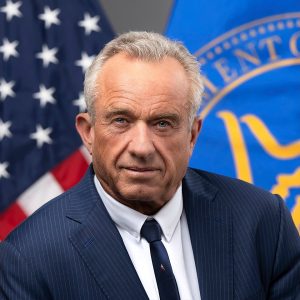 people familiar with the events said. Four other high-profile C.D.C. officials quit en masse, apparently in frustration over vaccine policy and Mr. Kennedy’s leadership.
Because Dr. Monarez has been confirmed by the Senate — previous C.D.C. directors were not subject to such confirmation — she serves at the pleasure of the president, and Mr. Kennedy likely did not have the authority to dismiss her.
At 9:30 p.m., a spokesman for President Trump, Kush Desai, said in an email that Dr. Monarez was “not aligned with the President’s agenda of Making America Healthy Again,” and so “the White House has terminated Monarez from her position with the C.D.C.”
Shortly past midnight, one of Dr. Monarez’s lawyers, Mark S. Zaid, rejected the firing as “legally deficient” because the president did not announce it. Mr. Desai did not respond to an email message asking if Mr. Trump would do so.
The wild back and forth over Dr. Monarez’s future, along with the resignations of four of the C.D.C.’s top leaders, will undoubtedly throw the nation’s public health agency into further turmoil after a tumultuous month in which agency employees were laid off and a gunman fired a barrage of bullets at the Atlanta headquarters, killing a policeman and terrifying employees.
Her lawyers, Mr. Zaid and Abbe Lowell, asserted in a statement earlier Wednesday that Dr. Monarez’s situation was symbolic of larger issues.
“It is about the systematic dismantling of public health institutions, the silencing of experts, and the dangerous politicization of science,” they wrote. “The attack on Dr. Monarez is a warning to every American: Our evidence-based systems are being undermined from within.”
The clash between Mr. Kennedy and Dr. Monarez, which had been brewing for days, burst into public view on Wednesday. That afternoon, the Department of Health and Human Services announced on X that Dr. Monarez was “no longer” director of the C.D.C.Without elaborating, the agency thanked her for “her dedicated service to the American people,” adding, “@SecKennedy has full confidence in his team at @CDCgov who will continue to be vigilant in protecting Americans against infectious diseases at home and abroad.”
Hours later, Mr. Lowell and Mr. Zaid disputed the department’s account, saying Dr. Monarez “has neither resigned nor received notification from the White House that she has been fired, and as a person of integrity and devoted to science, she will not resign.”
Mr. Kennedy and his department, they said, “have set their sights on weaponizing public health for political gain and putting millions of American lives at risk.”
Neither Dr. Monarez nor the department responded to requests for comment.
Dr. Monarez and Mr. Kennedy were at odds over vaccine policy, according to an administration official who is familiar with the events.
New York Times, An Industry Insider’s Changes at the E.P.A. Could Cost Taxpayers Billions, Hiroko Tabuchi, Aug. 28, 2025. A Trump appointee has proposed rewriting a measure that requires companies to clean up “forever chemicals,” documents show. The new version would shift costs from polluters.
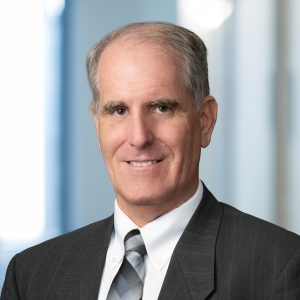
Early this year, Steven Cook, right, was a lawyer representing chemical companies suing to block a new rule that would force them to clean up pollution from “forever chemicals,” which are linked to low birthrates and cancer.
Now Mr. Cook is in a senior role at the Environmental Protection Agency, where he has proposed scrapping the same rule his former clients were challenging in court. His effort could shift cleanup costs away from polluters and onto taxpayers, according to internal E.P.A. documents reviewed by The New York Times.
Last month Mr. Cook met with industry groups that are still challenging the rule in court. By the next business day after the meeting, the E.P.A. office that oversees toxic cleanups had reversed its internal recommendation on the rule, the documents show, to advise repealing instead of upholding it.
The change was evident in a presentation being prepared for Lee Zeldin, the E.P.A. administrator. The document contained edits saying that the office recommended repealing the rule and that its “cons outweigh pros.” Previously, the document had recommended keeping the rule in place and that its “pros outweigh cons.”
The rule in its current form could require the chemicals industry and others to pay billions of dollars in cleanup costs for chemicals known as PFAS, or forever chemicals. The reversal in the E.P.A.’s internal guidance, and Mr. Cook’s role in the policy change, has not been previously reported.
“It’s outrageous,” said Tracey Woodruff, a researcher at the University of California San Francisco who studies environmental health, particularly the effects of chemical exposures on pregnant mothers and their babies. “If they overturn this, it would leave the public responsible for cleaning up, not the companies that knowingly polluted the land.”
Mr. Zeldin, the E.P.A. chief, has yet to publicly issue a decision on the future of the rule. He is expected to be briefed on the internal recommendation as early as next week.
On Tuesday Carolyn Holran, the agency’s spokeswoman, said “no decisions have been made” on whether the E.P.A. will continue to defend the rule in court.
“Like every Trump political appointee, Steven Cook works with the career employees in the E.P.A. Ethics Office to ensure all applicable ethics obligations are addressed,” she said. “Steven Cook is recused from the litigation and has not been in any conversations from the case. As advised by E.P.A.’s career ethics officials, he is not recused from policy-making.”
Mr. Cook, whose formal title is principal deputy assistant in the agency’s Office of Land and Emergency Management, did not respond to a request for comment.

Letters from an American, Historical Commentary: Aug. 27, 2025 [Trump’s Military Takeover of Washington, DC], Heather Cox Richardson, right, Aug. 28, 2025. The image of National Guard troops, some of them from as far away as Louisiana and Mississippi, in Washington, D.C., spreading mulch around the cherry trees at the Tidal Basin and picking up trash, illustrates that President Donald J. Trump’s insistence that he needed troops to crack down on violent crime in the nation’s capital was always a cover for an authoritarian takeover.
As Kate Riga and Emine Yücel noted in Talking Points Memo today, earlier this spring Trump and congressional Republicans did all they could to weaken Washington, D.C. In March, Congress passed a resolution to fund the government temporarily while also freezing all federal spending. That included the District of Columbia, whose budget has to be approved by Congress although the monies involved come from local taxes, not federal funds.
Because those budget monies are local and not federal, according to Campbell Robertson of the New York Times, the Washington, D.C., budget is routinely exempted from federal spending freezes. But the House did not carve it out this time, leaving the city with a shortfall of $1.1 billion. The Senate unanimously approved a bill to fix the error, letting the city continue to operate under its current budget, but the House never took it up. Washington, D.C., mayor Muriel Bowser and local officials found a workaround to restore some funding but have had to freeze hiring and cut contracts, grants, and expenditures across the city’s agencies.
Cuts to city services have made it easier for Trump and his loyalists to insist the city is being poorly taken care of, although violent crime is dropping there, not rising, and the Department of Justice’s own numbers show it is at a 30-year low. Now, with troops stationed in the city, Trump and his MAGA loyalists are demonstrating that they control the federal capital.
Today, Transportation Secretary Sean Duffy announced that the administration will also take over Union Station in Washington, D.C., from which Amtrak and the city’s commuter rail lines run, saying such a takeover was part of Trump’s “beautification” program.
Amtrak took control of the station in July 2024, and the Bipartisan Infrastructure Law of the Biden era provided $22 billion to Amtrak to modernize trains and stations. The administration cut a $120 million federal grant to Amtrak in April. Taking control of Union Station will put the administration in charge of key transportation lines into and out of the city. It also will create a federal presence in an area where veterans have been protesting.
The freezing of D.C.’s budget is a different process from the dramatic cuts the Trump administration has made across the federal government, although the effects of the two are similar. As Tara Copp of the Washington Post noted today, custodial work like that being done by the National Guard troops normally would have been performed by National Park Service employees. But that service was already short staffed when the administration slashed through the federal workforce. The park service used to have 200 people assigned to the thousands of acres of gardens and trees in the capital. Now it has 20.
A park service official told Copp: “It’s everybody—the masons, the maintenance workers, the groundskeepers, the plumbers. Every shop is short.”
The Trump administration inherited decades of Republican rhetoric insisting the federal government was bloated and inefficient. It set out immediately to gut the civil service through hiring freezes, reductions in force, and impoundment of funds.
In an interview with Eileen Sullivan of the New York Times on Thursday, August 21, Office of Personnel Management director Scott Kupor said that by the end of December 2025 there will be 300,000 fewer federal workers than there were in January. Sullivan notes that this is the largest single-year reduction in civilian federal employment since World War II.
But even before these cuts, the federal workforce had not kept pace with the growth of the nation. The workforce when Trump took office in 2025 was about 2.4 million people, roughly the same number of government workers the nation had in 1969. As Bill Chappell of NPR reported in March, in 1969 the U.S. population was about 202.5 million. Now it is about 341.1 million.
The U.S. public workforce was about 14.9% of overall employment, significantly lower than our 37 peer nations in the Organisation for Economic Co-Operation and Development, where public sector employment averages at 18.1%. In Canada, that number is 19.4%. Chappell also noted that an OECD report showed more than 90% of U.S. civil servants believed it was important for their work to serve the public good.
The old Republican argument for getting rid of civil servants was that private contractors would be more efficient, and so in place of civil servants, the U.S. has relied on private contractors since the 1990s. While the U.S. spent about $270 billion on federal workers’ salaries before the 2025 cuts, it spent $478 billion on government contractors. Public policy scholar Elizabeth Linos explained that even before the recent cuts, the U.S. had “something like three times as many [contractors] delivering the work of government” as it had civil servants.
The Trump administration’s drastic cuts were almost certainly designed to speed up the shift to private contractors. Under the direction of billionaire Elon Musk, the “Department of Government Efficiency” (DOGE) cut jobs willy-nilly, apparently under the impression that replacing people with AI contracts and consolidating databases would make civil servants redundant. But like the D.C. budget freeze, the cuts have weakened the nation and make it more susceptible to an authoritarian takeover.
Yesterday news broke that a whistleblower, identified as Social Security Administration chief data officer Charles Borges, claims that a former senior DOGE official put a copy of a key Social Security database on a server that was vulnerable to hacking. The DOGE employee copied the names, birthdays, and Social Security numbers of more than 300 million Americans to an unsecure cloud server accessible to other former DOGE employees.
Borges alleges that the copy “constitute[s] violations of laws, rules, and regulations, abuse of authority, gross mismanagement, and creation of a substantial and specific threat to public health and safety.” He also said that as of late June, there were no verified audit or oversight mechanisms in place to oversee where DOGE was sharing that data or what it was using the data for. The agency assessed that a breach of the database would be “catastrophic” for Social Security beneficiaries, making them susceptible to identity theft, the loss of health care and nutrition benefits, and so on.
Last week, as the Trump administration prepared to fire nearly 90% of the workforce of the Consumer Financial Protection Bureau, virtually all pending matters flagged by bank examiners were simply closed without action.
Layla A. Jones reported last week that while the administration insisted it was targeting “bias” at NPR and PBS when it defunded the Corporation for Public Broadcasting (CPB), the $1.1 billion in cuts means that the CPB can no longer provide public broadcasting stations with severe weather alerts. CPB administered the Next Generation Warning System in partnership with the Federal Emergency Management Agency (FEMA) to issue alerts and information over radio and television stations, many of which are in rural America, and can continue to operate when other systems fail.
On August 20, former director of the Central Intelligence Agency and former deputy secretary of state William Burns thanked America’s fired public servants for serving their country with honor and told them they deserved better than the “gleeful indignity” inflicted on them by this administration. The current process of cutting the government is “not about reform,” he wrote, but about “retribution. It is about breaking people and breaking institutions by sowing fear and mistrust throughout our government. It is about paralyzing public servants—making them apprehensive about what they say, how it might be interpreted, and who might report on them. It is about deterring anyone from daring to speak truth to power.”
Deploying National Guard soldiers away from their families and sending them to Washington, D.C., in the heat of August to respond to an “emergency” only to put them to work spreading mulch and picking up trash certainly seems to fit the idea of inflicting indignity to break the nobility of public service for the nation.
The firefighters at work combating a wildfire in the state of Washington likely also felt the indignity inflicted by the government today when ICE agents showed up and made them line up so the agents could check their IDs. The agents arrested two firefighters, and when the a member of the crew asked for the chance to say goodbye, the agents responded: “[Y]ou need to get the f*ck out of here. I’m going to make you leave.” One firefighter said: “You risked your life out here to save the community. This is how they treat us.”
In his resignation letter today, Director of the CDC’s National Center for Immunization and Respiratory Diseases Demetre Daskalakis set an example for those refusing to be cowed. “The recent shooting at CDC is not why I am resigning,” he wrote. “My grandfather, who I am named after, stood up to fascist forces in Greece and lost his life doing so. I am resigning to make him and his legacy proud.”
Paul Krugman via Substack, Political-Economy Commentary: Why Aren’t Markets Freaking Out? Paul Krugman, right, Aug. 28, 2025. Of Trump, Keynes and Wile E. Coyote.
For those of us who follow economic policy in general and the Federal Reserve in particular, the past week has been shocking and terrifying.
Donald Trump’s ongoing attempts to bully the Fed into large interest rate cuts have escalated into an attempt to fire Lisa Cook, below, a member of the Fed’s Board of Governors, over unsubstantiated claims that she committed financial fraud while still a college professor. Indeed, Trump claims that he has already fired her, although he has no legal right to do so.
Whatever happens, Trump’s campaign to take over monetary policy has shifted from a public pressure to personal intimidation of Fed officials: the attack on Cook signals that Trump and his people will try to ruin the life of anyone who stands in his way. There is now a substantial chance that the Fed’s independence, its ability to manage the nation’s monetary policy on an objective, technocratic basis rather than as an instrument of the president’s political interests and personal whims, will soon be gone.
So why aren’t markets freaking out? Nations in which central banks lose their independence sooner or later suffer high inflation, especially when they are taken over by autocrats who buy into crackpot economic doctrines. And Trump, who has been demanding large rate cuts because, he claims, the economy is running hot — which almost every economist would say is a reason to raise rates, not cut them — certainly fits that pattern. Yet although there have been small tremors in the bond and currency markets, there have been no significant upheavals in financial markets that reflect the severity of the situation we are in. Throughout this episode, the stock market has remained fairly flat and bond yields haven’t spiked.
Why not? Do financial markets doubt that Trump will get his way? Or do they reject mainstream economics and the clear examples of countries like Turkey and Argentina?
Neither. My read of economic and financial history is that market pricing almost never takes into account the possibility of huge, disruptive events, even when the strong possibility of such events should be obvious. The usual pattern, instead, is one of market complacency until the last possible moment. That is, markets act as if everything is normal until it’s blindingly obvious that it isn’t.
The inimitable Nathan Tankus summarizes this by saying that the market is not, as stylized economic models would have us believe, a mechanism that pools the knowledge and informed judgment of millions of investors. It is, instead, a “conventional wisdom processor.” That is, it reflects views that seem safe to hold because many other people hold them — and the crowd only abandons those views when they become blatantly unsustainable.
John Maynard Keynes said something similar in Chapter 12 of his General Theory of Employment, Interest and Money. Market investors, he argued, pay little attention to the question of what assets are truly worth. Instead, they worry mostly about the market value of those assets a few months in the future. In a memorable albeit sexist passage (it was 1936), he declared that
professional investment may be likened to those newspaper competitions in which the competitors have to pick out the six prettiest faces from a hundred photographs, the prize being awarded to the competitor whose choice most nearly corresponds to the average preferences of the competitors as a whole; so that each competitor has to pick, not those faces which he himself finds prettiest, but those which he thinks likeliest to catch the fancy of the other competitors, all of whom are looking at the problem from the same point of view … we devote our intelligences to anticipating what average opinion expects the average opinion to be.
So if the conventional wisdom is that economic conditions will remain more or less normal despite highly abnormal policy, markets will remain calm until the illusion of normality becomes unsustainable. At that point market prices may “change violently.” The current technical term for this phenomenon is a “Wile E. Coyote moment” — the moment when the cartoon character, having run several steps off the edge of a cliff, looks down and realizes that there’s nothing supporting him. Only then, according to the laws of cartoon physics, does he fall.
You might ask why smart investors with long time horizons don’t foresee Wile E. Coyote moments and get very rich in the process. Some do. But for reasons that would take another long post to explain — maybe a primer one of these days — there never seem to be enough such investors to shake market complacency, no matter how unwarranted. It’s one thing to short a stock, but to short the entire market is a completely different beast.
Can I document these assertions? Let’s look at a couple of relatively recent examples of market complacency and myopia in the midst of clear signals of an oncoming crisis.
-
- First, the subprime crisis of the 2000s.
- Another example of market complacency is the euro area crisis that began in 2009
So if you want to know why markets aren’t reacting to the risk of very bad policy if Trump takes over the Fed, you should know that major market reactions to that kind of risk are rare. In fact, I can’t come up with a single example.
All of which says, in turn, that the absence of a strong reaction to Trump’s assault on the Fed isn’t a sign that everything is OK. We are, in fact, looking at a policy disaster in the making. But markets probably won’t react strongly until the disaster is already upon us.
The Daily Beast, CDC Leader Drops Bombshell RFK Jr. Admission, Catherine  Bouris and Jack Silvers, Aug. 29, 2025. A senior official spoke to the Daily Beast after quitting the CDC in a furious protest.
Robert F. Kennedy Jr. has never actually been briefed by CDC experts before making major public health decisions, according to a departing top official at the agency. The bombshell claim from Dr. Demetre Daskalakis came in a Thursday night CNN interview after the ousting.
The Contrarian, Political Opinion: Is the Trump Regime Trying to Kill Us? Jennifer Rubin, right, Aug. 28, 2025. The biggest threat to our health and safety is in the Oval Office.
No hostile power could have dreamed up so many ways to threaten the Americans’ health and safety as has the MAGA crowd. In attacking scientific expertise and destroying funding for life-saving government programs, the Trump regime has multiplied domestic dangers to all Americans, but especially to their most ardent supporters: those who live in red states and lack state governments willing to pick up the slack when the feds desert them. Preventable deaths have already occurred and will continue, due to Trump’s blunders.
The destruction of one of the most basic federal functions, emergency response, should worry all Americans. “Current and former FEMA officials are warning Congress that the Trump administration’s policies have undermined the nation’s ability to respond to natural disasters like Hurricane Katrina,” Politico reports. “The message, in a public letter addressed to Congress and the White House’s FEMA review council, comes ahead of the 20th anniversary of Hurricane Katrina, which devastated New Orleans and the Gulf Coast.” The letter’s 181 signatories accused Donald Trump and his minions of abandoning “reforms designed to correct the agency’s mistakes in responding to the 2005 hurricane.”
Several of the signatories were subsequently put on “leave.”
From the freakish obsession with micromanaging spending to mindless staff cuts, the Trump crew has been taking measures that, if not designed to harm Americans, will almost certainly have that effect. Emergency response experts lambaste “DHS Secretary Kristi Noem’s pattern of reviewing all contracts over $100,000 has slowed responsiveness, causing delays in deploying urban search and rescue teams in the wake of July 4 flooding that killed 138 people in central Texas.” At a time when climate change is increasing the number of extreme weather events, hobbling FEMA is particularly foolhardy.
FEMA certainly is not an isolated issue. Just a day before the FEMA letter was released, Politico reported that a rural Tennessee hospital nearly wiped out by Hurricane Helene may never be restored due to Trump’s big, disastrous bill. Unicoi County Hospital is one of hundreds of hospitals that may go under due to the massive Medicaid cuts. In addition to outright closures, “service line reductions and staff reductions, resulting in longer waiting times in emergency departments and for other essential services” will devastate the rural healthcare delivery service system (not to mention the economies of rural communities).
How many Americans will die driving hours to a distant hospital? How many rural resident will lose access to preventative care and critical diagnostic tests? How many trauma centers will close, leaving accident victims without emergency care? The Trump regime apparently does not care.Subscribed
We also learned this week that the anti-vaxxer Secretary of Health and Human Services Robert F. Kennedy, Jr. now plans to eliminate COVID vaccines altogether. “The prediction of a drastic move against the COVID vaccine comes after Kennedy canceled $500 million in funding for the development of mRNA vaccines,” the Daily Beast reports. “Such vaccines use a copy of a molecule called messenger RNA (mRNA) to provoke an immune response against certain diseases.”
Meanwhile, more than 750 current and former HHS employees demanded RFK, Jr. “stop ‘spreading inaccurate health information’ and prioritize the safety of public servants in the health sector in the wake of this month’s fatal shooting at the Atlanta headquarters of the U.S. Centers for Disease Control and Prevention,” Yahoo News reported.
The Hill, Air Force to provide funeral honors to Ashli Babbitt, Ella Lee, Aug. 28,  2025. The U.S. Air Force will provide Jan. 6 rioter Ashli Babbitt with military funeral honors, reversing a Biden-era decision that denied her family’s request, according to a legal group that has represented her family.
Judicial Watch, the conservative legal group, on Wednesday made public a letter from Under Secretary of the Air Force Matthew Lohmeier, extending an offer to allow the special funeral procedures to take place.
“I understand that the family’s initial request was denied by Air Force leadership in a letter dated February 9, 2021,” Lohmeier wrote in the Aug. 15 letter shared by Judicial Watch. “However, after reviewing the circumstances of Ashli’s death, and considering the information that has come forward since then, I am persuaded that the previous determination was incorrect.”
He additionally extended an invitation to her mother and husband to meet him at the Pentagon, so he may offer his condolences.
The Hill requested comment from the Pentagon regarding the veracity of the letter.
Babbitt, an Air Force veteran, was shot and killed by law enforcement during the Jan. 6, 2021, Capitol riot as she attempted to climb through a barricaded door to the Speaker’s lobby near the House chamber.
A month after the riot, an Air Force representative under former President Biden’s administration informed her family that military funeral honors were denied for her funeral “due to the circumstances preceding her death.”
“As a result, I have determined that military funeral honors would bring discredit upon the Air Force,” Brian Kelly, an Air Force lieutenant general, wrote in that letter.
An eligible veteran’s honor guard detail consists of at least two members of the armed forces, one of whom is a representative of the veteran’s service branch, according to the Department of Veterans Affairs. It will perform a ceremony including the playing of taps and the folding and presentation of the American flag to the next of kin.
The Daily Beast, Senator Delivers Blistering Rebuke to RFK Jr.: ‘Just Shut Up,’ Jack Silvers, Aug. 28, 2025. Minnesota Sen. Tina Smith excoriated Health and Human Services Secretary Robert F. Kennedy Jr., right, for suggesting that  antidepressants could have caused the deadly shooting at a church in Minneapolis.
“I dare you to go to Annunciation School and tell our grieving community, in effect, guns don’t kill kids, antidepressants do,” Smith wrote.Tina Smith had no patience for the health secretary’s suggestion that antidepressants were behind the school shooting in Minnesota.
New York Times, Minneapolis Suspect Knew Her Target, but Motive Is a Mystery, Talya Minsberg, Amy Harmon and Aric Toler, Aug. 28, 2025 (print ed.). The shooter who attacked a Catholic school on Wednesday posted social media videos and writings that betrayed a litany of grievances and obsessions.
The person who the police say opened fire on a Catholic school in Minneapolis on Wednesday appears to have known the school well.
R obin W. Westman, right, who officials said strafed the church through the stained glass windows, killing two children, was believed to have once attended the school at Annunciation Catholic Church, according to a law enforcement official with knowledge of the investigation.
Her mother, Mary Grace Westman, worked in the business office of the church for five years before retiring in 2021. And in a video posted on social media, the suspect showed a hand-drawn rendering of the Annunciation interior.
And Ms. Westman, armed with three weapons, seemed to choose the time carefully. She barricaded the doors during the first all-school Mass of the academic year, the police said.
But it is hard to fathom what drove Ms. Westman to attack before killing herself, despite the dark and violent writings and videos she left behind.
The attack killed an 8-year-old and a 10-year-old in the pews and injured 17 others, according to the Minneapolis police chief, Brian O’Hara. The three weapons were purchased legally, police officials said.
Ms. Westman, 23, lived in a three-story brick building in a complex in Richfield, a suburb just south of the church. She worked at a local cannabis dispensary for several months earlier this year.
As a 17-year-old, she filed a court document to change her first name, to Robin from Robert. It was also signed by her mother. The document noted that Ms. Westman “identified as female and wants her name to reflect that identification.”
On social media, some conservative activists have seized on the shooter’s gender identity to broadly portray transgender people as violent or mentally ill. The police did not provide any motive for the attack, but Ms. Westman’s extensive social media history was a contradictory catalog of anger and grievance.
In seemingly stream-of-consciousness videos that she posted, she fixated on guns, violence and school shooters. She displayed her own cache of weapons, bullets and what appear to be explosive devices, scrawled with antisemitic and racist language and threats against President Donald Trump.
The videos also show pages from a diary, with long entries describing self hatred, violence against children, and a desire to inflict harm on herself. The diary entries are almost entirely written in English, but using Cyrillic letters. A sticker in the diary displays L.G.B.T.Q. and transgender flags with a gun and the slogan “Defend Equality.”
Police said that the videos have been taken offline.
The right-wing uproar over Ms. Westman’s gender identity echoed the politicized reaction to a 2023 mass shooting at The Covenant School in Nashville, which was carried out by a former student whom the police said was transgender.
In a news conference, Mayor Jacob Frey of Minneapolis, a Democrat, urged the public to avoid scapegoating transgender people in the wake of the tragedy.
“I’ve heard a whole lot of hate directed at our trans community,” he said. “Anybody that is using this as an opportunity to villainize our trans community — or any other community out there — has lost their sense of common humanity.”
“We should not be operating out of a place of hate for anyone — we should be operating out of a place of love for our kids,” he added. “Kids died today. This needs to be about them.”
Global News
The Daily Beast, European Leader Calls Trump a ‘Russian Asset,’ Erkki Forster, Aug. 28, 2025. COMRADE-IN-CHIEF. The European president said Donald Trump “functions as an asset,” slamming the president for his stance on Russia’s war in Ukraine.
Portugal’s president has branded President Donald Trump a “Russian asset,” blasting him for his tepid response to Moscow while Ukraine struggles against Russia’s invasion.
Trump has wavered heavily in his public stance on the war that started when Russian President Vladimir Putin ordered a full-scale assault on Ukraine over three years ago.
While Trump has threatened Putin with higher sanctions and “severe consequences” if he presses on with the war, he has declined to follow through, often lashing out at Ukrainian President.
New York Times, 2 Weeks After Trump Talks, Russia Bombards Kyiv, Killing at Least 18, Maria Varenikova, Visuals by Finbarr O’Reilly, Aug. 28, 2025. The strikes, which hit a five-story apartment building, a shopping mall and buildings used by European governments, were the largest on the Ukrainian capital since the Alaska summit.
An hourslong barrage of Russian missiles and drones killed at least 18 people in Ukraine’s capital, including four children, early on Thursday, officials said.
The assault, less than two weeks after President Trump’s summit in Alaska with President Vladimir V. Putin of Russia, showed how the recent American diplomatic flurry has done little to change the Kremlin’s determination to continue fighting in Ukraine.
Since Mr. Trump pulled Mr. Putin out of Western diplomatic isolation by inviting him to Anchorage, Russia has made no significant concessions on any of the major sticking points between it and Ukraine, leaving the two sides no closer to peace. The attack on Thursday was Russia’s largest on Ukraine’s capital, Kyiv, since the Alaska meeting.
The Ukrainian authorities said that at least 45 people were injured. A five-story apartment building was destroyed, and other homes were damaged. A missile also hit a shopping mall in central Kyiv, the authorities said, and buildings belonging to the European Union mission and the British Council suffered damage. European officials denounced the Russian strikes.
In all, officials said, Russia launched 598 drones and 31 missiles in the overnight assault on Kyiv and other cities. Ukraine’s defenses shot down 563 drones and 26 missiles, according to the Ukrainian authorities.
President Volodymyr Zelensky of Ukraine said that the Russian bombardment was the Kremlin’s answer to the recent diplomatic efforts.
“Russia chooses ballistics instead of the negotiating table,” Mr. Zelensky wrote on social media. “It chooses to continue killing instead of ending the war. And this means that Russia still does not fear the consequences.”
Aug. 27
The cabinet event on Tuesday, Aug. 26, 2025, was billed as a celebration of American workers ahead of Labor Day. (New York Times Photo by Doug Mills.)
New York Times, News Analysis: What, Exactly, Was That Cabinet Meeting? Katie Rogers, Aug. 27, 2025 (print ed.). As hours ticked by, President Trump played reality television host — “This has never been done before!” — as his cabinet members offered praise. It was a glimpse of how he runs his presidency.
What do you get for a president who commands everybody’s attention, all of the time?
For members of President Trump’s cabinet on Tuesday, the answer was apparently this: a televised meeting at the White House that lasted almost half the workday.
In front of a wall of cameras, the old “Apprentice” host offered a clear window into the way he was running his administration, starting with an ego that appeared to need frequent feeding, and blustery stamina: “This has never been done before,” the president said at one point, in between calling on secretaries to speak and marveling over the waiting reporters’ abilities to hold microphones and cameras aloft for several hours.
There in the Cabinet Room — which is starting to take on the gilded-cage look of Mr. Trump’s Oval Office — all of the president’s men and women took their turns, each working a little bit harder than the last to offer Mr. Trump praise and to assure him that they were working to tackle his long list of grievances.
That list is as ever-growing as it is specific to Mr. Trump’s pet peeves and political ambitions. It includes preventing “transgender for everybody” in American sports; using a heavy hand — perhaps the death penalty, the president said — to crack down on violent crime; the ongoing threat of windmills; the foul state of traffic medians; the speed with which water flows; and the attempts at securing peace deals for as many as seven international wars, a number that seems to grow by the day.
New York Times, Trump Administration Live Updates: Transportation Dept. to Take Over Washington’s Union Station, Duffy Says, Ann E. Marimow, Aug. 27, 2025. The Trump administration asked the Supreme Court to lift an order from a federal judge that requires the administration to spend funds Congress already budgeted for foreign aid.
Where Things Stand:
- Union Station: The Transportation Department will take over Union Station in Washington in an effort to “drive out” homelessness and crime, Transportation Secretary Sean Duffy said Wednesday. The announcement appeared to be the Trump administration’s latest move to crack down on crime in the city. President Trump has claimed that crime in Washington is worse than ever, but statistics show it has been falling.
- India tariffs: Mr. Trump on Wednesday followed through on his threat to impose a 50 percent tariff on nearly all goods arriving from India, punishing the country for buying Russian oil. The move could rupture America’s expanding economic relationship with India, where two-thirds of the largest U.S. corporations have offshore operations. Read more ›
- Gaza meeting: Mr. Trump will lead a meeting at the White House on Wednesday to discuss a plan for what should happen in Gaza if a peace settlement is reached, said Steve Witkoff, an envoy for the president. “It’s a very comprehensive plan we’re putting together,” Mr. Witkoff said in an interview with Fox News on Tuesday. He said the plan reflected the president’s “humanitarian motives,” but gave no further details.
- Crime legislation: Mr. Trump said Republican leaders in Congress were working with him on a “comprehensive crime bill,” his latest effort to push the issue to the foreground of American politics. Targeting crime was a central part of Mr. Trump’s 2024 presidential campaign, even though crime in the United States is close to its lowest level in decades. Read more ›
Letters from an American, Historical Commentary: Aug. 26, 2025 [America “Wants” A Dictator?], Heather Cox Richardson, right, Aug. 27, 2025. Today, for the second time in as many days, President Donald J. Trump suggested that Americans want a dictator.
In a meeting in the Cabinet Room that lasted more than three hours, during which he listened to the fulsome praise of his cabinet officers and kept his hands below the table, seemingly to hide the bad bruising on his right hand, Trump said: “The line is that I’m a dictator, but I stop crime. So a lot of people say, ‘You know, if that’s the case, I’d rather have a dictator.’”
With Trump underwater on all his key issues and his job approval rating dismal, the administration appears to be trying to create support for Trump by insisting that the U.S. is mired in crime and he alone can solve the problem. The administration’s solution is not to fund violence prevention programs and local law enforcement—two methods proven to work—but instead to use the power of the government to terrorize communities.
There is a frantic feel to that effort, as if they feel they must convince Americans to fear crime more than they fear rising grocery prices or having to take their children past police checkpoints on their way to school.
Last night, speaking with personality Sean Hannity on the Fox News Channel, White House deputy chief of staff Stephen Miller, widely believed to be the person behind the draconian immigration raids in the country, seemed to be angry that Washingtonians weren’t sufficiently grateful for Trump’s takeover of the streets. But Miller indicated that the administration is really focused on splitting Republicans and Democrats who disapprove of the administration’s policies, demonizing the Democrats.
Miller asserted to Hannity that the “Democrat Party does not fight for, care about, or represent American citizens. It is an entity devoted exclusively to the defense of hardened criminals, gangbangers, and illegal, alien killers and terrorists. The Democrat Party is not a political party. It is a domestic extremist organization…. The Democrat Party, Sean, that exists today,” he said, “it disgusts me.”
Now, with Illinois governor J.B. Pritzker taking a stand against the deployment of troops in Chicago, Trump appears to be nervous about sending troops on his own hook and instead trying to pressure Pritzker to ask for them. In the Oval Office today, he complained that Pritzker wasn’t asking for troops, and on social media tonight he called Pritzker “an incompetent Governor who should call me for HELP.”
And yet, for all their talk of dispatching soldiers to combat crime, National Guard troops today were picking up trash in Washington, D.C., and working on dozens of “beautification and restoration” projects.
The administration’s focus on crime to win back support for the president is going to have to overcome increasing uneasiness with Trump’s attempt to take control of the nation’s monetary policy.
In a letter posted to social media last night at 8:02 Eastern Time, President Donald J. Trump announced that he was removing Federal Reserve Board governor Lisa Cook from her position “for cause.” That cause, he claimed, was the allegation from Trump loyalist William Pulte, who heads the Federal Housing Finance Agency, that Cook had made false statements on a mortgage years ago. With Pulte’s help, the administration has gone after a number of Democrats with such allegations. Cook has not been charged with any crime. Historically, “for cause” has meant corruption or dereliction of duty.
Trump has been at war with the Federal Reserve for months. The Fed is an independent institution that oversees the nation’s economy and manages the nation’s monetary policy, which means the Federal Reserve sets interest rates for the country. Trump wants it to lower interest rates to make it easier to borrow money. Cheaper money will goose the economy, but it is also likely to spur inflation, which is already on the rise thanks to Trump’s tariff war and massive deportations of migrant workers. Trump has been pressuring Federal Reserve chair Jerome Powell to lower interest rates or, failing that, to resign.
Trump has mused about taking control of the Fed himself, but the politicization of the nation’s monetary policy so it responds to the whims of Trump rather than actual economic conditions makes economists and most elected officials recoil. Today in his newsletter, economist Paul Krugman wrote that if Trump’s illegal firing of Cook is allowed to stand, “the implications will be profound and disastrous. The United States will be well on its way to becoming Turkey, where an authoritarian ruler imposed his crackpot economics on the central bank, sending inflation soaring to 80 percent. And,” he added, “the damage will be felt far beyond the Fed. This will mark the destruction of professionalism and independent thinking throughout the federal government.”
In May the Supreme Court suggested it would overturn an almost century-old precedent saying that the president cannot remove the heads of independent agencies created by Congress. But even then, it protected the independence of the Fed, writing: “The Federal Reserve is a uniquely structured, quasi-private entity that follows in the distinct historical tradition of the First and Second Banks of the United States.”
Trump administration officials appear to be trying to find a way around that ruling by going after Cook on trumped-up charges. After serving as a professor of economics and international relations at Michigan State University and on the board of directors of the Federal Reserve Bank of Chicago, Cook has been on the board of governors since 2022. She is the first Black woman to sit on the board and might have drawn Trump’s ire as well when she noted publicly that the jobs report earlier this month could signal an economic turning point.
Cook responded to Trump’s letter in a statement saying: “President Trump purported to fire me ‘for cause’ when no cause exists under the law, and he has no authority to do so. I will not resign. I will continue to carry out my duties to help the American economy as I have been doing since 2022.”
The administration’s apparent persecution of undocumented immigrant Kilmar Abrego Garcia, whom it unlawfully deported to the notorious terrorist CECOT prison in El Salvador in March and then refused to return despite court orders to do so, is a more immediate illustration of the lawlessness of authoritarian rule.
The government finally returned Abrego to the U.S., only to announce that it had secured an indictment against him in Tennessee for allegedly conspiring to transport undocumented immigrants for financial gain, charges stemming from a 2022 traffic stop for which Abrego was not charged with anything. He was jailed in Tennessee, and a judge ordered that he remain in jail to protect him from the government, which threatened to deport him again if he were released. He was finally released on August 22 and went home to his family in Maryland, but when he attended a mandatory check-in at the ICE facility in Baltimore, Maryland, on Monday, August 25, he was arrested.
Members of the administration routinely describe Abrego, who has no criminal convictions, as a gang member, a human trafficker, a domestic abuser, and child predator who is terrorizing the United States. Trump referred to him yesterday as “an animal.”
Now, as Jeremy Roebuck, Maria Sacchetti, and Dana Munro of the Washington Post explained yesterday, Abrego’s lawyers say the government is trying to coerce him into pleading guilty of human trafficking, offering to send him to the Spanish-speaking Latin American country of Costa Rica if he does, but threatening to deport him to Uganda if he does not. As legal analyst Harry Litman notes, deportation would enable the government to avoid “having to show their hand on what seems to be a very threadbare case.”
The official social media account of the Department of Homeland Security—a cabinet-level department of the United States government—trolled Abrego, whom the media often identifies as a “Maryland man,” by posting: “Uganda Man.”
U.S. District Judge Paula Xinis, whose order to return Abrego to the U.S. the government ignored for months, indicated she had no faith that the government would obey the law. She temporarily barred the administration from deporting Abrego until she can make sure the government follows the law, making Department of Justice lawyer confirm he understood that “[y]our clients are absolutely forbidden at this juncture to remove Mr. Abrego Garcia from the continental United States.”
 Tonight, Democrat Catelin Drey won a special election for the Iowa state senate, breaking a Republican supermajority and flipping a seat in a district Trump won by 11.5 points in 2024. Drey won the seat by 10.4%, showing a swing of more than 2o points to the Democrats. And in a seven-way race in Georgia for the state Senate in a deep red district, the lone Democrat, Debra Shigley, came in first with 40% of the vote. Since no candidate won 50% of the vote, Shigley will face whichever Republican candidate comes out on top—the top two are currently hovering around 17%—in a runoff on September 23.

New York Times, Trump Administration: F.D.A. Approves Covid Shots With New Restrictions, Christina Jewett and Jacey Fortin, Aug. 27, 2025. The agency’s fall recommendations underscore the goals of Health Secretary Robert F. Kennedy Jr. to limit access to the vaccines, which he has long opposed.
The Food and Drug Administration on Wednesday approved updated Covid vaccines for the fall season that limit who can get the shots, the federal government’s most restrictive policy since the vaccines became available.
The agency authorized the vaccines for people who are 65 and older, who are known to be more vulnerable to severe illness from Covid. Younger people would only be eligible if they have at least one underlying medical condition that put them at risk for severe disease. Healthy children under 18 could still receive the shots if a medical provider is consulted.
People seeking the shots will soon face another hurdle. An influential advisory committee to the Centers for Disease Control and Prevention must vote to recommend them.
But that panel’s makeup shifted when Health Secretary Robert F. Kennedy Jr., right, unseated existing members, reduced the panel’s size and added some Covid vaccine opponents.
This would mark the first fall/winter season that Covid shots were not widely recommended to most people and children, pitting federal health officials in the Trump administration against several national medical groups that oppose the restrictions.
In a social media post, Mr. Kennedy said the approvals accomplished the goals of keeping vaccines available to people who want them and of demanding that companies conduct placebo-controlled trials. One new, required study would examine “post-Covid-19 vaccination syndrome” in patients, a condition that has been noted in at least one small preliminary medical report, but is still a matter of pitched debate.
“The American people demanded science, safety and common sense,” Mr. Kennedy’s post on X said. “This framework delivers all three.”
Many public health experts view the changes as part of Mr. Kennedy’s broader campaign against certain vaccines, especially his targeting of mRNA technology, which has been used in the vast majority of shots administered to Americans. They criticized his recent cancellation of $500 million in grants to study flu and Covid vaccines, as a move that would significantly set back the nation’s efforts to develop better therapies and leave the nation reliant on older, slower approaches.
The F.D.A.’s new limited approval covers two vaccines designed with mRNA.The Moderna vaccine authorization covers those who are 6 months old and older and have medical conditions and all people over 65. The Pfizer shot was approved for the same group ages 5 and older.
New York Times, Live Updates: At Least 2 Killed and 17 Injured in Shooting at Minneapolis Catholic School, Staff Reports, Aug. 27, 2025. Officials said an 8-year-old and a 10-year-old were killed in the shooting at Annunciation Catholic Church. Two more children were in critical condition.
A gunman fired a rifle through the windows of a Catholic church in South Minneapolis where students were celebrating their first Mass of the new school year on Wednesday morning, killing two children in the pews and injuring 17 others, 14 of them children, the police said.
The attacker then shot and killed himself in the rear of the church, the Minneapolis police chief, Brian O’Hara, said at a news conference. The gunman, who was in his early 20s, also had a shotgun and a pistol, Chief O’Hara said. The police did not release his name.
Paul Krugman via Substack, Political-Economy Commentary: The Crazy Comes for Clean Energy, Paul Krugman, right, Aug. 27, 2025. Nothing is safe from the madness of King Donald.
I do three things every morning: I start a pot of coffee, I feed the cat, and then I fire up my laptop. The first two are calming routines. The third is a moment of high anxiety, because I’m about to see the latest developments in The Crazy.
No, I haven’t developed a Trumpian habit of Random Capitalizations. “The Crazy” is my personal term for the escalating barrage of destructive actions and statements coming from the madman-in-chief and his minions. During Trump’s first term we got a couple of these each month. Now they come multiple times a week, sometimes several times in a single day.
At this point The Crazy is running at such a rapid pace that hugely important stories all too often get buried because some other terrible thing pops up and demands immediate attention. So I ended up writing about Trump’s attempt to fire Lisa Cook before I could manage to write about how his hatred for wind power has metastasized into an effort to shut down 10 percent of U.S. electricity production — even as electricity prices are soaring.
Before I get to Trump’s ill wind, let’s talk about the economics of renewable energy.
Whenever I write about energy, I get many comments from people insisting that renewables are too costly to compete with fossil fuels unless they receive huge subsidies, and anyway that they can’t meet a large fraction of our energy needs because of intermittency — the sun doesn’t always shine and the wind doesn’t always blow. Gosh, I never thought of that.
The most charitable interpretation of such comments is that the people making them formed their ideas about energy economics a long time ago, probably before 2010, and haven’t kept up with the extraordinary technological progress we’ve made in renewables since then. Between 2010 and 2023 the real cost of solar photovoltaic power fell 90 percent, while the cost of offshore wind fell 63 percent. Intermittency is still an issue, one that utilities to some extent deal with by using gas turbines to fill the gaps. But coal, much as some on the right love it, simply isn’t competitive anymore.
Since if I am not for myself, who will be for me, I might point out that I wrote about the coming solar revolution in 2011, in a column titled “Here comes the sun.”
And gas is becoming less important too, because there has also been huge progress in another energy technology — batteries.
Batteries, in turn, work synergistically with solar power, making it possible to generate power when the sun shines and use it after dark. Here, for example, is what happened last February in California.
In a way the most remarkable thing about the number of people insisting that large-scale reliance on renewables is impossible is that such reliance is already happening in many places around the world, including large parts of the United States. Britain gets 30 percent of its electricity from wind and another 5 percent from solar; Denmark gets 70 percent from renewables, mostly wind. Here in America, Iowa gets 65 percent of its electricity from renewables, mostly wind; California, whose economy is larger than that of most countries, gets 38 percent, mainly from solar.
The renewables revolution is, in short, well under way, and it’s one of the great technological success stories of modern times.
And the Trump administration is trying to kill it.
New York Times, FEMA Suspends Staff Who Signed a Letter Criticizing Trump, Maxine Joselow, Aug. 27, 2025 (print ed.). The letter, sent to Congress on Monday, said cuts made by the Trump administration had erased improvements made to disaster response since Hurricane Katrina.
The Federal Emergency Management Agency on Tuesday suspended around 30 employees after those workers wrote to Congress warning that the Trump administration had gutted the nation’s ability to handle hurricanes, floods and other extreme weather disasters.
Of the 182 FEMA employees who signed the letter to Congress, 36 attached their names, while the rest withheld their identities for fear of retaliation.
Those who used their names received emails on Tuesday night saying they had been placed on paid administrative leave “effective immediately, and continuing until further notice,” according to copies of the emails reviewed by The New York Times.
 The emails did not provide a reason for the decision. Representatives for FEMA did not immediately respond to a request for comment.
Colette Delawalla, the executive director of Stand Up for Science, an advocacy group that helped publicize the letter, said the move appeared to be an act of retaliation.
“Once again, we are seeing the federal government retaliate against our civil servants for whistle-blowing — which is both illegal and a deep betrayal of the most dedicated among us,” Ms. Delawalla said in a statement.
The letter to Congress rebuked President Trump’s plan to drastically scale down FEMA and shift more responsibility for disaster response — and more costs — to the states. It was sent on Monday, days before the 20th anniversary of Hurricane Katrina, one of the deadliest and costliest storms ever to strike the United States.
“Our shared commitment to our country, our oaths of office and our mission of helping people before, during and after disasters compel us to warn Congress and the American people of the cascading effects of decisions made by the current administration,” the FEMA employees wrote.
New York Times, The A.I. Spending Frenzy Is Propping Up the Real Economy, Too, Lydia DePillis, Aug. 27, 2025. The trillions of dollars that tech companies are pouring into new data centers are starting to show up in economic growth. For now, at least.
 It’s no secret by now, as investors await an earnings report on Wednesday by the chip behemoth Nvidia, that optimism around the windfall that artificial intelligence may generate is pumping up the stock market.
But in recent months, it has also become clear that A.I. spending is lifting the real economy, too.
It’s not because of how companies are using the technology, at least not yet. Rather, the sheer amount of investment — in data centers, semiconductor factories and power supply — needed to build the computing power that A.I. demands is creating enough business activity to brighten readings on the entire domestic economy.
Companies will spend $375 billion globally in 2025 on A.I. infrastructure, the investment bank UBS estimates. That is projected to rise to $500 billion next year. Investment in software and computer equipment, not counting the data center buildings, accounted for a quarter of all economic growth this past year, data from the Commerce Department shows.
(Even that probably doesn’t reflect the whole picture. Government data collectors have long had trouble capturing the economic value of semiconductors and computer equipment that large tech companies like Meta and Alphabet install for their own use, rather than farming out to contractors, so the total impact is likely to be higher.)
The big tech companies are the largest financiers of the frenzy, but private equity firms have been pouring in capital, too. Brookfield Asset Management, which manages a vast real estate portfolio, estimates that A.I. infrastructure will sop up $7 trillion over the next 10 years.

New York Times, Trump’s Appointees Could Rule the Fed for Decades, Lily Boyce and Christine Zhang, Aug. 26, 2025. When President Trump took office in 2025, just two of the seven seats on the Federal Reserve’s Board of Governors were held by his appointees. He had also elevated Jerome H. Powell to the chair position during his first term.
Mr. Trump has made no secret of his desire to reshape the top ranks of the Fed, repeatedly lashing out at Mr. Powell and his colleagues for keeping interest rates too high.
Mr. Trump’s first opportunity to remake the Fed roster came sooner than expected with the resignation of Adriana D. Kugler. He is working to create another with the firing of Lisa D. Cook over allegations of mortgage fraud. Fed governors can be fired only “for cause,” generally understood to mean gross misconduct.
Ms. Cook, who has not been charged with wrongdoing or convicted of a crime, said she would not leave, and her lawyer said she would sue to challenge the dismissal. In a statement, a spokesman for the Fed emphasized the central bank’s independence but said it would “abide by any court decision.”
If Mr. Trump succeeds in removing Ms. Cook, he will be able to appoint another governor to serve out her term, which ends in January 2038.
Note: Powell was appointed as governor by Obama and nominated as chair by Trump.
Notes: Kugler announced her resignation Aug. 1, and it took effect Aug. 8.
Global News
New York Times, Full Weight of American Tariffs Slams Into Effect Against India, Alex Travelli, Aug. 27, 2025. As punishment for buying Russian oil, President Trump is doubling the tax on goods imported from India, jeopardizing a relationship decades in the making.
President Trump on Wednesday followed through on his threat to impose a 50 percent tariff on nearly all goods arriving from India, leveling one of his most punitive tariffs at a country with deep ties to the United States.
The 50 percent rate, half of which is punishment for India’s buying Russian oil, is expected to damage many Indian exporters that collectively employ millions of people. The move could rupture America’s expanding economic relationship with India, where two-thirds of the largest U.S. corporations have offshore operations. The tariff also undermines the stability of billions of dollars of foreign investment in India’s stock market, the world’s fourth largest.
The extraordinary levy puts India at a disadvantage in the new trading order Mr. Trump set in motion when he announced tariffs on dozens of countries in April.
Mr. Trump has declared a truce with China, which ran a more than $1 trillion global surplus last year and is considered the principal antagonist in his trade war. In that context, the 50 percent tariff on India risks undermining a key strategy used more by American importers in recent years to shift production to India to lessen their dependency on Chinese factories.
Aug. 26
Letters from an American, Historical Commentary: Aug. 25, 2025 [Trump Orders More Military Control Over Democrat-Majority Cities], Heather Cox Richardson, right, Aug. 26, 2025. This morning, President Donald J. Trump talked to reporters as he signed several executive orders in the Oval Office. Trump sat behind the Resolute Desk as he has been doing lately, seeming to put its bulk between him and the reporters. Also as he has been doing lately, he kept his left hand over the right, seemingly to hide a large bruise.
Trump was there to announce an executive order charging Secretary of Defense Pete Hegseth, below, with creating “specialized units” in the National Guard that will be “specifically  trained and equipped to deal with public order issues,” apparently setting them up to take on domestic law enforcement as part of Trump’s attempt to take control of Democratic-run cities.
At the press opportunity, Trump claimed that he saved Washington, D.C.—where crime was at a 30-year low before he took control of the Metropolitan Police Department and mobilized the National Guard—from such rampant crime that no one dared to wear jewelry or carry purses. “People,” he said, “are free for the first time ever.”
Although in 1989 the Supreme Court ruled that burning a flag is a form of speech protected  by the First Amendment, Trump ordered the Department of Justice to prosecute anyone who burns a flag, claiming they would automatically go to prison for a year (he has no authority to make such an order). After seven European leaders rushed to the White House to stabilize the U.S. approach to Russia after Trump’s disastrous meeting with Russia’s president, Vladimir Putin, in Alaska on August 15, Trump claimed that the seven leaders actually represented 38 countries and that they refer to Trump as “the president of Europe.”
Calling Chicago, Illinois, a “a disaster” and “a killing field,” Trump referred to Illinois governor J.B. Pritzker as “a slob.” Trump complained that Pritzker had said Trump was infringing on American freedom and called Trump a dictator. Trump went on: “A lot of people are saying maybe we like a dictator. I don’t like a dictator. I’m not a dictator. I’m a man with great common sense and a smart person. And when I see what’s happening to our cities, and then you send in troops instead of being praised, they’re saying you’re trying to take over the Republic. These people are sick.”
This afternoon, standing flanked by leaders from business, law enforcement, faith communities, education, local communities, and politics at the Chicago waterfront near the Trump Tower there, Governor Pritzker responded to the news that Trump is planning to send troops to Chicago.
He began by saying: “I want to speak plainly about the moment that we are in and the actual crisis, not the manufactured one, that we are facing in the city and as a state and as a country. If it sounds to you like I am alarmist, that is because I am ringing an alarm, one that I hope every person listening will heed, both here in Illinois and across the country.”
He acknowledged that “[o]ver the weekend, we learned from the media that Donald Trump has been planning for quite a while now to deploy armed military personnel to the streets of Chicago. This is exactly the type of overreach that our country’s founders warned against. And it’s the reason that they established a federal system with a separation of powers built on checks and balances. What President Trump is doing is unprecedented and unwarranted. It is illegal, it is unconstitutional. It is un-American.”
Pritzker noted that neither his office nor that of Chicago’s mayor had received any communications from the White House. “We found out what Donald Trump was planning the same way that all of you did. We read a story in the Washington Post. If this was really about fighting crime and making the streets safe, what possible justification could the White House have for planning such an exceptional action without any conversations or consultations with the governor, the mayor or the police?”
“Let me answer that question,” he said. “This is not about fighting crime. This is about Donald Trump searching for any justification to deploy the military in a blue city in a blue state to try and intimidate his political rivals. This is about the president of the United States and his complicit lackey Stephen Miller searching for ways to lay the groundwork to circumvent our democracy, militarize our cities, and end elections. There is no emergency in Chicago that calls for armed military intervention. There is no insurrection.”
Pritzker noted that every major American city deals with crime, but that the rate of violent crime is actually higher in Republican-dominated states and cities than in those run by Democrats. Illinois, he said, had “hired more police and given them more funding. We banned assault weapons, ghost guns, bump stops, and high-capacity magazines” and “invested historic amounts into community violence intervention programs.” Those actions have cut violent crime down dramatically. Pritzker pointed out that “thirteen of the top twenty cities in homicide rates have Republican governors. None of these cities is Chicago. Eight of the top ten states with the highest homicide rates are led by Republicans. None of those states is Illinois.”
If Trump were serious about combatting crime, Pritzker asked, why did he, along with congressional Republicans, cut more than $800 million in public safety and crime prevention grants? “Trump,” Pritzker said, “is defunding the police.”
Then Pritzker turned to the larger national story. “To the members of the press who are assembled here today and listening across the country,” he said, “I am asking for your courage to tell it like it is. This is not a time to pretend here that there are two sides to this story. This is not a time to fall back into the reflexive crouch that I so often see where the authoritarian creep by this administration is ignored in favor of some horse race piece on who will be helped politically by the president’s actions. Donald Trump wants to use the military to occupy a U.S. city, punish his dissidents, and score political points. If this were happening in any other country, we would have no trouble calling it what it is: a dangerous power grab.”
Pritzker continued: “Earlier today in the Oval Office, Donald Trump looked at the assembled cameras and asked for me personally to say, ‘Mr. President, can you do us the honor of protecting our city?’ Instead, I say, ‘Mr. President, do not come to Chicago. You are neither wanted here nor needed here. Your remarks about this effort over the last several weeks have betrayed a continuing slip in your mental faculties and are not fit for the auspicious office that you occupy.’”
The governor called out the president for his willingness to drag National Guard personnel from their homes and communities to be used as political props. They are not trained to serve as law enforcement, he said, and did not “sign up for the National Guard to fight crime.” “It is insulting to their integrity and to the extraordinary sacrifices that they make to serve in the guard, to use them as a political prop, where they could be put in situations where they will be at odds with their local communities, the ones that they seek to serve.”
Pritzker said he hoped that Trump would “reconsider this dangerous and misguided encroachment upon our state and our city’s sovereignty” and that “rational voices, if there are any left inside the White House or the Pentagon, will prevail in the coming days.”
But if not, he urged Chicagoans to protest peacefully and to remember that most members of the military and the National Guard stationed in Chicago would be there unwillingly. He asked protesters to “remember that they can be court martialed, and their lives ruined, if they resist deployment.” He suggested protesters should look to members of the faith community for guidance on how to mobilize.
Then Pritzker turned to a warning. “To my fellow governors across the nation who would consider pulling your national guards from their duties at home to come into my state against the wishes of its elected representatives and its people,” he said, “cooperation and coordination between our states is vital to the fabric of our nation, and it benefits us all. Any action undercutting that and violating the sacred sovereignty of our state to cater to the ego of a dictator will be responded to.”
He went on: “The state of Illinois is ready to stand against this military deployment with every peaceful tool we have. We will see the Trump administration in court. We will use every lever in our disposal to protect the people of Illinois and their rights.”
“Finally,” he said, “to the Trump administration officials who are complicit in this scheme, to the public servants who have forsaken their oath to the Constitution to serve the petty whims of an arrogant little man, to any federal official who would come to Chicago and try to incite my people into violence as a pretext for something darker and more dangerous, we are watching, and we are taking names. This country has survived darker periods than the one that we are going through right now. And eventually, the pendulum will swing back, maybe even next year. Donald Trump has already shown himself to have little regard for the many acolytes that he has encouraged to commit crimes on his behalf. You can delay justice for a time, but history shows you cannot prevent it from finding you eventually.
“If you hurt my people, nothing will stop me, not time or political circumstance, from making sure that you face justice under our constitutional rule of law. As Dr. King once said, the arc of the moral Universe is long, but it bends toward justice. Humbly, I would add, it doesn’t bend on its own. History tells us we often have to apply force needed to make sure that the arc gets where it needs to go. This is one of those times.”
Aug 26
Daily Beast, ‘Big Balls’ in Biggest Ever Social Security Leak: Whistleblower, Laura Esposito Aug. 26, 2025. DATA DISASTER: The move “potentially violated multiple federal statutes” and could cause a “catastrophic impact,” the whistleblower warned, according to The New York Times.
Emptywheel, Analysis: Amid Hunt for Crime in DC, Whistleblower Implicates Ed “Big Balls” Coristine and John Roberts, Emptywheel (Marcy Wheeler, right), Aug. 26, 2025.
John Roberts and his Republican colleagues have granted a kid with ties to criminal hackers, Ed “Big Balls” Coristine, live access to every American’s Social Security data.
As I’ve noted repeatedly, there should be far more attention to the fact that right wing Governors are forcing members of their National Guard to leave their homes, their families, and their jobs to avenge Ed “Big Balls” Coristine, the privileged white kid with ties to criminal hackers who allegedly got assaulted when out past 3AM one night. Most are sending their own constituents away from their homes to fight crime, allegedly, in a safer place than their own home.And now, they’re doing so to avenge a guy accused of potential misconduct that may put their own privacy at risk.
NYT was the first to report on a new whistleblower complaint, from Social Security’s Chief Data Officer, Chuck Borges, alleging that DOGE boys created a live copy of the entire Social Security database. Specifically, the complaint alleges:
• When DOGE personnel were given access to Social Security data in mid-March, they had equipment pin access (meaning actions could not be traced to one user) and write access, potentially violating laws protecting IRS data.• After Judge Ellen Lipton Hollander imposed a Temporary Restraining Order on DOGE access on March 20, DOGE almost immediately restored — and expanded — access to Social Security data, potentially exposing those who granted access to CFAA hacking charges.• After SCOTUS lifted the preliminary injunction on this data, DOGE created their own replica of SSA’s Numerical Identification System on an insecure server.
A risk assessment of recreating a live Social Security database described the catastrophic risk involved.
Developers (presumably DOGE) planned to import NUMIDENT into the cloud, and because AWS-ACI is an extension of the SSA network, any other SSA production data and PII could also be imported; “unauthorized access to the NUMIDENT would be considered catastrophic impact to SSA beneficiaries and SSA programs” [emphasis Borges’];
Since earlier this month, Borges has been trying to understand the impact of that live replica database. Those with access — including Big Balls, but also Aaram Moghaddassi, who first created the replica copies — refused to respond to his questions. What answers he did get only confirmed his concerns. And he learned the lawyers were instructing people not to answer his questions.
That same day, in response to Mr. Borges’ August 8, 2025 request for information about concerns raised, a CIO employee confirmed that while two cloud access accounts owned by Aaram Moghaddassi were created per SSA policy, they are not managed by the Division of Infrastructure Services (DIS), are self-administered, and include access to both test and live data environments. 67
When Justice Ketanji Brown Jackson, dissented from lifting the preliminary injunction in June, she talked about how badly the Court was skewing relative harm, granting DOGE access — including to people like Big Balls — even while privacy law protected the data.
John Roberts and his Republican colleagues have granted a kid with ties to criminal hackers, Ed “Big Balls” Coristine, live access to every American’s Social Security data. And Jeanine Pirro thinks she should look to the streets of DC to find crime.
New York Times, Trump, in a Move With Little Precedent, Says He Is Firing a Fed Governor, Tony Romm, Colby Smith and Ben Casselman, Aug. 26, 2025 (print ed.). Trump told Lisa Cook that he had found sufficient cause “to remove you from your position.” Ms. Cook and her lawyer said they would fight the firing.
President Trump said on Monday that he was taking the extraordinary step of removing Lisa Cook, left, from the Board of Governors of the Federal Reserve, in a legally dubious maneuver that could undermine the independence of the nation’s central bank.
Mr. Trump justified the firing, which he said was effective immediately, by pointing to allegations that Ms. Cook may have falsified records to obtain favorable terms on a mortgage. But Ms. Cook and her lawyer vowed to fight her dismissal, maintaining that the president did not have the grounds to oust her.
Ms. Cook has not been charged with wrongdoing or convicted of a crime. In the days before Mr. Trump attempted to remove her, the president had made no secret about his desire to remake the roster of the Fed, as he savaged its members, including Jerome H. Powell, the chair, for keeping interest rates too high.
By targeting Ms. Cook, Mr. Trump appeared to set the stage for a landmark battle that could define the limits of his power over the Fed. Many legal experts raised serious concerns late Monday with the manner of Ms. Cook’s dismissal, and the president’s justification for doing so, as they warned that Mr. Trump’s intervention could compromise an institution at the heart of the economy with damaging results.
In a letter posted to social media, Mr. Trump said the allegations of mortgage fraud undermined Ms. Cook, who was confirmed by the Senate in 2022 as the first Black woman to serve on the Fed’s board. The president claimed she could not perform as an effective financial regulator, as he invoked a power in the Fed’s founding statute that allows him to fire governors for cause.
In a statement released through her lawyer on Monday evening, Ms. Cook said that “no cause exists under the law” for Mr. Trump to fire her.
“I will not resign,” she said. “I will continue to carry out my duties to help the American economy as I have been doing since 2022.”
Ms. Cook’s lawyer, Abbe Lowell, added: “We will take whatever actions are needed to prevent” her firing.
With Ms. Cook’s dismissal, Mr. Trump could effectively stand to gain a majority soon at the Fed, one composed of members he has appointed to the posts, with Mr. Powell’s term set to expire next year.
Peter Conti-Brown, a professor at the Wharton School of the University of Pennsylvania, said it would spell “the end of central bank independence as we know it” if Mr. Trump were to prevail, adding: “The president will run riot over the Federal Reserve by using the formidable resources of the U.S. government against our own central bank.”
New York Times, Lisa Cook Says She Will Not Step Down From the Fed Board, Yan Zhuang, Aug. 26, 2025. Ms. Cook said that she would not resign from the Board of Governors, hours after President Trump announced he was firing her.
Lisa Cook said that she would not step down from the Federal Reserve, hours after President Trump said that he was taking the extraordinary step of removing her from the central bank’s Board of Governors.
Mr. Trump announced the firing, which he said was effective immediately, earlier on Monday. He cited allegations that Ms. Cook may have falsified records in order to obtain favorable terms on a mortgage, even though she has not been charged with wrongdoing or convicted of a crime.
In a statement released through her lawyer on Monday evening, Ms. Cook said that “no cause exists under the law” for Mr. Trump to fire her.
“I will not resign,” she said. “I will continue to carry out my duties to help the American economy as I have been doing since 2022.”
Her lawyer, Abbe David Lowell, added: “We will take whatever actions are needed to prevent his attempted illegal action.”
Ms. Cook was initially appointed to the Board of Governors to fill an unexpired term. She was reappointed in 2023, and her full term is set to end in January 2038.
To fire Ms. Cook, Mr. Trump invoked a power in the Fed’s founding statute that allows him to remove members of the board with cause. He justified the maneuver, a legally dubious one that could undermine the independence of the central bank, by claiming that the allegations of mortgage fraud compromised Ms. Cook’s ability to perform as an effective financial regulator.
Mr. Trump has made no secret about his desire to remake the roster of the Federal Reserve, relentlessly attacking the central bank and its members in the hopes they will lower borrowing costs.
Until recently, he was focused on Jerome H. Powell, the Fed chair. But his attention recently turned to Ms. Cook. Bill Pulte, the director of the Federal Housing Finance Agency, last week accused her of falsifying records to obtain more favorable terms on mortgages, and said the agency had referred the issue to the Justice Department.Editors’ Picks‘Positive Obsession’ Is a Fresh Look at Octavia E. ButlerWhat Can I Wear on a Plane Besides Leggings and Sweats?Should I Get a Portable Induction Cooktop?
Mr. Trump’s decision to remove Ms. Cook from the Fed could be legally challenged. Ms. Cook was confirmed by the Senate in 2022 and is the first Black woman to serve as a Fed governor.
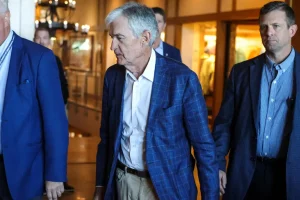
Jerome Powell, the Federal Reserve chair, at the Jackson Hole economic conference. President Trump focused his ire on Mr. Powell and now other policymakers over interest rates Reuters photo by Jim Urquhart).
Paul Krugman via Substack, Political-Economy Commentary: In the Matter of Lisa Cook, Paul Krugman, right, Aug. 26, 2025. Trump’s attempt to fire a Fed governor is illegal. Now we find out whether that matters.
Yesterday Donald Trump said that he had fired Lisa Cook, a member of the Federal Reserve Board of Governors. My wording is advisable: He “said” that he had fired her. I’m not a lawyer, but it seems clear that he does not have the right to summarily fire Fed officials, certainly on tissue-thin allegations of mortgage fraud before she even went to the Fed.
Cook has said that she will not resign. So at this point the immediate onus is on Jerome Powell, the Fed chairman. He has the right — I would say the obligation — to say, “Show me the legal basis for this action.” If Trump’s officials can’t provide that basis, he should declare that as far as he is concerned, Cook is still a Fed governor.
If Powell caves, or the Supreme Court acts supine again and validates Trump’s illegal declaration, the implications will be profound and disastrous. The United States will be well on its way to becoming Turkey, where an authoritarian ruler imposed his crackpot economics on the central bank, sending inflation soaring to 80 percent:Yesterday Donald Trump said that he had fired Lisa Cook, a member of the Federal Reserve Board of Governors. My wording is advisable: He “said” that he had fired her. I’m not a lawyer, but it seems clear that he does not have the right to summarily fire Fed officials, certainly on tissue-thin allegations of mortgage fraud before she even went to the Fed.
Cook has said that she will not resign. So at this point the immediate onus is on Jerome Powell, the Fed chairman. He has the right — I would say the obligation — to say, “Show me the legal basis for this action.” If Trump’s officials can’t provide that basis, he should declare that as far as he is concerned, Cook is still a Fed governor.
If Powell caves, or the Supreme Court acts supine again and validates Trump’s illegal declaration, the implications will be profound and disastrous. The United States will be well on its way to becoming Turkey, where an authoritarian ruler imposed his crackpot economics on the central bank, sending inflation soaring to 80 percent:
And the damage will be felt far beyond the Fed. This will mark the destruction of professionalism and independent thinking throughout the federal government.
So, about the legal authority. The Supreme Court, shamefully, has said that Trump has the authority to fire officials at will throughout the federal government, effectively eviscerating the principle of a professional civil service. But even the Court specifically carved out protections for Fed governors, saying that they can only be removed “for cause.”
Normally “for cause” means neglect of one’s job or malfeasance on the job. Yet even Trump’s people have made no claims that Lisa Cook has failed to fulfil her duties at the Fed or done anything wrong in her role as governor.
So what is the complaint about Cook? Trump says that she committed mortgage fraud by taking out two mortgages, claiming both properties as her primary residence, back when she was a professor at Michigan State, before joining the Fed.
Even if true, this accusation wouldn’t meet the standard for immediate dismissal from the Fed.
Furthermore, there’s no reason to believe Trump’s assertions that she committed fraud. So far, the Justice Department hasn’t even made any formal charges, let alone won a conviction. And we have no clear evidence of wrongdoing. As far as I can tell, the only evidence seen by outsiders shows that she took out mortgages on two properties, and the security instruments associated with these mortgages say that both properties are “principal residences.”
But as Adam Levitin at Credit Slips, says, “principal” isn’t the same as “primary”: someone who has a home in the city and a second place in the country might well consider both “principal” residences. Furthermore, there is no evidence that Cook even knew what the security instruments said — she may have done nothing more than promise to make her mortgage payments.
And a claim of mortgage fraud requires both that the borrower make a deliberate misrepresentation — as opposed to making a mistake on a complicated process — and that this misrepresentation caused financial harm to the lender. We’ve seen no evidence at all for either proposition.
This is not a case a nonpolitical Justice Department would even consider bringing to trial, or have much hope of winning. And again, it has no relevance at all to Cook’s work at the Fed, providing zero justification for dismissal “for cause.”
But of course Trump’s attempt to fire Cook has nothing to do with allegations of fraud. Her real crime, in his mind, is that she isn’t an obedient minion (oh, and that she’s a black woman.) The goal of his attempt to fire her is to replace independent Fed officials with lackeys who will take Trump’s orders — not just by getting rid of Cook but by intimidating everyone else.
As I wrote yesterday, the real message here is “If you get in our way we will ruin your life.”
The immediate test here is how the Fed itself responds. Cook is doing the right thing by refusing to resign. Jerome Powell now faces a moment of truth: Will he back her up, until or unless Trump demonstrates that he has the legal authority to fire her?
What if Trump uses some kind of force — deployment of U.S. Marshals? — to block Cook from continuing to work? Good. That will demonstrate to everyone the grotesqueness of this power grab.
And one way or another, this will end up in the courts, where we will find out whether our judicial system has any integrity left.
What will all of this mean for financial markets? The markets keep shrugging off the Trump administration’s lawlessness, and maybe they’ll do it again. But really, it doesn’t matter. This isn’t, ultimately, about monetary policy. It’s about whether we are still a nation of laws.
The Contrarian, Opinion: Word & Phrases We Should Ignore, Jennifer Rubin, right, Aug. 26, 2025. Assume bad faith from the Trump regime.
The “presumption of regularity,” a concept neither mentioned in the Constitution nor enshrined in any law, boils down to the notion that courts should give presidents the benefit of the doubt. As legal authority and founder of DemocracyDocket Marc Elias wrote in May, “Courts assume that the president and his administration act in good faith, that their actions are lawful, their statements truthful and their motivations honest.” (Don’t laugh, this used to be true.)
However, when it comes to Donald Trump, Elias, right, explains: “The cat-and-mouse game he has played with federal judges is rapidly turning into outright defiance. At every stage, the  government asserts the presumption of good faith and regularity to shield itself from the judicial scrutiny democracy requires.” Well, no one outside of the MAGA cult thinks the presumption of regularity is reasonable under this regime. (Even more fanciful is reliance on this Justice Department’s “professional ethics of the lawyers who appear before judges on behalf of the government.”)
That presumption was called into question again on Friday when FBI agents conducted searches of long-time virulent Trump critic, John Bolton. As lawyer, former FBI agent, and The Contrarian contributor Asha Rangappa wrote for The New York Times, “[T]he very fact that the public can’t be sure whether this is, in fact, a legitimate investigation highlights the current crisis of trust in federal law enforcement, a crisis that has been exacerbated by the words and actions of Mr. Trump and members of his administration.”
When the head of the FBI has made an enemies list (on which Bolton’s name appears), the regime systematically yanks security clearances and protective details for political opponents (including Bolton), and numerous figures—including Trump, FBI Director Kash Patel, and Vice President JD Vance—comment on the ongoing Bolton “investigation,” one might reasonably conclude things are not on the up-and-up. (As Peter Baker notes, citing his and Susan Glasser’s well-documented book The Divider, “Trump and his team have sought to use government power to go after Bolton since his first term even when it meant ignoring normal standards, so much so that his own assistant attorney general quietly resigned rather than go along anymore.”)
Given all that, the phrase the “presumption of regularity” is laughable under this thugocracy. As The Contrarian contributor Barb McQuade told the New York Times, “For all we know, the investigation into John Bolton’s conduct may be rock solid, but Trump’s Justice Department has lost any presumption of regularity.” However, she continues, “In light of all of the threats the Trump administration has made to target his enemies, they have lost any presumption of good faith.”
Beyond Bolton, evidence abounds to support skepticism about the regime’s intentions, based on its pattern of weaponizing government against opponents. The list of particulars includes: contriving “mortgage fraud” allegations against two of Trump’s prime enemies (New York Attorney General Letitia James and California Democratic Sen. Adam Schiff) as well as a Federal Reserve governor whom Trump pines to replace; extorting law firms that have represented foes; delaying, evading, and arguably ignoring a host of legal rulings; and charging Democratic officeholders (e.g. Judge Hannah Dugan, New Jersey Rep. LaMonica McIver) with bogus accusations of interfering with ICE arrests.
The has been an abundance of other instances of manifest “irregularity”: concocting a “corrupt bargain” to keep the New York mayor under Trump’s thumb; dismissing Justice Department officials who prosecuted Jan. 6 criminals; pardoning Jan. 6 felons; firing a Justice Department lawyer for being candid with the court; investigating special counsel Jack Smith, threatening to impeach judges who rule against Trump; slapping tariffs on Brazil for prosecuting its former president and coup instigator; and extracting “settlements” in frivolous claims against media companies (and holding up regulatory decisions until they pay).Subscribed
We cannot assume good faith when the president and his henchmen routinely lie (e.g., BLS figures are fraudulent! Crime in D.C. is soaring! Prices are down! No classified materials in Signalgate! Elon Musk doesn’t run DOGE!). As constitutional scholar and Harvard University Professor Larry Tribe put it to me recently: “The presumption of regularity rests on what has become a counterfactual assumption of normalcy.” It is time to make the presumption of irregularity (i.e. bad faith) when it comes to the Trump crowd.
Normalcy is entirely missing in the immigration realm, most glaringly in deportation of migrants to El Salvador. In dissembling over the timeline and falsely insisting the U.S. could not return Kilmar Abrego Garcia, Justice Department lawyers earned the ire of federal judges. Given the government’s repeated misrepresentations, then, courts going forward should “operate with persistent (and justified) skepticism toward the executive branch. … effectively shifting the burden to the government to affirmatively demonstrate its good faith, even in routine matters,” argued Alan Z. Rozenshtein in Lawfare.
For example, in considering a warrant to search the home or office of someone whose name is on a enemies list (or who happened to have litigated against Trump or whom Trump accused of “treason”), courts should demand an especially detailed factual showing to establish “probable cause” and should not rely on a Trump political appointee’s or recent hire’s affidavit without corroboration. Judges must be hyper-vigilant so as not to authorize a vengeance investigation.
Likewise, when evaluating if the government willfully disobeyed a court order, judges should assume trained lawyers understand the plain meaning of orders (and hence that disobedience is deliberate). If the government wants to rebut the assumption it willfully defied the court, a high-ranking official can testify to exculpatory facts under oath. Finally, whenever Trump invokes an “emergency” or other grounds (“rebellion”) for deploying troop domestically, courts should insist the government prove the factual basis for its claim (e.g., From where did they get the data that crime was trending up in D.C.?).
In short, the “presumption of regularity” is an absurd phrase to apply to an administration that cavalierly dissembles, disingenuously feigns confusion, and abuses power. The rule of law cannot survive if judges allow government lawyers to treat them like suckers.
New York Times, Public Broadcast Cuts Hit Rural Areas, Revealing a Political Shift, Megan Mineiro, Photographs and Video by Haiyun Jiang, Aug. 26, 2025. Threatened by the president with political retribution, Republicans agreed to defund public broadcasting, imperiling a lifeline of communication in rural Alaska.
As senators gathered at the Capitol last month to debate legislation to allow President Trump to zero out funding for public broadcasting, a siren and public service message rang out more than 4,000 miles away in this small town in the Aleutian Islands.
“Attention: A tsunami warning has been issued for this area,” the message said. “Move to high ground immediately. Tune to your local radio station for details.”
Residents of Unalaska, Alaska, hopped into their cars and tuned to KUCB, the only local station on the island, to listen for live updates as they drove uphill and away from danger.
The next day, the Senate passed the bill, acceding to Mr. Trump’s demand to cancel funding for the Corporation for Public Broadcasting, which provides money for KUCB and stations like it all over the country that serve listeners in remote areas — many in Alaska reachable only by plane, boat or, in the winter, ice bridge.
That has left 245 public broadcasting grantees in rural communities — including 27 stations in Alaska — at risk of going off the air. It has also pointed to a profound shift in Congress, where for decades lawmakers would regularly wheel and deal on major legislation, going up against their own president if necessary, to protect their constituents.
That was the case this summer for Senator Lisa Murkowski, Republican of Alaska, who defied Mr. Trump and tried unsuccessfully to salvage the public broadcasting funding, and then when she failed, broke with her party to vote against the bill.
But in a Senate remade by Mr. Trump’s threats of political retribution, Ms. Murkowski found herself in a lonely fight, with her fellow Republicans declining to join her in moving to protect funding for stations that serve as a lifeline of communication for many rural Americans.
In an interview, Ms. Murkowski said Republicans’ fear of the president’s wrath apparently overrode their concern for their own constituents, prompting them to oppose her efforts. And she agreed with Alaskans who said the public broadcasting fight had prompted them to wonder whether Congress could even work at all.“They’re right,” she said.
Aug. 25
New York Times, 20 Killed in Gaza Hospital Strikes. Netanyahu Cites ‘Tragic Mishap,’ Isabel Kershner, Aaron Boxerman and Ameera Harouda, Aug. 25, 2025. Five journalists, as well as medical workers, were among the dead at Nasser Hospital, where a second strike hit as ambulance crews were arriving.  Prime Minister Benjamin Netanyahu, right, said the military would investigate.
Twenty people were reported killed in Gaza on Monday, among them medical workers and journalists, when two Israeli strikes hit a hospital in what Israel’s prime minister later described as a “tragic mishap.”
 had been wounded. The five journalists had worked for media outlets including Reuters, The Associated Press and Al Jazeera, according to their employers.
The Israeli military said it had carried out a strike in the area of Nasser Hospital, without saying what the target was. In a statement, the military said that it regretted “any harm to uninvolved individuals.”
Later in the day, the office of Prime Minister Benjamin Netanyahu issued a rare statement of contrition about the strike.
 “Israel deeply regrets the tragic mishap that occurred today at the Nasser Hospital in Gaza,” he said. “Israel values the work of journalists, medical staff, and all civilians. The military authorities are conducting a thorough investigation. Our war is with Hamas terrorists. Our just goals are defeating Hamas and bringing our hostages home.”
The war in Gaza that began nearly two years ago has been one of the deadliest conflicts anywhere for journalists, with at least 192 killed since it began, according to the Committee to Protect Journalists.
The Israeli government has barred international journalists from entering Gaza to freely report throughout the war. That has left much
New York Times, Trump Threatens to Investigate Chris Christie Over ‘Bridgegate,’ Mike Ives, Aug. 25, 2025. President Trump floated the idea after the former governor of New Jersey, a onetime ally, criticized his use of the Justice Department.
President Trump on Sunday threatened to investigate former Gov. Chris Christie of New Jersey over a 2013 political scandal, days after the F.B.I. raided the home and office of another former Trump official turned critic.
Mr. Trump made the threat on social media after Mr. Christie said during an appearance on ABC News that the president “doesn’t care” about maintaining a separation between his office and criminal investigations.
Mr. Christie, a Republican who was a federal prosecutor before he was elected governor, had been discussing Mr. Trump’s connection to recent F.B.I. searches of the Maryland home and Washington office of John R. Bolton, a national security adviser in the president’s first term.
The raid last week of Mr. Bolton’s home and office was an escalation of a yearslong inquiry into whether he collected or leaked sensitive national security information. That episode, and Mr. Trump’s threat against Mr. Christie, were the latest examples of how the president’s campaign of retribution has undercut the principle that law enforcement should keep a distance from politics.
Mr. Trump wrote on his Truth Social platform late Sunday that Mr. Christie had lied about 2013 lane closures on the George Washington Bridge “in order to stay out of prison, at the same time sacrificing people who worked for him.” The president was referring to a decision by Mr. Christie’s associates to close access lanes to the bridge, which links New Jersey and Manhattan, in order to punish the Democratic mayor of a New Jersey town.
“Chris refused to take responsibility for these criminal acts,” Mr. Trump wrote. “For the sake of JUSTICE, perhaps we should start looking at that very serious situation again? NO ONE IS ABOVE THE LAW!”
The 2013 “Bridgegate” closures created days of traffic jams, and the scandal tarnished Mr. Christie’s reputation and helped to destroy his 2016 presidential candidacy. Mr. Christie has long denied any knowledge of the plan. He could not immediately be reached for comment.
Mr. Trump and Mr. Christie, who have known each other for decades, once had a good relationship. Mr. Christie initially served as the head of Mr. Trump’s first presidential transition team, and he helped Mr. Trump with debate preparations in the run-up to the 2020 election.
The Contrarian, Opinion: Two Cases Provide Critical Guidance to Rescue Democracy, Jennifer Rubin, right, Aug. 25, 2025. We need candor from the bench and from the media.
Two court decisions last week highlight the sorry state of our democracy yet also point the way ahead, toward a restoration of our constitutional principles and the rule of law. Another outlandish, unprincipled Supreme Court decision from the right-wing majority, again resorted to the “emergency” docket, underscoring that only substantial reform of this discredited court could halt its constitutional trail of destruction. Meanwhile, a district court judge and a plucky media watchdog reminded us that the First Amendment is the bedrock of our democracy.
The MAGA majority on the Supreme Court is continuing to issue partisan permission slips. Last week, without benefit of a reasoned opinion, it relied upon its infamous shadow document to overturn an impeccably reasoned lower court decision and allow the executive branch to kill hundreds of millions of dollars in National Institutes of Health grants. It ordered a cockamamie procedure whereby plaintiffs can challenge the legal violation in federal district court but must go to the Court of Federal Claims to restore grant money.Subscribed
Justice Ketanji Brown Jackson’s dissent admonished her colleagues’ reckless conduct. “A half paragraph of reasoning (issued without full briefing or any oral argument) thus suffices here to partially sustain the Government’s abrupt cancellation of hundreds of millions of dollars allocated to support life-saving biomedical research,” she wrote. “For a cautionary tale about lawmaking on the emergency docket, look no further than this newest iteration.”
Then, in a biting assessment of this court’s devolution into blatant, unabashed partisanship, she called out the entire farce:
In a broader sense, however, today’s ruling is of a piece with this Court’s recent tendencies.…This is Calvinball jurisprudence with a twist. Calvinball has only one rule: There are no fixed rules. We seem to have two: that one, and this Administration always wins.
How utterly refreshing for a Supreme Court justice to pinpoint what we have long known: The MAGA majority no longer even tries to act like unbiased jurists.
Recognition that the MAGA-ized court majority, devoid of judicial integrity, is nothing but a band of partisan hacks should inform democracy advocates’ agenda. Only systemic reform can reverse the massive damage wrought by a corrupted majority that has thoroughly distorted our constitutional system and enabled a tyrannical executive with nearly unlimited power. Pro-democracy advocates must begin now to rally public opinion and commit to ensuring that the high court actually behaves like a court restrained by precedent and judicial norms. A mandatory code of ethics, restriction on the court’s appellate jurisdiction, a fixed 18-year term for justices, and court expansion should all be on the table. The First Amendment
In a more reassuring sign, we saw last week that at least some courts take the First Amendment seriously. U.S. District Court Judge Sparkle L. Sooknanan for the District of Columbia concisely summarized the campaign of harassment against Media Matters, a nonpartisan media watchdog group:
In November 2023, it ran a story reporting that as a result of Elon Musk’s acquisition of Twitter (now “X”), advertisements on the social media platform were appearing next to antisemitic posts and other offensive content. Mr. Musk immediately promised to file “a thermonuclear lawsuit against Media Matters.” And he followed through. In the weeks and months that followed, X Corp. and its subsidiaries sued Media Matters all over the world….Meanwhile, seemingly at the behest of Steven Miller, the current White House Deputy Chief of Staff, the Missouri and Texas Attorneys General issued investigative demands (CIDs) to Media Matters, both of which were preliminarily enjoined in this Court as likely being retaliatory in violation of the First Amendment. But these court victories did not end the fight for Media Matters. Now the Federal Trade Commission (FTC) has taken up the cause. After Andrew Ferguson took on his new role as the Chairman of the FTC, the agency issued a sweeping CID to Media Matters, purportedly to investigate an advertiser boycott concerning social media platforms.
The Trump regime’s arrogant abuse of power in manipulating state officials and independent agencies to execute its program of revenge should shock Americans. Fortunately, the MAGA persecution of Media Matters shocked Judge Sooknanan, who delivered a rip-roaring defense of the First Amendment.
“Speech on matters of public concern is the heartland of the First Amendment. The principle that public issues should be debated freely has long been woven into the very fabric of who we are as a Nation,” Sooknanan wrote. “Without it, our democracy stands on shaky ground. It should alarm all Americans when the Government retaliates against individuals or organizations for engaging in constitutionally protected public debate.” Our alarm “should ring even louder when the Government retaliates against those engaged in newsgathering and reporting, she warned. After an exhaustive review of the facts and case law, she granted Media Matters’ request for an injunction to halt the FTC’s harassment.
The court’s eloquent decision and Media Matters’ tenacity should shame the legacy media outlets that have capitulated to Trump by paying him “settlements” in frivolous cases (nothing more than thinly disguised tributes) or destroying their august reputations for the sake of owners’ pecuniary or personal interests. We have learned that the First Amendment is too precious to entrust exclusively to corporate, billionaire owned media.
Unfortunately, the First Amendment is not self-enforcing; it requires principled defenders and conscientious journalists. Many of the latter have fled in droves to independent and/or nonprofit media where the truth and moral clarity continue to drive aggressive journalism.
These cases highlight the Trump regime’s unremitting pursuit of unlimited power, made possible because the Supreme Court has abandoned principled jurisprudence in favor of serving up disingenuous post-hoc rationalizations to justify executive imperialism. However, pro-democracy Americans have agency to reverse the slide into authoritarianism if they commit to redesign the Supreme Court, increase the ranks of diligent lower court judges, support
Letters from an American, Historical Commentary: Aug. 24, 2025 [U.S. Military vs. U.S. Citizens], Heather Cox Richardson, right, Aug. 25, 2025. As the administration of President Donald Trump is using loopholes in the nation’s laws to claim the right to use the military against American citizens, Democratic governors are pushing back.
The administration has taken control of the Washington, D.C., police under the 1973 Home Rule Act, which permits that takeover if “special conditions of an emergency nature exist.” Although the Department of Justice itself reported that crime in the city is at a 30-year low, Trump declared a crime emergency in the District of Columbia on August 11 to take control of the police.
The Home Rule Act limits the president’s takeover to 30 days unless the House and Senate pass a joint resolution to extend that time. On Friday, Representative Andy Biggs (R-AZ) introduced a bill to extend the takeover for about six months and to make that time the default for all future “emergencies.”
Tonight, California governor Gavin Newsom’s social media account posted: “Trump’s militarization of Los Angeles seems to have been just the start of an authoritarian takeover of American cities. This is not leadership. This is a scary, unlawful grab for power, and we should all be deeply concerned.”
Newsom has been calling attention to Trump’s erratic behavior and mental incapacity by imitating the president’s disjointed all-caps social media posts and mimicking the president’s merchandise. He recently replaced Trump’s name with his own on ball caps, for example, to say “Newsom was right about everything” after Trump appeared Friday with a cap saying “Trump was right about everything,” and has offered flags that say “Make America GAVIN Again” to troll Trump’s “Make America Great Again” slogan. Right-wing media complaints about Newsom’s unprofessional behavior highlight Trump’s instability, for Newsom is simply imitating Trump.
On Saturday, Dan Lamothe of the Washington Post reported that for weeks the Pentagon has been planning a military deployment of National Guard members and possibly active-duty troops to Chicago. The president cannot send National Guard troops unless a governor requests them, but Trump deployed troops in Los Angeles with the argument that the soldiers were protecting federal buildings and personnel, an argument that could apply almost anywhere he sends Immigration and Customs Enforcement (ICE) agents.
Illinois governor J.B. Pritzker responded: “The State of Illinois at this time has received no requests or outreach from the federal government asking if we need assistance, and we have made no requests for federal intervention. The safety of the people of Illinois is always my top priority. There is no emergency that warrants the President of the United States federalizing the [Illinois National Guard], deploying the National Guard from other states, or sending active duty military within our own borders. Donald Trump is attempting to manufacture a crisis, politicize Americans who serve in uniform, and continue abusing his power to distract from the pain he’s causing families. We’ll continue to follow the law, stand up for the sovereignty of our state, and protect Illinoisans.”
This morning, Trump threatened to send troops to Baltimore, Maryland, after Maryland governor Wes Moore invited him in what Trump called “a rather nasty and provocative tone,” to join him on a walk through the streets of Baltimore. Trump wrote that “I gave Wes Moore a lot of money to fix his demolished bridge. I will now have to rethink this decision???” Trump appeared to be referring not to his own money, but to federal funds supporting the rebuilding of Baltimore’s Key Bridge, which collapsed after a container ship hit it on March 26, 2024. The collapse stopped operations at one of the busiest ports in the nation.
In another post, Trump suggested that Moore, who served in Afghanistan and received a Bronze Star, awarded for acts of valor in combat, had lied about getting a Bronze Star.
Moore responded: “President Bone Spurs will do anything to get out of walking—even if that means spouting off more lies about the progress we’re making on public safety in Maryland. Hey Donald, we can get you a golf cart if that makes things easier. Just let my team know.” He added: “Did Donald Trump, the President of the United States, lie about an injury to dodge the Vietnam draft?”
The AI feature of X, called “Grok,” helpfully added: “Trump received four student deferments during the Vietnam era, followed by a 1968 medical deferment for bone spurs in his heels, per official records. The diagnosing doctor’s daughters later claimed it was a favor to Trump’s father, with no actual spurs. [Trump fixer] Michael Cohen testified Trump admitted faking it. Trump denies this, saying it was legitimate but temporary. No medical records confirm or refute.”
On Face the Nation today, Moore said he was actively looking at redistricting in Maryland to offset the Republican mid-decade redistricting in Republican-dominated states Trump is demanding. Moore said: “[W]e…need to make sure that if the president of the United States is putting his finger on the scale to try to manipulate elections because he knows that his policies cannot win in a ballot box, then it behooves each and every one of us to be able to keep all options on the table to ensure that the voters’ voices can actually be heard. “
The National Guard troops deployed to Washington, D.C., will begin carrying firearms tonight.
But Trump appears angry that he is not being given enough scope for his desires. Tonight he posted on social media that the tradition of blue slips, which enables senators to stop the appointment of objectionable federal judges in their own states, has made it impossible for him to appoint the judges he wants. He wrote: “I have a Consultational [sic] Right to appoint Judges and U.S. Attorneys, but that RIGHT has been completely taken away from me…. [T]he only candidates that I can get confirmed for these most important positions are, believe it or not, Democrats! [Chair of the Senate Judiciary Committee] Chuck Grassley should allow strong Republican candidates to ascend to these very vital and powerful roles, and tell the Democrats, as they often tell us, to go to HELL!”
Trump is likely reacting to his inability to keep his attorney Alina Habba, left, in the position of 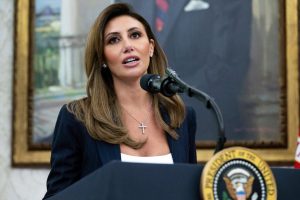 U.S. attorney for New Jersey after New Jersey senators Cory Booker and Andy Kim used blue slips to keep her from getting a Senate vote for confirmation. Trump appointed Habba acting U.S. attorney but after her 120-day interim period expired, a panel of judges skipped over her to appoint her assistant, Desiree Leigh Grace, to the job. Attorney general Pam Bondi then fired Grace, and Trump reappointed Habba. Last week, U.S. district judge Matthew Brann ruled that Habba was not holding the post lawfully.
There seems to be some tension in the White House tonight. As Trump’s poll numbers are in the low 40s on his job performance and underwater on every one of his policies, tonight he wrote: “Except what is written and broadcast in the Fake News, I now have the highest poll numbers I’ve ever had, some in the 60’s and even 70’s. Thank you. MAKE AMERICA GREAT AGAIN!!!”
Trump followed that post up with another. “Despite a very high popularity and, according to many, among the greatest 8 months in Presidential History, ABC & NBC FAKE NEWS, two of the worst and most biased networks in history, give me 97% BAD STORIES. IF THAT IS THE CASE, THEY ARE SIMPLY AN ARM OF THE DEMOCRAT PARTY AND SHOULD, ACCORDING TO MANY, HAVE THEIR LICENSES REVOKED BY THE FCC. I would be totally in favor of that because they are so biased and untruthful, an actual threat to our Democracy!!! MAGA”
Paul Krugman via Substack, Political-Economy Commentary: We Are All Lisa Cook, Paul Krugman, right, Aug. 25, 2025. Nobody is safe from weaponized government
Donald Trump is threatening to fire Lisa Cook, a member of the Federal Reserve’s Board of Governors, over allegations that she made false claims on mortgage applications before she went to the Fed.
I am not going to lead with a discussion of what Cook, left, may or may not have done. That would be playing Trump’s game.
Clearly, he’s just looking for a pretext to fire someone who isn’t a loyalist — and who happens, surprise, to be a black woman. If you write about politics and imagine that Trump cares about mortgage fraud — or for that matter believe anything Trump officials say about the affair without independent confirmation — you should find a different profession.
The real story here isn’t about Cook, or mortgages. It’s about the way the Trump administration is weaponizing government against political opponents, critics, or anyone it finds inconvenient.
You should think about the attack on Cook in the same context as mortgage fraud accusations made against California Senator Adam Schiff and New York Attorney General Letitia James. Or you should look at the attacks on Jerome Powell, the Federal Reserve chair, over the cost of renovations at the Fed’s headquarters. Or the still mysterious raid on the house of John Bolton, who at one time was Trump’s national security adviser.
The message here clearly isn’t “Don’t commit fraud,” which would be laughable coming from Donald Trump, of all people. Nor, despite what some commentators have said, is it all about revenge — although Trump is, indeed, a remarkably vindictive person. But mainly it’s about intimidation: “If you get in our way we will ruin your life.”
As with individuals, so with institutions. Universities are being threatened with loss of research grants unless they take orders from the White House. Law firms are being threatened with loss of access unless they do pro-bono work on behalf of the administration. Corporations are being threatened with punitive tariffs unless they support administration policies — and, in the case of Intel, hand over part ownership of the company.
This newsletter usually focuses on economics, and I could go on at length about the ways rule by intimidation will hurt the economy. There’s a whole economics literature devoted to the costs when an economy is dominated by “rent-seeking” — when business success depends on political connections rather than producing things people want. I’ve been writing a series of primers on stagflation. One of the way things could go very badly wrong would be politicization of the Federal Reserve, with monetary policy dictated by Trump’s whims, and it would be even worse if Fed policy is driven by officials’ fear of what will happen if they don’t follow Trump’s orders.
It’s also important to realize that the Fed does more than set interest rates. It’s also an important regulator of the financial system, a job that will be deeply compromised if Fed governors can be bullied by personal threats.
But there’s much more at stake here than the economy. What we’re witnessing is the authoritarian playbook in action. Tyrannies don’t always get their way by establishing a secret police force that arrests people at will — although we’re getting that too. Much of their power comes not from overt violence but from their ability to threaten people’s careers and livelihoods, up to and including trumped-up accusations of criminal behavior.
Which brings me, finally, to the accusations against Lisa Cook. According to Bill Pulte, left, the ultra-MAGA director of the Federal Housing Finance Agency, Cook applied for mortgages on two properties, claiming both as her primary residence. This isn’t allowed, because banks offer more favorable mortgage terms on your primary residence than on investment properties.
Borrowers sometimes do sometimes commit deliberate fraud, claiming multiple properties as their primary residence when they always intended to rent them out. For example, Ken Paxton, Texas’s Attorney General, claimed three houses as his primary residence, renting out two of them, and has also rented out at least two properties that he listed as vacation homes. Somehow, however, Pulte hasn’t highlighted his case, let alone threatened him with a 30-year prison sentence.
The truth is that even when clear mortgage fraud has taken place, it almost always leads to an out-of-court settlement, with fees paid to the lender, rather than a criminal case. In 2024, only 38 people in America were sentenced for mortgage fraud. No, I’m not missing some zeroes.
So did Cook say something false on her mortgage applications? Pulte says so, but I’d wait for verification. Also, false statements on mortgage applications are only a crime if they’re made knowingly, which is a high bar. And nothing at all about this story is relevant to Cook’s role at the Federal Reserve. If the administration thinks it has enough evidence to bring charges, it should bring charges, not demand that she quit her job.
The important thing to understand is that we are all Lisa Cook. You may imagine that your legal and financial history is so blameless that there’s no way MAGA can come after you. If you believe that, you’re living in a fantasy world. Criticize them or get in their way, and you will become a target.
Nobody is safe from weaponized government.
More U.S. Politics
New York Times, How China Influences Elections in America’s Biggest City, Michael Forsythe, Jay Root, Bianca Pallaro and David A. Fahrenthold, Aug. 25, 2025. The Chinese consulate in Manhattan has mobilized community groups to defeat candidates who don’t fall in line with the authoritarian state.
In New York City, social clubs backed by China undermined a congressional candidate who once challenged the regime on Chinese television.
They helped unseat a state senator for attending a banquet with the president of Taiwan.
And they condemned a City Council candidate on social media for supporting Hong Kong democracy.
In the past few years, these organizations have quietly foiled the careers of politicians who opposed China’s authoritarian government while backing others who supported policies of the country’s ruling Communist Party. The groups, many of them tax-exempt nonprofits, have allowed America’s most formidable adversary to influence elections in the country’s largest city, The New York Times found.
The groups are mostly “hometown associations” of people hailing from the same town or province in China. Some have been around for more than a century, while dozens of others have sprung up over the past decade. Like other heritage clubs in a city of immigrants, they welcome newcomers,
Global News

New York Times, News Analysis: Trump Relies on Personal Diplomacy With Putin. The Result Is a Strategic Muddle, David E. Sanger, Aug. 25, 2025. For President Trump, consistency is less important than leader-to-leader diplomacy. “Nothing’s going to happen,” President Trump told reporters on Air Force One in mid-May, “until Putin and I get together.”
Mr. Trump was making the argument that, for a problem as contentious as the Russian war in Ukraine, the only solution was a meeting of the minds of the leaders of the two superpowers, who could strike deals, knock heads and make it happen.
Now, nine days after that meeting happened at an American air base in Anchorage, all the outward signs are that any real progress has ground to a stop. Mr. Trump had hinted that President Vladimir V. Putin of Russia and President Volodymyr Zelensky of Ukraine would meet one on one and then together with Mr. Trump; neither meeting has been scheduled. “The agenda is not ready at all,” Sergey V. Lavrov, Russia’s foreign minister, said on NBC on Sunday.
And while Mr. Trump insisted to European leaders that Mr. Putin had agreed to allow a peacekeeping force inside Ukraine, by midweek the Russians were describing a very different construct, one in which Russia would participate in security guarantees for the country it invaded in February 2022. If ever there was a geopolitical fox-guarding-the-henhouse problem, that seemed to describe it.
New York Times, Expecting on the Front Lines: Motherhood in Ukraine’s Military, Cassandra Vinograd and Oleksandr Chubko, Aug. 25, 2025. Pregnant Ukrainian soldiers say they are fighting for the future of their country and for their children.
Ukraine’s military is finding it hard to recruit young men as the war with Russia grinds on, but women — all volunteers — are a bright spot. The number of women serving has grown more than 20 percent to about 70,000 since Russia’s invasion in 2022.
Those who become pregnant often serve in tough conditions under relentless shelling, living without heat in the winter, or running water and proper toilets.
“It’s terrifying — every single day,” said Nadia, 25, who served as a frontline radio operator until she was eight and half months pregnant. “You wake up wondering if everything is OK, if everyone is still alive,” she said, describing how every morning she would brush plaster off her bed that had fallen from the ceiling after a night of explosions.
Pregnancy, she said, made it even more difficult. The clinic where she would get ultrasounds closed. So did many nearby hospitals.
“You’re constantly thinking about your child’s well-being,” said Nadia, who gave birth to a boy, Yaroslav, in February. “It was nonstop stress every day, combined with constant physical activity.”
Aug. 24
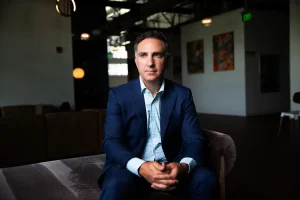
Michael Gordon, above, was dismissed as a federal prosecutor after investigating those who stormed the Capitol on Jan. 6, 2021 (New York Times photo by Octavio Jones).
New York Times, Reframing Jan. 6: After the Pardons, the Purge, Aug. 24, 2025. Dan Barry and Alan Feuer, Aug. 24, 2025. In its campaign of “uprooting the foot soldiers,” the Trump Justice Department has fired or demoted more than two dozen Jan. 6 prosecutors, even as those they sent to prison walk free.
The lawyer took the elevator 32 floors to the U.S. attorney’s office, where for eight years he had worked as a highly regarded prosecutor. He had a container of homemade chocolate chip cookies to share and some thoughts to keep to himself.Listen to this article with reporter commentary
“You have to be polite,” the lawyer, Michael Gordon, explained as the elevator rose. “But I don’t want to minimize it, or make it seem like everything’s OK. It’s not.”
Mr. Gordon was heading up on this steaming late July day in Tampa, Fla., to collect his things and say goodbye. Three weeks earlier, and just two days after receiving yet another outstanding performance review, he had been interviewing a witness online when a grim-faced colleague interrupted to hand him a letter. It said he was being “removed from federal service effective immediately” — as in, now.
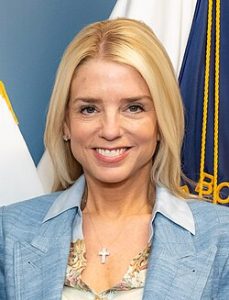 Although the brief letter, signed by Attorney General Pam Bondi, left, provided no justification, Mr. Gordon knew the likely reason: Jan. 6, 2021.
He was being fired for successfully prosecuting people who had stormed the United States Capitol that day — assaulting police officers, vandalizing a national landmark and disrupting that sacrosanct moment in a democracy, the transfer of presidential power.
He was being fired for doing his job.
The letter did more than inform Mr. Gordon, a 47-year-old father of two, that he was unemployed. It confirmed for him his view that the Justice Department he had been honored to work for was now helping to whitewash a traumatic event in American history, supporting President Trump’s reframing of its violence as patriotic — and those who had prosecuted rioters in the name of justice as villains, perhaps even traitors.
In the seven months since Mr. Trump, newly returned to the White House, granted clemency to nearly 1,600 people charged in the largest criminal investigation in Justice Department history, his administration has turned the agency upside down.
By tradition, the department long steered clear of White House intervention. Now, to remedy what the president has deemed the past weaponization of Justice, it has been deployed as a weapon for his score-settling and political crusades. To that end, it has sought to investigate and perhaps prosecute those who once investigated and prosecuted Mr. Trump and his allies, from the former special counsel, Jack Smith, to New York’s attorney general, Letitia James, to former President Barack Obama.
The template for that transformation was Jan. 6 — the pardons and then the purge.
To date, the Justice Department has fired or demoted more than two dozen prosecutors who were assigned to hold the rioters accountable — roughly a quarter of the complement. Some were junior prosecutors, like Sara Levine, who had secured a guilty plea from a rioter who had grabbed a police officer. Others were veterans, including Greg Rosen, who had led the department’s Jan. 6 task force. Scores more prosecutors, involved in these and other cases, have left, either in fear of where the ax might next fall or out of sheer disgust.
The Justice Department declined to comment for this article, but a White House spokesman, Harrison Fields, described the agency during the Biden administration as “a cabal of anti-Trump sycophants” engaged in a “relentless pursuit to throw the book at President Trump and his allies.” By “uprooting the foot soldiers,” Mr. Fields added, Mr. Trump’s attorney general, Ms. Bondi, “is restoring the integrity of the department.”
As he watched the Jan. 6 attack unfold on the television in his home office, Mr. Gordon recalled what a mentor had told him when he’d joined the Justice Department in 2017.
“You’ve probably seen things happen, bad things, and thought to yourself, ‘Somebody should do something about that,’” he remembered her saying. “That’s now you. You are that somebody.”
It was an inspiring message for someone who had taken a circuitous route to the law. He had taught high school history and humanities for several years before deciding to attend law school. An internship at the Queens district attorney’s office in New York sealed the deal. Now here he was, a federal prosecutor in Tampa, handling violent crime and narcotics cases — and he could be one of the somebodies who did something.

Democracy Docket, Commentary: Trump has replaced justice with retribution, Marc Elias, right, Aug. 23-24, 2025. Donald Trump has now fully weaponized the Department of Justice (DOJ), transforming it from an institution meant to safeguard the rule of law into a blunt political instrument used to silence critics and punish adversaries. This is not speculation. It is not a theory. It is a fact — and it is happening in plain sight, right now.
In the early hours of Friday morning, FBI agents executed a raid on the home  and office of John Bolton, above left, the former Trump national security adviser who has since become one of the former president’s most vocal critics.
The New York Post broke the news almost immediately, a suspiciously fast disclosure that suggests the Murdoch-owned tabloid may have received advance notice. That timing, combined with the choreography of official statements and social media posts, indicates a coordinated effort to maximize public spectacle.
As of one day after the raids, here is what we can say with certainty:
-
- John Bolton served in Trump’s first administration before becoming a vocal critic of Trump’s leadership and policies.
- Trump has repeatedly and publicly vowed retribution against his political enemies.
- The FBI raided both Bolton’s home and office.
- The sitting vice president acknowledged involvement in the prosecutorial decisions surrounding Bolton’s case.
The critical question now is: What do we do? How do citizens, the media and institutions of democracy respond to such brazen abuses of power?
There are a few critical steps we all must take.
First, the media must stop framing this story in terms that lend legitimacy to the Trump administration’s actions. Notice that I have not described the allegations against Bolton. That is intentional. The allegations are irrelevant because they are not the story.
The charges — or excuses for charges — serve only as distractions from the real news: the DOJ is being abused to target political opponents. By repeating the administration’s talking points, even skeptically, the press risks legitimizing them. Journalism must lead with the context of political persecution, not the pretext of alleged wrongdoing.
Second, the pro-democracy movement must put aside policy disagreements and rally to the defense of those targeted, even when they are not sympathetic figures. Bolton is far from a universally admired figure. Many vehemently disagree with his foreign policy views and past actions in government. But none of that matters here.
What matters is that he is a victim of political prosecution orchestrated by Trump and his allies. When authoritarianism is on the march, the rule of law and the preservation of democratic institutions must come before personal feelings.
Third, the judiciary must serve as a bulwark against this assault on the rule of law. Judges traditionally operate under the presumption that government prosecutors act in good faith. That presumption must be discarded in cases involving Trump’s DOJ.
Courts must instead approach such prosecutions with skepticism, recognizing the political context and being willing to dismiss indictments that clearly stem from retaliation. Without judicial intervention, the legal system risks becoming complicit in authoritarian abuse.
Most importantly, society must destigmatize being targeted by Trump’s DOJ. Today, when news breaks that someone has been raided or investigated, the reflexive assumption is that they must have committed some crime. Under this administration, the opposite presumption should apply.
We face a simple but urgent choice: act together now or accept the collapse of democracy and the rule of law. This moment demands courage — not just from those who are targeted, but from all of us. Because if this is what America looks like after seven months, imagine what it will look like after four years.
New York Times, In Trump’s Second Term, Far-Right Agenda Enters the Mainstream, Alan Feuer, Aug. 24, 2025 (print ed.). President Trump has embraced an array of far-right views and talking points in ways that have delighted many right-wing activists who have long supported those ideas.
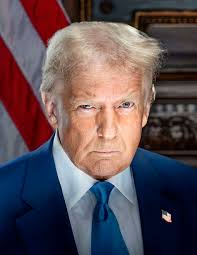 During President Trump’s first turn in the White House, right-wing extremists like the Proud Boys were on the streets, weekend after weekend, raising their voices — and oftentimes their fists — about issues such as immigration, the squelching of conservative speech and the removal of Confederate-era statues.
But in the first seven months of Mr. Trump’s second term, there has been a conspicuous absence of far-right demonstrations. And that, some leaders of the movement say, is because the president has effectively adopted their agenda.
“Things we were doing and talking about in 2017 that were taboo, they’re no longer taboo — they’re mainstream now,” said Enrique Tarrio, the chairman of the Proud Boys, who took part in many of those early far-right rallies. “Honestly, what do we have to complain about these days?”
Whether it is dismantling diversity programs, complaining about anti-white bias in museums or simply promoting an aura of authoritarian nationalism, Mr. Trump has embraced an array of far-right views and talking points in ways that have delighted many right-wing activists who have long supported those ideas.
His administration has also hired several people with a history of making racist or antisemitic remarks or who have looked favorably on the attack on the Capitol on Jan. 6, 2021.
Far-right figures have been particularly thrilled by Mr. Trump’s aggressive crackdown on undocumented immigrants, praising not only the ubiquitous images of masked federal agents raiding farms and factories, but also the ideology that has fueled those moves: a belief that migration to the United States is all but synonymous with a military invasion.
New York Times, D.C. Police Takeover: In Washington Crackdown, Making a Federal Case Out of Low-Level Arrests, Devlin Barrett, Aug. 24, 2025. A single afternoon in court illustrated the new ways in which laws are being enforced after President Trump’s takeover of the city’s police.
As President Trump posed triumphantly for photos with police officers, government agents and members of the National Guard in Southeast Washington last week, lawyers across town in federal court grappled with his new brand of justice.
The stream of defendants who shuffled through a federal courtroom on Thursday afternoon illustrated the new ways in which laws are being enforced in the nation’s capital after the president’s takeover of the city’s police. They were appearing before a magistrate judge on charges that would typically be handled at the local court level, if they were filed at all.
One man had been arrested over an open container of alcohol. Another had been charged with threatening the president after delivering a drunken outburst following his arrest on vandalism. And one defendant’s gun case so alarmed prosecutors that they intend to drop the case.
Mr. Trump has cast his crackdown on crime as a success, and suggested on Friday that it was a blueprint he would seek to apply to other cities, including Chicago. To defense lawyers and even some prosecutors, though, many of the cases that have landed in court have raised concerns that the takeover seems intended to artificially inflate its effect because government lawyers have been instructed to file the most serious federal charges, no matter how minor the incident.
One of the recipients of Mr. Trump’s show of force was Mark Bigelow, 28, a part-time delivery driver for Amazon.
After midnight on Aug. 19, Mr. Bigelow was sitting in the middle row of a van parked on a street in Northeast Washington with its doors open, according to court papers. Two other men were in the front when a full complement of law enforcement officials — from the Metropolitan Police Department, the F.B.I., the Drug Enforcement Administration, Immigration and Customs Enforcement and the State Department’s Diplomatic Security Service — stopped and saw what appeared to be an open container of alcohol in the front seat.
As law enforcement questioned and searched the two other passengers, Mr. Bigelow left the van and started to walk away, until other agents stopped him, according to the charging document. Peering into the van, an officer spotted “a second cup containing an alcoholic beverage in the middle row seat,” at which point Mr. Bigelow was arrested on charges of possession of an open container, a misdemeanor.
As he was placed in a vehicle, the handcuffed Mr. Bigelow became belligerent, twisting his body and yelling, “Get off me! Y’all too little, bro!” at an ICE agent, according to a court filing, which described how Mr. Bigelow made “physical contact” by kicking an agent in the hand and another in the leg.
As a result, Mr. Bigelow was charged with assaulting, resisting or impeding a federal officer, an offense that carries a maximum sentence of eight years in prison.
The charges follow a directive by the U.S. attorney, Jeanine Pirro, to prosecutors to charge the most serious crimes possible in each case and to do so in federal court, where sentences tend to run much longer.
Thomas Clay Jr. Substack, Political Opinion: Trump’s Dangerously Bad Health, Thomas Clay, Jr., right,  Aug. 24, 2025. Everything I am about to say is speculation but anyone who is in the medical field will know as many layman will know, it is the truth.
When you have as much experience with death as I have had, you begin to notice certain things about people who are near their end.
Something happened the other day that very few people noticed but I noticed. Trump called into Fox and said something that Poker Players would call a ‘tell.’ “I want to try and get to heaven, if possible. I’m hearing I’m not doing well. I am really at the bottom of the totem pole. But if I can get to heaven, this (ending Ukraine war) will be one of the reasons.” ~ Donald Trump, August 19th on Fox & Fiends
What’s odd about this statement is that a malignant narcissist does not speak of death unless they have been given news as such.
Last week Karoline Leavitt Trump’s chief propagandist said something to explain his very swollen ankles. She said Trump had, ‘chronic venous insufficiency’ which must not be possible at all after the White House’s own Dr. Feelgood Ronnie Jackson informed the public that Trump’s genetics were so impressive that it would not seem at all strange to Doc Ronnie if Trump lived to be 200 years old because he is the most perfect specimen of a man that he’d ever seen. Trump is now 79 years-old.
Another very odd thing is that Trump has a lot of makeup covering an IV injection site. In fact you can see that whoever does Trump’s makeup did not quite have the shade he needed to cover the bruise he had on his right hand. One thing you can be certain of is that Walter Reed would absolutely have their very best phlebotomists putting his IV in if he were being treated for something.
Then there was the other picture of Trump showing his face noticeably swollen to a point that the public has not ever seen.
There was also very excellent photographs of Trump wearing a Foley catheter, which means he has lost control of his bladder.
This past week NATO members met inside the White House and the Italian Prime Minister was seated next to Trump and she kept moving her chair away from Trump. Trump also held a meeting where he sat behind the Resolute Desk and all the other leaders sat in front of him which is a break in decorum for meeting world leaders because when Trump met with Putin it revealed that his bespoke shoes were hiding how swollen up his ankles are.
There are only two logical diagnoses that can be deduced from these facts.
The first is that Trump has Myelodysplasia, which is a blood cancer that causes patients to become anaemic and as anyone can see to the side of his spray tan makeup that he is as white as a ghost. Hiding a cancer from the public would be very difficult.
The second and more likely explanation for all these sudden symptoms is that he has congestive heart failure. His heart clearly is not strong enough to pump the fluid accumulating in his feet. The bruise in his hand could indicate a transfusion of Lasix which is a Diuretic and causes patients to urinate excessively which would explain the Foley catheter he has been wearing.
Lastly is the the obvious swelling in his face.
One of the ancillary symptoms of Congestive Heart Failure is Renal Failure and with failing kidneys comes the inability to excrete excessive fluid in the body.
Letters from an American, Historical Commentary: Aug. 23, 2025 [GOP: From Free Markets To Fascism?], Heather Cox Richardson, right, Aug. 24, 2025. “It is my Great Honor to report that the United States of America now fully owns and controls 10% of INTEL, a Great American Company that has an even more incredible future,” President Donald Trump wrote yesterday afternoon on social media.
He took the stake in the company after calling on August 7 for its chief executive officer, Lip-Bu Tan, to step down. When Tan met with Trump on August 11, the president says, he told Tan the U.S. “should be given 10% of Intel.” Tan agreed. Announcing the deal, Trump referred to Tan as “the Highly Respected Chief Executive Officer of the Company.”
It is wild to see Republicans cheering on a president who publicly threatened a CEO and stated openly that he shook the man down for a major share in his company.
It is even wilder to see Republicans, who since 1980 have held so fervently to the idea of free markets that they have denounced even the most basic regulations as socialism, celebrate the government takeover of a private company.
The story of that shift is a larger story about how the Republicans came to put party over country and, now, how they have put power over everything.
It was not always this way.
After World War II, leaders of both major political parties agreed that the government should regulate business, provide a basic social safety net, promote infrastructure, protect civil rights, and shore up a rules-based international order to try to prevent another world war. Republicans and Democrats contended, sometimes bitterly, over policies, but members of both parties recognized that they shared with the other a loyalty to the country and a general set of beliefs about what was best for it that encouraged them to seek common ground.
By the end of the 1990s, leading Republicans no longer saw party differences as differences of policy. Party trumped country because they believed they were in a fight for the soul of America, and they were on the side of the angels.
If keeping Democrats out of power meant it was necessary to skew the system, surely that was justified. Republicans began to talk of purifying the voter rolls in the 1990s, and in 1998 the Florida legislature passed a law that purged from the system as many as 100,000 Black voters presumed to be Democrats. This purge paid off in 2000, when Democratic presidential candidate Al Gore won the popular vote by more than half a million votes but was four votes short of a win in the Electoral College. The contest came down to Florida, where a confusing ballot had siphoned about 10,000 votes intended for Gore off to far-right candidate Pat Buchanan.
A hand recount had reduced Republican candidate George W. Bush’s lead from 1,784 to 537 when Republican operatives attacked the recount venue in Miami-Dade County to stop the recount, claiming there was “voter fraud.” The Supreme Court—led by five Republican-appointed justices—stepped in to give the victory to Bush.
When voters elected Democrat Barack Obama in 2008, Republicans declared war. On the night of Obama’s inauguration, Republican senator Mitch McConnell (R-KY) and other Republican leaders agreed over dinner to oppose anything that the new president proposed, regardless of whether they agreed with it. “For the next two years, we can’t let you succeed in anything. That’s our ticket to coming back,” Republican senators told incoming vice president Joe Biden.
They also worked to make it easier for Republicans to win. In 2010 the Supreme Court overturned a century of campaign finance laws to permit unlimited corporate and other outside money to flow into elections.
At the same time, Republican operatives launched Operation REDMAP, or Redistricting Majority Project, to take over statehouses before the redistricting after the 2010 census. They won the statehouses of Florida, Wisconsin, North Carolina, Ohio, and Michigan, as well as other, smaller states, and they redrew congressional maps using precise computer models. In the 2012 election, Democrats won the White House decisively, the Senate easily, and a majority of 1.4 million votes for House candidates. And yet Republicans came away with a 33-seat majority in the House of Representatives.
Three years later, the Supreme Court gutted the Voting Rights Act by ending the requirement that states with a history of racial discrimination in voting preclear changes to their voting rules with the Department of Justice. Republican-dominated state legislatures immediately began to restrict voting rights.
But the Republican economic program of slashing regulations and taxes was never popular, and the Republicans stayed in power by doubling down on the racism and sexism of their voting base. After 1987, talk radio fed the rhetoric that racial minorities and women were ushering socialism into the United States, and after 1994 the Fox News Channel amplified it.
In 2016, Donald Trump rode to the White House by playing directly to that racism and  sexism and asserting that white men should dominate women and people of color. Establishment leaders backed him for the tax cuts he promised, but they no longer called the shots. The racist and sexist MAGA base did. Trump and his loyalists took the idea that they had a right to rule to its logical extreme. When voters elected Democrat Joe Biden to the presidency, they tried to overturn that election with violence.
Now, back in office, Trump is dismantling the government as Movement Conservatives have wanted for decades. But he has abandoned the small-government principles Movement Conservatives claimed to champion and is using state power to terrorize citizens. He has abandoned the due process of the law and states’ rights and is working to rig the system permanently in his favor. And now he has abandoned the free-market principles around which the Movement Conservatives organized in the first place.
From the beginning, “Movement Conservatism” was anything but conservative. Its supporters embraced the radical goal of dismantling a practical system that stabilized the country after the Great Depression and a devastating world war, a system that was based in the Declaration of Independence and the Constitution. But now they are embracing something altogether different.
Right-wing activist Christopher Rufo explained yesterday on social media that “a new conservatism has emerged. We are leading a rebellion against the establishment and dismantling the elements of the left-wing ideological regime—not for the purpose of nihilism, but for the purpose of rebirth, or restoration, of our republic.”
Rufo’s statement is, as one commenter noted, “just textbook 1930s fascism.”
Jerome Powell, the Federal Reserve chair, at the Jackson Hole economic conference. President Trump focused his ire on Mr. Powell and now other policymakers over interest rates Reuters photo by Jim Urquhart).
New York Times, Fed Officials Try to Keep Focus on Economy as Trump Intensifies Attacks, Colby Smith, Aug. 24, 2025 (print ed.). The administration’s effort to oust a Fed governor as part of a pressure campaign for lower borrowing costs created an inescapable distraction at this year’s Jackson Hole conference.
At first glance, this year’s Jackson Hole conference proceeded a lot like in years past. Attendees of the storied economics conference, who mostly hail from central banks around the world, engaged in a healthy debate about the outlook for monetary policy, the latest developments in inflation and structural shifts across the labor market.
But increasingly hostile attacks from the White House against the Federal Reserve, including President’s Trump’s threat to fire a sitting governor if she did not resign, created an inescapable distraction. As a result, officials at the central bank were left with little choice but to profess an unwavering focus on just doing their jobs.
“It is more than a full-time job to be focusing on the data and the analytics,” said Susan Collins, president of the Federal Reserve Bank of Boston, in an interview on the sidelines of the conference. “There is a huge amount to do.”
The central bank’s congressional mandate is to set interest rates with an aim of keeping inflation low and stable and fostering a healthy labor market. It strives to make its decisions free of political influence to ensure that the best economic outcome is reached rather than one that will most directly benefit the person in the Oval Office.
Mr. Trump does not agree with that approach and has spent the past seven months trying to chip away at the Fed’s independence in an attempt to get the rock-bottom interest rates he desires.
Most of his fury has centered on Jerome H. Powell, the Fed chair, whom he has called on to resign and has considered firing. But in a sign of the president’s commitment to systematically disrupt the institution, Mr. Trump has turned his attention to other members of the Board of Governors, to pressure them to leave so he can install loyalists who will acquiesce to his demands.
The board has seven seats, and all members vote at every policy meeting alongside a rotating group of presidents from the 12 regional banks. Mr. Trump has already appointed one governor after Adriana Kugler vacated her post in August, months before her term was set to expire in January.
Just before the conference kicked off on Wednesday, Lisa Cook, right, became the latest mark. By Friday, Mr. Trump told reporters that he would fire the governor if she did not resign over allegations that she falsified bank records to obtain favorable mortgage terms before she joined the Fed.
As much as officials wanted to stick to the policy debate at hand during the three-day conference, the ferocity of the White House’s attacks on the institution inevitably diverted some of their attention. When asked how much time he was spending on studying the Fed’s legal protections, Alberto Musalem, president of the St. Louis Fed, said he had been reading up on the issues and consulting with his staff. Ms. Collins said she was in close contact with the Boston Fed’s board of directors, which ran the search process and appointed her to the position in 2022, about all internal matters.
The Federal Reserve Act stipulates that the president can dismiss members of the board only for cause, which is generally interpreted to mean gross professional negligence or malfeasance. It is a broad term that has little legal precedent, meaning it could be a high bar to prove.
To suspend or remove any of the regional reserve bank presidents, whose appointments are approved by the board, the law says the cause must be “communicated in writing.” Those presidents are up for reappointment every five years, when a majority of the board could replace any of them, although that has never happened. The next vote on reappointing all the regional presidents will be in February.
Fed officials are now trying to figure out what constitutes cause, if the regional presidents have the same protections as board governors and whether policymakers can continue to serve if they are removed by the president and choose to litigate the matter.
Global News
Washington Post, Some countries are suspending postal deliveries to the U.S. Here’s why,  Victoria Bisset, Aug. 24, 2025 (print ed.). Postal companies in several countries, including France, Germany and the U.K., are taking the action because of President Donald Trump’s order ending tariff exemptions.
New York Times, The War in Israel Over Serving in War, Elisabeth Bumiller, Natan Odenheimer and Johnatan Reiss, Aug. 24, 2025. Ultra-Orthodox Israelis, exempt for decades from military service, are now being drafted. Their rage is dividing Israel and threatening Prime Minister Benjamin Netanyahu’s coalition.
It was 11 p.m. in Jerusalem, and one of the city’s most insular ultra-Orthodox communities was in a furor. Hundreds of men in black suits and black hats of the Edah Haredit sect grew agitated as a top rabbi, shouting in Yiddish from a balcony, denounced the Israeli government for drafting the ultra-Orthodox. They had been exempt from military service to focus on religious study since the founding of Israel, but now they were needed for the war in Gaza.
Days later, the Israeli military police began arresting ultra-Orthodox draft dodgers. Only a few have been detained so far, according to multiple Israeli news reports, but on Aug. 14, hundreds of ultra-Orthodox protested and clashed with the police outside a prison where the Ynet Hebrew news site reported that seven were held.
For now, at a time of rage among the ultra-Orthodox and building tension between the military and the government over Gaza, the military is holding off on mass arrests.
Military service is compulsory for most Jewish Israelis, both men and women. The exemption for the ultra-Orthodox, known in Hebrew as Haredim, has long been resented by the rest of the Jewish population. But the nearly two-year war in Gaza has turned an irritant into a political crisis that is deepening divisions in Israeli society and imperiling Prime Minister Benjamin Netanyahu’s fragile coalition.
Last month, two ultra-Orthodox parties crucial to Mr. Netanyahu’s majority in Parliament withdrew from the government after it did not pass legislation exempting the ultra-Orthodox from the draft. Their move could lead to the collapse of the prime minister’s coalition and early elections, although Mr. Netanyahu has survived far worse political threats.
“The war has pushed everything to an extreme,” said Nechumi Yaffe, a professor of public policy at Tel Aviv University who is ultra-Orthodox. Secular Israelis are asking, she said, “Why should our children die and your children are just sitting drinking coffee and learning?”
Professor Yaffe said she had polling that showed 25 percent of Haredi men would enlist if they were not ostracized by their communities for doing so, as many are, and another 25 percent would enlist with some encouragement. She said attitudes were softening within less extreme ultra-Orthodox sects, although many rabbis are resisting change.
“The rabbis are feeling like they’re losing control,” she said.
Aug. 23
New York Times, How Trump Used 10 Emergency Declarations to Justify Hundreds of Actions, Karen Yourish and Charlie Smart, Aug. 23, 2025 (print ed.) In his seven months back in office, President Trump has declared nine national emergencies, plus a “crime emergency” in Washington.
Those emergency declarations have been used to justify hundreds of actions — including immigration measures, sweeping tariffs and energy deregulation — that would typically require congressional approval or lengthy regulatory review, according to a New York Times analysis of presidential documents.
The chart below shows every emergency declaration and the actions that flowed from each. Hover or tap on the dots to see details.
All presidents have the authority under the National Emergencies Act, a post-Watergate law, to declare a national emergency to enable the federal government to respond quickly to a crisis. But Mr. Trump has already invoked this power much more frequently than his predecessors and, experts say, for situations that do not qualify as true emergencies.
Previous emergency declarations have been made over events like the Covid-19 pandemic in 2020 and the Sept. 11 attacks in 2001, as well as to issue sanctions on countries like South Africa during apartheid in 1985 and North Korea in 2008.
Mr. Trump’s use of emergency powers in this term has far outpaced what is typical. On average — between Ronald Reagan’s inauguration in January 1981 and the start of Mr. Trump’s second term this year — presidents declared about seven national emergencies per four-year term, according to a Times analysis of data from the Brennan Center for Justice, a nonpartisan think tank focused on democracy. Mr. Trump declared that many in his first month back in office.
New York Times, Homeland Security Dept. Says It Hasn’t Kept Text Message Data Since April, Minho Kim, Aug. 23, 2025 (print ed.). The agency’s response to public records requests indicated potential violations of federal records laws, experts said.
The Department of Homeland Security rebuffed a request for public records related to the National Guard deployment in Los Angeles this summer, saying that the agency had not maintained text message data among top officials since early April, according to its communications with a nonprofit watchdog group.
A July 23 letter from the Homeland Security Department’s public records office, in denying the request from the nonprofit American Oversight, said that “text message data generated after April 9” was “no longer maintained.” The group had requested all messages received and sent by top department officials related to the deployment of the National Guard in the Southern California city, which President Trump authorized in response to protests over immigration raids.
The agency gave a similar response on Thursday to a request for communications about the migrant detention camp in the Everglades called “Alligator Alcatraz,” telling American Oversight that it was “unable to locate or identify any response records” since the agency “no longer has the capability to conduct a search of text messages.”
Under the Federal Records Act, government agencies are required to preserve all documentation that officials and federal workers produce while executing their duties, and they have to make federal records available to the public under the Freedom of Information Act unless they fall under certain exemptions.
The responses from the department indicate that officials there are failing to preserve internal communications, which would violate federal law, said Chioma Chukwu, the executive director of American Oversight.
Text messages among top officials “are records that must be preserved and kept,” Ms. Chukwu said, “because they are created in the course of conducting government business.”
“If they are not preserving those records, or if they are making so they cannot search for those records,” she added, “that is a violation of the Federal Records Act.”
The agency’s statement that it had not retained text messages since early April came after defense and national security officials were mired in an explosive scandal in March for communicating sensitive details of U.S. airstrike plans in Yemen on Signal, a private messaging app where users can set messages to disappear after a set time period. The chat group was exposed after a journalist was inadvertently added to the conversation.
Ms. Chukwu said that investigations and lawsuits that followed the Signal controversy showed that the administration officials had frequently used the messenger app’s auto-delete feature.
The Homeland Security Department has previously come under scrutiny for failing to preserve public records. After Mr. Trump’s supporters stormed the Capitol in 2021, text messages sent and received by Secret Service agents around the time of the attack were erased, even after an inspector general had requested them as part of his inquiry into the events of Jan. 6.

Letters from an American, Historical Commentary: Aug. 22, 2025 [Trump Seeks Indefinite Power], Heather Cox Richardson, right, Aug. 23, 2025. In these last days of August, with Congress on hiatus and the Epstein files looming, the Trump White House appears to be making a big move to consolidate power over the federal government, weaponize it against Trump’s opponents, and keep him in power indefinitely.
At around 7:00 this morning, FBI agents searched the home and office of Trump’s former national security advisor John Bolton, who has been a fierce critic of Trump since leaving his first administration. Officials told reporters the search was part of an investigation into whether Bolton illegally retained classified information or leaked it to news media. But as J.V. Last of The Bulwark noted, an investigation into classified documents from several years ago—as opposed to a search of, say, a drug dealer—would normally mean the government officials would have a conversation with Bolton’s lawyers and arrange for a routine search to which Bolton agreed. Instead, agents stormed his house and office in an early morning raid.
The raid seems a pretty clear warning to those Trump perceives as enemies that he will bring the full weight of the United States government to harass them. Bolton has been a thorn in Trump’s side for years because he is a well-known right-wing figure who has not been shy about speaking out against Trump. As recently as last week, Bolton told CNN that Trump had “achieved very little” by meeting with Russian president Vladimir Putin in Alaska, and that “Putin clearly won.” He also noted that Trump “looked tired.”
Earlier this month, when ABC’s Jonathan Karl asked Bolton if he was worried Trump would come after him as part of the president’s “retribution campaign” being waged through the FBI and the Department of Justice. Bolton pointed out that Trump had already come after him by removing his Secret Service protection despite specific Iranian threats against his life. Bolton added: “I think it is a retribution presidency.”
Targeting Bolton has been a goal of FBI director Kash Patel, whom Trump appointed after Patel made it clear he intended to use the power of government against Trump’s opponents. “We’re going to come after you whether it’s criminally or civilly,” Patel said in 2023 on Trump associate Steve Bannon’s War Room podcast.
Indeed, Trump loyalist Attorney General Pam Bondi has launched criminal investigations into Senator Adam Schiff (D-CA), who led the House Intelligence Committee that broke the story of Trump’s phone call to Ukraine President Volodymyr Zelensky asking him to smear Trump’s 2020 political opponent Joe Biden; New York Attorney General Letitia James, who successfully sued Trump and the Trump Organization for fraud; and now Federal Reserve Governor Lisa Cook, who suggested on August 6 that the revision of the last few months’ jobs numbers might signal a turning point in the economy.
Those investigations come after another Trump loyalist, William Pulte, who heads the Federal Housing Finance Agency, alleged that the three committed mortgage fraud years ago. All three have denied the allegations, and Allan Smith, Steve Kopack, and Dareh Gregorian of NBC News note that accusation of mortgage fraud “has long been a common tactic in opposition research on political campaigns. James’s lawyer, Abbe Lowell, pointed out that the administration does not appear to be investigating Trump loyalist Ken Paxton, the Texas attorney general who, divorce filings released this July show, claimed three different properties as his primary residence, thus securing lower-interest mortgages on them.
Earlier this week, bodycam footage released from a court filing by Representative LaMonica McIver (D-NJ), whom the administration has charged with assaulting federal agents during the chaotic arrest of Newark, New Jersey, mayor Ras Baraka on May 9, shows that the Justice Department’s deputy attorney general Todd Blanche personally ordered Baraka’s arrest. The case was later dismissed.
And yet Trump loyalists are not just targeting people in order to intimidate opponents. They seem determined to rewrite history to suit Trump.
In July the Department of Justice launched investigations of former FBI director James Comey and former CIA director John Brennan, alleging they had made false statements to Congress about the investigation into the attempt by Russian operatives to help Trump’s 2016 candidacy. After all these years, Trump continues to come back to the scandal that he calls “Russia, Russia, Russia.”
Yesterday, Russia bombed a U.S. factory in Ukraine, wounding at least 15 people, and today, Russian officials made it clear they would not even entertain the bilateral summit with Ukraine Trump called for. Nonetheless, today in a bizarre session in the Oval Office, at what was supposed to be an announcement about next year’s FIFA World Cup, wearing a cap with the words “Trump Was Right About Everything,” Trump showed reporters a photograph of himself and Putin that Putin had sent him from their meeting in Alaska last week, and expressed sadness that Putin, who has murdered more than a million people and is wanted by the International Criminal Court for war crimes, can’t attend the FIFA games. Trump said he planned to sign the photograph as a gift for Putin.
The administration’s crusade against the U.S. intelligence agencies that uncovered the relationship between Russian operatives and Trump’s 2016 campaign is continuing as part of the administration’s power grab. On Wednesday, Director of National Intelligence Tulsi Gabbard announced she will cut 40% of her office, with cuts coming from the Foreign Malign Influence Center, which, as Maggie Miller and Dana Nickel of Politico note, “collects and analyzes data on foreign influence operations seeking to undermine U.S. democracy.”
Today Hegseth fired the director of the Defense Intelligence Agency, U.S. Air Force Lt. General Jeffrey Kruse. The Defense Intelligence Agency provides intelligence to the Joint Chiefs of Staff and to U.S. military personnel in the field.
The crackdown in Washington, D.C., seems to have far less to do with combating crime in a city where crime rates are at a 30-year low than it does with demonstrating that the administration controls the capital, the seat of the U.S. government. As conservative lawyer George Conway, who helpfully videoed the FBI raid on John Bolton’s house this morning, put it: “If you want to have a coup against the constitutional order, you want to control the capital city. And if he has control of the policing in the city of Washington,… how do you stop him? Who’s gonna tell him to leave the White House?”
Trump has rewarded those who fought to steal the 2020 election for him, pardoning or commuting the sentences of more than 1,500 people convicted or charged in connection with the January 6, 2021 riot designed to stop the counting of the electoral votes that would make Biden president, and yesterday he demanded that Colorado officials release former election officer Tina Peters, whom a jury found guilty of four felonies for breaching election equipment to support Trump’s lies about election fraud after that election. Trump posted on social media: “She did nothing wrong, except catching the Democrats cheat in the Election [sic]…. If she is not released, I am going to take harsh measures!!!”
Now Trump and his allies appear to be cementing control of the capital. Secretary of Defense Pete Hegseth said in a statement today from the Pentagon that the 2,000 National Guard members stationed in Washington, D.C., will begin to carry weapons. More National Guard personnel are on the way. At the same time, FBI Director Patel and deputy director Dan Bongino appear to be turning the FBI into a national police force: dropping the requirement for a college degree, reducing training hours, and focusing on street crime rather than the bureau’s traditional expertise in white collar crime, corruption, and so on.
Trump said yesterday he wants to extend the deployment for more than the 30-day limit the law allows, and today he warned that he would take over the city “with the federal government.” Today, in the Oval Office, Trump told reporters that his administration would invade Chicago, which he called a “mess,” next. He said that “African American ladies, beautiful ladies, are saying, ‘Please, President Trump, come to Chicago, please.’”
On August 18, Democracy Docket’s Marc Elias warned that Trump is “stationing the military and other federal law enforcement in blue areas so—when the time comes—he can pivot their mission to suppressing voting rights and undermining free and fair elections.” On Tuesday, Trump ally Steve Bannon said on his webcast War Room: “They’re petrified over at MSNBC and CNN that, hey, since we’re taking control of the cities, there’s going to be ICE officers near polling places. You damn right.”
Last March, scholar of authoritarianism Timothy Snyder wrote that those who fantasize about a strongman make the terrible mistake of thinking “that a strongman will be your strongman. He won’t,” Snyder wrote. “In a democracy, elected representatives listen to constituents. We take this for granted, and imagine that a dictator would owe us something.” But he doesn’t, Snyder explains: your support makes you irrelevant.
Those who supported Trump from a belief that he would protect American business from state interference received yet another example of Snyder’s point today when Trump boasted that the government has taken a 10% stake in Intel, which builds semiconductors and chips. Trump says he intends to take similar stakes in other companies.
In the midst of the day’s firestorm of news, the administration released several pieces of the transcripts of Todd Blanche’s interview with Jeffrey Epstein associate Ghislaine Maxwell. In them, she is recorded as saying, among other things: “[A]s far as I’m concerned, President Trump was always very cordial and very kind to me. And I just want to say that I…admire his extraordinary achievement in becoming the president now. And I like him, and I’ve always liked him.”
Trump apologist lawyer Jonathan Turley suggested the Maxwell interviews would lay the story of the Epstein files to rest. But the interviews were always a distraction from the Epstein files themselves. Prosecutors at the Department of Justice itself called Maxwell a serial liar, and as Erica Orden, Josh Gerstein, and Kyle Cheney of Politico note, she is now angling for a pardon after her conviction on sex trafficking charges.
In Illinois today, Chicago mayor Brandon Johnson called Trump’s threat to take over the city an illegal abuse of power.

The Real Michael Cohen, Commentary: The Epstein Scandal Deepens, Michael Cohen, right, Aug. 23, 2025. The DOJ’s release of Maxwell’s audio creates more questions than answers. A scripted performance, redactions everywhere, and rising suspicion prove one thing: the full truth will never surface.
The Jeffrey Epstein scandal has always been less of a story and more of a black hole; an endless pull of secrets, half-truths, and whispers that consume everything in their orbit. Every new revelation doesn’t clarify; it clouds. Every new “disclosure” raises more questions than answers.
And now, with the Department of Justice releasing audio recordings of Ghislaine Maxwell’s  interview with Deputy Attorney General Todd Blanche, the fog has only thickened.
Notice what I said: audio recordings. Not video. Not the full picture. Just voices on tape. And in a case this radioactive, that choice matters. Why not release the video? Why not let the public see her body language, her eyes, her hesitations? Instead, we get the auditory equivalent of a shadow. That alone prompts the obvious question: was Maxwell reading from a prepared script? Was this carefully choreographed damage control dressed up as “transparency”? These are questions circling the tables around the country.
Maxwell, serving a 20-year sentence for sex trafficking, told Blanche she never witnessed Donald Trump in “any inappropriate setting” and, notably, never saw him in a massage environment. I’ll admit; I believe that part to be true. Years back, Trump and I had conversations about massages. He insisted he’d never had one. I hadn’t either. For Trump, the idea of surrendering control, of lying still while someone else was in charge of the room, was unthinkable. So yes, when Maxwell says she never saw him in that context, it rings true to me.
But that’s not the headline. The real headline is why Blanche himself; the number two at DOJ, was conducting this interview. As Senators Dick Durbin and Sheldon Whitehouse pointed out, it’s virtually unprecedented. That job typically belongs to line prosecutors who know the details of the case cold. Blanche’s involvement suggests something more delicate, more political, more stategic. Which begs the question: who wanted him in that room, and why?
Maxwell, for her part, described Trump as “cordial,” “kind,” even a “gentleman.” Her words sound less like testimony and more like carefully chosen phrases aimed at neutralizing speculation. But instead of putting the matter to rest, the DOJ’s selective release has only ignited new fires. Democrats see a cover-up. MAGA Republicans, once certain that a mythical Epstein client list would expose the “deep state,” are now muttering that Trump himself is protecting elites. In the end, both sides walk away angrier, more suspicious, more certain that the truth is being buried.
Meanwhile, Maxwell has been quietly moved to a minimum security facility in Texas. Victims and their families are outraged, and rightfully so. Trump brushed off the transfer as “not uncommon.” But when the most notorious woman in federal custody gets downgraded to lighter confinement while her interview tapes conveniently surface, coincidence starts looking a lot like orchestration.
And let’s not forget that Maxwell is still appealing her conviction; petitioning the Supreme Court on the grounds that she was unlawfully prosecuted. Against that backdrop, the DOJ hands her a platform to deny Trump’s involvement in any misconduct. That’s not justice; it’s narrative management.
Now, here’s the bottom line. This release didn’t settle anything. It didn’t give closure to victims. It didn’t reassure the public. It didn’t answer who knew what and when. Instead, it’s feeding more speculation, more conspiracy theories, and more distrust. By withholding the video, by redacting names, by giving us curated fragments instead of the full file, the DOJ ensured that the truth remains just out of reach.
And that’s the tragedy of the Epstein case. At this release pace of information, we will likely never see the full, un-redacted file. We will never have the entire story. Too many powerful people have too much to lose. Instead, we’re left with staged interviews, selective transparency, and a justice system that seems more concerned with managing fallout than delivering truth.
So yes; the Epstein plot thickens. Not because we’ve gotten closer to the truth, but because every move by the system pushes it further away. And the public, once again, is left staring into the void, wondering if the truth will ever be known.
New York Times, Corporate America’s Newest Activist Investor: Donald Trump, Lauren Hirsch and Maureen Farrell, Aug. 23, 2025. The president is demanding government stakes in U.S. companies and cuts of their revenue. Experts see some similarities to state-managed capitalism in other parts of the world.
Corporate America has built up defenses against the likes of Carl Icahn, Nelson Peltz and other corporate raiders who have rattled the cages of chief executives, pushing for higher stock prices. Now companies have a new investor to worry about: the president of the United States.
President Trump has inserted the government into U.S. companies in extraordinary ways, including taking a stake in U.S. Steel and pushing for a cut of Nvidia’s and Advanced Micro Devices’ revenue from China. Last month, the Pentagon said it was taking a 15 percent stake in MP Materials, a large American miner of rare earths.
 And on Friday, Intel agreed to allow the U.S. government to take a 10 percent stake in its business, worth $8.9 billion.
These developments could herald a shift from America’s vaunted free-market system to one that resembles, at least in some corners, a form of state-managed capitalism more frequently seen in Europe and, to a different degree, China and Russia, say lawyers, bankers and academics steeped in the history of hostile takeovers and international business.
And the actions are sending Wall Street’s bankers and lawyers scrambling to help companies come up with a playbook to defend against or least find ways to mollify Mr. Trump.
“Virtually every company I’ve talked to which is a regular recipient of subsidies or grants from the government is concerned about this right now,” Kai Liekefett, co-chairman of the corporate defense practice at the law firm Sidley Austin, said in an interview.
The Trump administration is casting a wide net, scouring other companies that it thinks could be ripe for some form of government involvement, three people briefed on these discussions said.
New York Times, Intel Agrees to Sell U.S. a 10% Stake in Its Business, Tripp Mickle, Lauren Hirsch and Ana Swanson, Aug. 23, 2025 (print ed.). The deal is among the largest government interventions in a U.S. company since the rescue of the auto industry after the 2008 financial crisis.
President Trump said on Friday that Intel, the troubled Silicon Valley chipmaker, had agreed to sell the U.S. government a 10 percent stake in its business, worth $8.9 billion, in one of the largest government interventions in a U.S. company since the rescue of the auto industry after the 2008 financial crisis.
At a news conference, Mr. Trump said the agreement had come out of negotiations last week with Lip-Bu Tan, Intel’s chief executive.
“I said, ‘I think it would be good having the United States as your partner.’ He agreed, and they’ve agreed to do it,” Mr. Trump said. “And I think it’s a great deal for them.”
Intel said the United States would invest $8.9 billion in its stock, on top of $2.2 billion that the government has paid the company under the CHIPS and Science Act, a federal program signed into law in 2022 that delivered billions in grants to revive U.S. semiconductor manufacturing. The government will not take a board seat or have other governance rights at Intel.
“We are grateful for the confidence the president and the administration have placed in Intel, and we look forward to working to advance U.S. technology and manufacturing leadership,” Mr. Tan said in a statement.
In a social media post, Commerce Secretary Howard Lutnick called the agreement “historic” and said it would strengthen U.S. leadership in semiconductors, which act as the brains of computers and are used in everything from toasters to cars and weapons. He included a photograph of himself beside Mr. Tan, whom he thanked “for striking a deal that’s fair to Intel and fair to the American People.”
The deal is perhaps the most notable government intervention in a U.S. company since 2008, when the government poured tens of billions into Chrysler and General Motors to prevent their collapse. The agreement was also the Trump administration’s latest effort to put its own stamp on the CHIPS Act, while trying to reinvigorate Intel. Mr. Trump and other officials have derided the CHIPS Act for handing out money without getting anything in return.
New York Times, Lisa Cook, Who Broke Ground at the Fed, Faces Attack by Trump, Ben Casselman, Aug. 23, 2025. The first Black woman to serve on the Federal Reserve board, Ms. Cook has long been a pathbreaker in a field dominated by white men.
Years before Lisa Cook, right, became President Trump’s latest target in his effort to exert control over the Federal Reserve, she wrote about her experience as one of a relative handful of Black women in a field long dominated by white men.
“Economics is neither a welcoming nor a supportive profession for women,” she and a colleague wrote in a New York Times opinion essay in 2019. She added, “But if economics is hostile to women, it is especially antagonistic to Black women.”
Three years later, President Joseph R. Biden Jr. nominated Ms. Cook to the Fed’s powerful Board of Governors. Her confirmation process was a difficult one — she faced repeated questions about her qualifications despite a résumé that included stints at the Treasury Department and the White House as well as extensive academic experience.
She was confirmed, but narrowly: Vice President Kamala Harris broke a 50-50 tie in the Senate after Republicans voted overwhelmingly against her appointment. She was the first — and remains the only — Black woman to serve as a Fed governor.
Mr. Trump is now trying to force Ms. Cook out of that job. On Wednesday, Bill Pulte, the director of the Federal Housing Finance Agency, accused her on social media of falsifying bank records and other documents in order to obtain favorable terms on a mortgage before she joined the Fed. Mr. Trump on Friday threatened to fire Ms. Cook if she didn’t resign.Sign up for the Race/Related Newsletter Join a deep and provocative exploration of race, identity and society with New York Times journalists. Get it sent to your inbox.
Ms. Cook did not respond to requests for comment on Friday. In a statement released by the Fed on Wednesday, she said she had “no intention of being bullied” and pledged to gather “accurate information to answer any legitimate questions and provide the facts.”
New York Times, White House Lists Smithsonian Exhibits It Finds Objectionable, Zachary Small, Aug. 22, 2025 (print ed.). The Trump administration highlighted material dealing with topics like sexuality, slavery and immigration.
The White House published a list of Smithsonian exhibits, programming and artwork it considered objectionable on Thursday, one week after announcing that eight of the institution’s museums must submit their current wall text and future exhibition plans for a comprehensive review.
The list borrows heavily from a recent article in The Federalist that objected to portrayals at several museums. It argued that the Museum of American History promoted homosexuality by hanging a pride flag; overemphasized Benjamin Franklin’s relationship to slavery in its programming; and promoted open borders by depicting migrants watching fireworks “through an opening in the U.S.-Mexico border wall.”
Other grievances were previously enumerated in an executive order that President Trump authorized in March, which criticized the National Museum of African American History and Culture for a 2020 worksheet that describes aspects of “whiteness” as “hard work,” “individualism” and “the nuclear family.” The worksheet was part of an online educational portal called Talking About Race; once it drew criticism, Lonnie G. Bunch III, the secretary of the Smithsonian, had it removed.
The White House list also featured complaints that were not part of the Federalist article or the president’s executive order. Those include a stop-motion animation at the National Portrait Gallery about Dr. Anthony S. Fauci, a government leader during the coronavirus pandemic, and a series at the African American museum that it says “featured content from hardcore woke activist Ibram X. Kendi.”
Aug. 22
New York Times, Analysis: Trump’s Attacks on Institutions Threaten a Bulwark of Economic Strength, Ben Casselman and Colby Smith, Aug. 22, 2025. The president’s efforts to control the Federal Reserve and Bureau of Labor Statistics carry risks. But collectively, the moves could be even more damaging, economists warn.
Through recessions, wars, financial crises and political turmoil, the U.S. economy has maintained its reputation as the safest place in the world for investors to put their money and for entrepreneurs to build their businesses.
That has given the United States a nearly incalculable economic advantage, allowing it to borrow more cheaply, grow more quickly and emerge from downturns more successfully than nearly any of its global peers.
President Trump may be chipping away at that advantage.
In recent weeks, Mr. Trump fired the head of the Bureau of Labor Statistics when her agency reported weak job growth and tried to force out officials at the Federal Reserve when they refused to cut interest rates. He and his aides have used the power of the federal government to target — and perhaps criminally prosecute — perceived enemies, including at the Fed, and to pressure companies over their business decisions.
His administration has used private tax data to pursue undocumented immigrants and overruled the decisions of once-independent government grant makers to cut off funding for certain kinds of scientific and medical research.
Individually, each move carries risks, according to economists across the political spectrum. Undermining Fed independence could lead to faster inflation. Meddling with economic statistics could drive up the government’s borrowing costs. Cutting research funding could threaten long-term economic growth.
New York Times, Trump Administration Live Updates: F.B.I. Searches John Bolton’s Maryland Home, Devlin Barrett, Aug. 22, 2025. Where Things Stand.
John Bolton: F.B.I. agents early Friday were searching the Maryland home of John Bolton, above left, President Trump’s former national security adviser, said an F.B.I. official. Mr. Bolton, who is now a frequent critic of the president, was accused during the first Trump administration of leaking sensitive government information, but the case went nowhere.  Asked about the visible F.B.I. presence at Bolton’s home, a spokesperson for the bureau said agents were “conducting court-authorized activity in the area.” The investigation into Mr. Bolton seeks to determine whether he illegally shared or possessed classified information, according to two people familiar with the case who spoke on condition of anonymity to describe the thrust of the investigation. A lawyer for Bolton did not immediately respond to messages seeking comment.
Job cuts: There will be some 300,000 fewer federal workers on the government payroll by the end of December than there were in January, Scott Kupor, the Trump administration’s top human resources official, told The New York Times in an interview. That amounts to the loss of about one in eight federal civilian workers, and would be the largest single-year reduction since World War II. Read more ›
“Alligator Alcatraz”: A federal judge on Thursday ordered that no more immigrant detainees be sent to a center in the Florida Everglades, and that much of the facility be dismantled. The ruling rebuked the state and federal governments for failing to consider potential environmental harms before building the facility known as Alligator Alcatraz. Read more ›
Krassenseteins via Substack, Opinion: FBI Raids John Bolton’s Home – Hypocrisy Cult! Brian and Eddie Krassenstein, Aug. 22, 2025. At around 7 a.m. ET, FBI agents executed a raid on the Bethesda, Maryland residence, of former National Security Adviser John Bolton, targeting a national security investigation involving classified documents. Bolton was neither detained nor charged at the time.
 Kash Patel, left, now serving as FBI Director since February 2025, publicly declared, “No one is above the law… @FBI agents on mission,” via a post on X.
This move stands in glaring contrast to Patel’s earlier reaction to the Mar a Lago raid, which he had blasted as a “witch hunt.” Today’s action raises questions: how can one decry a similar enforcement action one day, then facilitate one the next—merely because the target is a political adversary?Historically, Bolton had sparred with Trump—his former boss—particularly over leaked classified material in his memoir The Room Where It Happened. That case closed without charges under the Biden administration.
The optics are unmistakable: Patel condemns one case as aggressive overreach, yet authorizes another, same agency, same legal foundation, diffe rent subject. It isn’t just irony, it reflects the peril of selective judgment. Enforcement actions risk appearing politicized when the public perception is that penalties follow partisan lines.
The Hartmann Report, Pro-Democracy Advocacy: The Authoritarian’s Secret Weapon: They Never, Ever Leave Voluntarily, Thom Hartmann, right,  Aug. 22, 2025. Every gerrymander, purge, and press attack tightens the screw — until the system is locked and the tyrant holds the only key…
With the raid on John Bolton‘s home, it looks like we may have reached that stage when fascist governments begin to turn against their critics, weaponizing the tools of a police state.
Richard Nixon went after his enemies, too, and once said, in the depths of the Watergate scandal, that “when the president does it, that means that it is not illegal.” He discovered the hard way that wasn’t true, at least back in the 1970s. More than 40 people connected to his White House and campaign were indicted, and many went to prison.
Nixon’s Chief of Staff H.R. Haldeman, Domestic Policy Advisor John Ehrlichman, White House Counsel John Dean, Attorney General John Mitchell, and special counsel Charles Colson all did time. So did several members of Nixon’s Committee to Re-Elect the President, better known as CREEP, for their crimes of burglary, obstruction of justice, and conspiracy. Nixon himself escaped accountability only because Gerald Ford pardoned him.
That experience left a permanent scar on America’s political consciousness, but it also left a roadmap that Trump and his inner circle are determined not to follow. They have no intention of being, like Nixon and his people, crooks who lost their grip on power. They’re apparently making plans to guarantee it never happens to them.
That’s the context for Trump’s recent announcement that he intends to issue an executive order directing states to defer to him in “counting and tabulating votes.” He’s laying the groundwork to seize control of the elections in 2026 and 2028, turning them into stage-managed rituals rather than contests.
This isn’t bluster on Trump’s part. It’s the natural progression of what Republicans have already been doing with their gerrymandering binge, redrawing district lines to ensure that even if they lose the majority of votes, they can still control the House of Representatives. The game is to rig the system so thoroughly that the people’s will can no longer threaten their grip on power, that Democrats in Congress will never be able to investigate their abuse of our system like they did with Nixon.
What Nixon tried to do in secret with plumbers, burglars, and hush money, Trump is doing in the open, loudly, and with the full backing of the Republican Party and its billionaire benefactors.
The danger of this moment is that history shows how difficult it is to remove authoritarian leaders once they’ve succeeded in consolidating control.
Fascists are not like ordinary politicians. They don’t lose gracefully. They don’t respect rules, laws, or constitutions except insofar as they can be bent to entrench their power. As Chris Armitage writes, once in, they’re damn hard to get out.
Mussolini stayed in power for more than two decades until the Second World War turned against him. Franco held Spain in his iron grip for almost forty years (and they’re still finding bodies). Hitler’s regime collapsed only after catastrophic defeat and the near destruction of Germany.
These men understood that once you have bent the legal system to your will, crushed independent journalism, cowed the opposition, and taught the public to accept corruption as normal, there’s no easy way for citizens to push you out.
New York Times, Gaza City and Surrounding Areas Are Officially Under Famine, Monitors Say, Vivian Yee, Aug. 22, 2025. At least half a million people in the enclave were facing the most severe conditions measured by U.N.-backed international experts: starvation, acute malnutrition and death.
Gaza City and the surrounding territory are officially suffering from famine, a global group of experts announced on Friday, nearly two years into an unrelenting war in which Israel has blocked most food and other aid from entering the Gaza Strip.
The group, which the United Nations and aid agencies rely on to monitor and classify global hunger crises, said that at least half a million people in Gaza Governorate were facing the most severe conditions it measures: starvation, acute malnutrition and death.
With rare exceptions, the rest of Gaza’s total population of two million people was also struggling with severe hunger, according to the group, the Integrated Food Security Phase Classification, which is made up of food insecurity experts who monitor world hunger.
New York Times, Powell Sends Strongest Signal Yet That Interest Rate Cuts Are Coming, Colby Smith, Aug. 22, 2025. Jerome H. Powell said the “balance of risks” across the economy had started to shift, raising the odds the central bank lowers borrowing costs at its next meeting in September.·
Jerome H. Powell, right, the chair of the Federal Reserve, on Friday used a closely watched speech to send his strongest signal yet that the central bank is preparing to soon restart interest rate cuts, highlighting the labor market’s vulnerabilities even as inflation accelerates.
Mr. Powell held back from explicitly endorsing a reduction in borrowing costs at the Fed’s next meeting in September. But his emphasis on the prospects of a weakening economic backdrop made clear that a cut is likely next month.
“The balance of risks appears to be shifting,” Mr. Powell said in his final speech as Fed chair at an annual conference hosted by the Reserve Bank of Kansas City in Jackson, Wyo. With borrowing costs weighing on the economy, the labor market softening and inflation risks contained, “the shifting balance of risks may warrant adjusting our policy stance,” said the chair.
Mr. Powell highlighted the recent slowdown in monthly jobs growth, but questioned whether it was a function of a pullback in demand from companies or a reduction in the supply of workers resulting from President Trump’s immigration crackdown. He said that left the labor market in a “curious kind of balance” that warranted caution.
“This unusual situation suggests that downside risks to employment are rising,” he said. “And if those risks materialize, they can do so quickly in the form of sharply higher layoffs and rising unemployment.”
Mr. Powell stressed, however, that inflation was still too high even as he sought to push back on concerns that Mr. Trump’s tariffs would lead to a persistent rise in price pressures. Rather he said a “reasonable base case is that the effects will be relatively short lived — a one-time shift in the price level.”
“Of course, ‘one-time’ does not mean ‘all at once.’ It will continue to take time for tariff increases to work their way through supply chains and distribution networks,” he added.
Still, Mr. Powell acknowledged that the Fed was in a “challenging situation” given that the central bank’s two goals of low, stable inflation and a healthy labor market are now in tension with one another. Against this backdrop, he said, the Fed would need to “proceed carefully” with its plans to reduce the degree of restraint it is imposing on the economy.
That suggests that once the Fed starts cutting, it will not reduce interest rates quickly or by much if the economy evolves as expected. Mr. Powell reiterated on Friday that he viewed the central bank’s policy settings as only “modestly” restrictive, meaning there is not too far to go in terms of interest rate reductions before hitting the Fed’s desired level. The central bank is aiming for a “neutral” setting that neither revs up the economy nor slows it down.
His speech is typically the top billing of the three-day gathering, which brings together central bankers from around the world, current and past government officials and academics. But this year, attacks by the president and his allies on the institution and its  top officials have diverted attention away from the pressing economic issues that tend to dominate discussions.
The administration on Wednesday turned its focus to Lisa Cook, left, who has served as a member of the Board of Governors since 2022. 
Mr. Trump called on Ms. Cook to resign after Bill Pulte, right, the director of the Federal Housing Finance Agency, said his office had investigated her for falsifying bank documents before her tenure at the Fed to obtain favorable terms on a mortgage. Mr. Pulte said the F.H.F.A. had referred the matter to the Justice Department for a criminal inquiry, a representative of which said the case “requires further examination.”
New York Times, Taking on the Fed, Trump Combines Retribution Tactics With a Power Play, Zolan Kanno-Youngs, Aug. 22, 2025 (print ed.). The president’s second term has been marked by his eagerness to go after his foes and his assertions of presidential authority. Both traits are on display as he seeks control over the central bank.
Since taking office again, President Trump has aggressively sought to expand his power, asserting a right to override spending decisions by Congress, dismiss leaders of traditionally independent agencies and push through legal and even constitutional barriers on issues including immigration and birthright citizenship.
At the same time, he has used the government to pursue his campaign of retribution against political and personal foes, instigating criminal investigations, demanding big payments, revoking security clearances and dismissing federal employees.
But when Mr. Trump called for the resignation of a Federal Reserve governor this week, it marked the merging of those two defining features of his second term. He was using the tactics he has employed in targeting his enemies in the service of an attempt to exert control over the central bank, which by law is structured to maintain substantial independence from political influence.
Mr. Trump called for the resignation of the Fed governor, Lisa Cook, after Bill Pulte, the director of the Federal Housing Finance Agency and a key political ally of the president, said that his office had investigated Ms. Cook and found that she appeared to have falsified bank documents to obtain favorable mortgage loan terms. His agency referred the matter to the Justice Department, which confirmed it received the referral.
Mr. Trump’s move to push out Ms. Cook, an appointee of President Joseph R. Biden Jr. and specialist in international economics, came as he pursues a pressure campaign to install new leaders at the Fed who will heed his demand for lower interest rates. Mr. Trump has  relentlessly attacked and threatened to fire the Fed chair, Jerome H. Powell, left, and accused Mr. Powell of mismanaging the renovation of the central bank’s headquarters in Washington.
Mr. Trump has only limited ability to fire an official from the central bank, a protection recently reaffirmed by the Supreme Court. Policymakers on the Board of Governors can be removed only for “cause,” which legal experts define as breaking the law or gross misconduct.
“If you ‘steal’ money, any amount, you should be prosecuted,” Mr. Pulte said on social media on Thursday. “Period.”
New York Times, Judge Orders That ‘Alligator Alcatraz’ Detention Center Be Shut Down for Now, Patricia Mazzei and David C. Adams, Aug. 22, 2025 (print ed.). A judge ruled that the state and federal governments acted illegally by not conducting an environmental review before building the center in the Florida Everglades.
A federal judge on Thursday ordered that no more immigrant detainees be sent to a center in the Florida Everglades, and that much of the facility be dismantled. The ruling rebuked the state and federal governments for failing to consider potential environmental harms before building the facility, known as Alligator Alcatraz.
The judge gave both branches of the government 60 days to move out existing detainees and begin to remove fencing, lighting, power generators and other materials. The order also prohibits any new construction at the site.
The decision is a major legal setback for the detention center, the nation’s first state-run facility for federal immigration detainees, which has faced several lawsuits and numerous complaints about poor conditions and other problems. The state immediately filed a notice saying that it intended to appeal.
Judge Kathleen M. Williams of the Federal District Court in Miami found that the state and federal governments had violated a federal law that requires an environmental review before any major federal construction project. Judge Williams partly granted a preliminary injunction sought by environmentalists and the Miccosukee Tribe, whose members live in the area. The detention center is surrounded by protected lands that form part of the sensitive Everglades ecological system.
The detention center presents risks to wetlands and to communities that depend on the Everglades for their water supply, including the Miccosukee, Judge Williams found.
“The project creates irreparable harm in the form of habitat loss and increased mortality to endangered species in the area,” she wrote.
Her ruling is preliminary, as the case will continue to be litigated. The state is expected to ask that the ruling be stayed, or kept from taking effect, as it pursues its appeal.
The Trump administration had argued that a review under the National Environmental Policy Act did not apply because while the center houses federal immigration detainees, it is run by the state. At the same time, the administration of Gov. Ron DeSantis argued that its authority to operate the detention center came from an agreement with the federal government delegating some immigration enforcement powers to Florida.
In her ruling, Judge Williams said federal immigration enforcement is the “key driver” of the detention center’s construction. Because it is subject to federal funding, standards and direction, it is also subject to federal environmental laws, she concluded.
In making that determination, the judge wrote, the court will “‘adhere to the time-tested adage: If it walks like a duck, quacks like a duck, and looks like a duck, then it’s a duck.’”
Gov. Ron DeSantis, a Republican, has positioned Florida as particularly aggressive on immigration enforcement, pushing the boundaries of state authority to deputize state and municipal police officers to run detention centers. His administration plans to open a second immigration detention center in an empty state prison west of Jacksonville.
Even before Judge Williams ruled, Mr. DeSantis had said he expected the ruling to go against his administration.
“It’s pretty clear we’re in front of a judge who is not going to give us a fair shake on this,” he said on Tuesday.

The new congressional map released last month by Texas Republicans aims to lock in the party’s advantage in Washington over the next decade by building on the map previously gerrymandered in 2010. The proposed district lines also offset recent population growth spurred by communities of color, diminishing the voting power of those groups. Rather than create more Republican congressional districts, the Texas legislature chose to bolster incumbents with even safer districts; there are far fewer toss-up or competitive districts in the proposed map, dealing a blow to any Democratic hopes of flipping a competitive seat or two in Texas during the 2022 midterm elections, and risking deeper polarization through pumped-up primaries. The result: just one district — the 15th — where the 2020 presidential margin of victory would have fallen within 5 percentage points under the redrawn map (Maps by New York Times).
Letters from an American, Historical Commentary: Aug. 21, 2025 [White Power In Texas], Heather Cox Richardson, right, Aug. 22, 2025. Yesterday, Republicans in the Texas House of Representatives approved a new map redrawing congressional districts to switch five seats from Democratic control to Republican.
Now the Texas Senate will take it up. President Donald Trump demanded the new map because with popular support for his administration plummeting, he is worried about facing voters in the 2026 midterm elections. Texas Republicans are quite open that they launched a rare mid-decade redistricting simply to maximize their partisan gain. Although people of color are driving Texas’s population growth, the new maps put the vast majority of electoral power in the hands of white Texans.
Last night, just before midnight, Trump cheered on the Texas Republicans and called for Florida, Indiana, and other states to do the same thing. He also called for Republicans in the state legislatures to “STOP MAIL-IN VOTING” and “go to PAPER BALLOTS before it is too late.” “If we do these TWO things,” he wrote, “we will pick up 100 more seats, and the CROOKED game of politics is over. God Bless America!!!”
The president of the United States is openly admitting that his party cannot win a free and fair election.
Instead of appealing to voters with popular policies, he is calling for rigging our elections so that his party cannot lose. This appears to have been the plan all along. In July 2024, Trump told an audience of evangelical Christians that if they voted for him in November, “in four years, you don’t have to vote again. We’ll have it fixed so good, you’re not gonna have to vote.”
Republicans have put their thumb on the scales of the nation’s election machinery for years, suppressing Democratic voting and gerrymandering the states to make it harder to elect Democrats than to elect Republicans. Now Trump has come right out and admitted that leaders understand they cannot win without jiggering the system to create what political scientists Steven Levitsky and Lucan A. Way call “competitive authoritarianism,” in which elections are held because leaders want the legitimacy of an election, but the competition is so unfair the outcome is pretty much preordained.
But after decades of trying to protect democracy by reinforcing democratic norms, Democrats and their allies appear to be willing to fight fire with fire. Democratic lawmakers in California responded to the Texans’ power grab by redrawing their own congressional districts to act as a counterweight to the Texas plan.
Today the California legislature passed two measures to send to voters the question of whether to redistrict the state temporarily to offset the new Texas map. The urgent measures received the required two-thirds majority to pass, and Governor Gavin Newsom signed them into law this evening. He also declared that the state will hold a special election on November 4 for voters to weigh in on whether to adopt the new maps temporarily to neutralize the Texas Republicans’ power grab.
Republicans are now openly rigging the system—itself a profound attack on our democracy— for a leader whose mental acuity is slipping and whose association with convicted sex abuser Jeffrey Epstein has weakened his support even among his base.

New York Times, White House Lists Smithsonian Exhibits It Finds Objectionable, Zachary Small, Aug. 22, 2025 (print ed. The Trump administration highlighted material dealing with topics like sexuality, slavery and immigration.
The White House published a list of Smithsonian exhibits, programming and artwork it considered objectionable on Thursday, one week after announcing that eight of the institution’s museums must submit their current wall text and future exhibition plans for a comprehensive review.
The list borrows heavily from a recent article in The Federalist that objected to portrayals at several museums. It argued that the Museum of American History promoted homosexuality by hanging a pride flag; overemphasized Benjamin Franklin’s relationship to slavery in its programming; and promoted open borders by depicting migrants watching fireworks “through an opening in the U.S.-Mexico border wall.”
Other grievances were previously enumerated in an executive order that President Trump authorized in March, which criticized the National Museum of African American History and Culture for a 2020 worksheet that describes aspects of “whiteness” as “hard work,” “individualism” and “the nuclear family.” The worksheet was part of an online educational portal called Talking About Race; once it drew criticism, Lonnie G. Bunch III, the secretary of the Smithsonian, had it removed.
The White House list also featured complaints that were not part of the Federalist article or the president’s executive order. Those include a stop-motion animation at the National Portrait Gallery about Dr. Anthony S. Fauci, a government leader during the coronavirus pandemic, and a series at the African American museum that it says “featured content from hardcore woke activist Ibram X. Kendi.”
Global News
New York Times, Congo Has Astronomical Rates of Sexual Violence. Now Victims Have Lost Access to Care, Stephanie Nolen,.Aug. 22, 2025. The conflict that has put rebels in control of much of the east of the country has left victims with no legal recourse and dismantled many of the clinics that offered care.
On a hot day last November, Deborah M., a 22-year-old woman living in a camp for displaced people in the Democratic Republic of Congo, decided she had to take a risk. There was no food for her or her three children in the camp, where donated rations were chronically insufficient, so she set out in the early morning on a four-hour walk back to the small farm plot they had fled when Rwandan-backed rebels occupied their village earlier in the year.
She thought that there might be vegetables to harvest. But she also knew she might encounter rebels, or Congolese soldiers, or members of a local militia — and what could happen if she did.
Deborah’s gamble went badly. There was no food left in her garden, and she was confronted there by three armed men, who dragged her at gunpoint into an abandoned house, beat her and raped her.
In pain and distraught, she made it back to the camp late at night. The next morning, tears streaming down her face, she tied her 9-month-old daughter on her back with a frayed piece of cloth and walked to a clinic that treated victims of sexual violence, where she told me her story.
At the clinic, run by Médecins Sans Frontières, the international medical and humanitarian organization, staff members moved her efficiently through a series of steps they take hundreds of times a week: emergency contraception; prophylaxis for H.I.V.; vaccination against hepatitis; a rudimentary group counseling session. An hour later, Deborah was finished.
But no evidence was collected. She did not talk to law enforcement officials. She said she would not report her attack.
“To whom?” she asked blankly. “Why?”
Over decades of fighting in eastern Congo, and through the current conflict that has left the Rwandan-backed rebel group M23 in control of much of the east of the country, the warring parties on all sides have targeted a particular viciousness at women and girls, carrying out acts of sexual violence so widespread that rape has been almost normalized.
They do so knowing they are likely to enjoy complete impunity.
Aug. 21
“Team Newsom,” working for California Gov. Gavin Newsom above, has held up a mirror to what unserious nitwits conservatives are, and it’s broken their brains.”
Everyone Is Entitled To My Own Opinion, Commentary: Gavin Newsom has broken every Republican’s brain, Jeff Tiedrich, Aug. 21, 2025. ‘Don’t feed the troll.’ It’s the first thing most of us learn on the internet. ‘If someone is deliberately trying to wind you up, just to provoke response, don’t engage. don’t give them the pleasure of a reply. It’s what they want. It’s how they win. Just walk away.’
It’s been over a week since Team Newsom started tweeting in the crazypants ALL CAPS style of Mad King Donny. Imagine for a moment what would have happened if the Republican response had been silence. Newsom’s joke would have been funny for a couple of days, and then the world would have moved on to the next shiny object.
But no, Republicans can’t keep silent — and as a result they keep getting their asses handed to them. Newsom response:
I mean, even poor Kid Rock — these guys, they’ve gotten a little precious, haven’t they? The folks at Fox are like, ‘Oh, this is so unbecoming of a governor. oh, oh.’ And meanwhile, they sit there reading his tweets every single day. Are they really that out of touch? It’s jaw-dropping how precious and concerned the New York Post has suddenly gotten. How the Wall Street Journal board is like, ‘Oh no, we can’t have this.’ I mean, what I hope is that we’re exposing it all. I hope we’re entertaining some people.”
The governor asks, ‘Are they really that out of touch?’ Fox News has done as much as anyone to keep this story alive. they just keep bringing on an endless series of tiresome scolds to explain why it’s perfectly okay for Dear Leader to tweet like a coked-up squirrel, but it’s not okay for Gavin Newsom to mimic it.
New York Times, Divided Court Eliminates Trump’s Half-Billion-Dollar Fine in Fraud Case, Ben Protess and Jonah E. Bromwich, Aug. 21, 2025. New York appeals judges said that the judgment was excessive, but agreed to uphold the case so the appeal could continue.
A New York appeals court on Thursday threw out a half-billion-dollar judgment against President Trump, eliminating an enormous financial burden while declining to overturn the fraud case against him, a remarkable turn in a case that pitted the president against one of his fiercest political foes.
“While harm certainly occurred, it was not the cataclysmic harm that can justify a nearly half billion-dollar award to the state,” wrote Peter Moulton, one of the appeals judges whose lengthy and convoluted ruling reflected significant disagreement among the five-judge panel.
The president’s appeal will now most likely move to New York’s highest court, providing him another opportunity to challenge the finding that he was a fraudster.
Thursday’s ruling handed Mr. Trump a financial victory and some legal validation, and represents a major setback for the attorney general, Letitia James, who is one of the president’s foremost adversaries and a target of his retribution campaign. The case had been a career-defining victory after she campaigned for the attorney general’s office promising to bring Mr. Trump to justice.
 However, the decision fell short of the full vindication the president had been seeking in his fight against Ms. James, right. In denying Mr. Trump’s bid to throw out the case, the court kept in place the ruling that he had committed fraud, an ignominious distinction for a sitting American president.
Ms. James filed the case against Mr. Trump and his family real estate business in 2022, accusing them of inflating his net worth to obtain favorable loan terms. After a monthslong trial, the judge overseeing the case ruled last year that Mr. Trump was liable for fraud, denting the real estate mogul image that underpinned his political rise.
Thursday’s ruling came almost a year after judges heard oral arguments on the appeals case, an unusual delay that reflected the legal and political complexities of a case against a sitting president. Ultimately, the case was so divisive that the five appellate court judges failed to form a majority.
Justice Moulton’s opinion upholding the case and wiping out the financial penalties received one additional vote, from the chief judge, Dianne Renwick.
Another judge, David Friedman, who has been skeptical of the accusations for years, wanted to throw the case out entirely, believing Ms. James had lacked the power to bring it.
Two other judges concluded that Ms. James had the authority to file the case, but wanted to provide Mr. Trump a new trial.
The case infuriated Mr. Trump, who has sought revenge against Ms. James. His Justice Department has opened multiple inquiries into her and her office. One is a criminal investigation into her personal real-estate transactions, while the other is a civil rights inquiry into her office for its conduct in investigating Mr. Trump.
Meidas Touch Legal AF Podcast, Commentary: Trump handed COURT LOSS Despite CLAIMING VICTORY, Michael Popok, Aug. 21, 2025. Don’t believe the headlines.
 Trump is not the victor in the appeal of his $463 million dollar civil fraud judgment, although the lower level appellate court is sending it to the highest court in NY to decide whether any money should be “disgorged” from Trump and his family and executives, or if the injunction against his fraudulent business practices is enough.
Michael Popok, who has argued before this very same appeals court, breaks it all down for you and makes sense of it all.
New York Times, Deportations Reach New High After Summer Surge in Immigration Arrests, Albert Sun, Aug. 21, 2025 (print ed.). President Trump’s campaign promise of mass deportations may be coming closer to reality. Until June, deportations had lagged behind immigration arrests and detentions. By the first week of August, deportations reached nearly 1,500 people per day, according to the latest data, a pace not seen since the Obama administration.
With an infusion of cash from Mr. Trump’s domestic policy bill signed in July — an extra $76 billion that Immigration and Customs Enforcement can spend over a little more than four years — the agency appears poised to scale its operations even further.
At least 180,000 people have been deported by ICE under Mr. Trump so far. At the current higher pace, the agency is on track to deport more than 400,000 people in his first year in office, well more than the 271,000 people ICE removed in the year ending last September but still short of the administration’s stated goal of one million deportations a year.
(The Department of Homeland Security says the total number of deportations so far under Mr. Trump is much higher — at 332,000. That figure includes people who are turned around or quickly deported at U.S. borders by Customs and Border Protection.)
ICE now uses about a dozen charter planes every day to conduct deportations and move detainees around the country, almost twice as many as in January, according to data collected by Tom Cartwright, an immigration advocate who tracks ICE flights. In May, ICE modified its contract with CSI Aviation, its primary air charter company, to increase the number of flights per week. It has also resumed using a limited number of military planes.
ICE’s expanded operations have drawn nationwide protests, fierce backlash and an endless series of legal challenges. But officials have pressed forward with aggressive tactics anyway.Not just criminals
Mr. Trump may be catching up to President Barack Obama, whom immigrant advocates called the “deporter in chief,” but the nature of his immigration enforcement has been very different. The hundreds of thousands of people removed under Mr. Obama were mostly recent border-crossers, and ICE focused its arrests in the interior of the country on criminals.
In late May, Stephen Miller, a White House immigration policy adviser, ordered ICE leaders to escalate arrests across the board, even if it meant broadening its focus beyond immigrants with a criminal record.

New York Times, News Analysis: In Trump’s Ideal Picture of America, Diversity Is Taboo, Zolan Kanno-Youngs, Aug. 21, 2025. Using the full power of the federal government, President Trump has promoted a vision of America that challenges the legitimacy of the Black experience.
President Trump accused the Smithsonian Institution this week of focusing too much on “how bad slavery was” and not enough on the “brightness” of America. He has ordered Confederate statues honoring those who fought to preserve slavery to be restored and celebrated. And he used language carrying uncomfortable racial overtones to describe Washington, a historically Black city, as a hotbed of “savagery, filth and scum” in need of “beautification.”
Over the past seven months, Mr. Trump’s words and actions have revealed what he sees as an ideal picture of the United States, in which the concept of diversity is taboo; the traditional power centers in America — white and wealthy men — get the benefit of the doubt; immigrants are suspect or unwelcome; and people of color must set their grievances and outrage aside.
In the view of his critics, Mr. Trump has used the power of the federal government to promote a vision of America that not only challenges the legitimacy of the Black experience, but also demeans and dehumanizes people of color. In the process, they say, he has elevated and even endorsed a version of American culture that venerates a white-dominated society of old, and casts the history and reality of race in the United States as unwelcome or suspiciously “woke.”
“He’s very much in opposition to a lot of what has happened in terms of race over the last couple of generations,” said Chris Myers Asch, a historian and the author of the book “Chocolate City: A History of Race and Democracy in Our Nation’s Capital.”
“He’s born wealthy. He’s always had easy access to power. It works very well for him. So anything that undermines that world is suspect,” Mr. Myers Asch said.

President Donald Trump meets Russian President Vladimir Putin in Alaska last Friday (New York Times photo by Doug Mills).
MeidasTouch Podcast, Commentary: World Leaders TEAR Trump to PIECES in AFTERMATH OF VISIT, Ben Meiselas, Aug. 21, 2025. The MeidasTouch host reports on world leaders losing it with Donald Trump in the aftermath of their meeting in Washington DC this week and they are going public with how pissed they are at Trump.
Letters from an American, Historical Commentary: Aug. 20, 2025 [Trump Opposes Museum Presentations On Slavery], Heather Cox Richardson, right, Aug. 21, 2025. President Donald J. Trump created a firestorm yesterday when he said that the Smithsonian Institution, the world’s largest museum, education, and research complex, located mostly in Washington, D.C., focuses too much on “how bad slavery was.”
But his objection to recognizing the horrors of human enslavement is not simply white supremacy. It is the logical outcome of the political ideology that created MAGA. It is the same ideology that leads him and his loyalists to try to rig the nation’s voting system to create a one-party state.
That ideology took shape in the years immediately after the Civil War, when Black men and poor white men in the South voted for leaders who promised to rebuild their shattered region, provide schools and hospitals (as well as desperately needed prosthetics for veterans), and develop the economy with railroads to provide an equal opportunity for all men to work hard and rise.
Former Confederates, committed to the idea of both their racial superiority and their right to control the government, loathed the idea of Black men voting. But their opposition to Black voting on racial grounds ran headlong into the Fifteenth Amendment to the Constitution, which, after it was ratified in 1870, gave the U.S. government the power to make sure that no state denied any man the right to vote “on account of race, color, or previous condition of servitude.” When white former Confederates nonetheless tried to force their Black neighbors from the polls, Congress in 1870 created the Department of Justice, which began to prosecute the Ku Klux Klan members who had been terrorizing the South.
With racial discrimination now a federal offense, elite white southerners changed their approach. They insisted that they objected to Black voting not on racial grounds, but because Black men were voting for programs that redistributed wealth from hardworking white people to Black people, since hospitals and roads would cost tax dollars and white people were the only ones with taxable property in the Reconstruction South. Poor Black voters were instituting, one popular magazine wrote, “Socialism in South Carolina.”
In contrast to what they insisted was the federal government’s turn toward socialism, former Confederates celebrated the American cowboys who were moving cattle from Texas to railheads first in Missouri and then northward across the plains, mythologizing them as true Americans. Although the American West depended on the federal government more than any other region of the country, southern Democrats claimed the cowboy wanted nothing but for the government to leave him alone so he could earn prosperity through his own hard work with other men in a land where they dominated Indigenous Americans, Mexicans, and women.
That image faded during the Great Depression and World War II as southerners turned with relief to federal aid and investment. Like them, the vast majority of Americans—Democrats, Independents, and Republicans—turned to the federal government to regulate business, provide a basic social safety net, promote infrastructure, and support a rules-based international order. This way of thinking became known as the “liberal consensus.”
But some businessmen, furious at the idea of regulation and taxes, set out to destroy the liberal consensus that they believed stopped them from accumulating as much money as they deserved. They made little headway until the Supreme Court in 1954 unanimously decided that segregation in public schools was unconstitutional. Three years later, Republican president Dwight D. Eisenhower federalized the Arkansas National Guard and mobilized the 101st Airborne Division to protect the Black students at Little Rock Central High School. The use of tax dollars to protect Black rights gave those determined to destroy the liberal consensus an opening to reach back and rally supporters with the racism of Reconstruction.
Federal protection of equal rights was a form of socialism, they insisted, and just as their predecessors had done in the 1870s, they turned to the image of the cowboy as the true American. When Arizona senator Barry Goldwater, who boasted of his western roots and wore a white cowboy hat, won the Republican nomination for president in 1964, convention organizers chose to make sure that it was the delegation from South Carolina—the heart of the Confederacy—that put his candidacy over the top.
The 1965 Voting Rights Act protected Black and Brown voting, giving the political parties the choice of courting either those voters or their reactionary opponents. President Richard Nixon cast the die for the Republicans when he chose to court the same southern white supremacists that backed Goldwater to give him the win in 1968.
As his popularity slid because of U.S. involvement in Vietnam and Cambodia and the May 1970 Kent State shooting, Nixon began to demonize “women’s libbers” as well as Black Americans and people of color. With his determination to roll back the New Deal, Ronald Reagan doubled down on the idea that racial minorities and women were turning the U.S. into a socialist country: his “welfare queen” was a Black woman who lived large by scamming government services.
After 1980, women and racial minorities voted for Democrats over Republicans, and as they did so, talk radio and, later, personalities on the Fox News Channel hammered on the idea that these voters were ushering socialism into the United States. After the Democrats passed the 1993 National Voter Registration Act, often called the “Motor Voter Act,” to make registering to vote in federal elections easier, Republicans began to insist that Democrats could win elections only through voter fraud.
Increasingly, Republicans treated Democratic victories as illegitimate and worked to prevent them. In 2000, Republican operatives rioted to shut down a recount in Florida that might have given Democrat Al Gore the presidency. Then, when voters elected Democratic president Barack Obama in 2008, Republican operatives launched Operation REDMAP—Republican Redistricting Majority Project—to take control of statehouses before the 2010 census and gerrymander states to keep control of the House of Representatives and prevent the Democrats from passing legislation.
In that same year, the Republican-dominated Supreme Court reversed a century of campaign finance restrictions to permit corporations and other groups from outside the electoral region to spend unlimited money on elections. Three years after the Citizens United decision, the Supreme Court gutted the Voting Rights Act that protected minority voting.
Despite the Republican thumb on the scale of American elections by the time he ran in 2016, Trump made his political career on the idea that Democrats were trying to cheat him of victory. Before the 2016 election, Trump’s associate Roger Stone launched a “Stop the Steal” website asking for donations of $10,000 because, he said, “If this election is close, THEY WILL STEAL IT.” “Donald Trump thinks Hillary Clinton and the Democrats are going to steal the next election,” the website said. A federal judge had to bar Stone and his Stop the Steal colleagues from intimidating voters at the polls in what they claimed was their search for election fraud.
In 2020, of course, Trump turned that rhetoric into a weapon designed to overturn the results of a presidential election. Just today, newly unredacted filings in the lawsuit Smartmatic brought against Fox News included text messages showing that Fox News Channel personalities knew the election wasn’t stolen. But Jesse Watters mused to Greg Gutfield, “Think about how incredible our ratings would be if Fox went ALL in on STOP THE STEAL.” Jeanine Pirro, now the U.S. attorney for the District of Columbia, boasted of how hard she was working for Trump and the Republicans.
In forty years, Republicans went from opposing Democrats’ policies, to insisting that Democrats were socialists who had no right to govern, to the idea that Republicans have a right to rig the system to keep voters from being able to elect Democrats to office. Now they appear to have gone to the next logical step: that democracy itself must be destroyed to create permanent Republican rule in order to make sure the government cannot be used for the government programs Americans want.
More On U.S. Politics

Collage of recent messages posted on social media by California Gov. Gavin Newsom.
The Hartmann Report, Political Opinion: Culture Is Where Democracy Lives or Dies, Thom Hartmann, right, Aug. 21, 2025. Because Politics Always Follows the Story a Nation Tells Itself.
Republicans have mastered storytelling. Unless Democrats learn to fight on cultural ground, their policies will never matter.
Gavin Newsom knows that politics isn’t just about policy papers or legislative roll calls; it’s about culture, imagery, and the stories people tell each other. That’s why he’s been trolling Trump online with parody memes and razor-sharp mockery that’s spread faster than any campaign ad ever could.
The effect is unmistakable: Newsom is shifting the cultural battlefield, showing that Democrats can seize the same terrain of humor and symbolism Republicans have dominated since Nixon’s “law and order” days; he’s left conservative pundits — particularly on Fox “News” — sputtering.
It’s the kind of cultural jujitsu that Antonio Gramsci imagined — flipping power by seizing the symbols and frames of your opponent — and it’s the kind of thing Democrats have needed to do for years but haven’t successfully pulled off since the days of FDR’s New Deal and LBJ’s Great Society.
Gramsci sat in one of Mussolini’s prison cells in the 1920s and 1930s, scribbling his Prison Notebooks and thinking about power. The Italian Marxist theorist recognized something most political leaders of his era missed: raw political control is never enough.
To truly rule with the broad consent of a nation’s citizens, he realized, you have to shape the culture. You have to convince people that your worldview is “common sense,” that your version of reality is the only normal, natural way to see the world.
He called this “cultural hegemony.” The churches, the schools, the newspapers, the songs people sang, the plays they watched and the stories they told all carried values. And those values shaped politics far more than any speech in parliament.
If you win the cultural battle, he argued, you will inevitably win the political one.
Gramsci’s ideas didn’t stay locked up with him. They passed through post-war European intellectuals, the British cultural theorists of the 1950s and 60s, and the American left in the academy. But conservatives were reading too, and by the 1990s a handful of right-wing thinkers had begun warning that liberals were using “cultural Marxism” to dominate universities and Hollywood.
Their solution was simple: steal Gramsci’s insight and use it to push back. Andrew Breitbart put the slogan on bumper stickers: “Politics is downstream from culture.” Steve Bannon made it into a strategy for the Trump White House.
Change the story the nation tells itself, control the cultural conversation, and politics will follow.
Republicans have taken that playbook and used it ruthlessly. Following Frank Luntz and other NLP experts’ advice, they reduce every issue to a frame that touches the gut, not the head, and then repeat it until it becomes the background noise of American life.
Richard Nixon gave us one of the earliest, ugliest examples. His “law and order” campaign wasn’t about crime in general; it was code for crushing the civil rights movement and suppressing Black political power.
His “war on drugs” wasn’t a moral crusade against addiction; as his aide John Ehrlichman later admitted, it was a way to criminalize Black people and anti-war activists. They couldn’t outlaw being Black or protesting the Vietnam War, but they could associate both with drugs and then use police and prisons to break movements and communities.
That was cultural framing at its most cynical and vicious. Nixon didn’t have to talk about race. He just had to say “law and order” and “drugs,” and racist white voters understood the code.
The pattern has repeated itself ever since.
When Republicans attack reproductive rights, they don’t say they want to outlaw abortion or strip women of autonomy; they say they’re defending “life.” That single word is a cultural sledgehammer. Democrats, for years, answered with “choice,” which at least carried some emotional punch, but over time they got pulled into defending Planned Parenthood against smears and explaining the economic dimensions of reproductive healthcare as a women’s “economic issue.” Important arguments, yes, but they don’t resonate at the same visceral level as “life.”
The Midwestern U.S. State of Iowa, formerly a “swing state” and now with both of its U.S. senators Republican.
The Contrarian, Opinion: Yup, Iowa’s Senate Seat is in Play, Jennifer Rubin, right, Aug. 21, 2025. Few incumbents are as vulnerable as Ernst.
Buoyed by Sherrod Brown’s announcement from Ohio that he will run for Senate, Democrats are looking around the country for other red states with vulnerable MAGA Senate incumbents. One prime target is Iowa, where incumbent Sen. Joni Ernst (R) is up for re-election, if in fact she decides to run.
Ernst, below left, is hugely unpopular back home. A June PPP poll put her approval at a pathetic 39% with her disapproval rating at 47%. An incumbent under 50% approval is generally  considered to be in trouble.
The poll also found just 28% approved of her handling of Medicaid, with 49% disapproving. “69% of voters have heard about Ernst’s recent comment that we’re all going to die, and she’s facing fallout from it,” the pollsters found. “By a 37 point margin, those familiar with what she said report being less likely to vote for her next year.” When the midterms roll around, Ernst should expect every Iowa voter to have heard about her stance, and will realize, among other things, the impact her vote will have on Iowa’s rural hospitals.
The local NBC TV affiliate reported last month, “There are more than 700,000 Iowans enrolled in Medicaid, which is roughly 22% of the population.” Many of these people live in rural Iowa. “According to the American Hospital Association, the state would see a $2.666 billion reduction in federal Medicaid spending on rural hospitals over the next decade.”
While Ernst has not formally announced her re-election bid, she has begun daring Democrats to take her on.
Democrats need little encouragement, it seems. Unsurprisingly, with such a weak incumbent, the field is getting crowded. Democratic state representative Josh Turek, state senator Zach Wahls, Des Moines School Board Chair Jackie Norris and former Knoxville Chamber of Commerce Director Nathan Sage have all jumped in. Turek and Sage have already drawn national attention with their compelling announcement videos.
Turek, a Paralympics gold medalist, described his hardscrabble upbringing and experience living with a severe disability in what may be one of the most effective ads of the cycle.
A match-up between a courageous, tenacious individual for whom Medicaid was essential and an arrogant senator who has proven to deprioritize the real people she is supposed to represent has many Democrats chomping at the bit.
Paul Krugman via Substack, Political-Economy Commentary: Crime and Self-Promotion, Paul Krugman, right, Aug. 21, 2025. A smorgasbord post.
Normally my posts here are essays/analyses on a single topic. Today I’m going to slack off and present a bit of a smorgasbord. First, a discussion of how we talk about crime. Then some links for free subscribers who want to read my inequality series. Finally some notes on the state of the Stack.
Crime: Facts, feelings, and hearing
The Trump administration has a clear view of the state of the nation 7 months into Trump’s presidency. The economy, it says, is wonderful, with surging growth and no inflation, while big cities are crime-ridden hellscapes where nobody dares to go out.
The data, of course, don’t support any of this. Growth is slowing, possibly to “stall speed,” while inflation is accelerating. Urban crime, however, has been plunging, and in general our cities are safer than they’ve been since the 1960s, or maybe ever.
The administration’s response has been to attack the data and the people who report it. Trump fired the head of the Bureau of Labor Statistics after the BLS released a disappointing jobs report, and is trying to install someone completely unqualified (who may be a deranged QAnon type) to replace her. Stephen Miller has declared that “crime stats in big blue cities are fake,” that true crime levels are “orders of magnitude higher.”
What do we actually know? The invaluable Jeff Asher has looked into DC crime data. He finds that the numbers on robberies and assaults may be somewhat flaky. As he says, “data reporting issues happen all the time with crime data.” But the plunges in murders and carjackings are undoubtedly real.
Still, many Democrats have been reluctant to challenge MAGA lies about crime. Actual crime is way down, but people, they argue, feel that crime is up, and denying their feelings will backfire politically.
Well, I don’t know about the politics, but the claim about public perceptions is fundamentally wrong. People don’t feel that crime is up; they’ve heard that it’s up, which isn’t the same thing.
New York Times, Trump Administration Live Updates: U.S. and E.U. Agree on Details of Trade Deal, Staff Reports, Aug. 21, 2025. Where Things Stand.
Trade deal: The United States and the European Union on Thursday published much-anticipated details of the trade agreement they struck last month. Under the deal, Washington will maintain high tariffs on vehicles imported from the 27-nation bloc until the E.U. takes steps to lower its levies on many American industrial and agricultural products. The backbone of the deal remains unchanged, with the United States imposing a 15 percent tariff on most goods arriving from the bloc, a rate that President Trump enacted in an executive order that took effect earlier this month. Read more ›
Ukraine war: Marco Rubio, the secretary of state and national security adviser, plans to meet with counterparts from Ukraine and other European allies on Thursday to discuss security guarantees for Kyiv, according to a person familiar with the plans. The meeting is the latest effort to advance a peace process that so far has gotten little traction. Read more ›
Deportations: Uganda on Thursday joined a small but growing number of African countries that have made deals to accept people deported from the United States, as the Trump administration seeks to expel tens of thousands of migrants in custody. The East African country did not specify how many it would accept, calling the deal “a temporary arrangement.” Read more ›
New York Times, Uganda Joins African Countries Agreeing to Take Deportees From U.S., Eve Sampson, Aug. 21, 2025. The East African country said it had reached a deal to accept an unspecified number of deportees, who would not include people with criminal records or unaccompanied minors.
Uganda said on Thursday that it had reached a deal with the U.S. government to accept migrants deported from the United States, stipulating that those sent must not have criminal records or be unaccompanied minors.
The East African country will accept “third country nationals who may not be granted asylum in the United States but are reluctant to or may have concerns about returning to their countries of origin,” according to a statement released by its foreign ministry.
The statement said that Uganda preferred to accept deportees who had originated from African nations. It did not specify how many people Uganda would accept from the United States, calling the deal “a temporary arrangement.” It did not provide further details.
The foreign ministry did not immediately respond to a request for comment.
Uganda joins a small but growing contingent of African countries that have made deals to accept migrants from the United States as the Trump administration seeks to expel tens of thousands of migrants in American custody.
This month, Rwanda agreed to accept 250 deportees from the United States and in July, the U.S. Supreme Court approved the deportation of eight men to South Sudan.
Eswatini, a tiny African country formerly known as Swaziland, has also accepted deportees from the United States, but said it planned to repatriate those people to their home countries.
New York Times, He Asked Tiffany Trump to Marry Him. Then the Deals Started Coming, Justin Scheck, Tariq Panja, Jo Becker and Bradley Hope, Aug. 21, 2025.A Times investigation found that Michael Boulos and his family benefited financially from proximity to his in-laws for years.
Michael Boulos was an aspiring businessman, just a few years out of college, when he knelt in the White House Rose Garden in January 2021 and asked President Trump’s daughter Tiffany Trump to marry him.
Almost immediately after she said yes, Mr. Boulos, his family and their associates were benefiting financially from his proximity to his soon-to-be in-laws.
The first deal was a family affair. Mr. Boulos, working for his cousin’s international yacht brokerage, sold his future brother-in-law Jared Kushner on an investment in a roughly 50-meter superyacht. Unbeknown to Mr. Kushner, the firm overcharged him and worked to conceal the true price from him, contemporaneous text messages show. The exact amount is unclear but the messages and a lawyer’s written description of the deal say the overcharge was $2.5 million.
The second arrangement involved something less tangible: access to the Trumps. Mr. Boulos’s cousin promised to get a Saudi businessman invited to the Boulos-Trump wedding so that the businessman could pose for photographs with the Trumps and project a closeness with the family. “We want you to be at the top of the guest list,” the cousin, Jimmy Frangi, wrote.
More On Russia’s Invasion of Ukraine
Lev Remembers, Trump Promised Peace — Putin Delivered Missiles, Lev Parnas, right,  Aug. 21, 2025. 614 missiles and drones unleashed, civilians killed, and an American factory destroyed — while Trump stays silent.
Doesn’t it feel strange? Just last week—just a few days ago—every channel you turned on, the media was talking about “peace talks.”
They told you Donald Trump was negotiating an end to the war in Ukraine. They told you about the meetings in Alaska, the Oval Office theatrics, the European leaders flying in. The world was fed the illusion that peace was around the corner.
Now the dust has settled, and what do we see? Putin “thanked” Trump not with peace, but with one of the largest assaults of this entire war. A record-breaking attack: over 600 targets launched in a single night. Shahed drones, Kinzhal missiles, Kalibr cruise strikes—raining across Ukraine. Civilians killed, homes burned, lives shattered.
And in Mukachevo, a facility producing American coffee machines—an enterprise with no defense connection—was wiped off the map. Think about that. An American civilian factory, destroyed on European soil. While families with children spent the night hiding in metro stations
Putin unleashed a record onslaught across Ukraine — here’s what happened.:
614 aerial assets launched:
574 Shahed drones & decoys
4 Kinzhal missiles
2 Iskander ballistic missiles
19 Kh-101 cruise missiles
14 Kalibr cruise missiles
1 unidentified missile from Crimea
Ukraine’s air defense destroyed or suppressed 577 targets—an incredible feat, but still not enough to prevent devastation.
New York Times, Russia-Ukraine War News Analysis: Trump’s Bold Talk Aside, Russia and Ukraine Remain Miles Apart on Peace, Steven Erlanger and Anton Troianovski, Aug. 21, 2025. Nearly a week after President Trump’s Alaska summit, his suggestions of imminent breakthroughs have not come to pass.
To hear the Trump administration tell it, the diplomatic flurry of recent days produced breakthrough after breakthrough.
President Vladimir V. Putin of Russia, shown above, was supposedly ready for an imminent meeting with President Volodymyr Zelensky of Ukraine. The Kremlin had purportedly accepted Western security guarantees for Ukraine effectively as strong as NATO protection. Ukraine was said to be willing to give up huge swaths of territory, at least for now, to end the war.
But nearly a week after what Mr. Trump hailed as a groundbreaking U.S.-Russia summit in Alaska, none of these things have panned out, and the problem of ending Russia’s invasion of Ukraine looks no less intractable. Neither a cease-fire nor a peace settlement looks any closer, and Russia continues to pound Ukraine and its citizens with fierce barrages of missiles and drones.
Both sides may be considering concessions behind closed doors that they are not yet ready to acknowledge in public. European leaders believe that they have Mr. Trump’s ear after their unusual group visit to the White House on Monday, and his commitment to some sort of post-settlement security assurances for Ukraine. Mr. Zelensky survived another White House meeting without humiliation, and he sounded guardedly upbeat about the direction of the talks in comments to reporters on Wednesday.
Still, the gulf between Moscow and Kyiv’s positions remains huge, and that reality is crashing into the expectations set by the White House for an imminent peace. Here’s a breakdown of the key issues that separate Russia and Ukraine. Updated 9:29 a.m. ET
To hear the Trump administration tell it, the diplomatic flurry of recent days produced breakthrough after breakthrough.
President Vladimir V. Putin of Russia was supposedly ready for an imminent meeting with President Volodymyr Zelensky of Ukraine. The Kremlin had purportedly accepted Western security guarantees for Ukraine effectively as strong as NATO protection. Ukraine was said to be willing to give up huge swaths of territory, at least for now, to end the war.
But nearly a week after what Mr. Trump hailed as a groundbreaking U.S.-Russia summit in Alaska, none of these things have panned out, and the problem of ending Russia’s invasion of Ukraine looks no less intractable. Neither a cease-fire nor a peace settlement looks any closer, and Russia continues to pound Ukraine and its citizens with fierce barrages of missiles and drones.
Both sides may be considering concessions behind closed doors that they are not yet ready to acknowledge in public. European leaders believe that they have Mr. Trump’s ear after their unusual group visit to the White House on Monday, and his commitment to some sort of post-settlement security assurances for Ukraine. Mr. Zelensky survived another White House meeting without humiliation, and he sounded guardedly upbeat about the direction of the talks in comments to reporters on Wednesday.
Still, the gulf between Moscow and Kyiv’s positions remains huge, and that reality is crashing into the expectations set by the White House for an imminent peace. Here’s a breakdown of the key issues that separate Russia and Ukraine.
New York Times, A Rail Platform Becomes a Lab to Identify 6,000 Bodies Sent From Russia, Yurii Shyvala, Visuals by David Guttenfelder, Aug. 21, 2025. The mass return of fallen soldiers is one of the few concrete results of U.S.-orchestrated truce negotiations.
The bodies arrive by the hundreds on a dusty railroad platform, nameless, mutilated, unearthed from mud, sand or collapsed trenches. In quick procession, they are unloaded in their white bags from a refrigerated car and wheeled to a trackside field lab, where they are examined and documented with quiet efficiency.
This vast shipment of the dead, returned by Russia in a swap with Ukraine, is one of the few results of three rounds of American-orchestrated cease-fire talks. Those negotiations and a summit on Friday between President Trump and the Russian leader, Vladimir V. Putin, have done little to slow the fighting on the battlefield.
Ukraine hopes to identify each of the 6,000 bodies it has received from Russia under a deal reached in Istanbul — which also included a prisoner exchange — and return the soldiers’ remains to loved ones.
The bodies are just a fraction of the more than 70,000 people in Ukraine, both military personnel and civilians, who have been listed as “missing under special circumstances,” the legal designation for those who have disappeared during more than three years of war.
New York Times, Zelensky Says U.S. Talks Brought ‘Very Important’ Advance, Constant Méheut, Aug. 21, 2025. The Ukrainian leader returned with a U.S. commitment to participate in security guarantees for Kyiv in a postwar settlement.
The last time President Volodymyr Zelensky returned to Kyiv from Washington, Ukraine had been plunged into its biggest diplomatic crisis of the war. A disastrous meeting with President Trump had prompted the United States to temporarily freeze all military aid and intelligence sharing with the war-torn nation, leaving Kyiv scrambling to repair the fallout.
Mr. Zelensky’s return this week from another high-stakes meeting at the White House could not have been more different. Although Russia would unleash one of the largest air attacks of the war in the early hours of Thursday morning, on Wednesday, Mr. Zelensky projected cautious optimism, pointing to how the United States had agreed to participate in security guarantees for Ukraine as part of a postwar settlement intended to deter further Russian aggression.
“Before our meeting in Washington, the United States had not been involved in the security guarantees,” Mr. Zelensky, looking tired but resolute after the long trip home, said as he sat down with reporters. “Now we have heard about their readiness to join. This is very important for Ukraine and for all of Europe. I am very grateful to President Trump for this.”
What the guarantees will entail remains unclear, and Russia on Wednesday threw a wrench in the works by insisting that it must be part of these assurances. That demand would effectively give the aggressor a say in the victim’s future security architecture, an obvious nonstarter for Kyiv.
Aug. 20
The new congressional map released last month by Texas Republicans aims to lock in the party’s advantage in Washington over the next decade by building on the map previously gerrymandered in 2010. The proposed district lines also offset recent population growth spurred by communities of color, diminishing the voting power of those groups. Rather than create more Republican congressional districts, the Texas legislature chose to bolster incumbents with even safer districts; there are far fewer toss-up or competitive districts in the proposed map, dealing a blow to any Democratic hopes of flipping a competitive seat or two in Texas during the 2022 midterm elections, and risking deeper polarization through pumped-up primaries. The result: just one district — the 15th — where the 2020 presidential margin of victory would have fallen within 5 percentage points under the redrawn map (Maps by New York Times).
Letters from an American, Historical Commentary: Aug. 19, 2025 [Texas House Democrats Forced To Give Up Rights], Heather Cox Richardson, right, Aug. 20, 2025. Yesterday, the 51 Democratic Texas state representatives who left the state for Illinois, New York, and Massachusetts on August 3 to prevent Republican lawmakers from redistricting Texas to give five Democratic congressional seats to Republicans went back home.
Immediately, they discovered that Republican House speaker Dustin Burrows wanted them to sign a statement that committed them to showing up for the Wednesday morning vote on the rigged maps President Donald Trump demands, limiting their liberty until they enabled the Republicans’ power grab. Burrows also assigned state troopers to the Democrats to monitor their movements around the clock to make sure they were present Wednesday morning and until the final vote on the measure.
Refusal to sign the commitment meant risking arrest.
Representative Nicole Collier, a Black woman who represents a majority-minority district in Fort Worth, refused to sign. As Joe Sommerlad of The Independent reported, Collier said: “I refuse to sign. I will not agree to be in custody. I’m not a criminal. I am exercising my right to resist and oppose the decisions of our government. So this is my form of protest.” She said: “My constituents sent me to Austin to protect their voices and rights. I refuse to sign away my dignity as a duly elected representative just so Republicans can control my movements and monitor me with police escorts.” Noting that officers policing Democratic lawmakers were not on the beat, she suggested that loss made the public less safe.
 Told she could not leave the Capitol building without being arrested, Collier spent the night inside the House chamber. When demonstrators showed up to support her, state troopers arrested them.
Texas state senator Roland Gutierrez posted a video of people outside the chamber chanting “Let Her Go!” to social media with the heading: “This is full-on authoritarianism.” In the video, he said: “This is the kind of bullsh*t that’s happening right now in the Texas legislature. Dustin Burrows has locked up Nicole Collier because she won’t sign some bullsh*t permission slip to be followed around by a DPS escort—that’s a cop following around for the next three weeks to make sure that she comes in and votes for this bullsh*t Donald Trump redistricting bill.”
“What’s going on in Texas is absolutely 100% wrong and locking up members of the legislature because they won’t sign your bullsh*t document: it’s just wrong. It’s wrong. We need more people up here fighting. We need more people up here fighting alongside state representative Nicole Collier who’s doing this protest because she must. And we all must. We must fight against Donald Trump and all of this madness that’s happening in this country and fight against his constant grab for power in the United States.”
Today, Collier filed a writ of habeas corpus to force the Texas House of Representative’s Sergeant-at-Arms to end her “illegal confinement” immediately.
Under pressure from a deeply unpopular president to rig the 2026 elections to keep MAGA Republicans in power, the Texas governor has called the Texas legislature into session to rewrite congressional district maps to create five new Republican-dominated districts. When Democrats tried to stop this power grab, Republican legislative leadership responded by assigning state troopers to make sure they showed up to let that power grab go through. When one refused to enter police custody to perform her job as an elected legislator, the Republican leadership took away her liberty.
On the road to authoritarianism, this is a whole factory of red flags.
It lays bare the political power grab driving the Trump administration’s expansion of the police power. Although administration officials claim to be combating crime, they are setting up a one-state political system that will answer only to MAGA.
Trump’s announcement on August 11 that he was taking control of the Washington, D.C., Metropolitan Police Department and calling out the District of Columbia National Guard to fight crime was in keeping with the determination to exert control over Democratic-led cities that he has exhibited since at least 2020. The government’s own statistics show that violent crime in Washington, D.C., is at a 30-year-low, but Trump describes it as a violent hellhole requiring a show of force. That show has included not only local police officers and the National Guard, but also officers from at least 10 federal agencies, including Immigration and Customs Enforcement, the Drug Enforcement Administration, and the Federal Bureau of Investigation (FBI).
This morning, MSNBC’s Ken Dilanian reported that the Trump administration is taking FBI agents away from their specialties in combatting terrorism, hackers, and spies, as well as fighting public corruption, white-collar crime, civil rights, and child sex crimes. Instead, FBI director Kash Patel and deputy director Dan Bongino, both formerly MAGA influencers, are turning the FBI into a national police force, despite the fact that their own statistics show that violent crime rates are much lower than they were twenty years ago.
New York Times, Out of power, The Democratic Party Faces a Voter Registration Crisis, Shane Goldmacher With Jonah Smith, Aug. 20, 2025. The party is bleeding support beyond the ballot box, a new analysis shows. The Democratic Party is hemorrhaging voters long before they even go to the polls.
Of the 30 states that track voter registration by political party, Democrats lost ground to Republicans in every single one between the 2020 and 2024 elections — and often by a lot.
 That four-year swing toward the Republicans adds up to 4.5 million voters, a deep political hole that could take years for Democrats to climb out from.
The stampede away from the Democratic Party is occurring in battleground states, the bluest states and the reddest states, too, according to a new analysis of voter registration data by The New York Times. The analysis used voter registration data compiled by L2, a nonpartisan data firm.
Few measurements reflect the luster of a political party’s brand more clearly than the choice by voters to identify with it — whether they register on a clipboard in a supermarket parking lot, at the Department of Motor Vehicles or in the comfort of their own home.
And fewer and fewer Americans are choosing to be Democrats.
In fact, for the first time since 2018, more new voters nationwide chose to be Republicans than Democrats last year.
All told, Democrats lost about 2.1 million registered voters between the 2020 and 2024 elections in the 30 states, along with Washington, D.C., that allow people to register with a political party. (In the remaining 20 states, voters do not register with a political party.) Republicans gained 2.4 million.
There are still more Democrats registered nationwide than Republicans, partly because of big blue states like California allow people to register by party, while red states like Texas do not. But the trajectory is troublesome for Democrats, and there are growing tensions over what to do about it.
New York Times, Europe Has Learned to Speak So Trump Will Listen, Jim Tankersley, Aug. 20, 2025 (print ed.). The leaders of Germany, France, Britain and other nations that support Ukraine have come together in exceptional ways to help sway President Trump.
By midday Saturday in Europe, a question was bouncing between the government offices and vacation villas of the continent’s most influential leaders. The Ukrainian president was  headed to the White House for a crucial meeting with President Trump. Mr. Trump was allowing him to bring backup. But who should go?
It was the sort of dilemma that once might have erupted into public disputes between Germany, France and Britain, the continent’s largest powers. This time, it didn’t.
The leaders of those countries decided they would all accompany Volodymyr Zelensky, the president of Ukraine, to Washington, for a summit with Mr. Trump about peace talks with Russia. So would the leaders of Italy, Finland, the European Union and NATO.
They flew in on separate planes. But with Mr. Trump, they spoke in one voice.
“We were well prepared and well coordinated,” Friedrich Merz, the chancellor of Germany, told reporters after he and his counterparts met Mr. Trump at the White House. “We also represented the same viewpoints. I think that really pleased the American president.”
Mr. Trump’s persistent and sometimes volatile effort to bring a diplomatic end to the war between Ukraine and Russia has forged stronger bonds among European leaders. It has strengthened the unity that emerged earlier this year amid Mr. Trump’s tariff threats and his wavering on what have been decades-long security guarantees that America has provided to Europe.
New York Times, News Analysis: For Trump, Flashy Summits Come First. Grunt Work Comes Next, Zolan Kanno-Youngs, Aug. 20, 2025 (print ed.). Diplomats scrambled to come up with detailed proposals for security guarantees and other sticking points following two high-level summits in Alaska and Washington.
First, President Trump rolled out the red carpet for President Vladimir V. Putin of Russia for a high-stakes summit in Alaska. Then he brought the president of Ukraine and seven other European leaders to the White House for an extraordinary gathering to discuss an end to the war.
Now comes the grunt work.
Mr. Trump in the past week has effectively flipped the traditional diplomatic process on its head. After two critical meetings in four days aimed at ending the war in Ukraine, American and European diplomats scrambled to come up with detailed proposals for security guarantees and other sticking points that could upend any momentum to secure peace.
Aug. 19

President Trump, center, meets with eight European leaders, including Ukraine President Volodymyr Zelensky at Trump’s left at the White House on Aug. 18, 2025 (New York Times Photo by Doug Mills).
New York Times, News Analysis: Europe’s Leaders Headed Off Giveaway to Putin, but Emerged Without a Clear Path, Mark Landler, Aug. 19, 2025. The leaders dropped everything to travel to Washington to ensure President Trump didn’t force a bad deal on Ukraine. A road map for peace remains elusive.
In the annals of trans-Atlantic diplomacy, Monday’s meeting between President Trump and European leaders may go down as one of the stranger summits in memory. Historic, yet uncertain in its outcome; momentous, yet ephemeral in its effect on the war in Ukraine; choreographed, yet hostage to the impulses of a single man, Mr. Trump.
As Europe’s leaders began returning to their slumbering capitals, diplomats and foreign policy experts struggled to make sense of a midsummer’s meeting with Mr. Trump and President Volodymyr Zelensky that often had a dreamlike quality — with made-for-TV moments and unexpected interludes.
The seven European leaders put forward a show of support for Mr. Zelensky and unity with each other. They won a potentially vital, if vague, expression of support from Mr. Trump for postwar security guarantees for Ukraine and sidestepped a discussion of territorial concessions, according to Chancellor Friedrich Merz of Germany.
Still, they all but acquiesced to Mr. Trump’s abandonment of a cease-fire between Russia and Ukraine as a condition for further talks. Analysts said that put Europe’s leaders essentially where they were before Mr. Trump’s meeting with President Vladimir V. Putin of Russia in Alaska last week: subject to the president’s faith that he can conjure a deal with the Russian leader to end the grinding war.
New York Times, Trump Administration Updates: 37 Current and Former National Security Officials Lose Clearances, Tim Williams, Aug. 19, 2025.
- Security clearances: The clearances of 37 current and former national security officials were revoked at the direction of President Trump, his director of national intelligence, Tulsi Gabbard, said on Tuesday. Many of them worked on Russia analysis or foreign threats to U.S. elections. Critics say Mr. Trump has been trying to turn attention to the 2016 election to shift focus from Jeffrey Epstein.
- Troops in D.C.: The 800 National Guard troops in Washington are sticking mostly to tourist-heavy areas near the National Mall and monuments. The troops are being joined by 1,000 more, dispatched by Republican governors at the administration’s request. Their role, supporting law enforcement, is vague.
- European tariffs: Irish whiskey, Italian prosecco and other alcohol imports from the European Union will likely face 15 percent tariffs, the White House said, despite efforts from E.U. negotiators to keep alcohol tariffs at zero. Read more ›
- Abrego Garcia: Lawyers for Kilmar Armando Abrego Garcia, the immigrant who was wrongfully deported to El Salvador in March, accused the Justice Department of vindictive prosecution for hitting him with criminal charges after he fought his expulsion. “Mr. Abrego was charged because he refused to acquiesce in the government’s violation of his due process rights,” they wrote. Read more ›
Homeland Security Secretary Kristi Noem and Gov. Jim Pillen of Nebraska announced Tuesday that a facility in rural McCook, Neb., will serve as a detention center for immigrants awaiting deportation hearings. The center will hold around 300 people who are considered low or minimal risk, Pillen said. “It’s important that we find the criminals, the bad people, and remove them,” he said.
Earlier in the day, Noem had said that the “entire” southern border wall would be painted black so that it gets hotter in the sun and harder to climb, at President Trump’s request. She did not give details on the plan or its costs.
The administration has been scrambling find space to hold undocumented immigrants as it seeks to ramp up deportations. Officials in Florida in June unveiled “Alligator Alcatraz” on an airfield in the Everglades, aiming to hold thousands of detainees in tents and trailers.
New York Times, Trump Wants Universities to Show Him the Money, or No Deal, Michael C. Bender, Alan Blinder and Michael S. Schmidt, Aug. 19, 2025. President Trump has personally stipulated that hefty financial penalties be part of agreements his administration is negotiating with the elite universities. Critics call it extortion.Listen to this article ·
In May, cabinet officials and West Wing aides brought President Trump a potential settlement with Columbia University. But instead of giving his sign-off, he issued a new demand.
The school needed to pay $200 million, Mr. Trump told his team. The university’s cost for a deal soared from zero dollars to nine figures in the course of a single meeting.
The sudden stipulation, described by six people familiar with the episode and which has not been previously reported, jarred university leaders. They had seen the fierce backlash that followed when major law firms struck deals with the White House and promised to pour resources into seemingly benign causes favored by Mr. Trump. And although negotiations were still unfolding, they had already spent weeks working through policy changes intended to meet the administration’s original dictates around addressing antisemitism on campus.
Still, eager to maintain $1.3 billion in annual federal grant funding, Columbia ultimately agreed to the price.
The people spoke on the condition of anonymity to discuss private talks.
Since the beginning of Mr. Trump’s second term, his administration targeted elite schools with a few defined goals: root out antisemitism, restore a more traditional definition of gender in campus activities and athletic programs, and expunge perceived liberal bias from colleges.
To achieve those ends, the government unleashed the full scope and breadth of its power. Federal agencies under Mr. Trump’s control have spent months squeezing elite public and private colleges with civil rights investigations, freezing billions in federal research money and threatening to prevent international students from enrolling.
But privately, the president saw dollar signs — and the chance to put his personal stamp on institutions that prize nothing more than their independence.
Critics have likened Mr. Trump’s methods to extortion. The White House has said that the goal of extracting money from universities is to enhance trade schools, apprenticeships and other “real world” training.
Now, a hefty payment appears to be a bedrock provision for any deal, including one with Harvard University, which the administration sees as its biggest prize, and which has billions in federal grants at stake. The emerging agreement with Harvard would see the school spend $500 million, owing to Mr. Trump’s demand that the university spend more than double what Columbia agreed to pay.Editors’ PicksEscondido, Calif., a Showcase for Fire-Resilient BuildingAnticipating Taylor Swift’s ‘The Life of a Showgirl’How I Plan to Get in Shape: Read (and Then Maybe Exercise)
How Mr. Trump arrives at his figures for financial penalties is not entirely clear, but he has suggested that challenging his administration as Harvard did raises the stakes. He noted in May that Columbia had taken itself off “the hot seat” by negotiating with the government without availing itself to legal remedies. Harvard sued the administration, leading to many weeks of acrimony before talks restarted.
“Every time they fight, they lose another $250 million,” Mr. Trump said of Harvard in the spring.
“Harvard has to understand, the last thing I want to do is hurt them,” he added. “They’re hurting themselves. They’re fighting.”
Administration officials have also signaled that a university’s wealth is a significant factor in the financial terms that the White House pushes. Still, the government’s demands of the University of California, Los Angeles, this month suggest that other considerations matter, too.
As of last summer, the university had total endowment assets of roughly $10 billion — about $5 billion less than Columbia’s endowment and about $43 billion less than Harvard’s, the nation’s largest.
But in a draft agreement reviewed by The New York Times, the administration asked U.C.L.A. to make payments to two recipients: $1 billion to the federal government and $172 million to a claims fund to compensate victims of civil rights violations.
The White House has not publicly explained the formula for the U.C.L.A. demand.
But over the past six months, the Trump administration’s assault on higher education has moved from the purview of government agencies and the administration’s antisemitism task force to a process mostly controlled by the West Wing.
This shift has sharpened the government’s pressure campaign into an insistent focus on financial promises, an approach that Mr. Trump has deployed elsewhere to impose his agenda, including on trade policy and bringing major law firms to heel.
“The settlements serve as an accountability measure, and the Trump administration commends the universities for collaborating to restore the greatness of these once-revered institutions and uphold students’ rights on campus,” Harrison Fields, a White House spokesman, said in a statement.
But officials from several universities have privately described feeling as if they had little choice but to take Mr. Trump’s demands seriously, no matter how exorbitant they seem, given the government’s leverage in funding medical, national security and other research that schools perform.
Mr. Trump appears to have a limited interest in the finer details of the financial settlements. He has not insisted, for instance, that universities write checks to the Treasury Department — Brown University will spend $50 million on state work force development programs — and there is no evidence that Mr. Trump has sought to direct money to pursuits like his presidential library. But government officials have made clear there is little room to haggle over the price tags.
A person familiar with the talks between the government and one of the universities said administration officials had conveyed that the financial demand was nonnegotiable.
The Trump administration began seeking a financial settlement from Columbia after Harvard sued the government in April.
The litigation stunned the White House, which had expected Harvard to surrender to a list of intrusive demands, and it complicated talks with Columbia as administration officials diverted their attention from Manhattan toward the defiant university in Cambridge, Mass.
Within weeks, though, administration officials were confident enough in the talks with Columbia that they headed to see Mr. Trump. The president surprised aides with his new demand for a financial penalty, and the White House, according to two people familiar with the negotiations, soon told Columbia that $200 million could go either to the government or to trade schools.
School officials have publicly acknowledged that they viewed the restoration of federal funds as vital to maintaining Columbia’s top-tier standing, and the university did not seriously contest the sum. Instead, internal deliberations often focused on where Columbia’s money would be spent.
Ultimately, two people familiar with the negotiations said, Columbia leaders were reluctant to follow the model of the law firm Paul, Weiss, Rifkind, Wharton & Garrison, which drew scorn after it pledged $40 million in pro bono legal work to causes Mr. Trump supported.
Payments to the government would bring fewer administrative headaches than trying to distribute the money to trade schools, according to the people with knowledge of the talks. But, more crucially, a payment to the U.S. Treasury would help the university avoid directly burnishing a Trump project that blended policy with his political brand. (The university, whose final deal included a provision explicitly shielding its academic freedom, also agreed to a $21 million settlement with the Equal Employment Opportunity Commission.)
More recently, Harvard has been negotiating with the White House over the terms of a $500 million settlement. Unlike Columbia, Harvard has sought not to make a direct payment to the government. Though the terms could ultimately shift, the university is poised to spend $500 million on vocational and educational programs.
The demand of U.C.L.A. is the largest that has become public.
James B. Milliken, the University of California’s president, has warned that “a payment of this scale would completely devastate our country’s greatest public university system as well as inflict great harm on our students and all Californians.”
Gov. Gavin Newsom and other state officials were even sharper in their response, condemning the demand as “a billion-dollar political shakedown from the pay-to-play president” and “disgusting political extortion.” Mr. Newsom indicated he would sue.
The administration was unbowed. Asked during a White House press briefing about Mr. Newsom’s lawsuit threat, Karoline Leavitt, the White House press secretary, replied, “Bring it on, Gavin.”
Lev Remembers, Opinion: Exposed: Trump and Europe Fall for Putin’s Peace “Trap” as Ukraine Burns, Lev Parnas, right, Putin brags about deceiving the West—hours later, Ukraine suffers one of the heaviest missile and drone barrages since the invasion began.
Now that the theatrics in Washington are over, I need to speak plainly. Watching Donald Trump hold court in the White House like a king—while European leaders and President Zelensky lined up to plead for peace—was sickening. Everyone in that room knew what I’ve been warning you about for months: this was never about peace. It was about delay. It was about distraction.Subscribed
Trump and the Europeans bought into the performance, hook, line, and sinker. But Putin never intended to agree to a cease-fire, never intended to negotiate. He doesn’t even acknowledge Zelensky as a legitimate president. My sources confirmed to me today that Putin openly bragged to his inner circle—cheering that Trump and Europe swallowed the bait. Behind closed doors, Putin was mocking the idea of ever sitting down with Zelensky. He isn’t planning peace. He’s planning regime change. And Trump knows it.
While Trump played his kingly theatrics, Ukraine endured one of the largest air assaults of this war. Overnight, Russia unleashed 280 aerial weapons:
270 Shahed-type attack drones and decoys launched from Russia’s border;
5 Iskander-M ballistic missiles fired from Rostov, Voronezh, and Crimea;
5 Kh-101 cruise missiles from strategic bombers over the Caspian Sea.
By morning, Ukrainian defenses had destroyed or suppressed 236 targets—including 230 drones, 2 ballistic missiles, and 4 cruise missiles. And yet, 4 missiles and 40 drones still struck 16 locations. Debris rained over three regions.
The Poltava region was hit hardest. In Kremenchuk, the sky turned black with smoke. Power plants and gas storage facilities were struck, plunging parts of the region into darkness. The energy sector—the lifeblood of Ukraine’s survival—was deliberately targeted.
This is not peace. This is escalation. And it is escalation by design.
What the media won’t tell you is what actually went down in Trump’s private meeting with Zelensky before the staged summit. My sources confirm that Trump pushed Putin’s talking points, telling Zelensky that once a so-called “peace deal” was signed, he should immediately hold elections. But let’s be clear—this was never about democracy. This is part of Putin’s larger plan, one I’ve been warning you about all along: to push Zelensky out and replace him with a pro-Russia, pro-Trump president and administration. Behind the mask of peace, the real strategy is regime change dressed up as legitimacy. This is exactly what Putin wants: destabilization through illegitimate elections and the illusion of democracy under fire.
Trump is playing along. He’s using Ukraine as cover while he builds his own authoritarian rule back home. He’s gambling with Ukrainian lives and American democracy at the same time.
While Trump and Putin choreograph their global theater, real people are suffering. Temperatures in parts of Ukraine are topping 100°F. Children, the elderly, and the sick are going without water and electricity. Families live under constant terror of missiles overhead.
That’s why Oleksandr, with Voice from Ukraine, is once again heading directly into the hardest-hit regions. He’s been delivering humanitarian aid since February 2022—since the day Russia’s full-scale invasion began. Now he’s preparing to bring hygiene kits and life-saving supplies to communities left in the dark, literally and figuratively.
New York Times, Trump’s Get-Tough Approach on Homelessness May Sweep Up Veterans, Ellen Barry, Aug. 19, 2025. The administration has pledged to end support for Housing First, the approach behind the V.A.’s greatest housing success story.
Midway through Donald J. Trump’s first administration, his top Veterans Affairs officials hailed an extraordinary achievement. A government housing program had reduced homelessness among veterans by nearly one-half since 2010.Listen to this article with reporter commentary
The program, known as HUD-VASH, provided homeless veterans with housing vouchers and case management, asking them to chip in about one-third of whatever income they received as rent. The rental assistance came with no preconditions, and drug treatment and mental health care were offered, but not required, an approach known as Housing First.
But that approach is being swept aside by the new Trump administration. In an executive order issued late last month, President Trump instructed government agencies to stop funding Housing First programs which, the order said, “deprioritize accountability and fail to promote treatment, recovery and self-sufficiency.”
Though veterans are not mentioned in the executive order, they are at the heart of the nation’s homelessness crisis. Roughly one in every 11 homeless people is a veteran, according to the government’s annual census, and housing them is a major priority for Congress, which allotted $3.2 billion for that purpose this year.
Many who work with homeless veterans said they were blindsided by the president’s new policy, which calls for “shifting homeless individuals into long-term institutional settings,” and says housing assistance should be leveraged as a reward for good behavior.
If the order is applied strictly, they warned, some veterans will lose their housing, and others will decide not to seek treatment at all. “We are going to see a lot more homelessness, a lot more mental health crisis, a lot more people going to jail instead of into housing,” said Aaron Estabrook, an Army veteran and director of the housing authority in Manhattan, Kan.
Mr. Estabrook, who worked as a V.A. case manager after his military discharge, said he often met homeless veterans who were couch-surfing or living in their vehicles, and that as soon as they moved into permanent housing, he saw them “kind of flip a switch.”
“Once they got into housing and could lock a door and be safe, they started to turn on that mentality that they learned in the military,” he said. “Something triggers a level of responsibility and they start to take care of themselves better and then become good neighbors.”
President Trump’s tough new rhetoric on homelessness — or “vagrancy,” as he calls it in the order — has put the administration in a bind where veterans are concerned. Clearing encampments and introducing mandatory treatment has become a popular conservative cause, pushed by influential think tanks like the Austin-based Cicero Institute, the brainchild of tech mogul Joe Lonsdale.
The critics say a big part of the problem is Housing First, an approach that was first embraced under George W. Bush and expanded under the Obama and Biden administrations. By providing housing up front, they argue, the government removes the incentive for homeless people to get sober and accept mental health treatment. They propose routing federal dollars away from permanent housing and toward supervised treatment centers.
But stripping housing benefits from veterans is politically risky for Mr. Trump, and for congressional Republicans. Leaders of the Senate Veterans Affairs Committee have been pressing the White House to clarify whether HUD-VASH will continue in its current form, noting that significant changes would require congressional authorization.
Anna Kelly, a White House spokeswoman, did not respond to specific questions about HUD-VASH’s future, but said the president “cares deeply about our veterans.”
As evidence, she mentioned two recent initiatives — establishing a campus-style National Center for Warrior Independence in Los Angeles and a law shielding veterans from foreclosure — that, she said, “will not be affected by this Executive Order.”
“Under the President’s leadership, the V.A. also continues to cut bureaucracy and bloat to better serve our nation’s heroes and ensure they can access the benefits they earned,” she said, in a written statement.
Representatives for the two agencies which oversee HUD-VASH said they believed the new approach outlined in the executive order would not affect the program.
New York Times, Updates: Zelensky and European Leaders Press for Security Guarantees in Meeting With Trump, Maggie Haberman, David E. Sanger and Jim Tankersley, Aug. 19, 2025 (print ed.). President Volodymyr Zelensky of Ukraine said that a full prisoner exchange was also essential to ending the war. Other European leaders also expressed their support for a cease-fire. Here’s the latest.
 President Volodymyr Zelensky of Ukraine, right, met with President Trump and an extraordinary delegation of European leaders at the White House on Monday, seeking to defend his nation’s interests as Mr. Trump presses for a quick peace agreement with Russia that would require Ukraine to make sweeping concessions.
Mr. Trump and Mr. Zelensky huddled for several hours in the East Room with the small group of European leaders, who had rushed to Washington to support the Ukrainian president in talks about how to end the war despite serious disagreements over the path forward.
 News that their meeting had ended was accompanied by word that Mr. Trump had called President Vladimir V. Putin of Russia, shown in a file photo, while Mr. Zelensky and the other European presidents and prime ministers were still at the White House, two people briefed on the call said. It was unclear what Mr. Trump relayed to Mr. Putin.
Wearing a black suit instead of his usual military clothing, Mr. Zelensky had arrived around 1 p.m., greeted warmly by Mr. Trump at the door the West Wing. Inside the Oval Office, the two presidents showed few signs of their once-frayed relationship, talked positively about the United States’ playing a role in security guarantees for Ukraine, and expressed their eagerness to pursue a trilateral meeting with Mr. Putin.
But details of any progress toward peace were scarce. And Mr. Zelensky, now three and a half years into a war instigated by Russia, was expected to soon confront a difficult choice: surrender territory in exchange for vague promises for Ukraine’s future security, or hold his ground and risk reigniting Mr. Trump’s anger.
During the portion of a meeting with European leaders and Mr. Zelensky that was open to reporters, Mr. Trump listened as the German chancellor, Friedrich Merz, and President Emmanuel Macron of France pressed for a cease-fire, something Mr. Trump had said on Friday he wanted but then abandoned as a condition after he met with Mr. Putin in Alaska.
The initial interactions were a striking departure from the tone of Mr. Zelensky’s previous visit to the White House in February, when Mr. Trump and Vice President JD Vance berated him in the Oval Office on live television. Mr. Vance said nothing this time, and both presidents were genial. Mr. Zelensky absorbed jokes about his suit and handed Mr. Trump a letter his wife had written to the first lady, Melania Trump.
On Monday, Mr. Trump, a skeptic of multilateral alliances and deeply desiring of a Nobel  Peace Prize, was not specific about what security guarantees for Ukraine would look like, although he said the U.S. would help in some way, and he did not rule out involving American troops. (Russia’s foreign ministry swiftly rejected the idea of deploying of any NATO troops in Ukraine.) He said he believed he could secure a joint meeting with Mr. Putin and Mr. Zelensky “if everything works out well today,” and that there was a “reasonable chance in ending the war” through such a meeting.
Mr. Trump told reporters, with Mr. Zelensky sitting beside him, that he had communicated indirectly with Mr. Putin earlier on Monday, and would speak with him later in the day.
Mr. Trump also continued to push back on criticism that he had given Mr. Putin a major diplomatic victory by hosting him for a summit in Alaska (as shown above), asserting that it had been difficult for Mr. Putin to come to the United States. In reality, it was the first time Mr. Putin had been warmly embraced in the West since the war made him an international pariah, and he seemed to delight at the opportunity to take part.
While Mr. Zelensky said he was ready for a trilateral meeting, he has steadfastly rejected ceding land to Russia. But as Mr. Trump has aligned more closely with Russia after his warm meeting with Mr. Putin, Mr. Zelensky now faces increased pressure to persuade the United States that Ukraine should get a better deal.
Mr. Trump has swung between saying in their last Oval Office meeting that Mr. Zelensky, right, does not hold “the cards” in the war, to more recently expressing public frustration that Mr. Putin was stringing him along and agreeing to sell more arms to European nations that would be earmarked for Ukraine. Asked at the outset of their Monday meeting which side was in better position now, Mr. Trump said he didn’t want to discuss that, and repeated his oft-stated desire an end to the fighting.
In a sign of the alarm among allies, a posse of European leaders — including Keir Starmer of Britain, left, Mr. Macron, and two leaders whom Mr. Trump generally  likes, Giorgia Meloni of Italy and Alexander Stubb of Finland — had rushed to join Monday’s meetings in an effort to show solidarity with Ukraine and “to defend the interests of the Europeans,” according to Mr. Macron.
Several top European officials have warned that if Mr. Putin, who has a history of breaking diplomatic commitments, is not stopped in Ukraine, he could try to take more European territory by force.
Here’s what else to know:
- Suiting up: During his famously acrimonious meeting with Mr. Trump in March, Mr. Zelensky’s military-style attire became a talking point. On Monday, perhaps wary of a repeat, the Ukrainian president adopted a more statesmanlike ensemble: black field jacket, black shirt and black slacks. Mr. Trump took note.
- Deadly strikes: Hours before the meetings in Washington, Russian attacks in the Ukrainian cities of Kharkiv and Zaporizhzhia killed at least 10 people, including a child, and injured dozens of others, the Ukrainian authorities said. Mr. Zelensky condemned the strikes as a deliberate attempt to put pressure on Ukraine amid the talks.
- Putin’s plan: Before meeting with Mr. Putin on Friday in Alaska, Mr. Trump had said that there would be “severe consequences” if the Russian leader did not agree to a cease-fire. But since the meeting, Mr. Trump has backed Mr. Putin’s plan for skipping cease-fire discussions and proceeding to a sweeping peace agreement based on Ukraine ceding land to Russia, which now occupies almost 20 percent of Ukraine.
New York Times, News Analysis: Can Zelensky Trust Trump? Ukraine’s Fate May Depend on the Answer, Zolan Kanno-Youngs, Aug. 19, 2025 (print ed.). President Trump has offered only vague assurances of security guarantees for Ukraine if President Volodymyr Zelensky agrees to cut a deal with Russia.
For President Volodymyr Zelensky of Ukraine, a lot is riding on how much he can trust President Trump.
Mr. Trump offered only vague assurances on Monday that the United States would play a role in guaranteeing Ukraine’s safety if Mr. Zelensky were to cut a deal with President Vladimir V. Putin of Russia to stop the fighting.
“We’re going to make sure it works,” Mr. Trump said at the start of an hourslong meeting with Mr. Zelensky and a delegation of European leaders at the White House. “And I think if we can get to peace, it’s going to work. I have no doubt about it.”
The meeting ended with upbeat assessments by the Europeans and some progress toward a meeting between Mr. Zelensky and Mr. Putin, at a site to be determined. But the question of whether Mr. Trump can be trusted to keep his word speaks to his history of ever-changing positions and mercurial feelings about Ukraine and other diplomatic crises, especially when it comes to high-stakes negotiations.
It is a lot for a wartime leader like Mr. Zelensky to bet on, especially with his country three and a half years into a war instigated by Russia.
New York Times, News analysis, Securing Postwar Ukraine, Even With Trump’s Pledge to Help, Is Complex, Steven Erlanger, Aug. 19, 2025. Russia seems unlikely to agree to Western troops in Ukraine as part of any deal to end the war.
President Trump has pleased Ukrainian and European leaders by promising American involvement in providing security guarantees for Ukraine if a peace settlement with Russia ever comes together.
Mark Rutte, the NATO secretary general, pronounced himself “excited” over Mr. Trump’s public commitment on Monday at a summit at the White House to some sort of security guarantee, a pledge that the Europeans have been eagerly seeking. He called it “a breakthrough.”
But exactly what those guarantees would involve remains ambiguous. Officials promised more clarity in the weeks to come as defense ministry planners come to grips with the considerable complications of turning a broad promise into realistic options.
Mr. Trump said that European countries would be the “first line of defense” in providing security guarantees for Ukraine, but Washington will “help them out, we’ll be involved.” He added later: “European nations are going to take a lot of the burden. We’re going to help them and we’re going to make it very secure,” he said.
He did not explain how.
Some involved, like Prime Minister Giorgia Meloni of Italy and the president of the European Commission, Ursula von der Leyen, spoke of an “Article 5-like” guarantee outside of NATO itself, though based on the commitment in the alliance’s charter that an attack on one member is considered an attack on all of them.
But it is hard to imagine that NATO itself would not be quickly implicated if any member state of the alliance with troops stationed in Ukraine gets into a shooting war with Russia.
New York Times, In Pursuing Trump Rival, Weaponization Czar Sidesteps Justice Dept. Norms, Jonah E. Bromwich, Glenn Thrush, Alan Feuer and Michael S. Schmidt, Aug. 19, 2025. Edward R. Martin Jr.’s conduct is part of a pattern in which top administration officials try to use the vast powers of the government to cast the specter of criminality on President Trump’s enemies.
Edward R. Martin Jr. did not waste any time. Days after Mr. Martin, a Trump-aligned activist, was tapped by the Justice Department to investigate the New York attorney general,  Letitia James, he wrote a letter to her lawyer saying he would take it as an act of “good faith” if she were to resign.
Mr. Martin, left, followed up this breach of prosecutorial protocol by showing up outside Ms. James’s Brooklyn home, clad in a trench coat and posing for pictures for The New York Post.
While he told an inquiring neighbor that he was “just looking at houses, interesting houses,” Mr. Martin later appeared on Fox News saying that, as a prosecutor, he wanted to see the property with his own eyes. It was the latest in a string of media appearances he made in relation to his investigation of Ms. James, right, one of Mr. Trump’s most prominent adversaries.
Each of Mr. Martin’s actions violates Justice Department rules and norms: Prosecutors are barred from making investigative decisions based on politics; they are asked not to comment on specific cases; and they are supposed to avoid turning their investigations into public spectacles.
The request that Ms. James, right, resign is particularly unusual because it appears the Justice Department is trying to harness its criminal powers to accomplish one of Mr. Trump’s political goals.
Mr. Martin’s conduct is part of an emerging pattern from Mr. Trump’s administration over the past two months in which top officials seek to use the federal government’s vast intelligence gathering and law enforcement authority to cast the specter of criminality on Mr. Trump’s enemies without demonstrating that they might have committed crimes that rise to the level of an indictment.
The behavior may ultimately be so outside the bounds that it could undermine any criminal case, according to legal experts. Attorney General Pam Bondi, left, and her top deputy, Todd Blanche, caught off guard by the Brooklyn stunt, let Mr. Martin know that his actions were not helpful, according to people with knowledge of the situation.
But regardless of the future of the inquiry into Ms. James, Mr. Martin’s actions — along with those from Mr. Trump’s director of national intelligence, Tulsi Gabbard, and the C.I.A. director, John Ratcliffe — have once again stoked the base, leading them to believe that the president’s perceived enemies, including Ms. James, former President Barack Obama, the former F.B.I. director James B. Comey and the former C.I.A. director John O. Brennan, will soon be punished.
Letters from an American, Historical Commentary: August 18, 2025 [Trump Reaction To Disastrous Putin Meeting], Heather Cox Richardson, right, Aug. 19, 2025. This morning, J.D. Wolf of Meidas News pulled together all of Trump’s self-congratulatory posts from Sunday morning, when the president evidently was boosting his ego after Friday’s disastrous meeting with Russia’s president Vladimir Putin in Alaska.
Trump shared an AI-generated meme of himself with a large male lion standing next to him and the words “Peace through Strength. Anyone can make war, but only most courageous [sic] can make peace.” He posted memes claiming he is the “best president…in American history” and the “G[reatest] O[f] A[ll] T[ime], a “legend.”
Trump also reposted material from two QAnon-related accounts and pushed the QAnon belief that the Democratic Party is “the party of hate, evil, and Satan.” Trump has faced a rebellion among his QAnon supporters as he and administration officials have refused to release information from the federal investigation into convicted sex offender Jeffrey Epstein and have moved Epstein’s associate Ghislaine Maxwell, convicted of sex trafficking children, to a minimum-security prison camp and given her work-release privileges. It appears he’s working to make QAnon supporters forget that he was named in those files and to lure them back to his support.
For their part, Russia Today trolled Trump’s “peace through strength” boast this morning by posting a video of an armored vehicle first going slowly on a road and then dramatically speeding up. The vehicle was flying both Russian and U.S. flags.
Paul Krugman via Substack, Political-Economy Commentary: What Happens If AI Hits An Energy Wall? Paul Krugman, right, Aug. 19, 2025. The technology driving the economy has some big problems. This is the way the bubble ends: Not with a pop, but with smog and brownouts.
What? I’ll explain in a minute. But first, a word from MechaHitler.
You’ve probably heard about the problems Elon Musk, shown above in a file photo, has been having with Grok, his entry in the artificial intelligence sweepstakes. He keeps trying to stop Grok from giving answers he doesn’t like, for example telling users (correctly) that right-wing violence is more frequent and deadly than left-wing violence. But his efforts to make Grok less woke keep making it racist and antisemitic instead.
But you may not have heard about the environmental crisis created by xAI, which operates Grok. From Politico in May:
Elon Musk’s artificial intelligence company is belching smog-forming pollution into an area of South Memphis that already leads the state in emergency department visits for asthma.
None of the 35 methane gas turbines that help power xAI’s massive supercomputer is equipped with pollution controls typically required by federal rules.
At the time these turbines were operating without permits. On July 2 Shelby County — overruling local protests — issued permits for 15 turbines, together with emission standards. But given the history, it’s hard to avoid being skeptical about whether those standards will be honored.
Did I mention that South Memphis is 99.5 percent Black?
There’s a lot to be said here about environmental protection and the corrupting influence of big money on politics. But for today let’s ask a different question: Why did Musk need to install his own, highly polluting generating capacity to power his data center? Why not just buy power from the grid, like everyone else?
The answer, as I explained yesterday, is that the grid doesn’t have power to spare; we don’t have nearly enough generating capacity to operate all the data centers being built to run AI. That’s why we’re hearing a lot of talk about requiring data centers to provide their own power. But what Musk is doing to Memphis shows that there are big problems with that solution too.
And that in turn suggests that AI may be a bigger short-term risk to the economy than many realize.
Notice that I said short-term, not long-term. This isn’t about AI causing unemployment by replacing humans. We’re talking instead about the risk of a recession if the current surge in AI-driven investment turns out to be unsustainable.
Like many observers, I see obvious parallels between today’s AI boom and the telecom boom of the late 1990s. (Telecom, not dot-com — overinvestment in fiberoptic networks etc. was a much bigger deal than overvalued websites.)
Then as now, huge amounts of business investment were driven by enthusiasm about an exciting new technology. And the enthusiasm back then was justified! I’ve been watching old Qwest ads about the wonders of fiberoptics, and pretty everything they promised has come to pass. You can in fact check into a grungy hotel with decent wifi and watch practically every movie ever made:
But the economic payoff to telecom technology didn’t come fast enough to prevent a huge bust in telecom investment: And this bust in turn led to a recession and a long period of elevated unemployment: Fast forward to the present. Recent economic growth has been sluggish — only 1.2 percent at an annual rate during the first half of the year — and AI-related investment has probably been the only thing keeping us above “stall speed,” growth so slow that economic weakness becomes self-reinforcing.
The chart below shows the changes between the fourth quarter of 2024 and the second quarter of 2025 in real GDP and some of its components. Investment in information processing equipment — which at this point basically means data centers — accounted for more than half of overall growth, more than consumer spending, which makes up 70 percent of the economy: So the AI boom is really the only thing keeping the economy’s head above water, and you have to be worried about what happens if and when it ends.
So far, so 1999. And as in 1999 you have to worry about whether the technology is really as great as the enthusiasts claim, and even if it is, whether it will generate large profits soon enough to justify today’s massive capital expenditures.
But we also have an additional worry: Will companies spending huge amounts on AI hit the brakes once they realize that they won’t be able to power their data centers?
The point is that the mismatch between the immense amounts of electricity data centers are expecting to use and the generating capacity we’re likely to have isn’t just a problem for the companies sinking hundreds of billions into AI. It’s a threat to the economy as a whole.
Aug. 18
New York Times, Trump Administration Live Updates: President Says He’ll ‘Lead a Movement’ to Eliminate Mail-In Ballots, Staff Reports, Aug. 18, 2025. President Trump said on Monday that he would lead a movement to eliminate mail-in ballots and would sign an executive order to “help bring HONESTY to the 2026 Midterm Elections.”
- Mail-in voting: President Trump said on Monday that he would lead a movement to
 eliminate mail-in ballots and would sign an executive order to “help bring HONESTY to the 2026 Midterm Elections.” Mr. Trump has long opposed mail-in voting and said it was a source of fraud during the 2020 presidential election, though his attorney general at that time said that his assertions of widespread fraud couldn’t be proven. Read more ›
 - Washington: Former Vice President Mike Pence, who pushed for earlier deployment of National Guard troops to the Capitol during the Jan. 6, 2021, riots, said on Sunday that he welcomed President Trump’s recent decision to send federal troops to Washington to combat crime. Read more ›
- Russia-Ukraine: President Volodymyr Zelensky of Ukraine, with backup from an array of European leaders, will meet with Mr. Trump at the White House on Monday afternoon. Mr. Trump, who aligned more closely with the Kremlin after his summit with President Vladimir V. Putin, was expected to put pressure on Mr. Zelensky to give up land to Russia in exchange for security guarantees. Follow live ›
New York Times, News analysis: Putin’s Proposal for Land Deal, Made to Trump, Shifts Pressure to Zelensky, Paul Sonne and Michael Schwirtz, Aug. 18, 2025. In Alaska, the Russian leader proposed that Ukraine hand over the remainder of the Donbas region to Moscow to stop the fighting.
President Vladimir V. Putin of Russia has shifted President Trump’s attention back to President Volodymyr Zelensky of Ukraine by making a proposal for territory that is fraught with security and political risk for Kyiv.
 Along with other demands, Mr. Putin proposed that Ukraine hand over the remainder of the Donbas region to Moscow, and in exchange Russia would stop fighting along the rest of the front, Mr. Trump told European leaders in a call after meeting with Mr. Putin in Alaska. Mr. Trump backed the idea of Ukraine’s ceding territory to freeze the war.
In a meeting on Monday at the White House, Mr. Zelensky will be forced to contend with the Russian proposal and the possibility that Mr. Trump could return to viewing him as an obstacle to peace.
After the Alaska summit Friday, Mr. Trump said it would be up to Mr. Zelensky, who has rejected the idea of ceding territory outright, to make a deal to end the war.
“It’s a very smart ploy by Putin,” said Alexander Gabuev, director of the Carnegie Russia Eurasia Center. Mr. Gabuev said the proposal could be a “poison pill” designed to weaken Ukraine internally or get Mr. Trump to walk away from Mr. Zelensky if he refuses.
Ukraine’s Constitution bars ceding territory apart from through a nationwide referendum. A recent poll by the Kyiv International Institute of Sociology found that 78 percent of Ukrainians were against transferring territory controlled by Ukraine to Russia.
The Kremlin typically sees the Donbas as comprising the Donetsk and Luhansk regions in eastern Ukraine. Moscow has taken nearly all of Luhansk, but despite trying for more than a decade, it hasn’t managed to wrest full control of the Donetsk region. Ukraine still controls more than 2,500 square miles of territory there.
New York Times, News Analysis: Zelensky Brings Backup to the White House as Trump Aligns More Closely With Putin, David E. Sanger, Aug. 18, 2025 (print ed.). European leaders are joining a trip to Washington to make sure the trans-Atlantic alliance remains intact.
This time, when President Volodymyr Zelensky of Ukraine arrives in the Oval Office, he will come with backup.
An array of European prime ministers and presidents are flying in for the meeting on Monday to make sure that a viable, defensible Ukraine survives whatever carving up of its territory is about to happen at the negotiating table.
 But they are also there to make certain that the trans-Atlantic alliance emerges intact. President Trump’s instant reversal on the critical issue of obtaining a cease-fire before negotiating over land or security guarantees has left many of them shaken, and wondering whether Mr. Trump had once again been swayed by President Vladimir V. Putin of Russia.
By most accounts, the European officials want to ensure that Mr. Trump has not pivoted too close to the Russian side, and does not try to strong-arm Mr. Zelensky into a deal that will ultimately sow the seeds of Ukraine’s dissolution. And they want to safeguard against the risk of the United States, the linchpin of European security since NATO’s creation in 1949, undermining that interest.
In a call with Mr. Zelensky on Saturday, Mr. Trump offered support for U.S. security assurance for Ukraine after the war, a shift from his stance that Europe should bear the burden of protecting the country, though the specifics were unclear.
At a news conference on Sunday in Brussels, Ursula von der Leyen, the president of the European Union’s executive arm, stressed the importance of the security guarantees for Ukraine and respect for its territory. But she also said it was paramount to “stop the killing” and urged talks among the presidents of Russia, Ukraine and the United States “as soon as possible.”
One senior European diplomat, who spoke on the condition of anonymity out of fear of angering Mr. Trump, described a sense of panic among European allies. The diplomat had not seen a meeting like the one set for Monday come together so quickly since just before the Iraq War.
The foremost concern, the diplomat said, was to avoid another scene like the one that took place in February when Mr. Zelensky, right, met with Mr. Trump in front of television cameras at the White House.
At that meeting, Mr. Trump berated the Ukrainian president, saying “you don’t have the cards” in the war — essentially telling a weak foreign power to bend to the demands of a far more powerful one. The president did so again on Friday night, after Mr. Putin flew back to the Russian Far East, telling a Fox News interviewer that Ukraine was going to have to realize that Russia was a more “powerful” country, and that power meant Mr. Zelensky was going to have to make concessions.
On Sunday, Secretary of State Marco Rubio, who sat in on the meetings with Mr. Putin at the American air base outside of Anchorage, disputed the idea that the Europeans were coming as a posse to protect Mr. Zelensky from a repeat of the February shouting match.
Emptywheel, Analysis: Trump Confesses that the United States Is a Client of Russia, Emptywheel (Marcy Wheeler, right), Aug. 18, 2025. The hold Putin has over Trump is existential for Trump. And unless we can expose that, the US will increasingly become a mere satellite of Russia.
There’s a great deal of normalcy bias in the reporting on Trump’s capitulation. NYT reports (based on watching the Sunday shows) that Marco Rubio and Steve Witkoff “hint” that Putin will make concessions to reach a plea deal with Ukraine, without questioning whether those are anything but personal inducements to Trump (like a Trump Tower) and without noting that Wikoff is incompetent to understand what would be a real concession in any case. WaPo describes that Putin was willing to offer security guarantees, without noting that guarantees without NATO are useless (and one of the tools Putin has used to lull his imperial victims in the past).
Curiously, one place that is not suffering from normalcy bias is WSJ’s editorial page, which notes what is being shared with “friendly media” (seemingly excluding WSJ from that moniker) are “worse than worthless.”
The President went into the summit promising “severe consequences” if there was no agreement on a cease-fire. He left the summit having dropped the cease-fire with no consequences in favor of Vladimir Putin’s wish for a long-term peace deal as the war continues. Mr. Trump took new sanctions on buyers of Russian oil off the table.
Mr. Trump also said the burden is now on Ukraine to close the deal. European leaders told the press that, in his conversations with them, Mr. Trump said Mr. Putin demanded that he get all of Ukraine’s Donetsk region, which would mean that Ukraine give up its main line of defense in the east.
White House leaks to friendly media suggest Mr. Putin promised that, in return for Donetsk, he’ll stop his assault and won’t invade other countries. No wonder Russian commentators and Putin allies were celebrating the summit’s results. Their President ended his isolation in the West, made no public concessions, and can continue killing Ukrainians without further sanction.
Mr. Putin’s promises are worse than worthless. He has broken promise after promise to Ukraine and the West. This includes the 1994 Budapest Memorandum promising to defend Ukraine against outside attack, and multiple Minsk agreements. He wants Donetsk because he would gain at the negotiating table what he hasn’t been able to conquer on the battlefield. It would also make it easier to take more territory when he or his successor think the time is right to strike again.
The silver lining is that European leaders say Mr. Trump told them Mr. Putin had agreed to accept “security guarantees” for Ukraine. The suggestion is that the U.S. might even be one of those guarantors, albeit outside NATO. But Mr. Trump provided no details.
For guarantees to have real deterrent effect, they would have to include foreign troops in Ukraine. Kyiv would need the ability to build up its military and arms industry.
All this is distracting from the question not asked at the Sunday shows yesterday: Why Trump’s team walked out of their meeting with Putin looking like they had seen death.
Let’s recap what got us here:
 Some weeks ago, Trump gave Putin the 50 days the Russian president wanted before he would come to the table. Then, as Putin kept bombing, making Trump look weak, Trump shortened the timeline to ten days. But instead of imposing the sanctions that Lindsey Graham had spent months crafting, Trump instead sent Steve Witkoff to Moscow. Witkoff, by design (because this is what happens when you choose to put someone with no relevant expertise or temperament in charge of negotiating deals), came back promising deals he couldn’t describe, it’s just not clear for whom. On an impossibly short notice, Trump arranged to host Putin on former Russian land. Going in, Trump promised that if Russia didn’t deal on a cease fire, there would be tough consequences. Europeans and Volodymyr Zelenskyy smelled a rat, but didn’t succeed in convincing Trump how badly he would be manhandled. And manhandled he was. Sergei Lavrov showed up wearing a CCCP jersey, Putin displayed undisguised contempt for everyone. And Trump walked out looking ashen.
Putin treated Trump like a menial client. Trump told Sean Hannity that he shouldn’t have done his interview right afterwards, and I wonder if he had not — if Trump had not felt it necessary to immediately declare a success, ten of ten — then Trump’s team might have tried to find a way out. But whatever Trump then said to Zelenskyy and European leaders made them realize things were worse than they anticipated. Trump sent out Rubio, right, and  Witkoff on the Sunday shows to basically defer, making transparently bullshit claims of concessions from Russia. But today, Trump is making it clear that he will made demands Zelenskyy cannot accept — the Crimea recognition Trump floated to get elected in 2016, and no hopes of NATO membership — even while suggesting that Zelenskyy will have to make all the concessions.
Effectively, Putin ordered Trump to make Ukraine capitulate. Hell, maybe he even gave Trump a deadline.
And I would be unsurprised if Trump does what happened in February, after he bullied Zelenskyy, but for which Trump later blamed Pete Hegseth’s incompetence. I would be unsurprised Trump withdrew US intelligence sharing, without which Ukraine cannot defend itself, possibly even halting the sale of weapons to Ukraine.
But the implications of all this are much larger. These demands, particularly the demand that Ukraine turn over the part of Donetsk that Moscow has never conquered, would leave Ukraine defenseless. Conceding these demands would make Zelenskyy vulnerable (indeed, one of Russia’s puppets in Ukraine is already challenging his leadership). Ukraine really is the front line of Europe — of Moldova (with elections scheduled in September), of Czechia (with elections scheduled in October), of the Baltics, where Putin has been staging for some time.
And remember: one of the promises Trump floated during the election, one of the promises that — Nicolay Patrushev said — is why Russia helped reinstall Trump is that Trump limit intelligence sharing with Europe, all of it. Europe relies on that intelligence to combat Russia’s influence operations within Europe. Without that intelligence, one after another country would fall to a pro-Russian party.
Since returning to office, Trump has dismantled every tool the US created to win the Cold War. It doesn’t need to be the case that Trump has stashed his Administration with actual Russian agents — narcissism and venality explain much of what we’re seeing — but there are somewhere between two and twenty Trump advisors who I have good reason to suspect are Russian agents. Over the past three years, right wingers have forced the tech platforms to eliminate the moderation that had provided visibility on Russia’s influence operations. As I laid out, Trump dismantled US Russian expertise and the investigative tools created to hunt and prevent Russian influence operations in the US. Meanwhile, he is willfully bankrupting the country based on plans largely adopted in joint venture with Putin client Viktor Orbán.
Trump has made the United States powerless against Russia, and I expect he will be instructed to make Europe powerless against Russia as well.
This is the point I’m trying to convey: All of Trump’s power depends on his continued reinforcement of the disinformation that Russia used to get him elected the first time. Without Russia’s continued indulgence, the foundational myths to Trump’s power would crumble. Particularly amid the willful destruction of US power, it would provide cause — and maybe even the will, among right wingers — to expel and prosecute him.
The hold Putin has over Trump is existential for Trump. And unless we can expose that, the US will increasingly become a mere satellite of Russia.
Trump is not making America great. He is gutting America.
This is not just about forcing Ukraine to surrender.
Trump has surrendered. And going forward, it is only going to get worse.
Letters from an American, Historical Commentary: Aug. 17, 2025 [Trump Embraces Putin’s View], Heather Cox Richardson, right, Aug. 18, 2025. On the heels of President Donald J. Trump’s Friday meeting with Russia’s president Vladimir Putin in Anchorage, Alaska, Trump will meet with Ukraine’s president Volodymyr Zelensky Monday afternoon at the White House.
According to Barak Ravid of Axios, Trump called Zelensky from Air Force One on the way home from Alaska. Secretary of State Marco Rubio and White House special envoy Steve Witkoff were also on the hour-long call. The leaders of the European Commission, Finland, France, Germany, Italy, the North Atlantic Treaty Organization (NATO), and the United Kingdom then joined the call for another half hour.
In the call, Trump embraced Putin’s view of the conflict, telling Zelensky and European leaders that Putin does not want a ceasefire. Trump indicated that he is abandoning his own demand for a ceasefire and adopting Putin’s position that negotiations should take place without one. Zelensky insists on a ceasefire before negotiations.
After the call, Trump posted on social media that “it was determined by all that the best way to end the horrific war between Russia and Ukraine is to go directly to a Peace Agreement, which would end the war, and not a mere Ceasefire Agreement, which often times do not hold up.” “All” is doing a lot of work in that sentence: it appears to mean Putin, with the possible agreement now of Trump.
What is clear from the summit, though, is that Trump and Putin badly miscalculated the nature of power in democracies.
It has seemed since 2016 that Putin believed that if he could drive a wedge between the U.S., NATO countries, and other allies, which together have defended a rules-based international order since 1949, he could break that order. Then, absent the system that worked to keep big countries from invading smaller ones, he could take over parts of Ukraine and possibly other countries around Russia. Together, Putin and Trump have gone a long way toward aligning the U.S. government with Putin and other authoritarians. In his first term, Trump talked of leaving NATO, but those in his administration who understood the nature of power prevented him. Now he is operating without those professionals and has shifted the U.S. to a foreign policy that is fraying our relationships with other countries.
But U.S. strength in international relations has always been its relationships, and with the U.S. withdrawing from its traditional democratic alliances, others are strengthening their relationships without the U.S. Today, at a meeting with Zelensky in Brussels, European Commission president Ursula von der Leyen stressed that international borders cannot be changed by force. She called for Ukraine to become “a steel porcupine, indigestible for potential invaders.” French president Emmanuel Macron said that Ukraine’s borders must be honored and that “if we show weakness today in front of Russia, we are laying the ground for future conflict.”

These allies are standing together against Putin and, if necessary, against Trump. Von der Leyen will accompany Zelensky to a meeting at the White House on Monday. So will French president Emmanuel Macron, Italian prime minister Giorgia Meloni, German chancellor Friedrich Merz, right, NATO secretary general Mark Rutte, United Kingdom prime minister Keir Starmer, and Finnish president Alexander Stubb.
National security scholar Tom Nichols noted on social media that it “suggests something went very wrong in Alaska if this many European leaders are coming to Washington on short notice.”
Trump has misunderstood the nature of power in a democracy at home, too. Rather than building domestic coalitions to support the government, he is overseeing the takeover of the government by a radical minority that seems to think the way to build power is for the government to attack its own people.
The administration’s defunding of scientific research, medical care, environmental protection, food safety and security, and emergency management all threaten Americans’ health, safety, and security. Its attacks on history and education, as well as its firing of women and racial and gender minorities, seem designed to drive wedges among Americans. Its incarceration and disappearing of undocumented migrants both creates an “other” for Trump loyalists to hate and provides a warning of what could happen to the regime’s opponents.
Now, under the guise of fighting crime, the administration has quite literally turned guns on the American people.
Lev Remembers, Opinion: The Next 24 Hours Could Decide the Fate of Democracy, Lev Parnas, right, Aug. 18, 2025. As bombs fall on Ukraine and soldiers patrol D.C., Trump and his enablers prepare to rewrite history. Here’s what they don’t want you to know.
In the next twenty-four hours, history will be written before our eyes.
First, Ukraine. Tomorrow, inside the Oval Office, Donald Trump is preparing for a mafia-style sit-down with President Volodymyr Zelenskyy and Europe’s top leaders—Macron, Ursula von der Leyen, Starmer, Merz, Meloni, Rutte. The meeting is being dressed up for the cameras as a “peace summit.” But don’t be fooled. As I write these words, my contacts in Ukraine tell me the bombs are falling nonstop. Since Putin’s plane took off from American soil after the Alaska summit, the drones, and the missiles haven’t stopped raining death. Tonight, Dnipropetrovsk is under attack. This is not peace. This is not diplomacy. This is raw, unrelenting conquest. Putin is not looking for compromise—he is looking to take all of Ukraine and more. And Trump has made a deal with the devil to let him do it.
When Trump learned Zelenskyy would not be walking in alone, but would be flanked by the leaders of Europe, he panicked. He demanded a private one-on-one with Zelenskyy before the group meeting. My sources say that behind closed doors Trump will try to bully him, flatter him, promise him anything if it means forcing him to concede land. Donetsk and Luhansk are the targets. But Ukraine’s leadership, I’m told, will not give up territory—especially land not fully occupied by Russia. They will not surrender their sovereignty, no matter what Trump promises, no matter what Putin threatens.
The second showdown of the day takes place in Congress. Former Attorney General Bill Barr is scheduled to testify under subpoena before the House Oversight Committee in its so-called Epstein probe. The media is already hyping it as a moment of truth. It isn’t. As I’ve told you before, James Comer is no investigator—he is part of Trump’s cleanup crew. Todd Blanche writes the script, Kash Patel and Pam Bondi scrub the history, and Comer uses his chairmanship to make the narrative sound official. Their job is not to find truth. Their job is to bury it.
There is nobody better than Bill Barr at covering up the truth and rewriting history, and I know that better than most. I was there, inside Trump’s orbit, when Rudy Giuliani and Victoria Toensing—Trump’s lawyers at the time—helped push Barr into the Attorney General’s seat with one mission: kill the Mueller report. Barr delivered. From there, he moved on to shielding Trump during the first impeachment, and I became one of his targets. He had me arrested, tried to silence me, bury my testimony, discredit me, and seal away the evidence. That is who Bill Barr is. So tomorrow, if he even shows up, don’t expect revelations about Epstein. Expect him to do what he has always done—rewrite the story and protect Donald Trump and cover up the truth.
And even though Donald Trump, Pam Bondi, Todd Blanche, left, and James Comer are working overtime to cover up, script, and rewrite the Epstein files, I promise you that here at Lev Remembers we will not let them succeed. The victims’ voices must be heard—they are the ones who deserve the microphone, not the fixers rewriting history to protect Trump. That is why I need each and every one of you with me. Because we are not only fighting for our democracy or for Ukraine’s sovereignty—we are fighting for the victims, for those silenced by Epstein’s network, and for the children Putin has kidnapped and trafficked away from their families. This is bigger than politics. This is about humanity. That is why this is not just a community anymore—this is a movement made up of fighters, each of you who believes in a world that is safe, free, and just. And together, standing side by side, we will achieve it.
And while this circus plays out, look around at what’s happening on American streets. The National Guard is no longer just in Los Angeles—they are now deployed in the nation’s capital. I told you this was coming. It’s not about public safety. It’s a trial run, part of Project 2025, part of Trump’s so-called “election reform.” He wants to desensitize the public, normalize the sight of soldiers in the streets, so by the time the election comes, outrage has been drained out of the system.
Don’t just take my word—listen to Trump’s own. Yesterday, in his conversation with Sean Hannity, Trump openly said what I’ve been warning about. He claimed Putin told him he would have won the 2020 election if it hadn’t been rigged, and that mail-in ballots must be eliminated. These are not idle conversations. While Trump floats it in the media, his operatives are executing it behind the scenes. Stephen Miller, Susie Wiles, and Russell Vought are engineering the machinery. Pam Bondi is working to rewrite DOJ policies. Tom Homan is positioning ICE to intimidate voters—scaring them, interrogating them, pressuring them at the polls.
This is not about policy. This is about Trump staying in power forever. This is about Putin swallowing Ukraine whole. It’s about the two of them dividing up the world like a Monopoly board, trading property and resources while lives are destroyed. That is what tomorrow is really about.
But there is hope. While Trump and Putin conspire, we are building something different. Later this week, my co-host Oleksandr from Voice from Ukraine will set out for Dnipropetrovsk with humanitarian aid. While leaders deal in land and power, we are delivering aid.
And those of you who know me know that I’ve been in Washington, D.C., working behind the scenes on very serious and important efforts. I can’t go into detail right now, but I can tell you this: these are plans to save our democracy, to stop Trump and his band of enablers from destroying it. There are things moving—quietly, strategically—that I promise you will come to light soon. And when they do, you will be the first to hear it here. That’s why I need you to subscribe, to turn on your notifications, to stay plugged in—because big announcements are coming, and I will not let them silence me. We will speak truth to power, we will stand together, and we will save our democracy. That’s why I need you, now more than ever, to stand with me, to support, to share, and to make this movement impossible to ignore, because this fight is just beginning, and we need every one of you ready
I am risking everything to bring you this. I am not a pundit, not a reporter. I am a whistleblower who was on the inside. I know these people, I worked with these people, and I know exactly how they operate. That is why I am on their list—not just Trump’s and Putin’s, but Comer’s, Blanche’s, Bondi’s, and Barr’s as well.
So I am asking you: stand with me. Share this message far and wide. Bring three or four more people into our community. I don’t have billionaires or corporate media behind me. I have you. And together, we are the resistance.
The Contrarian, Opinion: Dangers lie ahead for America under its inept leader, Jennifer Rubin, right, Aug. 18, 2025. In a summer of serial legal defeats, successive scandals, and sagging poll numbers, Donald Trump’s president hit new lows at the end of the last week. As with the big, ugly bill earlier in the summer, Trump’s attempts to boost his image and enhance his authoritarian reach backfired (several of them to a spectacular extent).
First, one didn’t need diplomatic experience to have predicted that Trump’s summit with Russian President Vladimir Putin would be a semi-fiasco. No “deal” was remotely possible, given Ukraine’s absence and Putin’s established unwillingness to cease his dream of obliterating Ukraine. But it need not have been this embarrassing.
Recall, rather than sanctioning Russia, Trump invited the known dictator to Alaska, a plum PR get for Putin. By the time he was back at the White House, Trump had dropped the demand for a ceasefire and was parroting Putin’s call for Ukraine to give up land. The best that could be said is that Trump didn’t hand over Alaska.
Trump was mocked widely for rolling out the red carpet for the brutal dictator presumed responsible for enumerable war crimes. He was bashed for allowing Putin to dominate the press availability (droning on in Russian) while Trump rambled incoherently and looked old, weak, and out-muscled. (Don’t take my word for it. His former national security advisor John Bolton remarked, “I thought Trump looked very tired up there. I mean, very tired. Not disappointed. Tired. And we’ll have to reflect on what that means.”) When even Fox News pans his performance, you know it’s a bellyflop.
CNN summed up the Trump debacle:
Trump’s lavish stage production of Putin’s arrival Friday, with near-simultaneous exits from presidential jets and red-carpet strolls, provided some image rehabilitation for a leader who is a pariah in the rest of the West and who is accused of war crimes in Ukraine.
And by the end of their meeting, Trump had offered a massive concession to his visitor by adopting the Russian position that peace moves should concentrate on a final peace deal — which will likely take months or years to negotiate — rather than a ceasefire to halt the Russian offensive now…. [But] that just gives Putin more time to grind down Ukraine.
And to add a touch of farce: someone left sensitive State Departments behind on a public printer at an Alaska hotel. (Apparently, Defense Secretary and Signalgate miscreant Pete Hegseth is not the only member of this regime that cannot uphold basic security protocols).
The Alaska charade was far from the Trump regime’s only blunder last week. Attorney General Pam Bondi’s overreaching letter claiming the regime’s intent to “take over” the Washington, D.C. Metropolitan Police Department prompted a lawsuit on Friday, which led to a swift federal retreat. After a feckless appearance in district court, the Justice Department dropped the takeover bid, although it continues to challenge D.C.’s law prohibiting police from assisting with ICE’s raids. (Unfortunately, in its timid litigation approach, D.C. did not formally challenge the “emergency” declaration based on the lie that crime had surged.)
Meanwhile, Trump’s National Guard deployment (of unarmed, unmasked troops sticking close to federal monuments) was just another empty, performative gesture. (With the addition of troops, perhaps armed, from other states, it is far from clear what all these volunteers will do—let alone how governors, some from states that have worse crime rates, will explain sending their troops to D.C. to serve as the president’s props.) Far more concerning is the mass deployment of feds to conduct violent raids reminiscent of Los Angeles’s illegal sweeps as well as legally suspect random traffic stops.
New York Times, Texas Democrats End Walkout, Allowing Redrawn Map to Pass, J. David Goodman, Aug. 18, 2025. Democratic lawmakers returned to Texas after fleeing the state for two weeks. Republicans are ready to quickly pass a new congressional map called for by President Trump. (New York Times map graphics.)
Texas Democrats, who had left the state to halt an aggressive redistricting, returned to Texas and ended their two-week walkout on Monday, paving the way for Republicans to pass a redrawn congressional map called for by President Trump.
For the past two weeks, Republican leaders in Texas bristled at the Democrats’ flight and took extraordinary steps to pressure them to return. Gov. Greg Abbott and the state attorney general, Ken Paxton, sued to try to remove the absent Democrats from office. Senator John Cornyn got the F.B.I. involved in locating them. The State House speaker, Dustin Burrows, issued civil arrest warrants and threatened to impose $500 daily fines under House rules.
But in the end, Democrats said they had decided to return only after they had denied a vote during a first special legislative session, a move that drew national attention to Mr. Trump’s push for a rare mid-decade redistricting and helped propel Democratic states to begin their own redistricting efforts.
On Monday, California state lawmakers were expected to move forward on a measure to redraw the state’s congressional map to favor Democrats and counteract the changes in Texas, a move championed by California’s Democratic governor, Gavin Newsom.
New York Times, Trump Wants to Fight Democrats on Crime. They’re Treading Cautiously, Jess Bidgood and Lisa Lerer, Aug. 18, 2025. Democrats see the federal takeover of Washington as a way for President Trump to stoke fear for political gain. But they are mindful that issues of public safety continue to resonate with their own supporters.
With his efforts to take control of law enforcement in Washington, D.C., this week, President Trump has pushed the issue of crime back to the foreground of American politics.
In doing so, he’s invited a fight with Democrats, who are treading cautiously as they seek to forcefully oppose the federal incursion into the nation’s capital, something no president has ever attempted, without getting caught up in a debate over public safety on Mr. Trump’s terms.
Mr. Trump and his Republican allies wielded the sharp increase in violent crime in urban areas during the pandemic as a campaign cudgel, winning control of the House in the 2022 midterms. Mr. Trump expanded his winning coalition two years later, in part with promises to prevent the rest of America from becoming like the cities he called “unlivable, unsanitary nightmares,” deriding the data that showed improvement across the country.
While his tactics in Washington, D.C., are extraordinary, the effort is an actualization of one of his most tried-and-true political arguments: Democrats — often Black Democrats — have let lawlessness run rampant in the cities and states they were elected to run. At a moment when Mr. Trump’s approval ratings even among his supporters are declining, he appears to be laying the groundwork for Republicans to once again weaponize the issue in the midterm elections.
Mr. Trump has sent National Guard troops to patrol the streets, turned federal law enforcement officers into beat cops and sought to put the local police department fully under his administration’s control. And the president has suggested he wants to bring his brand of law and order to Chicago; Baltimore; Oakland, Calif.; and New York, all liberal cities in blue states, while avoiding any mention of high-crime cities in red states, like Memphis or St. Louis.
New York Times, For D.C.’s Homeless, Strained Lives Become More Unstable, Anushka Patil and Aishvarya Kavi, Aug. 18, 2025. Some on the street have been forced to move, while others are fearful they could be next. Many face an even more uncertain future.
For some 15 years, David Brown had made a home in Washington Circle, living in a tent with a handful of others in an encampment. On Friday, that home was destroyed — his tent, clothing and other possessions were tossed into a dumpster by police officers carrying out  President Trump’s crackdown on some of the city’s most powerless residents.
Left with a fraction of his things, Mr. Brown and his 6-month-old puppy, Molly, moved a block away and slept outside the Foggy Bottom subway station. Sitting in a wheelchair outside the station on Saturday, he was still baffled at what was happening. “Why is he doing this, for no reason?” he asked of Mr. Trump.
The clearing of homeless people off the streets of Washington, part of the president’s marshaling of federal forces on the nation’s capital, has been more scattered than sweeping, and it is unclear how many of the estimated 900 people who sleep on the city’s streets have been affected.
But what emerged over the weekend were more stories like Mr. Brown’s. Many people are on the move, seeing their lives uprooted and their futures become even more precarious, whether as a result of force or out of fear.
Some have moved into shelters. Others have secured temporary hotel rooms with the help of nonprofit groups. Some have taken buses to surrounding areas, or are using donated metro cards to ride the subways back and forth at night. Still others have simply moved to another spot on the streets.
David Beatty, who was removed from an encampment between the Kennedy Center and the U.S. Institute for Peace, said he spent the first night after being cleared out behind bushes near the Foggy Bottom subway station. But without his tent or foam mat, he was getting little sleep. His other belongings had been put into storage, thanks to the Georgetown Ministry Center — but he kept his broom and dustpan, which he carried with him as he walked around the city during the day, sweeping up cigarette butts and litter.
Paul Krugman via Substack, Political-Economy Commentary: AI Is Power-Hungry, Paul Krugman, right, Aug. 18, 2025. And consumers are paying the price.
This is a post about AI, whose proponents are downright messianic in describing it as the technology of the future. Maybe. But much of their advocacy seems to ignore some mundane limits to AI’s growth — limits I’ll try to illustrate by talking about a technology of the past.
Many applications of information technology are, like the automats of yore, less miraculous than they seem. True, the user experience makes you feel as if you’ve transcended the material world. You click a button on Amazon’s web site and a day or two later the item you wanted magically appears on your porch. But behind that hands-free experience lie a million-strong workforce and a huge physical footprint of distribution centers and delivery vehicles.
And the disconnect between the trans-material feel of the consumer experience and the physical realities that deliver that experience is especially severe for the hot technology of the moment, AI. We’re constantly arguing about whether AI is a bubble, whether it can really live up to the hype. We don’t talk enough about AI’s massive use of physical resources, especially but not only electricity.
And we certainly don’t talk enough about (a) how U.S. electricity pricing effectively subsidizes AI and (b) the extent to which limitations on generating capacity may nonetheless severely limit the technology’s growth.
How much generating capacity are we talking about? The Department of Energy estimates that data centers already consumed 4.4 percent of U.S. electricity in 2023, and expects that to grow to as much as 12 percent by 2028: AI isn’t the only source of rising electricity demand from data centers. There are other drivers including, alas, crypto — which still has no legitimate use case, but now has powerful political backing.
So suppose that AI really does consume vast quantities of electricity over the next few years. Where are all those kilowatt-hours supposed to come from?
Aug. 17
New York Times, Trump Administration Live Updates: European Leaders to Join Zelensky for White House Meeting, Staff reports, Aug. 17, 2025. President Volodymyr Zelensky of Ukraine, shown in a file taken shortly after Russia invaded his country in 2022, is expected to meet with President Trump on Monday.
- War in Ukraine: European leaders said Sunday that they would join President Volodymyr Zelensky of Ukraine when he meets with President Trump at the White House on Monday, as they strive to present a united front against Russia. Mr. Trump split from Ukraine and key European allies on Saturday after his summit with President Vladimir V. Putin of Russia in Alaska, backing Mr. Putin’s plan for a sweeping peace agreement based on Ukraine ceding territory to Russia. Read more ›
- Washington, D.C.: The Trump administration plans to expand the National Guard’s presence in Washington in the coming days, with the governors of Ohio, West Virginia and South Carolina authorizing the deployment of hundreds of troops from their states’ National Guard, joining 800 others already deployed. Critics have called President Trump’s operation to address crime in the nation’s capital an abuse of power. Read more ›
- Protest in Washington: Hundreds of demonstrators marched across the city on Saturday to protest the deployment of the National Guard, many carrying signs that read “Trump Must Go Now” and “No ICE! No National Guard!” Read more ›
European leaders said Sunday that they will join President Volodymyr Zelensky of Ukraine on Monday when he meets with President Trump at the White House, as they strive to present a united front against Russia and avoid being sidelined in talks aimed at ending the war in Ukraine.
German Chancellor Friedrich Merz, President Emmanuel Macron of France and Prime Minister Keir Starmer of Britain, were among the leaders who announced that they will join Mr. Zelensky in Washington. Giorgia Meloni, Italy’s prime minister, will also join, as will NATO’s secretary general, Mark Rutte, and Ursula von der Leyen, the president of the European Union’s executive arm.
Ursula von der Leyen, the president of the European Union’s executive arm, just laid out her top points on Ukraine at a news conference in Brussels ahead of tomorrow’s White House meeting with President Trump. The points included strong security guarantees for Ukraine, Ukrainian territorial sovereignty and no limitations on Ukrainian armed forces cooperating with other third countries. “International borders cannot be changed by force,” she emphasized.
President Vladimir V. Putin and President Trump at Joint Base Elmendorf Richardson in Anchorage on Friday, Aug. 15, 2025 (New York Times photo by Doug Mills.)
New York Times, Putin Sees Ukraine Through a Lens of Grievance Over Lost Glory, Andrew Higgins, Aug. 17, 2025. Speaking after Friday’s summit, President Putin again implied that the war is all about Russia’s diminished status since the fall of the Soviet Union.
After all of the pre-summit talk of land swaps and the technicalities of a possible cease-fire in Ukraine, President Vladimir V. Putin made clear after his meeting in Alaska with President Trump that his deepest concern was not an end to three and a half years of bloodshed. Rather, it was with what he called the “situation around Ukraine,” code for his standard litany of grievances over Russia’s lost glory.
Returning to grudges he first aired angrily in 2007 at a security conference in Munich, and revived in February 2022 to announce and justify his full scale-invasion of Ukraine, Mr. Putin in his post-summit remarks in Alaska demanded that “a fair balance in the security sphere in Europe and the world as whole must be restored.”
Only this, he said, would remove “the root causes of the crisis” in Ukraine — Kremlin shorthand for Russia’s diminished status since it lost the Cold War with the collapse of the Soviet Union in 1991 and the end of Moscow’s hegemony over Eastern Europe.
President Trump and Mr. Putin walk on a platform that says “Alaska 2025” with warplanes in the background.
New York Times, Ukrainians Fleeing Russia’s Attacks Say the Alaska Summit Was an Insult, Kim Barker and Oleksandra Mykolyshyn, Aug. 17, 2025. Evacuees at a shelter in eastern Ukraine reacted angrily to talk that land that has long been theirs could be given to Russia in exchange for peace.The children’s author had violence in her heart.
Valentyna Shevchenko, 69, recently fled the home where she had lived for 21 years, a home now threatened by a new Russian offensive. And she was angry about the meeting in Alaska that was taking place between President Trump and President Vladimir V. Putin of Russia.
“It’s not right that the presidents of two other countries discuss our fate without us,” said Ms. Shevchenko, who clasped like talismans two poetry books she had written — one was called “A Wonderful Adventure” — while sitting on the edge of her bed in a shelter. She added that she would like to beat the two leaders with a wooden sick, or even a shovel.
“This is insane,” she said. “Here there is war, rivers of blood, and they are making some kind of deal.”
While the much-ballyhooed summit appeared to be more a show of amiable backslapping than tough negotiating, by Saturday it had become clear that Mr. Putin and Mr. Trump had discussed proposals that would be very hard for Ukraine to swallow.
Thinking About, Historical Commentary, Common Sense about Negotiations, Tim Snyder, Aug. 17, 2025. Ukrainian and European l eaders travel to Washington for discussions in the White House this Monday about ending Russia’s illegal war of aggression, Americans would do well to remember ten principles of negotiation.
1. Outsiders should be aware of their information deficit. Americans tend to think that we know everything. This is never the case, and such a belief is especially harmful when we are outsiders to a horrendous war. Both Ukrainians and Russians know things that we either do not know or tend to forget. The Russians work put our knowledge gaps to good use. For example, Russians have trained Americans to talk about “four oblasts,” as if the war were only taking place in four Ukrainian regions. The number of regions currently under occupation or threat is seven. Russia’s main war aim is to destroy Ukrainian sovereignty as such. And of course any obligations placed on Russia have to concern all of Ukraine and all of Russia. When Ukrainians and Europeans point such things out, it is important for Americans to listen rather than be irritated. If we allow our information deficit to become a Russian weapon, we will be both unjust and ineffective as negotiators.
2. Outsiders should be aware of their emotional deficit. The fact that Americans might prefer that the war end does not mean that they have access to the emotions that made war possible. On the one side, Vladimir Putin is fighting a war of choice. It matters to him in a certain way. He wants to be remembered as a great imperial leader, like Catherine the Great, someone who took land for Russia. As an enormously wealthy man with no political rivals, these posthumous stakes are all that matter to him. The war is an oligarchical pet project, a personal immortality quest. He has brought his people along through propaganda and payments to soldiers, but there was little organic popular support for a war. In order to get Putin to negotiate, Americans have to understand where he is coming from, and create a situation where he worries that he will be remembered not as the man who enlarged Russia but as the man who brought about its disintegration. The only way to move him to that place is to implement policies that make it easier for Ukraine to win, such as enforcement of sanctions, secondary sanctions, use of seized Russian assets, and the supply of arms to Ukraine. On the other side, on the Ukrainian side, people are fighting a war of necessity. They are fighting for their lives, and for a way of life.
3. Outsiders should be aware of their linguistic deficit. Russians and Ukrainians know English, but Americans do not know Russian or Ukrainian (generally).
These three deficits would be best addressed by visits of high administration officials to Ukraine. It is hard to negotiate the end of a war without personal knowledge.
4, 5, 6. In effective negotiations, concessions are not made in advance, not made in exchange for nothing, and not made in the name of other people without their agreement. I am putting three principles in together here, because Americans are violating all three together on major issues, and thereby making the continuation of the war much more likely.
7. In negotiating the end of a war, it is important to be aware of the traditional means of dealing with aggression and deterring further attacks. This need not involve a moral judgment; it is simply practical politics. Traditionally, the country that illegally invades another country and carries out war crimes is held responsible legally and financially for these actions. Trying war criminals and requiring aggressor states to pay reparations are part of the traditional set of measures used to bring wars to an end. It is expected that countries return their armed forces to within their own borders. It would be entirely normal (should Ukraine wish it) for Ukraine’s allies to station troops on Ukrainian territory. This sort of thing has happened routinely in history. It is possible to imagine negotiating these away in exchange for other things. But Americans, negotiators and press alike, should remember that these are entirely traditional measures and not startling new developments.
8. In negotiating the end of a war, it is important to remember that a war is going on. This is not a game. Words in themselves do not much matter. Successful negotiations rest on policy and institutions and have to lead to structures of incentive and structures of enforcement that directly influence present and future actions. This begins from knowledge of the battlefield. So, for example, Russia is demanding that Ukraine concede territory that Russia does not control in the Donetsk region. This is a historically quite a strange demand on its own, the more so as Russia is offering nothing in return. Basic knowledge of the battlefield would include the information that Ukraine has built crucial physical defenses in the Donetsk region. Giving control of this land to Russia makes it much easier for Russia to continue the war. It cannot reasonably be seen as having any other meaning (except Russia’s desire to control Ukrainian mineral resources in exchange for nothing).
9. In negotiating the end of a war, it is important to think of the future. The United States may have the leverage to get Ukraine to do certain things. But if those are simply things that feel right to us at the present moment, because of our linguistic, emotional, and information deficits, then their realization is unlikely to lead to anything like peace (let alone peace prizes). Successful negotiators will have to think ahead to the situation (say) six weeks, six months, six years after the notional end of the war.
10. In negotiating the end to a war, it is important to keep in mind the fundamental difference between de facto and de jure concessions involving territory. Troublingly, in our lingo of “swaps” and “deals,” neither American policy-makers or (generally) American journalists are making this distinction. Failing to do so will be disastrous. It is one thing for Ukraine to accept, de facto, that Russia is illegally occupying its territory, and agree informally not to take certain steps to regain it. That is far from an ideal situation, but it has precedents, and does not break the entire international legal order. It is another thing entirely to demand that Ukraine accept that Russia legally holds Ukrainian territory on the ground that Russia has invaded that territory. This is not something that Ukrainians can accept. But, most fundamentally, endorsing the principle that invasions can legally change the borders of countries puts in jeopardy the international order that was built after 1945. It is an imperfect order, to be sure, but it is far better than what would be created if Russian aggression is legitimated: a world of all against all, with interstate war becoming the norm, and with countries all over the world building nuclear weapons. Should the United States thoughtlessly legalize Russia’s war of aggression, it will invite global chaos.
This war can be brought to an end. The United States has the power to help, but that power must be consciously directed to the benefit of the side that is defending itself, and in accordance with what we know about successful negotiations. Just talking, especially repeating the propaganda of the aggressor, will not bring peace.
Letters from an American, Historical Commentary: Aug. 16, 2025 [Trump’s Variable View On Crime], Heather Cox Richardson, right, Aug. 17, 2025. Yesterday, military personnel from the United States of America literally rolled out a red carpet for a dictator who invaded a sovereign country and is wanted by the International Criminal Court for war crimes including the stealing of children.
Apparently coached by his team, Trump stood to let Russia’s president Vladimir Putin walk toward him after Putin arrived at Joint Base Elmendorf-Richardson in Anchorage, Alaska, putting Trump in a dominant position, but he clapped as Putin walked toward him. The two men greeted each other warmly.
This summit between the president of the United States and the president of Russia came together fast, in the midst of the outcry in the U.S. over Trump’s inclusion in the Epstein files and the administration’s refusal to release those files.
U.S. envoy Steve Witkoff had been visiting Moscow for months to talk about a ceasefire between Russia and Ukraine when he heard through a back channel that Putin might be willing to talk to Trump in person to offer a deal. On August 6, after a meeting in Moscow, Witkoff announced that Russia was ready to retreat from some of the land it occupies in Ukraine. This apparent concession came just two days before the August 8 deadline Trump had set for severe sanctions against Russia unless it agreed to a ceasefire.
Quickly, though, it became clear that Witkoff’s description of Putin’s offer was wrong, either because Putin had misled him or because he had misunderstood: Witkoff does not speak Russian and, according to former U.S. ambassador to Russia Michael McFaul, does not use a notetaker from the U.S. embassy. Nonetheless, on Friday, August 8, Trump announced on social media that he would meet personally with Putin in Alaska, without Ukraine president Volodymyr Zelensky.
That the president of the United States offered a meeting to Putin on U.S. soil, ground that once belonged to Russia and that Russian nationalists fantasize about taking back, was itself a win for Putin.
As Jonathan Lemire noted yesterday in The Atlantic, in the week before the meeting, leaders in Ukraine and Europe worried that Trump would agree to Putin’s demand that Ukraine hand over Crimea and most of its four eastern oblasts, a demand that Russian operatives made initially in 2016 when they offered to help Trump win the White House—the so-called Mariupol Plan—and then pressure Ukraine to accept the deal.
In the end, that did not happen. The summit appears to have produced nothing but a favorable photo op for Putin.
That is no small thing, for Russia, which is weak and struggling, managed to break the political isolation it’s lived in since invading Ukraine again in 2022. Further, the choreography of the summit suggested that Russia is equal to the United States. But those important optics were less than Russia wanted.
It appeared that Russia was trying to set the scene for a major powers summit of the past, one in which the United States and the Union of Soviet Socialist Republics (USSR), also known as the Soviet Union, were the dominant players, with the USSR dominating the U.S. Russian foreign minister Sergey Lavrov showed up to Alaska in a sweatshirt with the Russian initials for USSR, a sign that Russia intends to absorb Ukraine as well as other former Soviet republics and recreate itself as a dominant world power.
As Lemire notes, Putin indicated he was interested in broadening the conversation to reach beyond Ukraine into economic relations between the two countries, including a discussion of the Arctic, and a nuclear arms agreement. The U.S. seemed to be following suit. It sent a high-ranking delegation that included Secretary of State Marco Rubio, Treasury Secretary Scott Bessent, Commerce Secretary Howard Lutnick, Special Envoy Witkoff, press secretary Karoline Leavitt, Central Intelligence Agency director John Ratcliffe, White House chief of staff Susie Wiles, deputy White House chief of staff Dan Scavino, and Defense Secretary Pete Hegseth.
Exactly what the White House expected from the summit was unclear. Trump warned that if Putin didn’t agree to a ceasefire there would be “very severe consequences,” but the White House also had seemed to be walking back any expectations of a deal at the summit, downgrading the meeting to a “listening exercise.”
After Trump and Putin met on the tarmac, Trump ushered the Russian president to the presidential limousine, known as The Beast, giving them time to speak privately despite the apparent efforts of the U.S. delegation to keep that from happening. When the summit began, Rubio and Witkoff joined Trump to make up the U.S. delegation, while Putin, his longtime foreign policy advisor Yuri Ushakov, and Lavrov made up the Russian delegation. The principals emerged after a three-hour meeting with little to say.
At the news conference after their meeting, Putin took the podium first—an odd development, since he was on U.S. soil—and spoke for about eight minutes. Then Trump spoke for three minutes, telling reporters the parties had not agreed to a ceasefire but that he and Putin had made “great progress” in their talks. Both men appeared subdued. They declined to take reporters’ questions.
A Fox News Channel reporter said: “The way it felt in the room was not good. It did not seem like things went well. It seemed like Putin came in and steamrolled, got right into what he wanted to say and got his photo next to the president, then left.” But while Putin got his photo op, he did not get the larger superpower dialogue he evidently wanted. Neither did he get the open support of the United States to end the war on his terms, something he needs as his war against Ukraine drags on.
The two and a half hour working lunch that was scheduled did not take place. Both men left Alaska within an hour.
Speaking with European leaders in a phone call from Air Force One on his way home from the summit, Trump said that Putin rejected the idea of a ceasefire and insisted that Ukraine cede territory to Russia. He also suggested that a coalition of the willing, including the U.S., would be required to provide security guarantees to Ukraine. But within hours, Trump had dropped his demand for a ceasefire and instead echoed Putin’s position that negotiations for a peace agreement should begin without one.
In an interview with Fox News Channel personality Sean Hannity after the meeting, Trump said he would not impose further sanctions on Russia because the meeting with Putin had gone “very well.” “Because of what happened today, I think I don’t have to think about that now,” Trump told Hannity. “I may have to think about it in two weeks or three weeks or something, but we don’t have to think about that right now.”
Trump also suggested he was backing away from trying to end the war and instead dumping the burden on Ukraine’s president. He told Hannity that “it’s really up to President Zelensky to get it done.”
Today Chiara Eisner of NPR reported that officials from the Trump administration left eight pages of information produced by the U.S. State Department in a public printer at the business center of an Alaskan hotel. The pages revealed potentially sensitive information about the August 15 meetings, including the names and phone numbers of three U.S. staff members and thirteen U.S. and Russian state leaders.
The pages also contained the information that Trump intended to give Putin an “American Bald Eagle Desk Statue,” and the menu for the cancelled lunch, which specified that the luncheon was “in honor of his excellency, Vladimir Putin, president of the Russian Federation.”
New York Times, News Analysis: Trump’s Selective Stance on Justice: Redemption for Some, Scorn for Others, Erica L. Green, Aug. 17, 2025. President Trump, himself a felon, has shown particular leniency to criminals he seems to identify with — people who are white or wealthy, or who rioted in his name on Jan. 6, 2021.
As President Trump made the case for militarizing the streets of Washington, he used pictures of “homegrown terrorists” to illustrate his point that crime in the nation’s capital was out of control.
“Look at these people here,” Mr. Trump said at a news conference last week, flipping through a handout from the White House containing five mug shots, all people of color.
“They will never be an asset to society,” he said. “I don’t care. I know we all want to say, ‘Oh, they’re going to be rehabbed.’ They’re not going to be rehabbed.”
The declaration provided a window into the president’s selective view of criminality and redemption. In his eyes, Capitol rioters, a triple murderer, two police officers involved in covering up the killing of a Black man, and an Israeli settler accused of extremist violence all deserve a second chance.
But the people accused of crimes in Washington are irredeemable.
Mr. Trump, himself a felon, has shown particular leniency to criminals he seems to identify with — people who are white or wealthy, or who he believes have been unfairly persecuted, or who rioted in his name on Jan. 6, 2021.
The White House defends the president’s actions, pointing to his criminal justice record from his first term, which included signing prison overhaul legislation aimed at rehabilitation and using his clemency powers to release many Black offenders who faced excessive punishments for nonviolent crimes.
But in his second term,Mr. Trump has seized on racial tensions to further his longstanding view that cities are hopelessly dirty, violent and menaced by criminals. In addition to the District of Columbia, Mr. Trump characterized other cities, which have Black, Democratic mayors, in incendiary terms.
Chicago, he said, was “very bad.” Baltimore and Oakland were “so far gone.”
“When you look at what he’s doing, it’s very much selective criminality,” said Carl W. Tobias, a professor at the University of Richmond School of Law. “A lot of this is the ongoing racialization of crime. It’s not an accident that all the cities he’s thinking about targeting have either immigrants or they have Black mayors. It’s just so obvious.”
U.S. Economy, Jobs, Inflation
Paul Krugman via Substack, Political-Economy Commentary: The Economics of Stagflation, Part I, Paul Krugman, right, Aug. 17, 2025. What are the risks? And how big are they?
The widely watched Michigan Index of Consumer Sentiment took a tumble last week. This came after a disappointing jobs report on Aug. 1, when Donald Trump decided the best policy move was to shoot the messenger by firing the head of the Bureau of Labor Statistics. It was a doubly self-defeating move: the bad news moved to the top headlines, as well as undermining the credibility of any future Trump-appointed replacement.
In any case, between signs of an economic slowdown and growing evidence that tariffs as well as deportations are pushing up prices, I’m definitely hearing more buzz about the possibility of stagflation — a term that, I recently learned, was coined in Britain in the 1960s. So this seems like a good time to write a primer about what stagflation is, how it affects people’s lives, why it is a particularly hard problem for policymakers to address — and why the risks of long-term stagflation, which we have avoided for many decades, are once again looking serious.
Beyond the paywall, I’ll address the following:
1. The stagflations that were — and the stagflations that weren’t
2. The logic of stagflation
3. Why Bidenomics didn’t cause stagflation
Part II, which will be posted next week, will turn to Trumponomics and address the question of whether it will inflict stagflation on the American economy. In addition I will present some thoughts on how to track the economy if, as seems all too likely, the current administration begins suppressing and distorting data it doesn’t like.
More On Trump’s Help For Russia

The Real Michael Cohen via Substack, Opinion: “Nobel Prize Lust Leaves The World In Peril,” Michael Cohen, right, Aug. 17, 2025. Trump’s obsession with the Nobel Peace Prize isn’t about peace — It’s about ego, envy, and erasing Obama’s legacy, even if it means fueling chaos to crown himself the ultimate peacemaker.
I’ll never forget the first time Donald Trump asked me about the NobelPeace Prize. He leaned across his desk on the 26th floor in Trump Tower, eyes glinting with that familiar mix of envy and self-delusion, and said: “Why did Obama get it? He didn’t do anything.” The implication was clear; Trump deserved it more, because in his own mind he deserved everything more. That obsession; what began as an offhand gripe, has now metastasized into a full-blown crusade. President Trump wants the Nobel Peace Prize, and he wants it badly.
Toward the end of his first term, his national security adviser, Robert O’Brien, half-joked that Trump should win the award for brokering relations between Israel and a handful of Arab states. Another aide, ever eager to stroke Trump’s ego, piled on, reminding him that Obama had won it “for nothing.” At the time, Trump shrugged, pretending indifference. But let me be crystal clear; Trump has never been indifferent to applause. If you hear him claim otherwise, it’s because he’s already plotting how to manipulate the narrative so he looks like he doesn’t care; even as it consumes him.
And now, years later, we see the truth. Trump is campaigning harder for the Nobel Peace Prize than he did for reelection. His press secretary brings it up at briefings without prompting. He posts about it relentlessly on social media, whining that while he “deserves it,” he’ll never get it. He drops hints in meetings with foreign leaders. He even raised the issue in a phone call with Jens Stoltenberg, Norway’s former NATO chief, under the guise of tariff discussions. Imagine that; Trump talking about world trade with a European statesman, only to detour into “By the way, do you think I’m gonna get the (Nobel) prize?” This isn’t diplomacy. It’s a man chasing his own reflection.
But here’s the darker side of the pursuit: for Trump, peace isn’t the goal; it’s about the trophy. And when peace becomes a trophy, you have to ask what happens when there’s no war left to stop. What happens when conflicts resolve themselves or when others; India and Pakistan, for example, settle their disputes without him? The answer is simple; Trump invents his own role. He’ll claim credit for outcomes he had no hand in, insisting that his trade leverage or “very good relationship” with a leader was the deciding factor. Never mind that an Indian official already flat-out denied Trump’s mediation had anything to do with cooling tensions with Pakistan. Facts don’t matter when the story is about Donald Trump.
More troubling is the possibility that conflict itself becomes a tool; a necessary backdrop for his performance as the “great peacemaker.” If ending wars earns you Oslo’s gold medallion, then why not delay peace until you’re the one signing the deal? Why not fan the flames just long enough to ensure you’re standing at the center of the cameras when the truce is declared? For Trump, chaos is not an obstacle; it’s leverage.
Take the summit with Vladimir Putin in Alaska. On paper, it was about ending a war that has cost 1.5 million lives in Ukraine and Russia. In reality, it’s about the photo op. If Trump can sit across from Putin and have walked away with a piece of paper; no matter how lopsided, no matter how damaging to Ukraine, he would have sold it as a diplomatic masterstroke. He would have plastered his face on the front page of every newspaper, shouting that he succeeded where Obama and Biden failed, and declare himself, once again, worthy of the Nobel Peace Prize. Never mind the details of the deal. Never mind if Ukraine is forced to give up swaths of its territory. In Trump’s calculus, peace is not about justice; it’s about the glory.
And let’s not forget; the Nobel is awarded by an independent committee in Norway. It is not a campaign prop. Politicians don’t pick the winner. Yet Trump has already badgered foreign leaders, nudged allies, and woven his Nobel fixation into press briefings. The desperation is palpable. He sees Obama’s portrait hanging in the White House every day, and it eats at him. Hence why he moved it into storage. The thought that his predecessor; a man he loathes with pathological intensity, holds that honor truly gnaws at Trump like acid on metal. He cannot, he will not rest until he eclipses it.
But here’s the problem; the Nobel Peace Prize is not about being the loudest man in the room. It’s not about winning deals by strong arming allies or dangling tariffs. It’s about genuine peacemaking; sacrifice, compromise, vision. And that’s the one role President Trump cannot play. He doesn’t broker peace; he commodifies it. He doesn’t soothe conflict; he exploits it. He doesn’t end wars; he monetizes them for applause. And the enablers around him, they are even worse.
So, the real question is, why does Trump want the Nobel Peace Prize? Because it’s the ultimate validation. Because Obama got it first. Because, in his narcissistic worldview, every accolade belongs to him until proven otherwise.
At what cost? Potentially the stability of nations, the safety of millions, and the credibility of global diplomacy itself. If Trump has to create, prolong, or hijack conflicts just to play peacemaker, then the cost is everything.
President Trump is not chasing peace. He’s chasing a prize. And in his pursuit of it, the world should be very afraid.
New York Times, Fox News Warrior Takes on Prosecutor Role in Trump’s D.C. Crackdown, Glenn Thrush, Aug. 17, 2025 (print ed.). As the U.S. attorney in Washington, Jeanine Pirro (shown above in a file photo) is a central player in a clash that could define her legacy: the president’s takeover of local law enforcement.
Jeanine Pirro, the former Fox co-host who took over the U.S. attorney’s office in the District of Columbia three months ago, has had a little trouble downshifting her high-rev New York motor to the flat-tire pace of bureaucratic Washington — as anybody within earshot knows.
Ms. Pirro, a cable TV celebrity who has not run a prosecutor’s office in the iPhone era, has vented her impatience over matters trivial and consequential, be it her difficulty getting free water for her office or grousing about federal and local laws limiting prosecution of young offenders, a consistent complaint of federal law enforcement for years.
Like many big-shot outsiders who take on medium-shot government jobs, Ms. Pirro has been aggravated by red tape, particularly requirements that she obtain approval of other officials before taking actions she would have done unilaterally as Westchester County district attorney two decades ago.
“I’ll call Bondi!” Ms. Pirro has told staff members when she is frustrated, according to people familiar with her remarks, referring to her friend and boss, Attorney General Pam Bondi.
“I’ll call the president!” is what she says when she is really, really frustrated.
Ms. Pirro, 74, a longtime friend of President Trump who tried and failed to secure a top Justice Department job during his first term, has embraced her new post with a gravelly gusto and a focus on street crime. For now, she has set aside the partisan bomb throwing that endeared her to the president in the first place, including anti-Muslim slurs and election lies.
The tonal change is jarring. Few pro-Trump news personalities have talked more loudly or carried a bigger shtick than Ms. Pirro, whose in-your-face presence earned her a right-wing following and a leather-lunged, Merlot-sloshing caricature on “Saturday Night Live.” Among her more memorable statements: suggesting Hillary Clinton had “a lobotomy,” declaring that Biden-era Justice Department officials be “taken out in handcuffs,” and asserting that voting machines were rigged to sink Mr. Trump’s 2020 campaign.
The exodus of experienced career prosecutors at the office has continued under her tenure, according to current and former department officials, but morale has stabilized somewhat after the departure of the interim U.S. attorney, Ed Martin, who purged lawyers involved in the Capitol riot prosecutions and targeted Trump enemies for investigations in part to embarrass them.
Over the past week, Ms. Pirro has emerged as a central player in a confrontation that will do much to define her legacy and the role of the Justice Department in Mr. Trump’s second term: the White House-mandated takeover of the District of Columbia’s law enforcement, at a time when violent crime in the city is steadily decreasing but a persistent concern for residents.
New York Times, Hazardous fumes Firefighters who have fallen ill shared videos from their time on the front lines, Hannah Dreier, Aug. 17, 2025. The U.S. Forest Service has fought decades of efforts to better protect its crews — sending them into smoke without masks or warnings about the risks.
The smoke from the wildfires that burned through Los Angeles in January smelled like plastic and was so thick that it hid the ocean. Firefighters who responded developed instant migraines, coughed up black goo and dropped to their knees, vomiting and dizzy.
Seven months later, some are still jolted awake by wheezing fits in the middle of the night. One damaged his vocal cords so badly that his young son says he sounds like a supervillain. Another used to run a six-minute mile and now struggles to run at all.
Fernando Allende, a 33-year-old whose U.S. Forest Service crew was among the first on the ground, figured he would bounce back from his nagging cough. But in June, while fighting another fire, he suddenly couldn’t breathe. At the hospital, doctors discovered blood clots in his lungs and a mass pressing on his heart. They gave him a diagnosis usually seen in much older people: non-Hodgkin lymphoma, an aggressive cancer.
It would be unthinkable for urban firefighters — those American icons who loom large in the public imagination — to enter a burning building without wearing a mask. But across the country, tens of thousands of people who fight wildfires spend weeks working in toxic smoke and ash wearing only a cloth bandanna, or nothing at all.ImageA man with tattooed arms stands facing the camera with his hands in his pockets, wearing a black T-shirt and jeans.Fernando Allende, 33, whose U.S. Forest Service crew responded to the January fires in Los Angeles, was diagnosed with non-Hodgkin lymphoma.Credit…Philip Cheung for The New York Times
Wildfire crews were once seasonal laborers who fit in deployments between other jobs. They might have experienced only a few bad smoke days a year and had the winter and spring to recover. Now, as the United States sees more drought and extreme heat, forest fires are starting earlier in the year, burning longer and expanding further. Firefighters often work almost year-round.
And many of them are getting very sick.
Online forums for wildfire workers are crowded with appeals to help fund chemotherapy and radiation for young firefighters. These messages are often updated months later with death announcements and funeral details.
A 32-year old with terminal brain cancer, pictured looking at peace in the woods. A 37-year-old killed by a rare small-cell carcinoma, whose wife wrote, “Health is quickly declining,” and shared a final photo of him and their toddler. A 27-year-old former high school football star, who had channeled his athleticism and team spirit into firefighting, then developed cancerous lung tumors and left behind a fiancée, a stepson and parents who wished they had steered him into other work.
For decades, studies have consistently linked higher wildfire smoke exposure to increased cardiovascular and lung issues, cancer and premature death. The Forest Service’s own researchers have warned for years about the effects of smoke, calling on the agency to provide masks, monitor exposures and track long-term health outcomes for firefighters.
But year after year, the Forest Service sends crews into smoke with nothing to prevent them from inhaling its poisons. The agency has fought against equipping firefighters with masks. It issues safety handbooks that make no mention of the long-term hazards of smoke exposure. And its workers are not allowed to wear masks on the front line, even if they want to.Photos from online fund-raising pages for Brian Wolgamott, Aaron Beucus and Devin Howard, firefighters who died of cancer.
The agency said in a statement that it wanted to protect its crews but masks posed too great a risk that firefighters would overheat while doing the strenuous work needed to contain a wildfire. Instead, supervisors are supposed to move them out of heavy smoke and set up sleeping camps in cleaner air when possible.
“Respirators are a potential tool to reduce smoke exposure, but regulatory and logistical challenges make widespread use impractical,” the statement read.
Aug. 16
President Vladimir V. Putin and President Trump at Joint Base Elmendorf Richardson in Anchorage on Friday, Aug. 15, 2025 (New York Times photo by Doug Mills.)
New York Times, Live Updates: Trump Backs Off Cease-Fire Demand in Ukraine War, Aligning With Putin, Jim Tankersley and Ivan Nechepurenko, Aug. 16, 2025. President Trump said that he and President Vladimir V. Putin of Russia favor a comprehensive peace deal over the urgent cease-fire Ukraine wants. President Volodymyr Zelensky of Ukraine said he would meet with Mr. Trump in Washington on Monday.
President Trump appeared on Saturday to split from Ukraine and key European allies after his summit with President Vladimir V. Putin of Russia, adopting Mr. Putin’s preference for pursuing a sweeping peace agreement instead of the urgent cease-fire Mr. Trump said he wanted before the meeting.
Doing so would give Russia an advantage in the talks, which are due to continue on Monday when President Volodymyr Zelensky of Ukraine visits Mr. Trump at the White House.
It breaks from a strategy Mr. Trump and European allies, as well as Mr. Zelensky, had agreed to before the U.S.-Russia summit in Alaska, and it provoked a chilly reception in Europe, where leaders have time and again seen Mr. Trump reverse positions on Ukraine after speaking with Mr. Putin.
New York Times, News Analysis: No Deal, but No Consequence for Putin, David E. Sanger, Aug. 16, 2025 (print ed.). President Trump’s failure to reach an accord on Ukraine only made his warm welcome for the Russian leader more striking.
In ordinary times, the failure of the leaders of the world’s two largest nuclear powers to reach agreement on ending a brutal, three-year conflict at the heart of Europe might be cause for despair.
But to the Ukrainians and their European neighbors, the breakup of talks between President Trump and President Vladimir V. Putin after less than three and a half hours contained an element of relief.
Desperate as they are to end the death and destruction, their deepest fear was that Mr. Trump would give in to the Russian president’s territorial demands, and force President Volodymyr Zelensky of Ukraine into a painful choice between giving up more than 20 percent of his country or rejecting a peace accord that he fears is a poison chalice.
Mr. Zelensky may yet have to make that choice. But Mr. Trump lifted off from Alaska, ahead of schedule, without having achieved the most basic first step: a temporary cease-fire that would allow further negotiations to take place. It was exactly the outcome, he told reporters earlier on Friday, with which he would not “be happy.”
As Mr. Putin and Mr. Trump boarded their planes and flew off in different directions, it was unclear whether they were putting the best face on failure, or just being coy about some kind of agreement on a way forward. Mr. Putin insisted that “moving along this path we can reach — and the sooner the better — an end to the conflict in Ukraine.” But he did not detail the path.
Mr. Trump was no more specific. He said in an interview afterward with Sean Hannity of Fox News that the onus was now on Mr. Zelensky to get a cease-fire deal. If there was a framework for achieving that goal, no one was discussing it.But even if Mr. Trump made no concessions about Ukrainian territory, he no doubt left Mr. Zelensky concerned about how he handled the Russian leader. Mr. Trump spoke glowingly of Mr. Putin, calling him “Vladimir” and commiserating that both of them had been distracted by the U.S. investigation into Russia’s interference in the 2016 elections.
“We would have done a lot of good things, but we had the Russia, Russia, Russia hoax,” Mr. Trump said. He was referring to the investigations into whether his 2016 campaign had colluded with Russia and the findings of a special counsel and a bipartisan Senate committee that Russia had meddled in the election in the hopes of helping him win.
Mr. Trump said he and Mr. Putin “didn’t get there” but sought to sell their conversation as another step in a process and talked about another meeting soon — prompting Mr. Putin to suggest that Mr. Trump come to Moscow. But the fact that the two men were not willing to take a single question from reporters — a rarity for the loquacious Mr. Trump, always eager to describe his latest deal, or near-deal — made clear that there was little to talk about, at least for now.
New York Times, Live Updates: Trump Backs Putin’s Route for Talks, Dashing Ukraine’s Hopes for Swift Cease-Fire, Jim Tankersley and Ivan Nechepurenko, Aug. 16, 2025. President Trump said that he and President Vladimir V. Putin of Russia favor a comprehensive peace deal over the urgent cease-fire Ukraine wants. President Volodymyr Zelensky of Ukraine said he would meet with Mr. Trump in Washington on Monday.
President Trump appeared on Saturday to split from Ukraine and key European allies after his summit with President Vladimir V. Putin of Russia, adopting Mr. Putin’s preference for pursuing a sweeping peace agreement instead of the urgent cease-fire Mr. Trump said he wanted before the meeting.
Doing so would give Russia an advantage in the talks, which are due to continue on Monday when President Volodymyr Zelensky of Ukraine visits Mr. Trump at the White House. It breaks from a strategy Mr. Trump and European allies, as well as Mr. Zelensky, had agreed to before the U.S.-Russia summit in Alaska, and it provoked a chilly reception in Europe, where leaders have time and again seen Mr. Trump reverse positions on Ukraine after speaking with Mr. Putin.
Mr. Trump wrote on Truth Social early on Saturday that spoke by phone to Mr. Zelensky and European leaders after his meeting with Mr. Putin. He said that “it was determined by all that the best way to end the horrific war between Russia and Ukraine is to go directly to a Peace Agreement, which would end the war, and not a mere Ceasefire Agreement, which often times do not hold up.”
But European leaders issued a statement that did not echo Mr. Trump’s claim that peace talks were preferable to a cease-fire. Britain, France, Germany and others welcomed Mr. Trump’s efforts to stop the war but threatened to increase economic penalties on Russia “as long as the killing in Ukraine continues.”
Mr. Trump confirmed Mr. Zelensky’s announcement earlier Saturday that the Ukrainian president would come to the White House on Monday. If that visit goes well, Mr. Trump said, he would schedule another meeting with Mr. Putin.
Skipping cease-fire talks and going straight for a peace deal has been a demand of Mr. Putin’s in the long diplomatic effort to reach an end to the war in Ukraine. With Russia advancing on the battlefield, a cease-fire would give Ukraine relief from Moscow’s attacks and deprive Mr. Putin of some leverage at the bargaining table. Before his meeting with Mr. Putin, Mr. Trump had agreed with European allies and Mr. Zelensky that no peace negotiations could begin without a cease-fire in place.
Mr. Zelensky, who was left out of the summit, said in a statement that he and Mr. Trump would on Monday “discuss all of the details regarding ending the killing and the war.”
New York Times, Trump Administration Backs Off New Attempt to Widen Control of D.C. Police, Campbell Robertson and Zach Montague, Aug. 16, 2025 (print ed.). The chief will remain after a lawsuit challenged the Justice Department’s attempt to install a new leader as part of an effort to put the agency under federal control.
Facing a lawsuit and pointed questions from a federal judge, the Trump administration agreed on Friday to pull back its attempt to take direct control over the District of Columbia police department by installing a Trump administration official to run the agency.
The legal fight, which prompted an emergency court hearing on Friday afternoon, was the most contentious episode since the Trump administration announced on Monday that it was placing the city’s police department under “federal control.” The retreat by Justice Department officials represented a significant, if narrow, victory for the city’s government as it contends with the federal intervention.
A host of other issues raised by the city about the federal intervention were not resolved on Friday, including the scope of demands that the administration can place on the local police. A hearing on those issues is scheduled for next week.
In court on Friday, U.S. District Judge Ana C. Reyes issued no formal ruling but asked pointed questions of the Justice Department lawyer, Yaakov Roth, and appeared to take a skeptical view of the president’s broad interpretation of his authority under the 1973 Home Rule Act, the federal law granting the citizens of D.C. the right to limited self government.
“The statute would have no meaning at all if the president can just say, ‘We’re taking over your police department,’” said Judge Reyes, who was nominated to the federal bench by President Biden.
The judge made clear that she was considering a ruling that would block the administration’s entire order as unlawful, but said she would prefer if the lawyers on both sides worked out some modifications to the order. After several hours, the Justice Department lawyers reissued the order, leaving the city in control of the police force.
City officials praised the outcome on Friday as an affirmation of the Washington’s autonomy.
Speaking to reporters, Brian Schwalb, the D.C. attorney general, said the law makes clear “that the authority to appoint a chief of police sits squarely with the mayor, and the right to control the local policing of our city sits with the mayor and the chief of police, notwithstanding the government, the president and the attorney general’s efforts to suggest that they had taken control of our police force.”

Paul Krugman via Substack, Political-Economy Commentary: Talking With Jeff Asher, Paul Krugman, above left, Aug. 16, 2025. My go-to guy for crime data (above right).
Urban crime is a longstanding obsession for Donald Trump. Inaugural addresses are normally devoted to uplift and hope; his first inaugural was about “American carnage,” the wave of violent crime he claimed was destroying our cities. Last week he seized control of the DC police and sent in the National Guard to deal with what he claimed was out-of-control crime.
But what do the data say? I’ve come to rely heavily on Jeff Asher, whose Substack is an invaluable source of analysis and whose Real Time Crime Index lets us track recent developments in many cities. Jeff wrote presciently about DC just before Trump moved in.
So this week I talked with Jeff about crime trends and his views on the recent apparent plunge. Transcript follows:
It’s a subject that is important. Lots of statistics, lots of data to be interpreted. And Jeff’s Substack, Jeff-alytics, is now where you can find a lot of the number crunching analytics interpretation. He also has some views on what’s been driving swings in crime and this seems like a good week since we’ve just had something like martial law declared in the nation’s capital—or something like that—on the grounds of crime.

California Gov. Gavin Newsom held a campaign-style rally in Los Angeles on Thursday, Aug. 14, 2025, to urge voters to approve a redrawn congressional map in California (Reuters photo by Mike Blake).
New York Times, California Lawmakers Release a Proposed House Map Favoring Democrats, Laurel Rosenhall, Aug. 16, 2025 (print ed.). The plan would help Democrats flip five seats, offsetting the gains Republicans hope to make by redrawing maps in Texas.
Democrats who lead the California legislature on Friday unveiled a map proposing new boundaries for U.S. House districts that would substantially change five Republican-held seats, making them more likely to be won by Democrats next year.
The gerrymandered map, drawn by Democratic lawmakers expressly to help their party flip seats, is an attempt to offset the gains Republicans hope to make with maps Texas lawmakers have drafted at the request of President Trump.
The proposed California map is the latest development in an extraordinary race to change congressional districts ahead of the midterm elections. That race, which began in Texas, is now spreading across the country: Indiana, Missouri and Ohio may consider changing their district boundaries to gain Republican seats; New York and Illinois have discussed altering maps to benefit Democrats, though changes in those states face greater hurdles. The ultimate goal for each party is to control the House during the second half of Mr. Trump’s term.
Typically, states draw new congressional maps at the start of each decade following the census to adjust for population changes. But Mr. Trump’s request that Texas create five new Republican seats to help the party maintain its slim majority has upended the normal redistricting procedure there and in California.
Gov. Gavin Newsom of California vowed to respond with a maneuver giving Democrats a greater advantage, and he staged a campaign rally Thursday to promote what he’s calling the Election Rigging Response Act. The map unveiled Friday is the product of work by congressional Democrats, with input from those in the state legislature.
“Trump sparked this national crisis when he called Texas to rig the election,” Robert Rivas, the Democratic speaker of the California Assembly, said in a statement. “California is fighting back.”
The map California released on Friday is not yet official and remains a proposal. First, it will be considered by state lawmakers next week. If two-thirds approve, the map will go before voters in a special election on Nov. 4. The ballot measure would ask California voters if they approve using the redrawn map for congressional elections in 2026, 2028 and 2030. After that, California would return to using maps drawn by the state’s independent redistricting commission, which is supposed to create district boundaries without considering their partisan effects.
The map unveiled Friday would turn three Republican-held seats into safe Democratic seats, and turn two others into seats that lean Democratic, according to a chart that Democratic lawmakers have reviewed as part of the plan.Editors’ PicksYou Can Fix Those Annoying Plug Outlets‘Highest 2 Lowest’ Review: Spike Lee’s Back on Home TurfThis Easy Relish Is the Best Way to Use Up Any Produce
In Northern California, the map would substantially change the districts held by two Republicans, Representatives Kevin Kiley and Doug LaMalfa. In Southern California, it would move the boundaries for two other Republicans, Representatives Darrell Issa and Ken Calvert. And in the Central Valley, it would add more Democrats to the district held by another Republican, Representative David Valadao. If all five targeted seats flipped, the number of California Republicans in the House would drop to four from nine, while the number of California Democrats would increase to 48 from 43.
New York Times, In a Wider Redistricting War, Republicans Have an Advantage, Elena Shao and Nick Corasaniti, Aug. 16, 2025 (print ed.). The aggressive push by President Trump and Republicans in Texas to flip as many as five congressional seats by drawing new maps ahead of the midterm elections threatens to set off a nationwide redistricting arms race. But it is Republicans who have a clear advantage over Democrats in the total number of states that could redraw their maps.
The process of drawing new legislative maps — which is typically done at the beginning of every decade, after the census — varies from state to state. And not every state has the right conditions to participate in the emerging redistricting battle.
Redrawing a map in the middle of the decade without a court order is likely a highly partisan affair, requiring one party to control both the governor’s mansion and the statehouse. The state must have seats that could be drawn into a partisan advantage without running afoul of Voting Rights Act protections for communities of color. And it must also be one where the legislature holds the power to draw the maps.
Here’s how the list of states that could consider redistricting gets narrowed down.
Aug. 15
New York Times, Bondi Tightens Trump Administration’s Grip on D.C. Police, Devlin Barrett and Karoun Demirjian, Updated Aug. 15, 2025. The attorney general cleared the way for the police to aid in immigration enforcement and named an “emergency” commissioner, setting the stage for a conflict with local authorities.
Attorney General Pam Bondi, left, on Thursday night rescinded Washington policies that restrict the local police from aiding in immigration enforcement as she moved to tighten the Trump administration’s grip on law enforcement in the nation’s capital.
The two-page order from Ms. Bondi also declared that Terry Cole, the head of the Drug Enforcement Administration, who had already been overseeing the federal takeover of the city’s police department, was now the “emergency police commissioner,” with “all the powers and duties” invested in the city’s police chief, Pamela A. Smith.
The police department, including Chief Smith, must now receive approval from Mr. Cole before issuing any directives, the attorney general declared.
The directive seems intended to turn Washington from a sanctuary city into one that aggressively pursues undocumented immigrants, and was the most overt imposition yet by the Justice Department on the city’s police since the 30-day federal takeover. It also appeared to open a new flashpoint in the relationship between the city’s Democratic leadership and the Republican administration.
 In a legal opinion, the D.C. attorney general, Brian Schwalb, told Mayor Muriel Bowser, right, that Ms. Bondi’s directive removing power from the police chief was “unlawful.”
“You are not legally obligated to follow it,” he advised her.
Mr. Schwalb, below left, said the 1973 Home Rule Act, which granted Washington its limited self-government, gave the president the authority “to direct the mayor to provide” the president with police department services to address an emergency. The law does not give the president the authority, the letter said, to “alter the chain of command,” to rescind or suspend orders or to “otherwise determine how the District pursues purely local law enforcement.”
In a social media post late Thursday night, Ms. Bowser appeared to agree. “There is no statute that conveys the District’s personnel authority to a federal official,” she wrote, referring to Ms. Bondi’s directive.
Ms. Bowser has criticized President Trump’s decision on Monday to declare a crime emergency in the nation’s capital and flood the city with hundreds of National Guard troops and additional federal law enforcement agents. But the budding conflict threatened to upend what the mayor and police chief had characterized as a cooperative relationship with the Trump administration since the takeover. The local police have been conducting joint patrols with federal agents, and Washington’s leaders have said they could use the help to reduce crime.
New York Times, Trump Administration Live Updates: Federal Authorities Target Homeless Camps in D.C., Nicholas Bogel-Burroughs, Aug. 15, 2025.
- Washington raids: Federal officials began sweeping homeless encampments in Washington on Thursday night, part of President Trump’s takeover of law enforcement in the nation’s capital. City officials and advocates had spent much of the day urging homeless people to leave or risk arrest. Read more ›
- Washington, D.C. Responds: The District of Columbia filed a lawsuit on Friday challenging the Trump administration’s attempt to take over the city’s police department. The lawsuit, filed in U.S. District Court, comes after the Trump administration moved on Thursday to expand its control of the city’s police department by installing an “emergency commissioner” and revoking policies that limited officers’ cooperation with immigration enforcement. Federal officials began sweeping homeless encampments in Washington on Thursday night, after city officials and advocates urged homeless people to leave or risk arrest.
- Redistricting fight: The governor of California, Gavin Newsom, kicked off his campaign for a proposition asking the state’s voters to approve a new congressional map. It was an extraordinary move meant to help Democrats win more U.S. House seats to counter Mr. Trump’s request that Texas gerrymander five more seats for Republicans. More than a dozen Border Patrol agents turned up at the rally Mr. Newsom was holding in what local elected officials called an unacceptable show of force.
- Trump and Putin: Mr. Trump was scheduled to meet with President Vladimir V. Putin of Russia on Friday in Alaska to discuss the war in Ukraine. Mr. Trump set low expectations for the encounter, portraying it as the first of multiple meetings that would eventually include President Volodymyr Zelensky of Ukraine. Read more ›
President Trump’s announcement on Monday that the federal government was assuming law enforcement responsibility in the nation’s capital has begun to quietly transform the day-to-day business of policing. Routine calls that might have been handled solely by the Metropolitan Police Department now attract an alphabet soup of federal agencies, including agents from Homeland Security Investigations, the Drug Enforcement Administration and the Bureau of Alcohol, Tobacco, Firearms and Explosives, as well as the F.B.I.
In a city where federal law enforcement officials regularly go to work in offices, they are suddenly out on the street, visible almost everywhere — except for those hidden behind the tinted glass of unmarked cars.
Each evening this week, federal agents have rolled out of a vast federal Park Police station south of the Anacostia River to ride through the District until the early morning hours.
Agents have appeared at a range of locations, strolling by bars and restaurants in the trendy U Street Corridor, patrolling a near-empty National Mall after dark and winding through apartment complexes.
The week’s work has included a range of law enforcement activities that ordinarily would have been handled by local police officers, who have continued to do their work, but now federal agents were often collaborating or looking on. Federal agents have hunted for guns and stolen vehicles, conducted drug busts and chased down members of the public who ran when approached. Some agents could be seen pulling over cars for minor infractions, or reminding people at a sobriety checkpoint to wear their seatbelts.
The deployment of federal law enforcement has galvanized the city’s liberal activists, some of whom gathered around a sobriety checkpoint operated in part by federal officers and jeered until the officers left.
Late Thursday night, F.B.I. agents retreated from an effort to take down a handful of tents housing homeless people at Washington Circle when a woman who lived in one, accompanied by members of a homeless advocacy group, showed them a notice the city had given her allowing her to stay a few more days.
Federal officials have said they have made more than 150 arrests and seized 27 guns since the operation began, but have offered few details about the specific police work being done or the charges being brought.
The White House and the office of Jeanine Pirro, the U.S. attorney for D.C., did not provide the names of those arrested but did highlight charges filed against a man who was accused of throwing a sandwich at a Border Patrol officer after condemning the presence of federal agents on the streets.
Yet simply being present appears to be one of the goals.
A video taken in the Bellevue neighborhood this week showed a phalanx of federal agents, including the A.T.F. and Homeland Security, walking between brick apartment buildings and stopping to speak with a few people on a stoop.
“You got your I.D. on you, champ?” a U.S. Park Police officer asked the man taking the video, initially thinking he was holding a joint before realizing it was a cigarette. The man who recorded the encounter said later that he had been disturbed to see so many federal officers arrive at his house, but said he did not want to discuss it further to avoid drawing more attention.
Mr. Trump’s approach has been applauded by some residents who view Washington as increasingly unsafe (the city recorded its highest murder rate in 20 years in 2023 but has since seen a significant reduction). But some also said they worried that Mr. Trump, who has frequently spoken of “unleashing” the police, has given law enforcement a green light to return to harsh tactics that in the past have disrupted poorer neighborhoods and led to injustices, particularly for Black and Hispanic residents.
The federal authorities were attempting to clear homeless encampments in northwestern Washington on Thursday night as part of President Trump’s sprawling takeover of the city’s law enforcement apparatus, after city officials and advocates had spent much of the day urging unhoused people to go to shelters or risk arrest.
A federal operation that had been expected to start at 6:30 p.m. seemed to get underway only after dark. At around 9 p.m., federal agents from the F.B.I. and the U.S. Secret Service arrived at Washington Circle in the Foggy Bottom area to remove a few tents where homeless people had long stayed, according to Wes Heppler of the Washington Legal Clinic for the Homeless. They retreated after a woman presented a city notice saying she had until Monday to leave.
As the night unfolded and the city braced for raids, it was unclear how widespread or effective the raids were, with federal agents showing up in groups at sites and confronting the small numbers of homeless people they encountered.
“The District has worked proactively with homeless residents ahead these actions to provide services and offers of shelter,” read a statement from the Office of the Deputy Mayor for Health and Human Services. “D.C. will support the engagements with wraparound services and trash pickup, but the planned engagements are otherwise the purview of the federal agencies.”
There were signs that the show of force might run into some obstacles. At Washington Circle, Meghann Abraham, 34, who has been living outside in the area since March, presented agents with a notice that the city had given her earlier in the day, allowing her until Monday to clear out. The agents discussed the matter among themselves and then left soon after.
- District of Columbia, Office of the Attorney General, Frequently Asked Questions: Individuals in Homeless Encampments in DC, Aug. 14, 2025
etters from an American, Historical Commentary: Aug. 14, 2025 [Gerrymanders In Texas and California To Rig House Elections], Heather Cox Richardson, right, Aug. 15, 2025. Today, flanked by California’s Democratic elected officials and union leaders, California governor Gavin Newsom responded to Trump’s attempt to strongarm the Texas legislature into redistricting the state to give Trump the five additional congressional representatives to which he feels “entitled.”
Newsom announced that California will hold a special election on November 4 for voters to consider redistricting their state temporarily if Texas redistricts, so that California can neutralize Trump’s rigging of the state of Texas. The plan would only go into effect if Texas—or any of the other states pressured by Trump to redistrict to get more votes—launches its mid-decade redistricting that is transparently designed to help resurrect the Republicans’ prospects for 2026 and 2028.
After years of criticism that Democrats have not fought hard enough against Republicans’ manipulation of the system to amass power, the California plan, along with Newsom’s announcement of it, flips the script. The plan leverages Democrats’ control of the most populous state in the Union to warn Republicans to back away from their attempt to rig the 2026 election.
At the same time, the plan’s authors protected against claims that they were themselves trying to rig the game: the plan goes into effect only if Republicans push through their new maps, and it declares that the state still supports the use of fair, nonpartisan redistricting commissions nationwide, a system Republicans oppose.
Newsom’s announcement of the plan continued a shift in Democratic rhetoric from defense to offense. After years of Trump and Republicans attacking California, Newsom celebrated his state and the principles it reflects. “We are in Los Angeles, the most diverse city, in the most diverse county, in the most diverse state, in the world’s most diverse democracy,” he said. “And I’ve long believed that the world looks to us…to see…it’s possible to live together and advance together and prosper together across every conceivable and imaginable difference. What makes L.A. great, what makes California great, and what makes the United States of America great—is that…we don’t tolerate our diversity, we celebrate our diversity, and it’s a point of pride, because we’re all in this together,” he said.
California has the population of 21 smaller states combined, he pointed out, and the fourth largest economy in the world. Pushing back on the trope that says, “Don’t mess with Texas,” Newsom warned: “Don’t mess with the great Golden State.” In a reference to the 1846 California Republic, also known as the “Bear Flag Republic”—a history captured by the California grizzly bear on the state’s flag—Newsom echoed the words of Representative Adam Schiff (D-CA) when he added: “Donald Trump, you have poked the bear, and we will punch back.”
Newsom emphasized that democracy is under siege by Trump and his MAGA loyalists, a point illustrated by the fact that officials had sent more than a dozen masked and armed Border Patrol agents to the Japanese American National Museum in the Little Tokyo neighborhood of Los Angeles, where Newsom was speaking. Some of the agents were carrying rifles. A Border Patrol chief, Gregory Bovino, made it clear the agents were there to intimidate state officials, saying: ““We’re here making Los Angeles a safer place, since we don’t have politicians who can do that. We do that ourselves.”
Trump “doesn’t play by a different set of rules,” Newsom said. “He doesn’t believe in the rules. And as a consequence, we need to disabuse ourselves of the way things have been done…. We have got to meet fire with fire…. So that’s what this is about. It’s not complicated. We’re doing this in reaction to a president of the United States that called a sitting governor of the state of Texas and said, find me five seats…. We can’t stand back and watch this democracy disappear, district by district all across this country…. We need to be firm in our resolve. We need to push back.” He called this moment “a break the glass moment for our democracy, for our nation.”
Newsom called for Americans to “[w]ake up to what Donald Trump is doing…. Wake up to the assault on institutions and knowledge and history. Wake up to his war on science, public health, his war against the American people. This is a guy who lays claim to want to get a Nobel Prize sitting there and bending his knee to Mr. Putin.”
“We do have agency,” Newsom reminded his audience. “We’re not bystanders in this world. We can shape the future.” Noting that “this time requires us to act anew, not just think anew,” Newsom nodded to President Abraham Lincoln’s famous call from 1862: “The dogmas of the quiet past, are inadequate to the stormy present. The occasion is piled high with difficulty, and we must rise—with the occasion. As our case is new, so we must think anew, and act anew. We must disenthrall ourselves, and then we shall save our country.”
Newsom’s team has been garnering attention lately by trolling Trump on social media, taunting the president with grandiose, jerky, all-caps posts that mimic Trump’s own. Today, Newsom continued that taunting by pointing out that Trump wants to rig the district maps because he knows his party is going to lose the midterms. Newsom called Trump “a failed president” and pointed to Trump’s dispatch of the Border Patrol to intimidate the people in attendance at the event as proof Trump is “weak…broken, someone whose weakness is masquerading as his strength…. The most unpopular president in modern history.”
On a day in which a new report this morning from the Bureau of Labor Statistics showed flashing red lights over inflation caused by Trump’s tariffs, Newsom trolled Trump by echoing the president’s triumphant promise that April 2, when he announced those tariffs, was “Liberation Day. Newsom called today’s announcement “Liberation Day in the State of California.”
When a reporter asked Newsom whether his mimicry of Trump’s social media posts is a strategy, he replied: “I hope it’s a wake up call…. If you’ve got issues with what I’m putting out. You sure as hell should have concerns about what he’s putting out as president…. But I think the deeper question is, how have we allowed the normalization of his tweets through social posts over the course of the last many years to go without similar scrutiny and notice.”
In a press release about the event, Newsom’s office emphasized that Democratic leaders from across the country have been launching similar broadsides against Trump’s push for redistricting, quoting Arizona Senator Ruben Gallego, Michigan Senator Elissa Slotkin, New York governor Kathy Hochul, New Jersey governor Phil Murphy, and Illinois governor J.B. Pritzker.
After the events, Newsom’s press office posted on social media: “DONALD IS FINISHED—HE IS NO LONGER “HOT.” FIRST THE HANDS (SO TINY) AND NOW ME—GAVIN C. NEWSOM—HAVE TAKEN AWAY HIS “STEP.” MANY ARE SAYING HE CAN’T EVEN DO THE “BIG STAIRS” ON AIR FORCE ONE ANYMORE—USES THE LITTLE BABY STAIRS NOW. SAD! TOMORROW HE’S GOT HIS “MEETING” WITH PUTIN IN “RUSSIA.” NOBODY CARES. ALL THE TELEVISION CAMERAS ARE ON ME, AMERICA’S FAVORITE GOVERNOR. EVEN LOW-RATINGS LAURA INGRAM (EDITS THE TAPES!) CAN’T STOP TALKING ABOUT MY BEAUTIFUL MAPS. YOU’RE WELCOME FOR LIBERATION DAY, AMERICA! DONNIE J MISSED “THE DEADLINE” (WHOOPS!) AND NOW I RUN THE SHOW. THANK YOU FOR YOUR ATTENTION TO THIS MATTER! —GCN”
The office followed that post up with one that recalled Trump’s February 2025 reference to himself as a king, a reference that likely referred to a decades-old puff piece that called Trump “the king of New York.” After a popular outcry at Trump’s apparent claim to a throne, the White House followed up with an AI-generated image of the cover of what appeared to be Time magazine showing Trump wearing a crown in front of the New York City skyline with the legend “Long live the king.”
Newsom’s version replaced Trump’s image with his own, symbolically taking over turf that at the height of his popularity Trump considered his own. It declared: “A SUCCESSFUL LIBERATION DAY! THANK YOU!”
New York Times, Investigation: SpaceX Gets Billions From the Government. It Gives Little to Nothing Back in Taxes, Susanne Craig and Kirsten Grind, Aug. 15, 2025. Elon Musk’s rocket company, SpaceX, has become hugely successful. It’s one of the world’s most valuable private companies and the linchpin to Musk’s plan to colonize Mars. But little is known about its finances.
SpaceX, Elon Musk’s rocket and satellite internet company, has received billions of dollars in federal contracts over its more than two-decade existence.
But SpaceX has most likely paid little to no federal income taxes since its founding in 2002 and has privately told investors that it may never have to pay any, according to internal company documents reviewed by The New York Times.
The rocket maker’s finances have long been secret because the company is privately held. But the documents reviewed by The Times show that SpaceX can seize on a legal tax benefit that allows it to use the more than $5 billion in losses it racked up by late 2021 to offset paying future taxable income. President Trump made a change in 2017, during his first term, that eliminated the tax benefit’s expiration date for all companies. For SpaceX, that means that nearly $3 billion of its losses can be indefinitely applied against future taxable income.
Tax experts consulted by The Times said that not having to pay $5 billion in federal income taxes was substantial and notable for a company that has relied on contracts with the U.S. government to an unusual degree. SpaceX works closely with the Pentagon, NASA and other agencies, giving it a vital role in national security. In 2020, federal contracts generated almost 84 percent of the rocket maker’s revenue, according to the documents, a figure that had not been previously reported.
Larger tech companies — including some that have taken advantage of the tax benefit — often pay billions in federal income taxes. Microsoft, for one, said it expected to pay $14.1 billion in federal income taxes in its last fiscal year.
SpaceX can use the tax benefit even if its business thrives. By one measure of corporate profitability, the company had roughly $5 billion in earnings from its core operations last year, up from $2.6 billion in 2023, according to what the company has privately told some stakeholders.
Danielle Brian, the executive director of the Project on Government Oversight, a group that investigates corruption and waste in the government, said the tax benefit had historically been aimed at encouraging companies to stay in business during difficult times.
It was “quaint” that SpaceX was using it, she said, as it “was clearly not intended for a company doing so well.”
Mr. Musk has built SpaceX into one of the world’s most influential companies, which dominates the space industry through its rockets and its Starlink satellite internet service. It has been a jewel in the crown of his business empire and an essential source of his wealth and power, along with his electric vehicle company, Tesla. It has also given Mr. Musk a perch on the world stage, allowing him to weigh in on geopolitics.
Paul Krugman via Substack, Political-Economy Commentary: Stagflation: Shooting the Messengers, Paul Krugman, right, Aug. 15, 2025. A few days ago Donald Trump issued another of his hysterical broadsides, this time attacking a prominent economist who had warned that his policies would cause higher inflation and an economic slowdown.
And guess what: We aren’t talking about me. Instead, Trump demanded that Goldman Sachs fire its chief economist, presumably meaning Jan Hatzius.

True, he didn’t call out Hatzius by name, let alone call him a “Deranged BUM,” so I think I’m still ahead on points. But Trump’s latest tirade is one more indication of the extent to which he is triggered by any suggestion that he isn’t delivering on his economic promises.
Bear in mind that Trump inherited an economy in very good shape. Inflation, which surged around the world in 2021-22, had come way down without the recession many predicted. Growth in both GDP and employment was solid. As The Economist put it, the U.S. economy was “The envy of the world” in the fall of 2024.
Trump could have just left this success story alone and claimed credit. If he had, he’d probably be riding high in the polls right now. Instead, however, he took economic policy in a radical direction, notably by raising tariffs to levels not seen in 90 years. Tariffs, he insisted, would create an economic miracle.
What set him off about Goldman Sachs was that Hatzius and his team had just reiterated their prediction that Trump’s tariffs, rather than producing prosperity, will increase inflation and slow economic growth. This is a very mainstream position. While Hatzius has sometimes made predictions at odds with many of his colleagues, on this occasion Goldman was very much part of the professional consensus. And what is driving Trump crazy is the growing evidence that mainstream economists were right.
Before I get there, a word about Hatzius.
For all his self-aggrandizing bluster, Trump is clearly very insecure about his economic bona fides. On one side, he lashes out at any hint of criticism; on the other, he invariably claims that the people he chooses to listen to aren’t just his personal favorites but have great reputations in the wider world.
 Most recently, he proclaimed E.J. Antoni, left, who he wants to head the Bureau of Labor Statistics, a Highly Respected Economist, when the truth is that economists who have looked at Antoni’s work, such as it is, consider him “utterly unqualified,” someone ignorant of basic facts relevant to his potential new job, like the effect of an aging population on labor force participation.
And what was Antoni doing as part of the crowd outside the Capitol on Jan. 6?
But Hatzius really is a Highly Respected Economist. As a profile last year in the Wall Street Journal noted, he has “nailed some big calls.” He correctly predicted a soft landing from the inflationary shock of 2021-22 when many economists insisted that disinflation would require years of high unemployment. Earlier, back in 2008, he warned that the bursting housing bubble could cause a severe recession, when many were still dismissing that risk.
And yes, Hatzius has made some bad calls too. If you’re an economist who has never made an incorrect prediction, you aren’t taking enough risks.
Overall, however, Hatzius has an impressive record of getting things right when many of his colleagues got them wrong. Yet he isn’t one of those attention-seeking economists who is constantly making out-of-consensus predictions and has gotten lucky on a few occasions. Most of the time he and his team are, as they are on tariffs, close to the mainstream view.
And what’s driving Trump crazy (well, crazier) is that as the data roll in, they are increasingly suggesting that the mainstream view was right.
Trump has been insisting that his tariffs will create an economic boom while having no effect on consumer prices. But most independent economists have argued that the tariffs will hurt economic growth while raising prices.
Sure enough, the jobs data released two weeks ago point to a significant economic slowdown, while the two inflation reports released this week — on consumer and producer prices — show clear fingerprints of the effects of tariffs on prices.
To be clear, what we’re looking at so far is probably a 1 or 2 point rise in inflation and a moderate rise in unemployment that might not be enough to be considered a recession. But Trump’s tariffs combined with his savage cuts to social programs will be a huge burden on lower-income households.
And tariffs aren’t the only source of rising prices. Look at what just happened to the wholesale price of fresh vegetables:
That’s probably partly ICE at work. After all, who do you think picks vegetables?
Still, as far as I know, the only prominent figure warning about imminent economic catastrophe is Trump himself, who insists that we will face a GREAT DEPRESSION if the courts rule that his illegal tariffs are in fact illegal.
Trump, however, is now staring down the barrels of a different kind of catastrophe, one that is more political and psychological than strictly economic. His whole act — and for Trump, everything is an act — is based around claiming to be an economic genius, who knows far more than all those so-called experts. For a normal president, discovering that he got the economy wrong would hurt, but not that much. For Trump, it would be a humiliating defeat.
So Trump is doing what he always does when he receives bad news: try to shoot the messenger. When the Bureau of Labor Statistics reported weak job growth, he fired the agency’s head. When Goldman Sachs reported that tariffs are indeed raising consumer prices, he demanded that the firm fire its chief economist.
This won’t work, of course. And Trump’s refusal to accept bad news makes sustained stagflation much more likely. But more about that in Sunday’s primer.
New York Times, How Trump’s Meeting With Putin Could Unfold, David E. Sanger, Aug. 15, 2025. A sudden feud, an impasse or a first step toward a cease-fire are all possible at the summit in Alaska as the two leaders navigate thorny issues such as Ukraine’s territory and NATO expansion.
All wars end eventually, and usually they end at the negotiating table. And, as in any negotiation, disagreements over goals, bitterness, betrayal and recriminations often arise.
Each of those could manifest in Anchorage when President Trump and President Vladimir V. Putin meet at Joint Base Elmendorf-Richardson, the first face-to-face discussion between American and Russian leaders since the invasion of Ukraine three and a half years ago. And the scenarios that could unfurl are as unpredictable as the leaders themselves, both brimming with confidence that in a personal encounter, they can manipulate events, and each other.
It could be a failure from the start. Mr. Trump said before leaving Washington that if he showed up for a joint news conference alone, the world would know that no deal was forthcoming with Mr. Putin, with whom Mr. Trump once predicted he could solve the intractable war in 24 hours.
Or, Mr. Trump said on Thursday, if there was real progress, he might remain in Alaska and ask President Volodymyr Zelensky of Ukraine to fly in, which he said “would be by far the easiest way” to mediate.
But it is hard to imagine that the issues as complex as those swirling around the biggest war in Europe since 1945 can be resolved in one session at an air base in Alaska.
The fault lines simply run too deep, even beyond the question of where to draw the boundaries between Russia and Ukraine, 11 years after Mr. Putin annexed Crimea and began to seize parts of southern and eastern Ukraine. They go to the core disagreement over whether Ukraine has a right to exist within its current borders. Mr. Putin has been clear that eastern Ukraine belongs to Russia, forming the basis of his justification for a war that has already brought well over a million casualties.
And so Mr. Trump may have to make a fundamental choice: whether he is a “neutral arbiter” in this conflict, or a partner in Ukraine’s defense, a role he has consistently walked back.
Aug. 14
New York Times, News Analysis: Trump and Putin Could Decide Others’ Fates, Echoing Yalta Summit, Steven Erlanger, Aug. 14, 2025 (print ed.). In 1945, the map of Europe was redrawn in Yalta without input from the affected countries. Ukraine and Europe fear a repeat in Alaska.
The world’s superpowers met in 1945 in the Black Sea port of Yalta to divide up Europe after the defeat of Nazi Germany. They drew lines on the map that tore apart countries, effectively delivered Eastern Europe to Soviet occupation and dismembered Poland. And none of those countries were represented or had a say.
As President Trump prepares to meet President Vladimir V. Putin of Russia on Friday in Alaska, there is more talk — and anxiety — among Ukrainians and Europeans about a second Yalta. They are not scheduled to be present, and Mr. Trump has said he plans to negotiate “land swaps” with Mr. Putin over Ukrainian territory.
“Yalta is a symbol of everything we fear,” said Peter Schneider, a German novelist who wrote The Wall Jumper, about the division of Berlin. At Yalta, the world itself was divided and “countries were handed to Stalin,” he said. “Now we see that Putin wants to reconstruct the world as it was at Yalta. For him, it begins with Ukraine, but that’s not his ending.”
Yalta, itself in Russian-annexed Crimea, has become a symbol for how superpowers can decide the fates of other nations and peoples. “It’s a linchpin moment, when the European world is divided in two and the fate of Europeans in the East is locked in without any possible say,” said Ivan Vejvoda, a Serb political scientist with the Institute for Human Sciences, a research institution in Vienna.
The prospect that big powers might settle the fate of a third country that is not present is “a national trauma in most of Eastern Europe, including Estonia,” said Kadri Liik, an Estonian and Russia expert with the European Council on Foreign Relations. “That fear is always close to the surface, the fear that someone will sell us off or sell Ukraine off and that’s the start of a bigger process.”
New York Times, Putin as he pushes for a peace deal on his terms, Anatoly Kurmanaev, Josh Holder, Paul Sonne and Oleg Matsnev Aug. 14, 2025. Why Putin Thinks Russia Has the Upper Hand.
Vladimir V. Putin exuded confidence. Sitting back, surrounded by foreign dignitaries, the Russian president explained the futility of Ukrainian resistance. Russia had the advantage on the battlefield, as he saw it, and by rejecting his demands, Ukraine risked even more for peace.
“Keep at it, then, keep at it. It will only get worse,” Mr. Putin said at an economic forum in June, as he taunted the Ukrainian government. “Wherever a Russian soldier sets his foot, it’s ours,” he added, a smirk animating his face.
His self-assurance is born out of the Russian military’s resurgence.
In the depths of 2022, his underequipped forces were disoriented, decimated and struggling to counter Ukraine’s hit-and-run tactics and precision-guided weapons. Instead of abandoning the invasion, Mr. Putin threw the full strength of the Russian state behind the war, re-engineering the military and the economy with a singular goal of crushing Ukraine. In his push, the country revamped recruitment, weapons production and frontline tactics.
This is now a war of attrition favoring Russia, which has mobilized more men and arms than Ukraine and its Western backers. While their casualties are mounting, Russian forces are edging forward across most of the 750-mile front, strengthening Mr. Putin’s resolve to keep fighting until he gets the peace deal he wants.
New York Times, How a Call From Trump Ignited a Frantic Week of Diplomacy by Ukraine, Constant Méheut, Aug. 14, 2025. Once a vague proposal for a territorial swap gained clarity, a worried President Volodymyr Zelensky worked to rally allies before Friday’s Trump-Putin summit.
President Volodymyr Zelensky of Ukraine was returning from the front line last week when he joined a pivotal call with President Trump.
Hours earlier, Mr. Zelensky had visited soldiers defending Ukraine’s northeastern Sumy region against Russian ground assaults. Now, stopping in the small city of Romny, he listened on a secure line with other European leaders as Mr. Trump outlined Russia’s proposal to end the war.
Moscow, Mr. Trump told them, was ready to halt hostilities under a deal involving a territorial exchange between Russia and Ukraine, according to a Kyiv-based European diplomat and a top Ukrainian official who were briefed on the call and spoke on the condition of anonymity to discuss sensitive information. Seeing a chance to broker peace, Mr. Trump told those on the line that he would meet one on one with President Vladimir V. Putin of Russia to try to seal an agreement.
Mr. Trump had just brought into play two of Kyiv’s deepest fears: that it would be forced to cede land to Russia as part of a peace deal, and that Mr. Putin would be given a way out of his diplomatic isolation. It was a direct challenge to Ukraine’s core principles that territorial issues be addressed only after a cease-fire and that no deal be concluded without Kyiv.
New York Times, Judge Appears Skeptical of Lawsuit Against Federal Bench in Maryland, Alan Feuer, Aug. 14, 2025 (print ed.). The spectacle of the White House suing an entire district court in the name of the United States of America underscored just how rancorous relations between the two branches had become.
A federal judge signaled on Wednesday that he had doubts about an extraordinary lawsuit the Trump administration filed against the entire federal bench in Maryland, challenging a standing order intended to briefly slow down the government’s ability to deport undocumented immigrants.
During a hearing in Federal District Court in Baltimore, the judge, Thomas T. Cullen, said he had some reservations about the suit, making his remarks even before a lawyer for the Justice Department had the chance to offer any arguments on behalf of the administration.
It was clear from the outset of the hearing just how unusual the case was, which amounted to the administration’s latest attack on the judiciary. Because all 15 federal judges in Maryland were named as defendants, Judge Cullen, who normally sits in Roanoke, Va., was asked to cross state lines to preside over the matter. The judges themselves were excused from being in the courtroom and some in fact were on the bench in other proceedings as the hearing unfolded.
Moreover, the judges managed to get Paul Clement, a former solicitor general who has argued more than 100 cases in front of the Supreme Court, to represent them. Out of the gate, Mr. Clement emphasized the bizarre nature of the government’s efforts.
New York Times, Fed Faces High Bar for Big Cuts Despite White House Pressure, Colby Smith, Aug. 14, 2025. The Federal Reserve is poised to lower interest rates in September. But signs of stickier inflation could limit how much relief officials can ultimately provide to borrowers.
Scott Bessent, the Treasury secretary, thinks the Federal Reserve should go big when the central bank meets to vote on interest rates in September.
On Wednesday, he urged Fed officials to forgo gradualism and cut interest rates by half a percentage point next month, followed by a series of reductions that would slash borrowing costs from their current level of 4.25 percent to 4.5 percent.
That is unlikely to happen without a substantial deterioration of the labor market, keeping Jerome H. Powell, the Fed chair, at odds with the administration’s demands. Mr. Bessent said on Wednesday that interest rates should be at least one and a half percentage points lower than they are now. President Trump has insisted on an even more aggressive reduction, saying rates should be lowered to nearly 1 percent — a level typically reserved for periods of economic distress.
New York Times, At the Kennedy Center, Trump Puts His Pop Culture Obsession on Display, Shawn McCreesh, Aug. 14, 2025 (print ed.). President Trump held forth about the nature of show business and his own tortured relationship with celebrity.
The president of the United States was talking about Gloria Gaynor, Rambo, Kiss, “The Phantom of the Opera” and Nancy Reagan’s “Just Say No” campaign.
It was not 1986 and the president was not Ronald Reagan. It was 2025 and it was Donald Trump.
He was standing on the plush, red-carpeted grand foyer of the John F. Kennedy Center for the Performing Arts, unveiling his own personal choices for the next class of Kennedy Center honorees. He also announced his plans to host the award ceremony himself, and then began to hold forth more generally about the nature of show business and his own tortured relationship with celebrity.
“I’m on the Hollywood Walk of Fame,” Mr. Trump said proudly at one point. “If you can believe that one.”
There is something about the Kennedy Center that seems to bring this out in him — a kind of yearning for a simpler time when he was thought of as a tabloid rascal turned reality television maestro, a mostly in-on-the-joke figure who symbolized greed and commercialism and who appeared in everything from “Home Alone 2” to “Sex and the City” to a Pizza Hut commercial.
Whatever else he is or has become, Donald J. Trump is at heart a pop culture obsessive. A fame junkie of the highest order. Us Weekly in human form.
New York Times, Behind Wall Street’s Abrupt Flip on Crypto, Rob Copeland, Aug. 14, 2025 (print ed.). The reversal risks declawing a century of consumer financial protections and replacing the backbone of bank accounts.
Not long ago, bank executives would compete with one another to be the loudest critic of cryptocurrencies.
Jamie Dimon, the chief executive of JPMorgan Chase, once compared Bitcoin to a pet rock and said the whole crypto industry should be banned. Bank of America’s Brian Moynihan described the space as an “untraceable tool for money laundering,” while HSBC’s chief executive proclaimed bluntly: “We are not into Bitcoin.”
Now big banks can’t stop talking about crypto.
In investor calls, public presentations and meetings with Washington regulators, financial executives are tripping over one another to unveil new plans — including the development of fresh cryptocurrencies under bank umbrellas and loans tied to digital assets.
There’s no small mix of political opportunism at play, given that President Trump and his family are vociferous crypto boosters and investors. And of course there is a degree of old-fashioned jealousy among the traditional finance set at the riches earned by onetime fringe companies and investors as Bitcoin more than doubled over the past year to blow past $100,000.
New York Times, Law Firms That Settled With Trump Are Pressed to Help on Trade Deals, Michael S. Schmidt and Maggie Haberman, Aug. 14, 2025 (print ed.). Boris Epshteyn, a personal lawyer for President Trump, connected two firms — Kirkland & Ellis and Skadden Arps — to the Commerce Department.
Two of the law firms that reached deals with President Trump this year to avoid punitive executive orders were connected in recent months with the Commerce Department about working on trade deals, according to three people briefed on the matter.
The firms, Kirkland & Ellis and Skadden Arps, were connected to the department by Mr. Trump’s personal lawyer, Boris Epshteyn, two of the people said.
Mr. Epshteyn, who does not hold a government position, played a direct role in brokering the initial deals between Mr. Trump and the law firms, in which the firms agreed to do pro bono work on causes the president has championed, like helping veterans, military families and first responders.
His previously undisclosed efforts connecting the firms with the Commerce Department shows how he is seeking to impose Mr. Trump’s expansive view of the deals, including recruiting firms to work for the government in advancing the administration’s agenda
After Mr. Epshteyn helped connect the firms with the government in recent months, Kirkland and Ellis went on to work on the trade deals the administration struck with Japan and South Korea, which were announced in July, according to three of the people. It is unclear if Skadden Arps has done work for the administration.Sign up to get Maggie Haberman’s articles emailed to you. Maggie Haberman is a White House correspondent reporting on President Trump. Get it sent to your inbox.
Earlier this year, after the law firms struck deals with Mr. Trump, the president said that he had a broader understanding of the terms than the firms had let on, saying the pro bono work included helping the administration on trade deals and could even be applied to representing him in a personal capacity.
It’s unclear whether Kirkland & Ellis did the work for free or charged the Commerce Department. But the revelation of the firm’s work marks the first time that it has been publicly known that one of the firms that cut a deal with Mr. Trump is now doing work for the administration.
Representatives of Kirkland & Ellis and Skadden Arps did not immediately respond to requests for comment.
When asked for comment, Harrison Fields, a White House spokesman, did not directly address the latest developments. Instead, he said, Mr. Trump “has radically changed the business of discrimination, including by ending D.E.I. in Big Law.”
He added: “Law firms that have for years propelled one-sided justice by providing pro bono resources to those causes that make our nation more dangerous and less free have started serving their nation.”
Benno Kass, the director of public affairs for the Commerce Department, said the agency and the secretary, Howard Lutnick, “are working with some of America’s top law firms and legal minds to cement the truly historic trade deals that President Trump negotiated for the American people.” He did not specify which firms or what work they were doing.
Nine firms reached deals with Mr. Trump to head off executive orders. In total, the firms pledged nearly a billion dollars in pro bono legal work. At least some of the other firms are said to have been connected with the administration to do work for the government, but it’s unclear which firms or what issues they were discussing working on.
None of the firms have acknowledged any wrongdoing. They were targeted with punitive executive orders or implicit threats for representing or aiding Mr. Trump’s political foes or employing people he sees as having used the legal system to come after him.
The deals have been criticized by many in the legal community as unconstitutional and undemocratic, and have led to splits inside some of the firms about the wisdom of agreeing to terms with the White House.
Aug. 13
New York Times, Trump’s Show of Force Begins to Take Shape as Guard Troops Deploy in D.C., Tyler Pager and Devlin Barrett, Aug. 13, 2025 (print ed.). Troops appeared near the Washington Monument on Tuesday evening. But it remained unclear whether the eventual show of force would match the president’s apocalyptic rhetoric.
National Guard troops began to deploy in Washington on Tuesday evening as President Trump’s plan to use the federal government to crack down on crime in the city started taking shape.
About a dozen members of the National Guard appeared in five military vehicles near the Washington Monument as the sun set, a stark juxtaposition to a peaceful evening scene of people jogging by with headphones and walking their dogs. An Army official said troops were continuing to gather at the D.C. Armory and were expected to deploy around national monuments, and near a U.S. Park Police facility in the Anacostia neighborhood of southeast Washington.
Mr. Trump on Monday described the nation’s capital in apocalyptic terms as a crime-infested wasteland — a description that ignores the extent to which crime has been falling in the city over the last two years. But it remains unclear whether the eventual show of force will match the president’s rhetoric.
The initial deployment near the Washington Monument, at least, often resembled something less fearsome, with troops snapping photos of themselves with visitors. They left roughly two hours after they arrived.
“We just did a presence patrol to be amongst the people, to be seen,” Master Sgt. Cory Boroff said as he stood near a Humvee. “Of the people, for the people in D.C.,” he added. He said he did not know where they would be headed next.
Karoline Leavitt, the White House press secretary, said Tuesday that the administration’s campaign was just beginning. “Over the course of the next month, the Trump administration will relentlessly pursue and arrest every violent criminal in the District who breaks the law, undermines public safety and endangers law-abiding Americans,” she said.
Ms. Leavitt boasted that a federal task force, which includes some local officers, made 23 arrests on Monday evening in connection with a range of crimes. Kash Patel, the F.B.I. director, said in a post on X Tuesday evening that the F.B.I. had participated in 10 arrests in “the first big push” of Mr. Trump’s crackdown. In Washington, a city of roughly 700,000 people, the Metropolitan Police Department makes an average of 68 arrests a day, officials said.
Muriel Bowser, the mayor of Washington, and Pamela A. Smith, her police chief, met Tuesday morning with Attorney General Pam Bondi and other administration officials. City officials emerged from the meeting saying they were focused on how to make the most of the federal support, and Ms. Bowser said she wanted to make sure the federal force was “being well used, and all in an effort to drive down crime.”
Ms. Bondi, in a post on X, called the meeting “productive,” and said the Justice Department would work closely with the city and its police department to “make Washington, D.C. safe again.”Editors’ PicksThe Pillows, Track Suits and Letters That Fans Send to Broadway StarsCraving More of ‘The Gilded Age’? Read These Books Next.Michelle Obama and Justice Ketanji Brown Jackson Draw Crowds on Martha’s Vineyard
But Ms. Bowser struck a far more forceful tone by Tuesday night, calling Mr. Trump’s actions an “authoritarian push” and an “intrusion on our autonomy.” In a live town hall on social media, she denounced the frightening characterization of Washington that Mr. Trump has promoted, saying that seeing homeless encampments “triggers something in him that has him believing that our very beautiful city is dirty, which it is not.”
“We are not 700,000 scumbags and punks,” she said. “We don’t have neighborhoods that should be bulldozed. We have to be clear about our story, who we are and what we want for our city.”
New York Times, News Analysis: Trump Deploys National Guard for D.C. Crime but Called Jan. 6 Rioters ‘Very Special,’ Luke Broadwater, Aug. 13, 2025 (print ed.). President Trump said he needed to send in the Guard to secure the nation’s capital. But on Jan. 6, 2021 — the most lawless day in recent Washington history — he had a very different reaction.
National Guard soldiers at the Capitol on the night of Jan. 6, 2021. President Trump has sought to rewrite the history of the riot and called those arrested “hostages.”Credit…Kenny Holston for The New York Times
On Jan. 6, 2021, a pro-Trump mob committed a month’s worth of crime in the span of about three hours.
The F.B.I. has estimated that around 2,000 people took part in criminal acts that day, and more than 600 people were charged with assaulting, resisting or interfering with the police. (Citywide, Washington currently averages about 70 crimes a day.)
But President Trump’s handling of the most lawless day in recent Washington history stands in sharp contrast to his announcement on Monday that he needed to use the full force of the federal government to crack down on “violent gangs and bloodthirsty criminals” in the nation’s capital.
After a prominent member of the Department of Government Efficiency, known by his online pseudonym, “Big Balls,” was assaulted this month, the president took federal control of Washington’s police force and mobilized National Guard troops. His team passed out a packet of mug shots, and Mr. Trump described “roving mobs of wild youth, drugged-out maniacs and homeless people.”

New York Times, Trump Administration Violated Order on U.C.L.A. Grant Terminations, Judge Says, Zach Montague, Aug. 13, 2025 (print ed.). Judge Rita F. Lin ordered the National Science Foundation to restore grants awarded to the university, which she said had been suspended in defiance of the court.
A federal judge in California ordered the National Science Foundation to reinstate millions of dollars in grants awarded to the University of California, Los Angeles, finding that the agency had tried to circumvent a ruling in June requiring restoration of the funds.
In a pointed order on Tuesday evening, Judge Rita F. Lin wrote that the Trump administration had misleadingly framed its latest attempt to cancel the grants as suspensions.
“N.S.F. claims that it could simply turn around the day after the preliminary injunction” and freeze “funding on every grant that had been ordered reinstated, so long as that action was labeled as a ‘suspension’ rather than a ‘termination,’” she wrote. “This is not a reasonable interpretation.”
Judge Lin, a Biden appointee, noted in the order that the University of California system had lost around $324 million in grant funding earlier this year as the Trump administration began culling science funding for projects it considered out of step with the president’s agenda.
In the previous ruling in June, Judge Lin informed the Trump administration that it could issue cancellations of individual grants for coherent reasons, but not blanket terminations.
But beginning on July 30, the administration sent out a round of letters announcing what Judge Lin described as “en masse, form letter funding cuts,” targeting U.C.L.A. specifically, freezing more than $300 million in research funds. That sum appeared to include around $81 million in funding awarded by the N.S.F.
The judge said that letters on the cuts echoed familiar grievances about the university’s handling of diversity in admissions practices, alleged antisemitism on campus and policies surrounding transgender athletes — the same grounds on which the administration has tried to extract enormous settlements from Harvard and other universities in recent weeks.
Judge Lin said that the Trump administration’s freezing of university grants appeared designed more to suspend research the Trump administration has associated with liberal causes than to sincerely address concerns about racism or antisemitism.
Politico, Judge orders ICE to stop forcing detainees to sleep on dirty concrete floors, Erica Orden and Kyle Cheney, Aug. 13, 2025 (print ed.). And he ordered officials to offer detainees three meals a day, not just two.Posters are displayed next to a chain-link fence.
 A federal judge ordered the Trump administration Tuesday to improve the conditions for ICE detainees in Manhattan after a lawsuit filed by a Peruvian immigrant complained of cramped and unsanitary holding cells.
U.S. District Judge Lewis Kaplan ordered officials by Aug. 26 to provide more spacious accommodations that are equipped with a bedding mat for each detainee held overnight, have hygiene supplies and are cleaned “thoroughly” at least three times a day.
Kaplan, a Clinton appointee, also ordered officials to allow detainees private phone calls with their lawyers within 24 hours of being detained and to give them a printed notice of their rights within one hour of being placed in a holding room. The notice, Kaplan ordered, should inform them that, upon request, they will be given bottled water and one additional meal per day beyond the two that are automatically provided to them.
Kaplan indicated at a hearing Tuesday that his short-term restraining order would be followed quickly by consideration of the detainees’ motion for a longer-term injunction and the certification of a class action that would provide more sweeping protections for those detained by ICE.
The judge’s order comes amid broader national concerns about the conditions ICE detainees have been subjected to amid the Trump administration’s mass deportation and pressure to ramp up arrests. Facilities meant for short-term detention have become overcrowded and used for more prolonged confinement, with strains on supplies and access to attorneys. A federal judge in California ruled last month that conditions at a temporary facility in Los Angeles were similarly deficient, requiring ICE officials to provide for more robust access to detainees’ lawyers.
The New York-focused lawsuit was filed by Sergio Alberto Barco Mercado, a citizen of Peru who lives in New Jersey with his wife and two young children. According to court papers, Barco Mercado was detained by ICE on Friday after appearing for a court date at the Manhattan building that houses immigration offices and short-term detention facilities.
Barco Mercado’s lawsuit said the detainees are given no access to medical care, showers or changes of clothes. At Tuesday’s hearing, a lawyer for Barco Mercado told the judge that between 40 and 90 people are forced to share one or two toilets in open view of the holding cells.
“They are also being subjected to unsanitary and unsafe conditions, sleeping for days or weeks on a concrete floor with only an aluminum blanket, often with insufficient space to even lie down, often sleeping near the toilets,” the lawyer, Heather Gregorio, said.
Popular Information, Accountability Journalism: Your favorite brands are funding anti-abortion legal campaigns,  Judd Legum, right, Rebecca Crosby and Noel Sims, Aug. 13, 2025. Big-name companies are donating to a powerful political group using the legal system to expand abortion restrictions nation.
Since the Supreme Court overturned Roe v. Wade on June 24, 2022, ending the federal right to an abortion, Republicans have been working tirelessly to restrict abortion access across the states. Leading these efforts is the Republican Attorneys General Association (RAGA). In a fundraising email sent the day Roe was overturned, RAGA pledged: “Every donation will help Republican Attorneys General combat the Democrats’ pro-abortion agenda and stand tall for life.”
A 70-page financial disclosure document filed with the Internal Revenue Service (IRS) on August 8 reveals that RAGA’s largest contributors include major American corporations. The money has been used to assist members of RAGA as they aggressively seek to limit abortion not only in their states, but across the nation.
On July 29, 16 Republican attorneys general sent a letter encouraging Congress to override state “shield laws,” which nearly two dozen blue states have enacted to protect reproductive healthcare providers and patients from being targeted by authorities in other states where abortion is banned.
The shield laws generally prohibit officials from cooperating with investigations and prosecutions by anti-abortion states. That means the states will not honor extradition requests, search warrants, or subpoenas. Some states’ shield laws extend these protections regardless of the patient’s location, including telehealth services.
RAGA members are asking Congress to preempt these shield laws and compel blue states to help them prosecute reproductive healthcare providers. Two of the attorneys general who signed the letter, Ken Paxton of Texas and Liz Murrill of Louisiana, have sued a New York doctor for prescribing medication for abortion to residents of their states.
Similar efforts have been pursued by RAGA members for several years.
On January 13, 2023, 22 RAGA members sent a letter to the Food and Drug Administration (FDA) commissioner at the time demanding that the FDA impose more restrictions on access to mifepristone, a medication that is commonly used for abortions. On February 1, 2023, 20 RAGA members sent letters to pharmacies in their states, such as Walgreens, threatening legal action if the pharmacies distributed abortion medication. The RAGA members claimed that pharmacies that dispense abortion medication were violating the law, even though the FDA recently approved the practice.
On February 10, 2023, 22 RAGA members filed a brief in support of a lawsuit by anti-abortion physicians to make medication abortion illegal. This lawsuit ultimately failed in June 2024, when the Supreme Court ruled that the plaintiffs had no standing to sue. But just a few months later, RAGA members filed an amended complaint, which is still pending.
On September 4, 2024, Paxton filed another lawsuit against the Biden administration, attempting to overturn a new rule strengthening HIPAA protections for reproductive healthcare. In June 2025, a judge ruled in Paxton’s favor and vacated the privacy rule, allowing state governments greater access to sensitive information about reproductive healthcare for criminal investigations.
The efforts of RAGA and its members to restrict abortion are backed by American corporations, including several that claim to support abortion rights.
Lev Remembers, Exclusive: What Trump and Putin Are Really Planning in Alaska, Lev Parnas, right, Aug. 13, 2025. It’s not about peace—it’s about minerals, lifting sanctions, and selling out Ukraine behind closed doors.
Something about this entire moment feels staged. The timing, the leaks, the press briefings—it’s all too perfect, like a play where every actor already knows their lines. That’s exactly what’s happening with this Trump–Putin meeting in Alaska. My sources are telling me this isn’t about peace. It’s about optics.
Trump is walking into Anchorage with a bag of so-called “economic incentives” for Putin—rare-earth mineral access, easing sanctions on Russia’s aviation industry, even possible trade openings. He’s selling it as a chance to “listen,” a chance to “see if Putin is serious about peace.” But there’s no real peace deal here. There’s no genuine negotiation over ending the war. This is a stage, and both men know their roles.
Behind the curtain, the real story is that Europe and Ukraine are already preparing to fight this war without America’s involvement. I’m hearing that European leaders have quietly agreed that they can’t wait on Trump, can’t rely on his promises, and can’t afford to watch him cut a backroom deal that trades away Ukraine’s future. They’re building their own military commitments, their own defensive shields, and their own financial plans to fight Russia for as long as it takes—without Washington calling the shots.
I want you to remember all the concessions Ukraine has already made—every time Donald Trump came up with a new “plan” thinking Ukraine would fold, they gave a little, hoping it would buy peace. From stalling weapons shipments to dragging out negotiations, and finally to that infamous mineral deal. You remember the one—when Zelensky was attacked in the Oval, and Trump and his whole Looney Tunes crew tried to sell it as some grand bargain?
They claimed it was the key to protecting Ukraine, the way to “pay back” America for the aid we gave, a shield against future attacks. Ukraine signed it. They gave in. And what happened? Russia kept attacking. Because those minerals Trump was so eager to talk about are the same ones under fire today, sitting right in the heart of the war zone. As I told you then and I’m telling you now—it was never about Ukraine’s security. It was an illusion. And now, the crazy part? Trump is using those very same minerals as a bargaining chip with Putin. Just think about that. He’s negotiating away land and resources that aren’t his to give—belonging to the Ukrainian people, who are spilling their blood every single day to defend their homeland—while he treats it more like a real estate deal.
From what my sources are telling me, Trump’s real plan is to come out of this Alaska meeting blaming Ukraine for refusing to “negotiate,” painting them as the obstacle to peace. Then he walks away, says he tried, and pivots straight to lifting sanctions and rebuilding trade with Russia. It’s the same playbook he’s used before—pretend to be the dealmaker, then cash in while everyone’s distracted.
And that’s exactly what this whole production is meant to do—distract you. Distract from the scandals, from the constitutional damage, from the rewriting and hiding of records, from the power grabs that have nothing to do with foreign policy and everything to do with staying in control. For Putin, it’s about buying time—time to dig in, time to prepare for the next offensive. For Trump, it’s about owning the headlines and rewriting the narrative. For Ukraine, it’s about survival, and they’re not being invited into the room where their future is being carved up like a real estate deal.
I used to be in those rooms. I know these people. I know how they think, how they lie, how they smile while they take something that doesn’t belong to them. That’s why I’m telling you—there is no real peace plan on the table. Just business proposals, energy deals, and land negotiations that cross every line of sovereignty and decency.
I’m risking a lot to bring you this information because I’ve seen this movie before, and I know how it ends if we don’t step in. Doing nothing is not an option. We are living through the most dangerous moment of the century, and if we don’t stand up, speak out, and push back now, we might not get our democracy back for a very long time.
Emptywheel, Analysis: What Price Would Trump Demand to Sell Out Ukraine? Emptywheel (Marcy Wheeler, right), Aug. 13, 2025.
If I hadn’t already concluded that the coverage of Trump’s sell-out to Putin on Ukraine adopts the wrong framework, I’d be pissed that Lawrence Freedman stole my intended title, “Baked Alaska,” for this column. Freedman’s is the best analysis of Trump’s “deal” using a traditional diplomatic framework. Freedman argues that Trump has accepted this deal out of wishful thinking.
 Donald Trump continues to pursue a peace deal between Russia and Ukraine despite the accumulating evidence that there is no deal to be had. He has acknowledged, after many fruitless phone calls, that Putin has been stringing him along, even accusing him of peddling ‘bullshit’. In an interview with the BBC, he acknowledged
‘We’ll have a great conversation. I’ll say: “That’s good, I’ll think we’re close to getting it done,” and then he’ll knock down a building in Kyiv.’
He observed of Putin that ‘I’m disappointed in him, but I’m not done with him.’
And so like Charlie Brown, shocked each time Lucy pulls the ball away as he is about to kick it, Trump allows wishful thinking to triumph over experience. He clings to the belief that a direct conversation with the Russian leader is the key to unlocking the whole process. As he insisted two months ago, ’Look, nothing is going to happen until Putin and I get together.’
 Freedman links to but doesn’t dwell on the implications of this BILD report: as the clock was ticking down on Trump’s imaginary deadline for Putin to stop fighting, Trump offered up sanctions relief and territorial concessions, but Putin refused.
“Vladimir Putin still wants full control over the Donetsk, Luhansk, Zaporizhzhia, and Kherson regions. He only offered a partial ceasefire – a refusal to attack energy facilities and large cities in the rear. But not a comprehensive ceasefire,” a BILD source stated.
The publication emphasizes that the US, on the contrary, proposed freezing the war along the current front line in exchange for a broad lifting of sanctions and new economic agreements with Russia. According to BILD, the Kremlin was unwilling to accept this proposal.
Even after offering Russia most of what it needs to keep fighting and getting rejected, Trump claimed he might still get concessions out of Putin.
And while that does confirm Freedman’s conclusion — that Trump will be embarrassed — I think imposing a diplomatic lens on this negotiation is as ridiculous, at this point, as it would be to impose an economic lens on Trump’s tariff deals. These deals are not about outcomes — improving the economy or saving Ukrainians’ (much less Palestinians’) lives.
They’re about about Trump’s need to feel powerful, his need to coerce tribute. And he’s willing to destroy America in that pursuit.

Letters from an American, Historical Commentary: Aug. 12, 2025 [Trump Distracts From Epstein Files], Heather Cox Richardson, right, Aug. 13, 2025. Liberal commentator Jessica Tarlov nailed it this morning when she wrote: “He’s doing everything EXCEPT releasing the Epstein files.”
Her comment was in reference to President Donald Trump’s social media post of 7:30 this morning, when he chummed the water by suggesting that the John F. Kennedy Center for the Performing Arts, more commonly known as the Kennedy Center, would soon be called the “TRUMP/KENNEDY CENTER.” He made the comment as he said this year’s Kennedy Center Honors recipients would be announced tomorrow.
Trump has been frantically trying to change the subject away from his friendship with convicted sex offender Jeffrey Epstein since July 7, when Attorney General Pam Bondi stirred up fury from Trump’s MAGA base by saying the Department of Justice will not release any more information from the Epstein investigation.
On July 23, the Wall Street Journal reported that Trump’s name is in the Epstein files “multiple times.”
But even Trump’s attack on Washington, D.C., yesterday has not managed to distract attention from the possibility that the president of the United States sexually assaulted children. Epstein’s associate, convicted sex trafficker Ghislaine Maxwell, has been in the news because of the administration’s sudden transfer of her from a low-security prison in Florida to a minimum-security prison camp in Texas. In 2021, Maxwell was convicted of conspiring with Epstein to sexually abuse children and sentenced to 20 years in prison.
Allison Gill, who goes by the name Mueller She Wrote on social media and who writes at The Breakdown, reported yesterday on Ghislaine Maxwell’s electronic file from the Bureau of Prisons, to which she got exclusive access. Sex offenders are not eligible to serve their sentences in minimum security prisons, but the file shows that someone waived that status to permit her transfer. Gill’s information also shows that the terms of her custody permit her “to leave the minimum security campus for work assignments; much like Jeffrey Epstein was allowed to leave prison as part of the sweetheart deal he got from Alex Acosta.”
Writing in The Hill today, former deputy U.S. attorney for the Southern District of New York James Zirin wrote: “You may ask whether Trump approved the transfer. You can bet on it. This Justice Department doesn’t make a move without Trump’s thumb on the scale.”
 Also yesterday, Judge Paul Engelmayer, left, of the U.S. District Court for the Southern District of New York refused to grant the Trump administration’s request that grand jury files from Maxwell’s sex trafficking case be unsealed. As Zirin noted, that request was always a red herring: grand jury minutes do not include evidence or witness statements and are “largely uniformative.”
Judge Engelmayer was even clearer. As Casey Gannon noted at CNN, the judge called out the Department of Justice for misleading the public about what the files would reveal. “Its entire premise—that the Maxwell grand jury materials would bring to light meaningful new information about Epstein’s and Maxwell’s crimes, or the Government’s investigation into them—is demonstrably false,” he wrote, and pointed out that the material is already almost all public.
Engelmayer continued with an observation about why Bondi might have made the request: “A member of the public, appreciating that the Maxwell grand jury materials do not contribute anything to public knowledge, might conclude that the Government’s motion for their unsealing was aimed not at ‘transparency’ but at diversion—aimed not at full disclosure but at the illusion of such,” he wrote.
The administration also has an interest in getting people to look away from the rising inflation numbers. A report released today by the Bureau of Labor Statistics shows that consumer prices rose again in July, an indication that businesses are beginning to pass on the cost of tariffs to consumers. As economist Justin Wolfers noted, after declining for two years, inflation is on its way back up and is now at 3.1% for the year. Those numbers do not include the tariffs that went into effect on August 7.
Meanwhile, as Aliss Higham of Newsweek reported today, layoffs in the U.S. “surged in July to their highest level since the early months of the COVID-19 pandemic.” After the July jobs report showed that hiring has stalled and that hiring in May and June had been dramatically overestimated, Trump fired the commissioner of the Bureau of Labor Statistics, Erika McEntarfer, claiming that the numbers in the report were rigged.
Yesterday Trump nominated E.J. Antoni, let, a 37-year-old economist from the right-wing Heritage Foundation, to replace McEntarfer. Heritage was the driving force behind Project 2025, and in keeping with that institution’s drive toward Christian nationalism, Antoni’s doctoral dissertation from Northern Illinois University thanks his “spiritual patrons: Our Lady of Victory, St. Joseph, St. Thomas Aquinas, St. Jude, St. Joseph of Cupertino, and Sts. Peter and Paul. Thank you, most especially, to Our Lord, with whom anything is possible.” Antoni is known  primarily for media work, including appearances on the Fox News Channel, where he has relentlessly cheered on Trump’s policies.
Dominic Pino of the conservative National Review wrote today that Antoni is “nowhere near qualified to be BLS commissioner,” noting that “he has demonstrated time and again that he does not understand economic statistics.” As J.V. Last of The Bulwark notes, destroying faith in statistics by cooking the books is actually Trump’s plan, illustrated in his announcement of Antoni’s nomination when he wrote: “Our Economy is booming, and E.J. will ensure that the Numbers released are Honest and Accurate.”
New York Times, Trump Has Made Himself Commander in Chief of the Chip Industry, Tripp Mickle, Aug. 13, 2025. President Trump has become the semiconductor sector’s leading decision maker, from new fees on exports to China to a brief demand for a C.E.O.’s firing.
At an Oval Office meeting last week, President Trump dangled an offer to Jensen Huang, the chief executive of Nvidia. Mr. Trump said there would be a price for granting Nvidia the licenses it needed to sell artificial intelligence chips to China.
“I want 20 percent,” Mr. Trump said.
“Will you make it 15?” Mr. Huang asked.
Mr. Trump, who recounted the meeting during a press event on Monday, agreed to the counterproposal. Two days later, the administration granted Nvidia the licenses it wanted, with the unorthodox payments expected to go to the government.
The negotiation was the most prominent example of Mr. Trump’s blunt interventions in the global operations of the chip industry’s most powerful companies. He has threatened to take away government grants, restricted billions of dollars in sales, warned of high tariffs on chips made outside the United States, demanded investments and urged one company, Intel, to fire its chief executive.
In just eight months, Mr. Trump has made himself the biggest decision maker for one of the world’s most economically and strategically important industries, which makes key components for everything from giant A.I. systems to military weapons. And he has turned the careful planning of companies historically led by engineers into a game of insider politics.
The intrusion into private business underscores how far this administration has veered from the hands-off economic philosophy of President Ronald Reagan, which guided the Republican Party for decades.
Economic historians have said it is the most aggressive federal incursion into the U.S. economy since the Obama administration’s actions in 2008 to rescue banks and the auto industry and avoid a worsening financial crisis. This time, they say, the intrusion is unprovoked.
Aug. 12
New York Times, White House Announces Comprehensive Review of Smithsonian Exhibitions, Graham Bowley, Jennifer Schuessler and Robin Pogrebin, Aug. 12, 2025. The Trump administration is giving museums 120 days to replace “divisive or ideologically driven language with unifying, historically accurate and constructive descriptions.”
The Trump administration said on Tuesday that it would begin a wide-ranging review of current and planned exhibitions at the Smithsonian Institution, scouring wall text, websites and social media “to assess tone, historical framing and alignment with American ideals.”
White House officials announced the review in a letter sent to Lonnie G. Bunch III, the secretary of the Smithsonian. Museums will be required to adjust any content that the administration finds problematic within 120 days, the letter said, “replacing divisive or ideologically driven language with unifying, historically accurate and constructive descriptions.”
The review, which will begin with eight of the Smithsonian’s 21 museums, is the latest attempt by President Trump to try to impose his will on the Smithsonian, which has traditionally operated as an independent institution that regards itself outside the purview of the executive branch.
Kim Sajet, the head of the National Portrait Gallery, resigned in June after Mr. Trump said he was firing her for being partisan. The Smithsonian’s governing board said at the time that it had sole responsibility for personnel decisions.
In its letter, the White House says its review “aims to ensure alignment with the president’s directive to celebrate American exceptionalism, remove divisive or partisan narratives and restore confidence in our shared cultural institutions.” It adds that the “goal is not to interfere with the day-to-day operations of curators or staff, but rather to support a broader vision of excellence that highlights historically accurate, uplifting and inclusive portrayals of America’s heritage.”
News of the letter was earlier reported by The Wall Street Journal. It is signed by Lindsey Halligan, a special assistant to the president; Vince Haley, the director of the Domestic Policy Council; and Russell T. Vought, the director of the Office of Management and Budget.
Popular Information, Accountability Journalism: Calling crime data “fake news,” Trump seizes DC police, Judd Legum, right, Rebecca Crosby and and Noel Sims, Aug. 12, 2025. Lies, manipulated data, unsubstantiated allegations, and an unprecedented federal takeover.
In an executive order signed on Monday morning, President Trump announced a federal takeover of the DC’s police department. Attorney General Pam Bondi is now in charge of the city’s police force. Trump also said he would deploy 800 National Guard troops on the streets of the nation’s capital.
According to Trump, these actions are required because “crime is out of control in the District of Columbia” and the city is being overrun by “bloodthirsty criminals.” Trump claims that “rising violence in the capital now urgently endangers public servants, citizens, and tourists, [and] disrupts safe and secure transportation and the proper functioning of the Federal Government.” He says the situation “demands an effective law-enforcement mechanism capable of halting the precipitous rise in violent crime.”
Trump’s claim that there is a “precipitous rise in violent crime” in DC is directly contradicted by official crime statistics. In January, the Department of Justice (DOJ) announced that “[t]otal violent crime for 2024 in the District of Columbia is down 35% from 2023 and is the lowest it has been in over 30 years.” According to city data, violent crime has declined by an additional 25% in 2025 year-to-date. Crime data expert Jeff Asher says that number could be potentially overstated due to differences in how the Federal Bureau of Investigation (FBI) and DC categorize certain offenses. Nevertheless, he says that no matter how you slice the data, “[v]iolent crime is still declining” in DC. After looking at a variety of sources, Asher concludes there is “a strong downward trend in the crimes with the highest cost to society in the nation’s capital.”
But even if crime is declining in DC, is DC still more dangerous than other large American cities? According to newly released FBI data for 2024, among cities with populations over 200,000, DC does not rank among the top 20 for violent crime rates per capita.
Politico, Ukraine won’t give up Donbas, Zelenskyy vows, Veronika Melkozerova, Aug. 12, 2025. Handing Donbas to Russia without  security guarantees will gift Putin a springboard for future invasion, Ukraine’s president says.
Ukrainian President Volodymyr Zelenskyy, right, said he will not give the Donbas region to Russia as part of a ceasefire deal, days ahead of Donald Trump and Vladimir Putin’s meeting in Alaska.
The U.S. and Russian presidents are set to meet Friday to discuss a truce in the Ukraine war, which Trump said would require some exchange of territories.
“We will not leave Donbas. We cannot do this. Donbas for the Russians is a springboard for a future new offensive,” Zelenskyy told journalists in Kyiv on Tuesday.
“If today we leave Donbas, from our fortifications, from our reliefs, from the heights that we control, we will clearly open a bridgehead for preparing an offensive by the Russians. In a few years, Putin will have an open path to both the Zaporizhzhia and Dnipro regions. And not only that. Also to Kharkiv.”
Trump said on Monday that a peace settlement would require “land swapping” done by both Ukraine and Russia, but did not specify which territories are on the table. “If it’s a fair deal, I will reveal it to the European Union leaders and the NATO leaders and also to President Zelenskyy,” Trump said. “I may say, ‘lots of luck, keep fighting,’ or I may say we can make a deal.”
Behind the scenes, the U.S. has floated the idea of Ukraine offering Donbas in return for Russia halting its offensive in the south, a person familiar with the matter told POLITICO.
“Any issue of territories cannot be separated from security guarantees. Otherwise, now they want to give them about 9,000 square kilometers, which is about 30 percent of the Donetsk region, and this is a bridgehead for their new aggression,” Zelenskyy said.
The Ukrainian president also slammed the idea of a territorial exchange as a real estate deal.
“I am not going to surrender my country, because I have no right to do so,” Zelenskyy said. “The state is what, private property? 30 percent of the Donetsk region is what, my private property? Or yours? Or someone else’s? The exchange of territories is a very complex issue that cannot be separated from security guarantees for Ukraine, for our sovereign state and our people.”
While supporting Trump’s goal of ending the war quickly, he said a lasting ceasefire is needed before any substantive talks. “Any productive talks without [Ukraine] at the table will not work for us. They are possible, but they will not be accepted by us.”
Ukraine’s president said he does not know what Trump will discuss with Putin during the bilateral meeting, but hopes that Trump will push for a ceasefire — and ideally also impose sanctions.
Paul Krugman via Substack, Political-Economy Commentary: Trump Plays the Carnage Card, Paul Krugman, right, Aug. 12, 2025. Fake crime wave, real power grab.
First, some personal news. For those who may not know, I received a great honor this weekend: I have now added “Deranged BUM” to my Substack profile.
But enough about me. Let’s move on to the subject of today’s post, Trump’s takeover of Washington, DC, where he has seized control of the city’s police force and sent in the National Guard.
Actually, there’s some relationship between Trump’s rage-tweeting about yours truly and his move against the nation’s capital.
Ever since that latest weak jobs report, Trump has been frantically trying to convince the American public that the economy is doing great. He is failing, and predictably so. Experience shows that trying to talk up the economy when people don’t perceive it as good never works, even if the data are favorable. It’s even less likely to work when the data actually aren’t good, and calling people who point out economic weakness BUMs isn’t likely to help.
On the other hand, telling people things are bad even when they’re actually good can work. This is sometimes true when it comes to the economy. It’s definitely true when we’re talking about crime.
In his press conference announcing that he was seizing power in the District of Columbia, Trump declared that
Our capital city has been overtaken by violent gangs and bloodthirsty criminals, roving mobs of wild youth, drugged out maniacs and homeless people.
He forgot to mention deranged bums. Anyway, the media were in general pretty good at pointing out that crime in DC has in fact been falling rapidly. According to the U.S. attorney’s office, violent crime is at a 30-year low.
New York Times, For Trump, Cities Like Washington Are Real Estate in Need of Fixing Up, Zolan Kanno-Youngs, Aug. 12, 2025. “It’s a natural instinct as a real estate person,” he said in announcing his federal takeover of the capital’s police, despite falling crime.To hear President Trump tell it, the nation’s capital is something akin to a blighted property in need of repair.
Washington, he says, is “unsafe” and “dirty” and “disgusting.” It is menaced by “bloodthirsty criminals” and marred by homelessness. It needs to be cleaned up and made “beautiful again.”
Mr. Trump’s bleak description of Washington is consistent with his view of American cities as dangerous and violent, dating to his time in New York City in the 1970s and ’80s during a period of rampant crime. On Monday, as he announced a temporary federal takeover of Washington’s police, Mr. Trump suggested that his background as a New York real estate developer made him more suited than the local authorities to blot out crime and homelessness in the nation’s capital.
“It’s a natural instinct as a real estate person,” Mr. Trump told reporters as he compared his envisioned makeover of Washington to his recent gold-trimmed makeover of the White House. “I was very good at that, and I was very good at fixing things up. I like fixing things up.”
He promised to rid Washington of trash, graffiti, potholes, homeless people and more, even as he ignored the fact that violent crime has fallen recently to a 30-year low. While Washington has struggled with youth crime, particularly robberies and carjackings, overall crime has fallen sharply in recent years.
In 2024, Washington had a violent crime rate of about 1,005 per 100,000 residents, according to data reported to the F.B.I. That is far less than cities with similar population sizes like Memphis and Detroit but also more than cities like Denver, Seattle and Louisville, Ky.
“We’re going to make it beautiful again,” Mr. Trump said. “We’re going to fix it with crime, and we’re going to also, as we’re doing that, we’re going to start doing things that we know how to do, that I know how to do better than anybody, I guess, because of my experience from previous life.”
In that previous life of real estate and business deals, Mr. Trump was known to invoke crime in a way that stoked racial tension. In 1989, he bought newspaper advertisements, including in The New York Times, calling for New York State to adopt the death penalty after five Black and Latino men were arrested and later wrongfully convicted of the rape of a jogger. Even after the men, known as the Central Park Five, were exonerated, Mr. Trump never apologized.
And while he has long denied any discrimination on his Trump properties, his family’s business for years faced accusations of discriminating against Black tenants. Mr. Trump opened a $100 million countersuit accusing the Justice Department of defamation after the federal government in 1973 sued Trump Management for discriminating against Black people.
As president, Mr. Trump has continued to stir up fears over violent crime and disorder, particularly in diverse metropolitan areas led by Democrats. And critics point out that he has done little to address underlying causes of poverty, crime and homelessness, noting that his policies have undercut safety net programs and added to inequality with tax cuts tilted toward the wealthy.
New York Times, For D.C., Threats of a Federal Takeover Were Familiar. Now They Are a Reality, Campbell Robertson, Aug. 12, 2025 (print ed.). Federal law gives presidents the power to take over Washington’s police force after declaring an emergency, but Donald Trump is the first president to do so.
Muriel Bowser, the mayor of Washington, D.C., was born just a year before the city’s residents were given the right to elect their mayor. In the five decades since, Washington has wrestled with challenges common to many U.S. cities, like violent crime. It has also faced challenges that, given its peculiar status under federal law, it shares with no other American city.
But even in Washington’s unique history, there was no episode quite like the one that Ms. Bowser, in her third term as mayor, had to confront on Monday afternoon.
“We know that access to our democracy is tenuous,” the mayor said to reporters just hours after the city’s most prominent resident, President Trump, announced that the federal government was going to take over the local police department and deploy the National Guard to the streets of Washington. “While this action today is unsettling and unprecedented,” the mayor said, “I can’t say that, given some of the rhetoric of the past, that we’re totally surprised.”
Indeed, Mr. Trump has not been shy about his feelings toward the nation’s capital, calling it a “filthy and crime-ridden embarrassment” and “a rat-infested, graffiti-infested shithole.”
For a city that federal law leaves vulnerable to the prerogatives of the White House, the raw rhetoric was a warning. Under the Home Rule Act of 1973, which gave residents the power to elect a mayor and a city council, Washington has a degree of self-governance, but it is limited.
New York Times, How College Financial Troubles Could Reshape the Student Experience, Alan Blinder, Aug. 12, 2025. Austerity is coming to colleges boxed in by President Trump’s cuts and their own troubles. As they lay off workers, cut majors and take other steps, the changes may eventually be felt in classrooms.
American higher education is lurching into an era of austerity.
 The nation’s colleges and universities are confronting a series of financial crises — fueled only in part by the White House — that are prompting layoffs, pushing costs higher and leaving the academic experience in flux.
Colleges are eliminating or consolidating programs, sometimes dozens of them on a single campus. The University of North Carolina at Chapel Hill is planning to more than halve its financial aid budget for out-of-state students. From coast to coast, graduate schools are admitting fewer applicants.
The financial squeeze comes just as demographic trends point toward plunging enrollments in the coming years that could force further belt-tightening.
Although months may pass before some of the most drastic shifts take effect, students and administrators alike are facing uncertainty over how much a school could potentially change over the course of a semester, much less an entire degree program.
Some of the turmoil traces directly to the Trump administration, which has been seeking to punish a clutch of elite schools. It is also, more broadly, trying to transform the financial ties between Washington and the nation’s colleges.
 But budgets are falling at schools across the spectrum, whether they are state flagships, wealthy private institutions, liberal arts schools, regional public universities or community colleges. For many, the reasons have nothing to do with the federal government. They include:
Rising administrative and support costs, which have soared in recent decades, even as state legislatures have tightened public spigots.
Higher tuition prices, among other considerations, which have turned off students, who are routinely paying more and oftentimes getting less.
Aug. 11
New York Times, Updates: Trump Orders National Guard to Washington and Takeover of Capital’s Police, Katie Rogers, Campbell Robertson and Chris Cameron, Aug. 11, 2025. D.C.’s mayor acknowledged local officials could do little to block what was expected to be a 30-day takeover of the capital’s policing. President Trump suggested his action might be expanded to other cities.
President Trump said that he was temporarily taking control of the Washington, D.C., police department and deploying 800 National Guard troops to the city, painting a dystopian picture of the nation’s capital that stood in sharp contrast to official figures showing violent crime in the city is at a 30-year low.
After Mr. Trump’s claims that the city was overrun by “bloodthirsty criminals” and “roving mobs of wild youth,” Mayor Muriel Bowser struck a diplomatic tone that acknowledged the president’s authority to enact a 30-day takeover of the city’s police. But she disputed his rationale and his depictions of life in the city, calling his actions “unsettling and unprecedented.”
During a White House news conference on Monday morning, Mr. Trump said Attorney General Pam Bondi, left, would oversee the federal takeover of the capital’s Metropolitan Police Department and, with Defense Secretary Pete Hegseth at his side, added that he was prepared to send the military into Washington “if needed.”
Mr. Trump also threatened to expand his efforts to other cities, including Chicago, if they did not deal with crime rates he claimed were “out of control.” But Mr. Trump’s authority to intervene elsewhere would be more limited: His announcement on Monday invoked a section of the District of Columbia Home Rule Act that granted him the power to temporarily seize control of the city’s police department.
While Ms. Bowser said there was little she could do to prevent such a takeover, Brian Schwalb, the attorney general of the District of Columbia, called it “unlawful” and vowed to “do what’s necessary to protect the rights and safety of District residents.”
Here’s what else to know:
- D.C. deployment: The Trump administration also plans to temporarily reassign 120 F.B.I. agents in Washington to nighttime patrol duties as part of the crackdown, according to people familiar with the matter. Residents expressed skepticism of the president’s actions, which also prompted protests.
- Dystopian claims: Mr. Trump’s most recent threats to take control of Washington came after a prominent member of the Department of Government Efficiency, his federal cost-cutting initiative, reported being beaten in an attempted carjacking. But on Monday he sought to lay out an even darker version of the city, overrun by violent crime and anarchy, that many who live in it are unlikely to recognize.
- Familiar targets: In portraying crime as out of control in cities across the country, he listed familiar targets like New York, Los Angeles and Chicago but did not mention cities in Republican-led states with the highest murder rates: Memphis, St. Louis or New Orleans. He also ignored the most violent episode in Washington’s recent history: the Jan. 6, 2021, riot at the Capitol, where his supporters sought to stop the certification of the 2020 election he lost. Mr. Trump pardoned nearly 1,600 of those rioters after returning to the White House in January.
- Earlier deployments: This summer, Mr. Trump deployed nearly 5,000 National Guard troops to Los Angeles with orders to help quell protests that had erupted over immigration raids and to protect the federal agents conducting them. A suit brought challenging the deployment’s legality went to trial on Monday, although most of the troops have since been withdrawn. And in his first term, Mr. Trump called up National Guard soldiers and federal law enforcement personnel to forcibly clear peaceful protests during the Black Lives Matter protests after the police killing of George Floyd in 2020.
Lev Remembers, Pro-Democracy Activism: Inside the Trump-Putin “Peace” scam — Zelensky Says ‘Ukraine Will Not Surrender, Lev Parnas, right, Aug. 11, 2025. Donald Trump stood at the podium today, flanked by Defense Secretary Pete Hegseth, and declared it “Liberation Day.”
With cameras rolling, he signed the order authorizing the deployment of the National Guard into Washington, D.C. He smiled as he said it, as if this was a day of victory.
Let’s be clear — this wasn’t liberation. It was the weaponization of the U.S. military against American citizens, dressed up as a patriotic moment. This is how authoritarians wrap the seizure of power in a flag.
I know this playbook. I’ve seen it before — from Trump himself, from Putin, and from other strongmen who use the language of freedom to justify control.
Today, Trump painted D.C. as a city under siege to justify federalizing its police and putting soldiers in the streets, even though violent crime has been dropping. He invoked emergency powers, ordered 800 Guard troops, and stripped local leaders of their authority. This isn’t public safety — it’s stagecraft and precedent. And yes, he warned New York and Chicago may be next.
Believe him. He said it. If this feels familiar, it should. They’ve already tested it in Los Angeles — national guard and Marines with coordinated deployments — and now they’re scaling it up. Washington, D.C. is the proof-of-concept for what they’re calling “restoring order.” In reality, it’s conditioning Americans to accept military patrols in their own neighborhoods.
And who’s standing behind him? The loyalists. Jeanine Pirro, now U.S. Attorney for D.C., using her time at the podium to demand harsher laws that would push 14- and 15-year-olds into adult prisons, calling them “young punks” and mocking existing protections. This is the message: exaggerate the threat, lower the age, raise the punishment, and normalize soldiers in the streets.
Why D.C., and why now? Because this is Project 2025 in motion — the legal wrapper for using federalized force to achieve political control. And it’s a perfect smokescreen. While the media focuses on troops and press conferences, Stephen miller pushes “Election Reform“ to keep Trump in power indefinitely.
Meanwhile my sources tell me one of the major deals being pushed right now by the Kremlin is Nord Stream 2 — the Russian gas pipeline. This is not speculation. This is what’s being discussed between Steve Witkoff, Kirill Dmitriev (one of Putin’s key financiers), and Trump’s people. The goal?
Put Trump in position to control oil and gas flows through that pipeline. And just like clockwork, Trump is already deflecting — throwing out distractions and unrelated controversies to keep the press from connecting the dots.You could hear it in his rhetoric today. He started parroting Putin’s propaganda about Ukraine — telling the story about how Russia “could have taken Ukraine in four days” if it weren’t for a general’s “mistake” in taking the wrong route, getting tanks stuck in the mud.
That is not analysis; that is Kremlin narrative, word-for-word. And then came the moment that froze me — the look in his face as he leaned in and said, “I know Vladimir, and knowing Vladimir… that general is gone now.” He wasn’t condemning it. He was gloating, as if it were proof of decisive leadership.
New York Times, Harvard and White House Move Toward Potential Landmark Settlement, Alan Blinder, Michael S. Schmidt and Michael C. Bender, Aug. 11, 2025. A potential $500 million settlement would end a months-long battle that pitted the nation’s wealthiest school against the Trump administration’s extraordinary crackdown on higher education.
 Harvard University and the Trump administration are nearing a potentially landmark legal settlement that would see Harvard agree to spend $500 million in exchange for the restoration of billions of dollars in federal research funding, according to four people familiar with the deliberations.
Negotiators for the White House and the university have made significant progress in their closed-door discussions over the past week, developing a framework for a settlement to end their months-long battle.
The talks could still collapse, as President Trump and senior Harvard officials need to sign off on the terms of the deal. The sides are still going back and forth over important wording for a potential agreement.
But under the framework coming together, Harvard would agree to spend $500 million on vocational and educational programs, three of the people said. That figure, currently penciled in to be paid out over years, would meet a demand from President Trump that Harvard spend more than double what Columbia University agreed last month to pay. It would also satisfy Harvard’s wish that it not pay the government directly, as Columbia is doing.
Harvard would also make commitments to continue its efforts to combat antisemitism on campus, two of the people said.
In return, Harvard — one of the largest recipients in higher education of federal research money — would see its research funding restored and avoid the appointment of a monitor, a condition the school has demanded as a way to preserve its academic independence, according to two of the people.
The Trump administration would also end its widening number of investigations into the university, including ones conducted by the Justice Department and another inquiry that the Commerce Department announced on Friday. The deal would also stop attempts by the Trump administration to block Harvard from enrolling thousands of international students, according to three of the people.
The stakes for reaching a deal are high for both Harvard and the administration. A deal would allow Mr. Trump to claim that Harvard forked over $500 million amid pressure from him. For Harvard, the deal would allow the school to remain one of the most robust higher education institutions in the country.
Harvard has insisted that any settlement must not jeopardize its academic freedom, and Mr. Trump has taken a keen interest in the details.
The people with knowledge of the deliberations spoke on the condition of anonymity because they did not want to be identified discussing talks that are supposed to remain confidential.
Harvard declined to comment.
Harvard has spent the last four months at the forefront of the opposition to the Trump administration’s pressure campaign against higher education. It is the only school that has sued after the administration targeted it with explicitly punitive funding cuts.
A settlement between the White House and the nation’s oldest and wealthiest university would reverberate throughout academia and could shape how other schools respond to Mr. Trump’s tactics. Last week, the administration proposed that the University of California, Los Angeles, pay more than $1 billion to reach a settlement with the government.
Some terms in an agreement with Harvard are expected to be similar to ones included in a deal Brown University struck with the White House in late July, such as a provision intended to guard academic independence.
Brown’s deal included language that barred the government from dictating curriculum or the content of academic speech. It also touched on several other issues central to the administration’s attacks on higher education, including transgender athletes who play on women’s teams and the treatment of Jewish students in the wake of the protests against the Gaza war.
Brown will have to ensure locker rooms and bathrooms are reserved for female athletes, perform outreach to Jewish groups and hire an external group to conduct campus climate surveys, for example.
Although Harvard officials welcomed many of the Brown deal’s nonfinancial conditions, they were stunned that the university agreed to pay only $50 million over a decade as they were being pressed to cough up 10 times that sum.
But with the beginning of the school year approaching, negotiators have accepted that they will have to pay $500 million to strike a deal, and instead focused on how payments would be structured.
One potential sticking point could be the government’s access to admissions data, especially numbers involving applicants’ race. The administration was seeking a stipulation in the deal that would require Harvard to release detailed admissions data, including on race and gender as well as grade point averages and standardized test scores. That would be consistent with an executive action that Mr. Trump signed last week, forcing schools nationwide to give the government similarly detailed data.
Brown and Columbia, as part of their deals, both agreed to supply the administration with that information, something conservatives have sought in an effort to prove that elite schools have disregarded a recent Supreme Court decision banning affirmative action.
May Mailman, a White House adviser driving the negotiations with top universities, suggested in a recent interview that Harvard’s inclination to provide data surrounding its consideration of race in admissions would be a factor in the government’s willingness to sign off on a deal.
It was not clear on Monday how any agreement between the government and Harvard would resolve that demand, which the university has viewed as overly invasive. It was also not clear when Mr. Trump would be briefed on the potential agreement.
The White House and the university opened negotiations in June, each seeking an offramp from a clash that began with accusations of antisemitism and became a battle over academic independence and the specter of federal overreach.
The dispute between Harvard and the White House erupted in the spring after the Trump administration inadvertently sent the university a list of demands that would reshape student and academic life, including surveys of the student body’s political ideology, audits of the curriculum and a reduction in the influence of untenured faculty. The university quickly refused them, and the administration responded hours later by starting to freeze billions of dollars in research funding.
Harvard, like other top schools, depends on that funding and has done so for decades. The university took the administration to court in April, arguing that assorted government demands threatened Harvard’s constitutional rights. The school also asserted that the government had violated its own procedures when it hastily cut off research funding.
New York Times, Strike That Killed 5 Journalists Was Aimed at One of Them, Israel Says, Matthew Mpoke Bigg, Aug. 11, 2025. Officials accused Anas al-Sharif of being a Hamas operative posing as a reporter. Al Jazeera says he and the other four victims all worked for the network.Listen to this article · 3:30 min Learn more
Palestinians in Gaza held a funeral procession on Monday for journalists for the Al Jazeera network who were killed in an Israeli airstrike on Sunday that has been condemned by the United Nations and media watchdog organizations.
Israel’s military said it carried out the attack on the tent where the men had worked near a hospital in Gaza City. Al Jazeera said five of its journalists were killed. A hospital official said that in total, seven people were killed.
Here’s a brief look at the journalists:Anas al-Sharif
A correspondent with the Qatar-based network, Mr. al-Sharif had delivered many live on-air reports, often from the scene of recent bombardments in Gaza. With news organizations generally barred by Israel from entering the territory, he and other Al Jazeera reporters have become symbols of the determination to broadcast reports about the war and conditions in that enclave to the Arab world.
Israel’s military said on social media on Sunday that it had conducted a targeted strike on Mr. al-Sharif, whom it accused of being a Hamas fighter posing as a reporter. In a statement, it called him “the head of a terrorist cell” and said it had taken steps to mitigate civilian harm.
Al Jazeera refuted that charge, and in a statement called the killing “a desperate attempt to silence the voices exposing the impending seizure and occupation of Gaza.”
Israel’s government has accused Al Jazeera reporters of serving the interests of Hamas by presenting an exaggerated and distorted picture of conditions in Gaza.
Mr. al-Sharif, a 28-year-old father of two, was born in the Jabaliya refugee camp in northern Gaza and graduated from Al-Aqsa University’s Faculty of Media, Al Jazeera said on its website. His father was killed by Israel in an airstrike on the family home in December 2023, the network said
New York Times, Gunman Kills Three at a Target Store in Austin, Texas, Pooja Salhotra, Aug. 11, 2025. Police said a fourth person was injured. The gunman was caught after stealing a succession of cars, the police said.
A gunman killed three people outside of a Target store in Austin, Texas, on Monday afternoon, then stole a succession of cars before he was apprehended, local police officials said.
Two of the victims were pronounced dead at the scene, shortly after emergency responders arrived around 2:20 p.m. Central time. A third person died at a nearby hospital, and a fourth was injured.
Police said the gunman, a 32-year-old man, then hijacked a car, crashed it, and stole another car. Austin police officers found him in South Austin and took him into custody after shocking him with a stun gun.
The man, whose name has not been released, had a history of mental health problems and has previously been placed on emergency holds, according to Lisa Davis, chief of the Austin Police Department. Such holds typically occur when individuals face a mental health crisis and pose a risk to themselves or others.
“This is a very sad day for Austin, a very sad day for all,” Ms. Davis said.
Authorities said they did not know the motive for the attack.
In a statement on social media, Austin’s mayor, Kirk Watson, said an investigation was ongoing.
“What I’ll say is that this was a sickening, cowardly act of violence,” Mr. Watson wrote.
New York Times, Goodbye, $165,000 Tech Jobs. Student Coders Seek Work at Chipotle, Natasha Singer, Aug. 11, 2025 (print ed.). As companies like Amazon and Microsoft lay off workers and embrace A.I. coding tools, computer science graduates say they’re struggling to land tech jobs.
Growing up near Silicon Valley, Manasi Mishra remembers seeing tech executives on social media urging students to study computer programming.
“The rhetoric was, if you just learned to code, work hard and get a computer science degree, you can get six figures for your starting salary,” Ms. Mishra, now 21, recalls hearing as she grew up in San Ramon, Calif.
Those golden industry promises helped spur Ms. Mishra to code her first website in elementary school, take advanced computing in high school and major in computer science in college. But after a year of hunting for tech jobs and internships, Ms. Mishra graduated from Purdue University in May without an offer.
“I just graduated with a computer science degree, and the only company that has called me for an interview is Chipotle,” Ms. Mishra said in a get-ready-with-me TikTok video this summer that has since racked up more than 147,000 views.
Since the early 2010s, a parade of billionaires, tech executives and even U.S. presidents has urged young people to learn coding, arguing that the tech skills would help bolster students’ job prospects as well as the economy. Tech companies promised computer science graduates high salaries and all manner of perks.
“Typically their starting salary is more than $100,000,” plus $15,000 hiring bonuses and stock grants worth $50,000, Brad Smith, a top Microsoft executive, said in 2012 as he kicked off a company campaign to get more high schools to teach computing.
The financial incentives, plus the chance to work on popular apps, quickly fed a boom in computer science education, the study of computer programming and processes like algorithms. Last year, the number of undergraduates majoring in the field topped 170,000 in the United States — more than double the number in 2014, according to the Computing Research Association, a nonprofit that gathers data annually from about 200 universities.
But now, the spread of A.I. programming tools, which can quickly generate thousands of lines of computer code — combined with layoffs at companies like Amazon, Intel, Meta and Microsoft — is dimming prospects in a field that tech leaders promoted for years as a golden career ticket. The turnabout is derailing the employment dreams of many new computing grads and sending them scrambling for other work.Editors’ PicksWhat to Do When Your Manager Doesn’t Work. Like, at All.How to Watch the Strongest Meteor Shower of the Summer36 Hours on Kefalonia
New York Times, Judge Will Not Unseal Grand Jury Papers in Epstein and Maxwell Cases, Hurubie Meko, Aug. 11, 2025. President Trump has tried to subdue conspiracy theories by pushing to disclose the transcripts from the cases of Jeffrey Epstein, who abused teenage girls, and Ghislaine Maxwell, who assisted him.
A federal judge on Monday denied the government’s request to unseal grand jury transcripts from its investigation into Jeffrey Epstein and Ghislaine Maxwell, a longtime companion of Mr. Epstein who is serving a 20-year prison sentence for sexually exploiting and abusing teenage girls.
Unsealing the transcripts would mean applying a “special circumstances” exception to the secrecy of grand juries, wrote the judge supervising Ms. Maxwell’s case, Paul A. Engelmayer.
Permitting such an exception “casually or promiscuously” would erode confidence in people called to testify before future grand juries, Judge Engelmayer wrote.
“This factor weighs heavily against unsealing,” the judge wrote in his order on Monday.
The ruling comes as President Trump tries to subdue criticism and conspiracy theories from his supporters about Mr. Epstein and his circle by pushing for the transcripts’ disclosure. Mr. Epstein’s death six years ago in a cell at the Metropolitan Correctional Center spurred improbable theories, including that he was killed by Democrats and that he was blackmailing rich and famous people. His death was ruled a suicide.

Meidas Touch Network, Political Commentary: Trump Warns Homeless to Leave D.C. ‘Immediately,’ Troy Matthews, Aug 11, 2025. Trump (shown in a file photo reviewing his military parade in June through District of Columbia streets) is reportedly preparing to use National Guard to forcibly remove unhoused people.
Trump warned homeless individuals in the nation’s capital to leave “immediately” in a post on Truth Social, Sunday, that included pictures of homeless encampments around Washington. Trump wrote that if they didn’t leave they would be relocated to places “far from the Capital…It’s all going to happen very fast, just like the Border.”
Trump also posted that, “Criminals…don’t have to move out. We’re going to put you in jail where you belong.” The White House has announced a press conference at 10am ET on Monday to discuss “Crime and Beautification” of Washington, D.C.
The President has sole authority over the D.C. National Guard. Presumably Trump is planning to use the National Guard to forcibly arrest and remove unhoused individuals, along with others. There are just over 3,500 known unhoused individuals in Washington, D.C. with a population of 700,000 people. Crime reached a 30-year low in Washington, D.C. in January.
Trump’s use of his authority to deploy National Guard troops to D.C. now to deal with “crime and beautification” contradicts his claim that he was unable to deploy troops on January 6th while insurrectionists attacked the Capitol Building.
The announcement comes just days after a Trump executive order implementing a national treatment-first approach to homelessness, which essentially provides grant funds for municipalities to forcibly institutionalize unhoused individuals in mental health and alcohol and drug abuse treatment centers.
Experts have called the order tantamount to criminalizing homelessness in the U.S. Treatment-first approaches have been shown repeatedly to not be effective in reducing drug use or mental illness.
U.S. Secretary of Defense Pete Hegseth, a Christian Nationalist, military veteran, accused sexual assaulter and former Fox News anchor
Popular Information, Accountability Journalism: Secretary of Defense Pete Hegseth promotes repealing women’s right to vote, Judd Legum, right, Aug. 11, 2025. Secretary of Defense Pete Hegseth, who oversees about 3 million military service members and civilian employees, reposted a video last week advocating repealing the 19th Amendment, which guarantees women the right to vote.
The video is an excerpt from CNN anchor Pamela Brown’s interview with Christian nationalist pastor Doug Wilson, who Brown reports believes “women shouldn’t be able to vote.”
Brown speaks to two pastors in Wilson’s Idaho church who agree with Wilson. “In my ideal society, we would vote as households,” pastor Toby Sumpter says. “And I would ordinarily be the one to cast the vote.” (This is the model also advocated by Wilson.) Pastor Jared Longshore says he supports the repeal of the 19th Amendment because “the current system is not good for humans.”
Hegseth is a member of a church that is part of Wilson’s network, the Communion of Reformed Evangelical Churches (CREC), in Tennessee. When a CREC branch recently opened in Washington, DC, Hegseth attended. Longshore delivered the sermon.
Hegseth’s response to the video — “All of Christ for All of Life” — is a Christian nationalist slogan used frequently by Wilson. It stands for the idea that Christianity should dominate all aspects of life, including government.
In response to media inquiries, the Pentagon reiterated Hegseth’s admiration for Wilson and his ideology. “The Secretary very much appreciates many of Mr. Wilson’s writings and teachings,” Chief Pentagon spokesman Sean Parnell said.
Beyond repealing women’s voting rights, what are Wilson’s “writing and teachings”? Let’s review.Wilson argues that slavery benefited blacks and whites and was “based on mutual affection”
Wilson has sought to recast slavery in the pre-Civil War South as a mutually beneficial relationship in many cases.
In a 1996 pamphlet co-written by Wilson, Southern Slavery as It Was, he argued that “[s]lavery as it existed in the South was not an adversarial relationship with pervasive racial animosity.” According to Wilson, “[b]ecause of its predominantly patriarchal character, it was a relationship based upon mutual affection and confidence.” He asserts that “[t]here has never been a multi-racial society which has existed with such mutual intimacy and harmony in the history of the world,” which he attributes to “the predominance of Christianity.”
Wilson claims that “[s]lave life was to [the slaves] a life of plenty, of simple pleasures, of food, clothes and good medical care.” He urges people not to “overlook the benefits of slavery for both blacks and whites.”
In Wilson’s 2005 book, Black and Tan, he defends Southern Slavery as It Was, and writes “that slavery was far more benign in practice than it was made to appear in the literature of the abolitionists.” He also claims that slavery was biblically justified, claiming that “the Christians who owned slaves in the South were on firm scriptural ground.”
In 2020, Wilson returned to the topic again, saying that slave narratives collected after the Civil War prove “that there were ‘many’ benevolent masters.” Here is one of the examples he provides:
She was a fine woman. The Brown boys and their wives was just as good. Wouldn’t let nobody mistreat the slaves. Whippings was few and nobody get the whip ‘less he need it bad. They teach the young ones how to read and write; say it was good for the Negroes to know about such things.
Nevertheless, Wilson says that he is not “a defender of the system of Southern slavery as it existed prior to the Civil War.” He also states that he condemns racism.
He does argue, however, that the Civil War was a mistake. “[W]ho cannot but lament the damage to both white and black that has occurred as a consequence of the way it was abolished?” Wilson asks in Southern Slavery as It Was. Wilson blames the Civil War for sparking a “revolution” that continues “to this day,” claiming “slavery has increased in our land as a result.”
Wilson describes himself as a “paleo-Confederate.” In a 2009 interview with Christianity Today, Wilson said, “I would say we’re fighting in a long war, and that [the Civil War] was one battle that we lost.” Wilson also describes Robert E. Lee as “one of the greatest men this nation has ever produced.”
Last week, Hegseth announced he was reinstalling a Confederate memorial at Arlington National Cemetery. The memorial was removed in 2003 following criticism that it “glorified the Southern cause and glossed over slavery.” The frieze depicts “an enslaved woman depicted as a “Mammy,” holding the infant child of a white officer, and an enslaved man following his owner to war.” The memorial also includes a Latin phrase pushing the “narrative of the Lost Cause, which romanticized the pre-Civil War South and denied the horrors of slavery.” Returning the memorial will cost taxpayers $10 million.
Wilson’s unsettling views on women and sex
Wilson’s retrograde views on women go well beyond repealing voting rights. Wilson explicitly advocates for “patriarchy,” saying that it should be the view of “every biblical Christian.” Wilson says, “the wife is to follow the lead of her husband in all things.”
Wilson has referred to feminists as “small-breasted biddies” and other women who don’t meet his approval as “‘lumberjack dykes’ and ‘cunts.'”
In his 1999 book Fidelity: What It Means to Be a One-Woman Man, Wilson applies his patriarchal worldview of the topic to sex. “A man penetrates, conquers, colonizes, plants,” Wilson writes, “A woman receives, surrenders, accepts.”
In Her Hand in Marriage: Biblical Courtship in the Modern World, which Wilson published in 1997, he writes that “[w]omen inescapably need godly masculine protection against ungodly masculine harassment.” Women who refuse such “masculine protection,” Wilson asserts, “are really women who tacitly agree on the propriety of rape.”
According to Wilson’s 2012 book, Reforming Marriage: Gospel Living for Couples, a husband must assume “lordship in the home.” That involves the wife submitting to the husband’s views on all matters, including “spending habits, television viewing habits, weight, rejection of his leadership, laziness in cleaning the house, lack of responsiveness to sexual advances.” To achieve this, a man must “outline clear expectations, and repeatedly point out her failures.” If a wife does not comply, Wilson says the man should report her to the church elders.
Hegseth’s nomination was nearly derailed over allegations that he engaged in sexual abuse, including the revelation that “he paid $50,000 as part of a confidentiality agreement to a woman who alleged he sexually assaulted her.” The settlement “included a confidentiality clause.” In another incident, “[a] California woman told police that Trump Cabinet pick Pete Hegseth physically blocked her from leaving a hotel room, took her phone, and then sexually assaulted her even though she ‘remembered saying ‘no’ a lot.'”
Hegseth was never criminally charged and denied the allegations.Wilson supports recriminalizing homosexuality
It is not surprising that Wilson wants the Supreme Court to overturn the Obergefell decision, which established the right to same sex marriage. But Wilson would go even further. In the same video promoted by Hegseth, Wilson argues for recriminalizing homosexuality.
“In the late ’70s and early ’80s, sodomy was a felony in all 50 states,” Wilson says. “That America of that day was not a totalitarian hellhole. In 2003, Wilson stated that someone who is homosexual should be subjected to punishment:
The Bible indicates the punishment for homosexuality is death. The Bible also indicates the punishment for homosexuality is exile. So death is not the minimal punishment for a homosexual. There are other alternatives.
Wilson says that this quote reflects his “rejection of the view that execution for homosexuals was mandatory.” He does not specify exactly what the appropriate punishment should be in modern times, but insists that there is some latitude.
As Defense Secretary, Hegseth has banned trans people from serving in the military and ordered the Navy to rename the USNS Harvey Milk, a ship named after a gay rights activist who served in the Korean War. Previously, Hegseth said he opposed allowing women or LGBTQ people to serve in the military. But he reversed his stance when it became clear he otherwise would not be able to be confirmed as Defense Secretary.
The Contrarian, Opinion: DHS is a Menace, Jennifer Rubin, right, Aug. 11, 2025. A human rights abomination unfolds.
On its website, the Department of Homeland Security has this jaw-dropping item in its list of so-called principles: “DHS will continue to implement safeguards for privacy, transparency, civil rights, and civil liberties when developing and adopting policies and throughout the performance of its mission to ensure that homeland security programs uphold privacy, civil rights, and civil liberties.”
Where to begin?
The only thing DHS is safeguarding these days is the massive egos of Stephen Miller and Donald Trump and the noxious brand of White nationalism that justifies the reign of brutality and terror utterly at odds with American values. (Just a small point, but notice that while DHS claims to “safeguard” transparency, transparency is absent from the list of things it promises to “uphold.” One suspects someone has been cutting and pasting words with no understanding or commitment to the ideas they reflect.)

ICE’s violence and brutality continues, likely in defiance of at least one TRO. The Los Angeles Times reports:
A man driving a Penske truck pulled up to day laborers at the Home Depot and told them he was looking for workers, recalled one day laborer.
The workers gathered around, just as more than half a dozen Border Patrol agents jumped out the back. Many of the people scattered, but 16 were arrested in the operation.
After weeks of relative quiet, the immigration raid on a Home Depot in Westlake early Wednesday morning revived fears of widespread sweeps in Los Angeles
The government is supposed to abide by a TRO that prohibits ICE from racially profiling people or deploying “roving patrols to target immigrants.” (“In her temporary restraining order, U.S. District Judge Maame Ewusi-Mensah Frimpong had ruled that using a person’s race, language, job or location as a probable cause to detain them violated the 4th Amendment.”)
Los Angeles Mayor Karen Bass suspects that the government is flouting the TRO. She will conduct an investigation to determine if the government has defied a court order. In any event, DHS obviously does not defend anyone’s civil rights or liberties.
Just as horrifying are the post-raid conditions and ordeal that ICE inflicts on detainees. The Wall Street Journal reports:
Frequent transfers between detention centers, across the country or to multiple locations in a few days, have become commonplace in the second Trump administration, according to more than a dozen immigration lawyers across the country. They describe a trend where their clients are disappearing into an opaque and labyrinthine system that is obstructing their ability to defend themselves in court.
While some immigrant advocacy groups complained of increasing detainee transfers under the Biden administration, the transfers now are accelerated, and a departure from a longstanding ICE policy to limit long-distance moves.
This sounds like what one might expect in the former Soviet Union. It sure is not an example of “safeguarding” civil liberties, civil rights or transparency.
“Many immigrant advocates say the transfers amount to denying a Constitutional right to due process, as they often place detainees far from their families and legal counsel, sometimes where they cannot access mandatory court hearings or even be located,” The Journal reports. It is not hard to figure out what is afoot: ICE shuttles detainees to places where access to counsel is difficult if not impossible, the courts are less hospitable, and detainees are far from loved ones.
The deeper one goes into ICE’s operations, the more horrified one becomes. A recent report on the mistreatment of pregnant detainees should shock the conscience of all Americans. Sen. Jon Ossoff (D-Ga.) released a report:
Since January 20, 2025, Senator Ossoff’s investigation has received or identified 510 credible reports of human rights abuse against individuals held in Department of Homeland Security (DHS), Bureau of Prisons (BOP), and Health and Human Services (HHS) facilities, county jails, and federal buildings across 25 U.S. states and Puerto Rico, at U.S. military bases (including Guantánamo Bay in Cuba and Camp Lemonnier in Djibouti), and on chartered deportation flights. Among these reports are 41 credible reports of physical and sexual abuse of individuals in U.S. immigration detention, 14 credible reports of mistreatment of pregnant women, and 18 credible reports of mistreatment of children.
The list of victims of random, chaotic, and irrational bodysnatching who pose zero threat to the public and in fact are engaged in First Amendment protected or beneficial activities continues to grow.
The case of Tae Heung “Will” Kim personifies DHS’s mindless, destructive operation which sweeps up not the “worst of the worst” but the “best of the best.”
The Los Angeles Times reported:
A Texas Lyme-disease researcher who came to the U.S. from South Korea at age 5 and is a longtime legal permanent resident was detained at San Francisco International Airport for a week, according to his lawyer.
Tae Heung “Will” Kim, 40, was returning from his brother’s wedding in South Korea on July 21 when he was pulled out of secondary screening for unknown reasons, said Eric Lee, an attorney who says he’s been unable to talk with his client.
He also suffers from asthma, raising real concerns about his physical well-being.
While he has a misdemeanor marijuana conviction 14 years ago, this should not have triggered this sort of over-the-top skullduggery, Kim’s lawyer explained. Indeed, Kim has contributed far more to America than the vicious Trump lackeys who have cooked up this Kafkaesque system. “Kim has a green card and has spent most of his life in the U.S. After helping out in his family’s doll-manufacturing business after the death of his father, he recently entered a doctoral program at Texas A&M and is helping to research a vaccine for Lyme disease.” THIS is the person they choose to snatch, lock up and hold incommunicado?
The disgusting conditions detainees face when inside detention centers should appall Americans. From the Florida everglades to the infamous Angola prison in Mississippi, Trump is creating a gulag system on American soil. Reports of deaths, serious gaps in medical treatment, unsanitary conditions, rotted and insufficient food, and overcrowding put us in the company of dictatorial regimes that consistently abuse human rights.
Taken as a whole, the DHS appears to have morphed into a brutal, lawless gang of street thugs reminiscent of dictatorial shock troops in other autocratic regimes. Run by an unqualified and publicity-seeking secretary, egged on by the infamously anti-immigrant scare-mongers Stephen Miller and Tom Homan, and designed to impress a racist president who ran on the fear immigrants were “poisoning our blood,” DHS has become a disgrace, a human rights nightmare, and a legal scofflaw.
It is hard to see how DHS could be repaired. Perhaps it is best to shut it down and start all over. That is the only way to safeguard privacy, transparency, civil liberties, and civil rights.
Letters from an American, Historical Commentary: Aug. 10, 2025 [Epstein Files Cover-Up], Heather Cox Richardson, right, Aug. 11, 2025. On Friday, Democracy Forward Foundation sued the Department of Justice (DOJ) and the Federal Bureau of Investigation (FBI) to make it respond to its request for the release of the Epstein files, as well as all communications the administration has exchanged over the files and President Donald Trump’s inclusion in them, as required under the Freedom of Information Act.
The Democracy Forward Foundation filed Freedom of Information Act requests on July 28, asking for expedited processing in light of public interest in the files, but the DOJ and the FBI have not responded.
The case has been assigned to Judge Tanya Chutkan of the U.S. District Court for the District of Columbia, who presided over Trump’s criminal trial for his attempt to overturn the results of the 2020 presidential election. Drawing Chutkan for an Epstein case means decisions will not be weighted in Trump’s favor.
On Saturday, Trump posted a screed against former House speaker Nancy Pelosi (D-CA) accusing her of insider trading and calling her “a disgusting degenerate, who Impeached me twice, on NO GROUNDS, and LOST! How are you feeling now, Nancy???”
Since Attorney General Pam Bondi, left, announced on July 7 that the administration would not be releasing any more information about the Epstein investigation and especially since July 23, when the Wall Street Journal reported that Bondi had told Trump in May that his name appears in those files, the president has thrown up one distraction after another. The attack on Pelosi fits that mold.
But it is interesting that the president appears to have impeachment on his mind.
Also on Saturday, Trump launched new action against Washington, D.C. He has threatened to “federalize” the nation’s capital since the 2024 presidential campaign, and now has found a trigger in the alleged carjacking attempt by two unarmed 15-year-olds—one girl and one boy—on August 6 against 19-year-old former “Department of Government Efficiency” staffer Edward Coristine, also known as “Big Balls.” Law enforcement officers apparently stopped the alleged attempt while it was in progress and arrested the two youths, but Trump posted on social media a picture that he claimed was Coristine, covered in blood, and wrote that the incident showed that “crime in Washington, D.C. is totally out of control.”
Although violent crime in Washington, D.C., has reached its lowest level in 30 years, Trump announced that he will hold a press conference Monday “which will, essentially, stop violent crime in Washington, D.C. It has become one of the most dangerous cities anywhere in the World. It will soon be one of the safest!!! Thank you for your attention to this matter.”
Today, he plugged his news conference again on social media and wrote: I’m going to make our Capital safer and more beautiful than it ever was before. The Homeless have to move out, IMMEDIATELY. We will give you places to stay, but FAR from the Capital. The Criminals, you don’t have to move out. We’re going to put you in jail where you belong. It’s all going to happen very fast, just like the Border. We went from millions pouring in, to ZERO in the last few months. This will be easier—Be prepared! There will be no ‘MR. NICE GUY.’ We want our Capital BACK. Thank you for your attention to this matter!”
Two hours later, he posted again, appearing to refer to his false claim that Washington, D.C., is beset by crime and also appearing to refer to his new plan to replace the East Wing of the White House with a 90,000-square-foot event space. And then he pivoted to an attack on Federal Reserve Chair Jerome Powell, whom he appears to be trying to hound out of office with complaints about the cost of renovating two buildings the Fed uses. Then he turned back to crime in Washington, saying, “The Mayor of D.C., Muriel Bowser, is a good person who has tried, but she has been given many chances, and the Crime Numbers get worse, and the City only gets dirtier and less attractive. The American Public is not going to put up with it any longer.”
Then he turned to his immigration sweeps, saying: “Just like I took care of the Border, where you had ZERO Illegals coming across last month, from millions the year before, I will take care of our cherished Capital, and we will make it, truly, GREAT AGAIN! Before the tents, squalor, filth, and Crime, it was the most beautiful Capital in the World. It will soon be that again.”
Trump seems to be suggesting that he wants to take control over Washington, D.C., the seat of the United States government. That will not be easy, as the U.S. Constitution gives control of the federal district to Congress, and a 1973 law permitted the inhabitants of the district to elect a mayor and a city council.
Trump’s fascination with Washington, D.C., might also be a reflection of a turn toward a focus on real estate, the sector in which he is most comfortable, as his administration is flailing and his own cognitive abilities are slipping. In The Atlantic today, Peter Wehner and Robert P. Beschel Jr. noted that people were willing to vote for Trump despite his corruption because they believed he would be an effective leader who would make their lives better.
Now, though, the public’s faith in his governing ability has plummeted. A recent Gallup poll found his approval rating at 37%, and more people disapprove than approve of his handling of the economy, immigration, and government efficiency.
The crumbling presidency might be behind the rush to cement the land grab Russia’s president Vladimir Putin has wanted since at least 2016. Bojan Pancevski and Yaroslav Trofimov reported in the Wall Street Journal that Trump’s special envoy Steve Witkoff, who is not a trained diplomat and does not speak Russian, appears to have misunderstood the terms Putin was offering for a ceasefire. After saying at first that Putin would withdraw his troops from parts of Zaporizhzhia and Kherson in exchange for complete control of Donetsk, Witkoff later clarified that the only offer Putin had made was for Ukraine to withdraw from Donetsk.
“This is deeply damaging incompetence,” former U.S. ambassador to Russia Michael McFaul posted on social media. “Witkoff should finally start taking a notetaker from the U.S. embassy for future meetings. That’s how professional diplomacy works.”
Trump is scheduled to meet with Putin in Alaska on August 15.
If Trump’s hope is to chum the news with stories about Washington, D.C., and his relationship with Putin so people forget about the Epstein files, he’s not getting much help from Vice President J.D. Vance. On Sunday Morning Futures with Maria Bartiromo on the Fox News Channel this morning, Vance said: “We know that Jeffrey Epstein had a lot of connections with left-wing politicians and left-wing billionaires…. Democrat billionaires and Democrat political leaders went to Epstein Island all the time. Who knows what they did.”
Vance’s suggestion that keeping the files under wraps protects Democrats is unlikely to convince the MAGA Republicans clamoring for their release to let the issue go. Indeed, it’s hard to imagine any other angle Vance could have chosen that would have poured more fuel on that particular dumpster fire.
New York Times, News Analysis: A Sidelined Zelensky Warns That Russia Will Try to Deceive the U.S., Marc Santora, Aug. 11, 2025. Ukraine fears that the Kremlin will try to convince President Trump at U.S.-Russian talks in Alaska that Ukraine, not Russia, is the obstacle to peace.
With President Trump and President Vladimir V. Putin preparing to meet in Alaska on Friday, ending the Russian leader’s years of diplomatic isolation with the West, Ukraine’s sidelined leaders warned that the Kremlin would try to “deceive America” as Mr. Trump pushed to end the war.
Ukraine’s president, Volodymyr Zelensky, is determined to demonstrate that his country is not the obstacle to peace by emphasizing Kyiv’s willingness to accept an unconditional cease-fire, an idea that Russia has rejected. He has cautioned that Mr. Putin will try to drive a wedge between the United States, Ukraine and its European allies by putting forth demands that the Kremlin knows Ukraine cannot accept and then portraying Mr. Zelensky as the barrier to a deal.
“We understand the Russians’ intention to try to deceive America — we will not allow this,” Mr. Zelensky said in his evening address to the nation on Sunday night.
Ukraine and its European allies are pressing hard for Mr. Zelensky to be included in the negotiations, fearing the consequences of bilateral talks that exclude them, given maximalist demands by Mr. Putin that Ukraine says threatens its survival.
The stakes of the diplomacy are high. The bloodiest war on the continent since World War II has become deadlier and the warring sides have expanded arsenals capable of striking deep into enemy territory.Want to stay updated on what’s happening in Russia and Ukraine? Sign up for Your Places: Global Update, and we’ll send our latest coverage to your inbox.

Paul Krugman via Substack, Political-Economy Commentary: The Political Economy of Incompetence, Paul Krugman, right, Aug. 11, 2025. How Hannah Arendt predicted Stephen Moore.
On August 1 Donald Trump fired the head of the Bureau of Labor Statistics after a weak jobs report, claiming — without a shred of evidence — that the numbers had been rigged to damage him politically. On Thursday he held a White House briefing, together with economist Stephen Moore, in an attempt to convince the media and the public that the economy is actually doing great. The photo above is a scene from that briefing.
What’s wrong with this picture?
First, look at the chart. The second line claims that it shows “medium income” — a term unknown to economics. Clearly it was supposed to say median income.
OK, speling misteaks hapen. But not, usually, in charts prepared for a presentation by the President of the United States.
Beyond that, Jared Bernstein, who has looked at the data Moore presented in that chart and others, says that the numbers appear to be all wrong. Which is no surprise given the source.
For the big problem with the picture above isn’t the embarrassing misspelling of “median,” or even the factual errors. It’s the fact that Trump gave a presentation about the state of the economy along with Stephen Moore — who may be the last person on the planet you’d trust to tell you the economic truth.
I don’t mean that Moore is extremely right-wing, although of course he is. I don’t even mean that he’s a dishonest hack, although again of course he is. I mean that even among dishonest right-wing hacks Moore stands out for his pathological inability to get numbers and facts right.
And the fact that Moore was the right’s go-to guy on economics even before Trump tells you a lot about the people who now rule America.
Before I get there: Some readers may think I’m being hyperbolic when I say that Moore’s problem with facts is pathological. But read this report from the Columbia Journalism Review:
You see, the Kansas City Star had reprinted a Moore column, originally written for Investors Business Daily, that cited a bunch of employment statistics as part of an attack on, well, me. One of the paper’s regular columnists happened to notice that some of Moore’s numbers looked wrong; when she checked them out it turned out that all of his numbers were wrong, in many cases bafflingly so.
Incidentally, Moore cited these bad numbers to support the “Kansas experiment,” then-governor Sam Brownback’s attempt to create an economic miracle by cutting taxes. The experiment was a disastrous failure:
Moore’s jobs debacle wasn’t an isolated incident. For example, in 2015 he published an op-ed attacking Obamacare in which not a single alleged fact was true. I’m not going to waste my time going through Moore’s collected writings, but it seems safe to assume that his bizarre inability to get any facts right, culminating in Thursday’s Oval Office debacle, has been consistent.
What’s Moore’s problem? I don’t know and I don’t care. The interesting question is why someone so incompetent — apparently he can’t even copy numbers correctly — has consistently failed upward. Trump even tried to put him on the Federal Reserve Board in 2019, and might have succeeded if Moore hadn’t also turned out to be a grotesque misogynist and a deadbeat dad who had been held in contempt for failure to pay child support.
Looking at the trajectory of Moore’s career, it’s hard to escape the impression that the political movement with which he is aligned — MAGA at this point, but his rise predates Trump — sees his surreal incompetence not as a liability but as an asset. After all, you never know when a competent economist, especially one with a good professional reputation, might balk at being asked to say ridiculous things.
I speculated about this briefly some years ago, but thought it was an original insight — and worried whether I myself was over the top. But it turns out that it was all in Hannah Arendt. In her classic book The Origins of Totalitarianism, she explained why totalitarians — I know, Trump isn’t a full-on dictator, yet, but he’s clearly a wannabe — promote the incompetent:
Totalitarianism in power invariably replaces all first-rate talents, regardless of their sympathies, with those crackpots and fools whose lack of intelligence and creativity is still the best guarantee of their loyalty.
Arendt also explained, in advance, the Trump administration’s extraordinary hostility to research, the extraordinary speed with which it is destroying America’s scientific base:
The consistent persecution of every higher form of intellectual activity by the new mass leaders springs from more than their natural resentment against everything they cannot understand. Total domination does not allow for free initiative in any field of life.
Which brings me back to that Trump/Moore event. Why am I spending time on a farcical show that surely did nothing to help Trump’s cratering polling on the economy?
The answer is that Trump/Moore was a symptom of a deep sickness in our body politic. And I have no idea when or how we’ll recover.
New York Times, U.S. Government to Take Cut of Nvidia and AMD A.I. Chip Sales to China, Tripp Mickle, Aug. 11, 2025 (print ed.). In a highly unusual arrangement with President Trump, the companies are expected to kick 15 percent of what they make in China to the U.S. government.
Nvidia and Advanced Micro Devices are expected to pay the United States 15 percent of the money they take in from selling artificial intelligence chips to China, as part of a highly unusual financial agreement with the Trump administration.
The deal, which was described by three people familiar with the agreement who spoke anonymously because they didn’t have permission to discuss it publicly, comes a month after Nvidia received permission to sell a version of its artificial intelligence chips to China.
While the Trump administration publicly said a month ago that it was giving the green light to Nvidia to sell an A.I. chip called H20 to China, it did not actually issue the licenses making those sales possible.
On Wednesday, Jensen Huang, Nvidia’s chief executive, met with President Trump at the White House and agreed to give the federal government its 15 percent cut, essentially making the federal government a partner in Nvidia’s business in China, said the people familiar with the deal. The Commerce Department began granting licenses for A.I. chip sales two days later, these people said.
Though Mr. Huang has led negotiations with the White House, Nvidia isn’t the only company that sells A.I. chips to China. AMD has an A.I. chip called the MI308 and in April the Trump administration also banned sales of it to the Chinese.
There are few precedents for the Commerce Department agreeing to grant licenses for exports in exchange for a share of revenue. But the unorthodox payments are consistent with Mr. Trump’s increasingly interventionist role in international business deals involving American companies. In June, the administration approved investment by Nippon Steel, a Japanese company, in U.S. Steel in a deal that included a so-called golden share in the company, a rarely used practice where the government takes a stake in a business.
New York Times, China’s Automakers Are Taking a Shortcut to European Markets, Keith Bradsher, Aug. 11, 2025. Ships carrying Chinese cars are using the Red Sea and Suez Canal even as other vessels still sail around Africa in fear of attacks by the Houthi militia.
New York Times, Small Businesses Brace for the Punishing Side Effects of Trump’s Tariffs, Patricia Cohen, Aug. 11, 2025. Large firms with big bank balances, workers already in jobs and households near the top of the income ladder will have an easier time navigating the economic waves.
Aug. 10
U.S. Secretary of Defense Pete Hegseth, a Christian Nationalist, military veteran, accused sexual assaulter and former Fox News anchor
Letters from an American, Historical Commentary: Aug. 10, 2025 [Christian Nationalism, Opposition To Women’s Right To Vote — and American Values], Heather Cox Richardson, right, Aug. 10, 2025. Last Thursday, Defense Secretary Pete Hegseth reposted a video in which Christian nationalist pastors express their opposition to the idea of women voting.
“I would like to see this nation being a Christian nation, and I would like this world to be a Christian world,” said Christian nationalist Doug Wilson. In his repost of the video, Hegseth wrote “All of Christ for All of Life.”
But the government of the United States of America is not, and never has been, based in Christianity. In his 1785 “Memorial and Remonstrance against Religious Assessments,” framer of the Constitution James Madison explained that what was at stake in the separation of church and state was not just religion, but also representative government itself. The establishment of one religion over others attacked a fundamental, unalienable human right—that of conscience. If lawmakers could destroy the right of freedom of conscience, they could destroy all other unalienable rights. Those in charge of government could throw representative government out the window and make themselves tyrants.
The United States of America is based not on religion but on the law. The country’s founding documents are the Declaration of Independence, which established the principle that all people are created equal, and the U.S. Constitution, which has gradually expanded since it was first written, increasingly recognizing the equal rights of all Americans.
At a time when political leaders like Hegseth are using their crabbed understanding of religion to take away rights, it seems worth remembering those who expanded rights by standing firm on the Declaration of Independence. The linked videos are a window into how ten people led the way.
Paul Krugman via Substack, Political-Economy Commentary: The Economics of Smoot Hawley 2.0, Part II, Paul Krugman, right, Aug.  10, 2025. This trade war is really a class war.
Most of Donald Trump’s tariffs are clearly illegal. There is a special court, the Court of International Trade, which is supposed to have jurisdiction over these issues, and it ruled the tariffs illegal on May 28.
However, the ruling was stayed while the administration appealed the decision to the Federal Circuit Court. Those following the deliberations mostly believe that this court will uphold the trade court’s ruling. But then the case will go to the Supreme Court, and almost everyone expects the Supremes to rule that Trump can do whatever he wants.
So high tariffs are probably here to stay. And I mean high tariffs. Trump has reversed 90 years of tariff reductions, achieved via reciprocal trade agreements — we’ll cut our tariffs if you cut yours. Here’s a chart of average U.S. tariffs since 1929, just before the infamous 1930 Smoot-Hawley tariff:
How should we think about the economics of this huge policy reversal? In last week’s primer I focused on the macroeconomics of Smoot-Hawley 2.0 — its effects on trade flows and real GDP. But as I suggested at the end of that post, the real economic significance of the tariffs — even though they are ostensibly aimed at foreigners — is mainly how they will affect the distribution of income among Americans.
In 2020 Matthew Klein and Michael Pettis published a very good book titled Trade Wars Are Class Wars. They didn’t have Trumpian trade wars in mind, and their analysis was in important ways different from mine. But their meta point — trade policy is mostly about income distribution — was absolutely right, and I am going to steal their tagline.
Not to be coy about it, what I’ll argue in today’s post is that Trump’s trade war should be seen as part of a package of policies that amounts to class warfare — class warfare against middle and lower-income Americans in favor of the affluent, especially the top 10 percent of the income distribution.
The Bulwark, Opinion: How RFK Jr. Mastered Fake Science—and Screwed Us in the Process, Jonathan Cohn, He’s Making America Great Again—for lethal pathogens.
The year is 2035 and the world is dealing with another pandemic, only this time it’s even worse. A bird flu strain has made the leap that scientists have long feared, evolving into a virus that spreads as quickly as COVID-19 but kills at a much higher rate. Businesses and schools have shut down. Economies have crashed. The infected are overwhelming hospitals.
In a virtual press conference, officials announce that there is hope, because the same kind of vaccine that got us through COVID will work this time as well. The catch is that it will take a few more months to develop and produce. And the death toll, already in the millions for the United States alone, is rising fast.
A reporter on the zoom call asks: Why will it take so long? Well, the officials explain, we had a chance about a decade ago to prepare for this by creating a ready-to-deploy vaccine platform that would have shaved months from the process. But our predecessors who were in charge back then killed the funding. So we don’t have that head start.
EVERYTHING ABOUT THE ABOVE SCENARIO is hypothetical—except the final part about the funding. That part happened last week.
On Tuesday, Health and Human Services Secretary Robert F. Kennedy Jr., right, announced that the Trump administration was canceling about half a billion dollars of federal contracts with companies and institutions that have been working to develop the next generation of mRNA vaccines.
MRNA stands for messenger RNA, the naturally occurring genetic material that cells use as their guide for making proteins. Vaccines with mRNA have a synthetic version of the material, with “coding” instructing cells to manufacture proteins that are part of viruses or other hostile elements, so that the body’s immune system can learn to recognize and fight them.
Research in this field goes back decades, with the first clinical trials of an mRNA vaccine (for a cancer treatment) in 2008. In early 2020, when COVID hit, the technology was ready for primetime. Scientists developed, tested, and mass produced mRNA vaccines that contained instructions for a protein spike on the coronavirus surface.
 The process took about eleven months—a medical miracle given vaccines usually take years to develop¹—and it worked, saving literally millions of lives worldwide. Now the hope is to improve on that progress, making it possible to develop and deploy mRNA vaccines even more quickly in response to future outbreaks and to other medical threats, as well.
To realize that potential, the Biden administration decided to invest heavily in mRNA research, much of it through an agency called BARDA, which is the federal government’s R&D division when it comes to pandemic and bioterrorism preparedness. But BARDA is part of HHS, which means it’s now under the control of Kennedy, whose hostility to vaccines generally—and mRNA specifically—is no secret.
In May, he announced that he was canceling a contract with Moderna—which produced one of the original COVID shots—to develop mRNA vaccines for other purposes. Now he’s canceling nearly two dozen more.
Kennedy made the announcement in a two-and-a-half minute video and accompanying press release, in which he stated “we reviewed the science” and “listened to the experts.” Several days later—after repeatedly declining to answer inquiries (including mine) about just what science and experts he had in mind—HHS updated its online press release with a link on the word “data.”²
The link is revealing, though more for what it says about Kennedy than what it says about mRNA technology. It goes to a page with a long list of studies that purportedly show the harms of the vaccines. But, notably, the page itself is not a government website, nor is it from a peer-reviewed journal or some other reputable source. Rather, it’s a storage page on an open website where anybody can post data, coding, or other research tools for sharing.
And what you’ll find on the website is exactly the sort of stuff you’d expect to find on a site with no gatekeepers. The authors listed on the mRNA page include a scientist who has touted the benefits of hydroxychloroquine and another who has claimed the COVID vaccine creates toxins in the body. According to the listing, they and two collaborators originally compiled the citations for Toxic Shock, an independently published 2024 book that claims that mRNA vaccines “are the real menace to our country’s long-term wellbeing.”
Kennedy Claim 1: “MRNA vaccines don’t perform well against viruses that infect the upper respiratory tract.”
The idea that the COVID vaccine didn’t work is a staple of anti-vaccine rhetoric. And it is plainly not true. Studies have shown convincingly, unequivocally that taking the shot reduces your chances of getting very sick—and, ultimately, of dying.
“They probably saved 3 million lives in this country—and an estimated 250,000 people, roughly, lost their lives because they chose not to be vaccinated,” Offit said.
One reason Kennedy’s argument might sound convincing is that it gestures at somewhat complex reality: The vaccine did not stop transmission or prevent disease altogether. People were expecting a total eradication, the kind the polio vaccine delivered. They didn’t get it.
New York Times, Gunman in Deadly C.D.C. Shooting Fixated on Covid Vaccine, Officials Say, Rick Rojas, Sean Keenan, Apoorva Mandavilli and Glenn Thrush, Aug. 10, 2025 (print ed.). The shooting in Atlanta, which killed a police officer, followed the spread of false information around Covid vaccines and animosity directed at the agency, public health workers say.
The shimmering low-rise metal and glass towers at the headquarters of the Centers for Disease Control and Prevention in Atlanta were pocked with dozens of bullet holes. Cracks streaked windows. Shell casings littered a sidewalk across the street.
Law enforcement officials said that Patrick Joseph White, a 30-year-old from the suburbs of Atlanta, opened fire on the complex of buildings on Friday afternoon. He had become fixated with the coronavirus vaccine, believing that it was the cause of his own physical ailments, officials said, and he attacked the institution that has been at the center of rampant conspiracy theories and misinformation about the federal government’s response to the pandemic.
Mr. White was found fatally shot, although it was unclear if he had been killed in an exchange of gunfire with the police or it was self-inflicted, police officials said. An officer from the DeKalb County Police Department — a rookie not even a year into the job — was killed.
New York Times, In a Trump-Putin Summit, Ukraine Fears Losing Say Over Its Future, David E. Sanger and Luke Broadwater, Aug. 10, 2025. Since President Trump retook office, many Ukrainians have worried a peace accord would be struck without them.
For nearly three years of the war in Ukraine, Washington’s rallying cry in backing a fight against a Russian invasion was “no negotiations about Ukraine without Ukraine.”
But when President Trump meets President Vladimir V. Putin of Russia in Alaska on Friday, the Ukrainians will not be there, barring any last-minute invitation. And Kyiv’s swift rejection of Mr. Trump’s declaration to reporters that he is already negotiating with the Russian leadership over what he vaguely called “land swaps,” with no mention of the security guarantees or arms supplies for Ukraine, underscores the enormous risks for the Ukrainians — and the political perils for Mr. Trump.
Ukraine’s fear for these past six months has been that Mr. Trump’s image of a “peace accord” is a deal struck directly between him and Mr. Putin — much as Franklin Roosevelt, Joseph Stalin and Winston Churchill divided up Europe at the Yalta conference in 1945. That meeting has become synonymous with historical debates over what can go wrong when great powers carve up the world, smaller powers suffer the consequences and free people find themselves cast under authoritarian rule.
New York Times, News Analysis: After Almost Losing Trump, Putin Gets His Ideal Summit, Paul Sonne, Aug. 10, 2025. For President Vladimir V. Putin of Russia, it is an opportunity not just to end the Ukraine war on his terms but to split apart the Western security alliance.
Late last month, President Vladimir V. Putin of Russia was facing a stark reality: He was on the verge of losing President Trump, the one Western leader possibly willing to help him get his way in Ukraine and achieve his long-held goal of rupturing the European security order.
After months of trying to get Mr. Putin to end the war, Mr. Trump had grown tired of ineffectual phone calls and talks, and had begun issuing ultimatums. Even worse for Mr. Putin, Mr. Trump appeared to have patched up his relationship with President Volodymyr Zelensky of Ukraine, despite an Oval Office blowup earlier this year that delighted Moscow.
It was not clear that Mr. Trump would be able or willing to follow through on the threats he had made to put punishing tariffs on nations buying Russian oil, or what real impact such moves would have on Moscow. But Mr. Trump’s deadline for Mr. Putin to end the war was swiftly approaching, presaging some sort of further rift between the White House and the Kremlin.
So Mr. Putin shifted tack ever so slightly.
Despite previous refusals by Russian officials to negotiate over territory in the Russia-Ukraine war, the Russian leader, during a meeting at the Kremlin last week, left Mr. Trump’s special envoy, Steve Witkoff, with the impression that Russia was now willing to engage in some deal-making on the question of land.
“We’re going to get some back, and we’re going to get some switched,” Mr. Trump said Friday. “There’ll be some swapping of territories to the betterment of both.”Want to stay updated on what’s happening in Russia and Ukraine? Sign up for Your Places: Global Update, and we’ll send our latest coverage to your inbox.
New York Times, A Sidelined Europe Seeks a Voice as Trump and Putin Prepare to Meet, Steven Erlanger, Updated Aug. 10, 2025. Ukraine and its allies are concerned that President Trump and President Vladimir V. Putin of Russia will do a deal without them and then try to impose it on Kyiv.
Worried about being sidelined at an upcoming summit meeting between President Trump and President Vladimir V. Putin of Russia, European and Ukrainian leaders gathered on Saturday outside London with top American officials both to understand Mr. Putin’s position and to ensure that Mr. Trump understands what is at stake.
At the meeting, the Europeans showed their solidarity with Ukraine’s president, Volodymyr Zelensky, and tried to make clear their view that Mr. Trump should take their joint perspectives into account, two European officials who were briefed on the meeting said on the condition of anonymity to discuss the negotiations.
New York Times, Behind Europe’s Anguished Words on Gaza, a Flurry of Hard Diplomacy, Michael D. Shear, Steven Erlanger and Roger Cohen, Aug. 10, 2025. Images of starving children and Israel’s planned expansion of settlements spurred Britain, France and Germany to a tougher stance. Prime Minister Benjamin Netanyahu was undeterred.
On the morning of July 23, Chancellor Friedrich Merz of Germany, right, and President
Emmanuel Macron of France met to discuss the Gaza crisis at a 112-year-old baroque revival mansion overlooking Lake Tegel in Berlin.
Mr. Macron told Mr. Merz that he was under immense pressure at home and would most likely recognize a Palestinian state at the United Nations in late September, according to two officials familiar with the discussion, who requested anonymity to discuss private diplomatic conversations. It was a timeline, Mr. Merz responded, that gave everyone room to consider their next move.
The next day, without telling the Germans, Mr. Macron announced his decision publicly, saying that recognition of Palestine showed France’s “commitment to a just and durable peace.”
It was part of a remarkable surge of Middle East diplomacy among the European powers that first accelerated on July 19, with the widespread publication of horrific pictures of starving children, and peaked 10 days later, with a similar announcement on a Palestinian state by Prime Minister Keir Starmer of Britain.
Together, these moves amounted to a declaration of independence from the Trump administration on a major strategic issue that the Europeans have long tried to approach in tandem. Interviews with a dozen officials and diplomats revealed a frantic and at times uncoordinated push for peace after years of debate, propelled by the conclusion they could no longer wait for the United States to lead or restrain Benjamin Netanyahu, the Israeli prime minister.
A key part of the diplomatic effort was an eight-point plan developed quietly by British officials over the past six months and circulated among Europeans on July 29 by Jonathan Powell, Mr. Starmer’s national security adviser and a veteran mediator. Mr. Powell was an architect of the Good Friday Agreement, which ended decades of bloody conflict in Northern Ireland, and has advised on several conflicts since.
A day after Mr. Powell began circulating the British plan, 22 Arab nations signed onto a declaration that mirrored its main goals at a United Nations conference co-hosted by Mr. Macron and the Saudis. The declaration, which reflected a concerted French and Saudi diplomatic effort over several months, included for the first time a demand from the Arab League that Hamas disarm and give up power in Gaza.
After months of incremental actions, Europe’s diplomatic surge reflected the global outrage over the carnage in the enclave, but also an attempt to present Israel with a transformative show of will from Arab nations that might unlock peace negotiations. Officials familiar with the deliberations in all three countries said the flurry of activity was driven by evidence of widespread malnutrition and starvation in Gaza, growing demands from constituents for action and a conclusion that the United States had abandoned its efforts to push for peace or curtail Israeli military action.
Lev Remembers, Important Sunday Message from Lev Parnas: Russia’s Digital Slave Market of Stolen Children, Lev Parnas, right, Aug. 10, 2025.  They’re being cataloged like products, erased from their families, and sold to strangers — this is the war crime no one is talking about..
This morning, as I was preparing to update you on what’s happening behind the scenes with this Putin–Trump fake “peace” meeting in Alaska, I came across something that stopped me cold. I couldn’t go any further. It hit me in a way that the rest of today’s chaos couldn’t. Because while we fight, while we talk about saving our democracy, while we battle these dictators and their enablers, what I saw was not just politics—it was something pure and innocent being shattered.Subscribed
I saw an article about a Russian “catalog” of kidnapped Ukrainian children. And as I read the details, I felt tears running down my face. As a father of seven, I couldn’t help but see my own kids’ faces in those photos. I thought about how precious they are—how every smile, every scraped knee, every silly question is a piece of who I am. And then I imagined them in a database like that, boxed into a grid, filtered by strangers like they were inventory in a warehouse.
Aug. 9

New York Times, Zelensky Rejects Ceding Territory to Russia After Trump Suggests a Land Swap, Constant Méheut, Aug. 9, 2025. The Ukrainian leader’s blunt comments risk angering President Trump, who has made a peace deal between Ukraine and Russia one of his signature foreign policy goals.
President Volodymyr Zelensky of Ukraine, shown above refusing to flee after the 2022 Russian invasion of his country, on Saturday flatly rejected the idea that Ukraine could cede land to Russia after President Trump suggested that a peace deal between Ukraine and Russia could include “some swapping of territories.”
“Ukrainians will not gift their land to the occupier,” Mr. Zelensky said in a video address from his office in Kyiv, several hours after Mr. Trump’s remarks, which appeared to overlook Ukraine’s role in the negotiations.
“Any decisions made against us, any decisions made without Ukraine, are at the same time decisions against peace,” Mr. Zelensky said. “They will bring nothing. These are dead decisions; they will never work.”
His blunt rejection risks angering Mr. Trump, who has made a peace deal between Ukraine and Russia one of his signature foreign policy goals, even if it means accepting terms that are unfavorable to Kyiv. In the past, Mr. Trump has criticized Ukraine for clinging to what he suggested were stubborn cease-fire demands and for being “not ready for peace.”
Mr. Trump said on Friday that he would meet with President Vladimir V. Putin of Russia on Aug. 15 in Alaska to discuss a possible peace deal, with potential land swaps most likely on the agenda.
“We’re going to get some back, and we’re going to get some switched,” he said during an event at the White House. “There’ll be some swapping of territories to the betterment of both.”
Mr. Trump did not clarify which territories could be swapped, and Ukrainian officials appeared uncertain about what he meant. Because Ukraine holds no Russian land, a swap would mean ceding Ukrainian-controlled territory in return for land currently occupied by Russia.Want to stay updated on what’s happening in Russia and Ukraine? Sign up for Your Places: Global Update, and we’ll send our latest coverage to your inbox.
Letters from an American, Historical Commentary: Aug. 8, 2025 [Trump’s ‘Peace Plan’ Promise], Heather Cox Richardson, right, Aug. 9, 2025. During the 2024 presidential campaign, Donald Trump vowed he could stop Russia’s war on Ukraine with a single phone call. Instead, Matt Murphy and Ned Davies of the BBC report that Russian attacks on Ukraine have doubled since Trump took office.
Today was the deadline the president had announced for Russian president Vladimir Putin to agree to a ceasefire in his illegal invasion of Ukraine or face further sanctions. Instead, Trump announced this afternoon that he intends to meet with Putin on August 15 in Alaska.
Putin generally cannot travel outside Russia because he has been indicted by the International Criminal Court for war crimes, including the theft of Ukrainian children. And yet Trump is welcoming him to the United States of America.
This welcome gives Putin the huge gift of letting him touch down on U.S. soil after he invaded Ukraine in defiance of the policy established after World War II to prevent another such devastating war. In 1945 the United Nations charter declared that “[a]ll Members shall refrain in their international relations from the threat or use of force against the territorial integrity or political independence of any state, or in any other manner inconsistent with the Purposes of the United Nations.” The United States was the key guarantor of this principle until Trump took office.
The U.S. has stood against Russian invasions into Ukraine not only on this general principle, but because of security guarantees the U.S., along with the United Kingdom and Russia, gave to Ukraine in 1994. After the Soviet Union crumbled in 1991, Ukraine had the third-largest stockpile of nuclear weapons in the world. In exchange for Ukraine’s giving up those weapons, the United States, the United Kingdom, and Russia agreed to secure Ukraine’s borders. In the 1994 Budapest Memorandum on Security Assurances, they agreed they would not use military force or economic coercion against Ukraine. Russia violated that agreement with its 2014 and 2022 invasions.
Now Trump will welcome Putin to the United States, to territory that once belonged to Russia, reinforcing for Russian nationalists the dream of recreating Russia’s old empire. That dream has been part of the ideology of Russia’s drive to seize Ukrainian land.
Donato Paolo Mancini, Alberto Nardelli, and Daryna Krasnolutska of Bloomberg reported this morning that U.S. and Russian officials are planning this summit to hammer out an agreement that will force Ukraine to cede to Russia its land currently occupied by Russian troops, as well as Crimea. This deal would hand Ukraine’s eastern industrial territory to Russia and bless the principle that one country can seize territory from another through force. Observers note that once this principle is established, as Putin wishes, there will be nothing stopping him from invading Ukraine again as soon as his war-weary country recovers its strength.
The plan revealed by the Bloomberg journalists is still vague, but it excludes Ukraine’s president Volodymyr Zelensky and European allies and is similar to the one Russia demanded in April 2025. That plan, in turn, rehashed almost entirely the plan Russian operatives presented to Trump’s 2016 campaign manager, Paul Manafort, in exchange for helping Trump win the White House.
Russia had invaded Ukraine in 2014 and was looking for a way to grab the land it wanted without continuing to fight. Special Counsel Robert Mueller’s 2019 report on Russian interference in the 2016 presidential election explained that Manafort and his partner, Russian operative Konstantin Kilimnik, in summer 2016 “discussed a plan to resolve the ongoing political problems in Ukraine by creating an autonomous republic in its more industrialized eastern region of Donbas, and having [Russian-backed Viktor] Yanukovych, the Ukrainian President ousted in 2014, elected to head that republic.”
New York Times, Investigation: Secret Compartments and Cartel Lookouts: How Fentanyl Reaches the U.S., Paulina Villegas and Maria Abi-Habib, Visuals by Adriana Zehbrauskas, Aug. 9, 2025. New York Times reporters documented how fentanyl was concealed by Mexico’s most powerful criminal syndicate, which is adapting in the face of a crackdown by two governments.
 The fentanyl packer moved with precision, his headlamp casting a sharp glow on the swift work of his gloved hands.
Hoodless carcasses of old vehicles sat gutted under a pitch-black sky. Car jacks, coils and greasy rags littered the ground.
The man sprayed six aluminum-wrapped packets with a liquid that smelled like chlorine, a compound that he said would help disguise fentanyl from search dogs. Underneath the foil, the deadly drug was wrapped in carbon paper to try to avoid basic methods of X-ray detection, he said.
The 58-year-old man, a mechanic by day and drug packer by night, had been working for the Sinaloa Cartel for over 20 years, fixing and loading cars with cocaine, meth and now fentanyl.
In all of that time, he said, his job has never been as dangerous as now. “Hopefully this is my last gig,” he said.
The cartel, which as one of the world’s most formidable drug syndicates had once seemed immune to challengers, has been pushed into survival mode. President Trump has vowed to crush the fentanyl trade — directing the Pentagon to begin using military force against certain cartels that his administration considers terrorist organizations.
Mexico, pushed hard by Mr. Trump, has launched its own aggressive crackdown, deploying hundreds of troops to combat the Sinaloa Cartel, a U.S.-designated terrorist group. While under intense pressure from both governments, the cartel has also been plagued by infighting.
But even in that weakened state, the cartel continues to adapt. Its smugglers are shifting to smaller loads, devising creative methods and adjusting in real time to changing threats — showing how extraordinarily difficult it would be for any government to dismantle such an entrenched criminal organization.
New York Times, Mexico’s President Says U.S. Forces Are Unwelcome in Her Country, Maria Abi-Habib, Updated Aug. 9, 2025. The Mexican government thought it had turned a corner in cooperating with the Trump administration on combating the cartels, having launched an aggressive crackdown of its own.
 President Claudia Sheinbaum of Mexico, right, rejected the use of U.S. military forces in her country on Friday, responding to news that President Trump had directed the Pentagon to target drug cartels that the United States considers terrorist organizations.
“The United States is not going to come to Mexico with the military. We cooperate, we collaborate, but there is not going to be an invasion. That is ruled out, absolutely ruled out,” she said, adding that she would read the order. “It is not part of any agreement, far from it. When it has been brought up, we have always said no.”
It remains unclear what plans the Pentagon is drawing up for possible action, and the order raises a range of legal questions. It is also unclear what notice the Mexican government had: Although Ms. Sheinbaum said U.S. officials had told her and her team that the directive “was coming,” three people familiar with the matter said Mexican officials had been blindsided.
Depending on what the United States does, Mexico could pull back its cooperation on issues like security and migration, those people said. They spoke on condition of anonymity to discuss sensitive internal deliberations.
For months, Mexican officials have in public and in private rejected suggestions of U.S. military action against drug cartels on Mexican territory.
The issue of U.S. military action has long raised hackles in Latin America, where the United States’ history of interventions goes back well over a century.
New York Times, Justice Dept. Subpoenas Office of Letitia James, Who Sued Trump for Fraud, Jonah E. Bromwich, Devlin Barrett and Santul Nerkar, Aug. 9, 2025 (print ed.). One of the two subpoenas sent to Ms. James, New York’s attorney general, relates to the civil fraud case she won against President Trump, which led to a half-billion-dollar penalty.
The Justice Department has opened an investigation into one of President Trump’s longtime adversaries, Attorney General Letitia James of New York, right, examining whether her office violated his civil rights in its successful fraud suit against him, according to three people with knowledge of the matter.
The acting U.S. attorney in Albany sent Ms. James’s office two subpoenas, one of which was related to the civil fraud case, which led to Mr. Trump being penalized more than half a billion dollars.
 The second subpoena is related to the office’s long-running case against the National Rifle Association, the people said.Ms. James sued the organization in 2020, winning the ouster of its longtime leader, Wayne LaPierre, and sharply diminishing its power.
Two of the people familiar with the matter said that the new subpoenas were part of a broader investigation to determine whether the office violated Mr. Trump’s rights or those of others. It is a highly unusual use of a civil rights law more typically used to investigate potential racial, religious or sex discrimination, among other categories.
The inquiry also appears to be an extraordinary example of federal intervention in state proceedings and another battle in Mr. Trump’s escalating campaign against his nemeses. Ms. James has been one of Trump’s fiercest opponents since she first ran for attorney general in 2018, and his Justice Department has already opened a separate investigation into her personal real estate transactions.
The enmity between Mr. Trump and Ms. James is longstanding. In 2022, she sued him, accusing him of overvaluing his assets by billions of dollars. Mr. Trump lost and was penalized with the fine, which has since grown to more than half a billion dollars with interest. The case is on appeal.
Ms. James’s lawyer, Abbe Lowell, on Friday called any investigation into Mr. Trump’s fraud case “the most blatant and desperate example of this administration carrying out the president’s political retribution campaign.”
“Weaponizing the Department of Justice to try to punish an elected official for doing her job is an attack on the rule of law and a dangerous escalation by this administration,” he said. “If prosecutors carry out this improper tactic and are genuinely interested in the truth, we are ready and waiting with facts and the law.”
Geoff Burgan, a spokesman for Ms. James, said: “We stand strongly behind our successful litigation against the Trump Organization and the National Rifle Association, and we will continue to stand up for New Yorkers’ rights.”
The subpoenas appear unrelated to the case involving Ms. James’s personal real-estate transactions. The existence of that investigation was publicly confirmed earlier this year by the F.B.I. director, Kash Patel, but it is unclear whether or how it has progressed.
In addition to Mr. Lowell, who is representing Ms. James as her personal lawyer, Ms. James’s office has retained Steven Banks, formerly of the firm Paul Weiss, to defend its staff members.
Some of Mr. Trump’s supporters have argued that his Justice Department should pursue cases against those who investigated or prosecuted him, and suggested one particular civil rights statute would give it grounds to do so.
That statute makes using law-enforcement authority to deprive a person of rights a crime. Historically, it has been used to investigate and prosecute police officers or prison guards who mistreat people based on their race, religion, sex, or national origin. The law, however, does not require that motive.
Mr. Trump has attacked Ms. James directly for years. In April, he called her a “crook” in a social media post in which he called for her resignation.
Mr. Sarcone, a Trump loyalist, is one of several U.S. attorneys the Justice Department has installed using an unusual legal procedure after judges and senators declined to appoint them permanently. He has take a strong stance against immigration and has inserted himself into the national culture war over the issue, railing against former President Joseph R. Biden Jr.’s policies.
New York Times, Trump Says He Will Meet With Putin in Alaska Next Week, Tyler Pager and David E. Sanger, Aug. 9, 2025 (print ed.). Mr. Trump also suggested that a peace deal between Russia and Ukraine would include “some swapping of territories,” signaling that the U.S. may join Russia in trying to compel Ukraine to cede land.
President Trump said he would meet with President Vladimir V. Putin of Russia next Friday in Alaska, as he tries to secure a deal to end the war between Russia and Ukraine.
Mr. Trump announced the meeting Friday shortly after he suggested that a peace deal between the two countries could include “some swapping of territories,” signaling that the United States may join Russia in trying to compel Ukraine to permanently cede some of its land.
“We’re going to get some back, and we’re going to get some switched,” Mr. Trump said while hosting the leaders of Armenia and Azerbaijan for a peace summit at the White House. “There’ll be some swapping of territories to the betterment of both, but we’ll be talking about that either later, or tomorrow.”
The meeting, the first in-person summit between an American and Russian president since President Joseph R. Biden Jr. met with Mr. Putin in June 2021, reflects Mr. Trump’s confidence in his ability to persuade Mr. Putin in a face-to-face encounter, a goal that has eluded Mr. Trump and his predecessors. For Mr. Putin, the meeting itself is a victory after he spent the past several months largely isolated from the international community, with NATO leaders — other than Mr. Trump — refusing to communicate directly with him.
The meeting also presents a host of challenges. Ukrainian leaders have adamantly opposed relinquishing any of their land to Russia, and the country’s constitution bars President Volodymyr Zelensky of Ukraine from ceding any territory.
Lev Remembers, Geo-Political Commentary: Trump–Putin Alaska Summit — With Zelensky and Ukraine on the Menu, Lev Parnas, right, Aug. 8-9, 2025. From Trump’s nuclear submarine show to Witkoff’s secret dealings with Putin — the inside story of how Alaska became the stage for a plan to carve up Ukraine.
The Night Ukraine Was Hit From Every Direction: At 8:30 p.m. on August 7, the assault began. From Shatalovo, Kursk, Bryansk, and Primorsko-Akhtarsk in Russia — and from occupied Chauda in Crimea — Russia launched 108 aerial attacks on Ukraine :But 26 drones hit their targets in ten locations, with debris raining down in eight more.
This is what Trump is allowing — no, enabling — to happen. This is what delay looks like. And that delay is not random. It’s calculated.
According to my sources, this was all theatrics choreographed and set in motion by Vladimir Putin himself. With Russia’s economy breaking under pressure, Putin needed a way out that still kept all the territories he’s seized in the meantime.
My sources say Putin personally put together the deal, handed it to Witkoff, had Witkoff deliver it to Trump, and then had Trump send Witkoff to Ukraine — making it appear as if the deal was Trump’s own idea.
And here are some key points of that proposal:
- A temporary truce — not peace — freezing the front lines where they are now.
- Postponing the status of occupied territories for 49 to 99 years, leaving them under Russian control for decades.
- Gradual lifting of U.S. sanctions against Russia — the linchpin that makes the rest of the deal possible.
- Resumption of Russian energy imports to Europe over time — Nord Stream 1 & 2 suddenly back in the conversation.
- No commitments to halt NATO expansion — wasn’t this the whole reason why Putin went to war in the first place?
- No promises to stop military aid to Ukraine — because Trump has already shifted that burden onto Europe.
- My sources tell me this entire sequence — from Trump and Medvedev’s WWIII scare theatrics, to the “urgent” deadline, to a sudden meeting with Putin on U.S. soil in Alaska — was choreographed.
In diplomacy, there’s an old saying: if you’re not at the table, you’re on the menu. With Trump and Putin meeting in Alaska and Zelensky nowhere in sight, Ukraine is the main course.
The goal? Corner Ukraine into a deal by letting Russia seize as much land as possible before talks. And that land isn’t just territory — it’s mineral-rich ground. Oil. Gas. Rare earth elements. Future leverage. This is about controlling the next century of energy and wealth.
If the EU helps broker such a ceasefire deal now, how could they later oppose Nord Stream’s reactivation? That’s the trap.
Even Rubio seemed out of the loop, telling reporters “we have to study and see.” Meanwhile, Trump was all smiles, saying “everything is moving fast” and Minutes later, Russian officials echoed his words. That’s not coincidence — that’s a direct Trump-Putin channel in action.
If this deal is real, Russia will get rewarded for their aggression and it will cement decades-long occupation and Economic Realignment: Reopening Russian energy flow, shifting the balance of global power.
It will be the most controversial peace overture yet — and it will put the Western alliance at a crossroads between ending the war at any cost and upholding the principles that bound them together.
Trump doesn’t want you to know this. Putin doesn’t want you to know this. They’re counting on backroom deals, manufactured deadlines, and a media distracted by circus headlines.Subscribed
That’s why I’m here, Speaking Truth To Power.

Lawfare, From Russian Interference to Revisionist Innuendo: What the Gabbard Files Actually Say, Renee DiResta (an Associate Research Professor at the McCourt School of Public Policy at Georgetown and a contributing editor at Lawfare), Aug. 6, 2025. Tulsi Gabbard’s latest “revelations”  are being spun as proof of a deep state conspiracy. The documents themselves tell a much duller story.
Director of National Intelligence Tulsi Gabbard has recently released a series of declassified documents she claims expose a “treasonous conspiracy” by former President Barack Obama and his top intelligence officials to sabotage Donald Trump. Gabbard’s performance—part of an ongoing effort by the Trump administration to retcon “Russiagate”—led to an announcement yesterday by Attorney General Pam Bondi assigning an as-yet-unknown federal prosecutor to convene a grand jury investigation into President Obama and others.
Before diving into the barrage of documents Gabbard declassified, and the allegations they don’t substantiate, we thought it would be useful to briefly cover the history she’s trying to rewrite. Because one of the clearest refutations of her claim that President Obama engaged in an “years-long coup” against Trump is simple: linear time.
Revisiting the History of 2016 Russian Interference and Its Aftermath
Russia interfered in the 2016 election in three distinct ways: First, the Internet Research Agency (IRA), also known as the “troll factory,” ran a disinformation campaign using fake social media accounts with content that reached more than 100 million people. The propaganda content surrounding the election aimed to depress the Black and liberal vote on the left, while promoting Trump on the right. During the Republican primary, following a brief effort to boost Rand Paul, they pivoted to Trump, denigrating primary opponents such as Sens. Marco Rubio and Ted Cruz. Contrary to the talking point that it was just “$150k in Facebook ads,” the IRA’s broader influence campaign cost around $10 million per year. It ultimately became the subject of a Department of Justice indictment against the IRA, its parent company, and individual operatives.

New York Times, Trump Is Removing I.R.S. Chief 2 Months After He Was Confirmed, Andrew Duehren, Alan Rappeport and Maggie Haberman, Aug. 9, 2025 (print ed.). Billy Long, a former Republican congressman, will no longer serve as the tax agency’s head. Treasury Secretary Scott Bessent will oversee the agency as acting commissioner.
Billy Long, the former auctioneer and Republican congressman who was confirmed less than two months ago as head of the Internal Revenue Service, has been abruptly removed from the post by President Trump, the administration disclosed on Friday.
 Mr. Long, who had little background in tax policy beyond promoting a fraud-riddled tax credit, had clashed at times with Treasury Secretary Scott Bessent during his brief tenure, three people familiar with the decision said. He also made high-profile mistakes, at one point last month telling tax practitioners that the agency’s all-important filing season would start late next year, a statement that the I.R.S. later said was premature.
A gregarious and colorful personality, Mr. Long had tried to cultivate a connection with the depleted and demoralized I.R.S. work force. He visited I.R.S. locations around the country and repeatedly sent emails to all I.R.S. employees allowing them to leave work early on Friday afternoons.
“With this being Thursday before another FriYay, please enjoy a 70-minute early exit tomorrow. That way you’ll be rested for my 70th birthday on Monday!” Mr. Long wrote to staff on Thursday.
H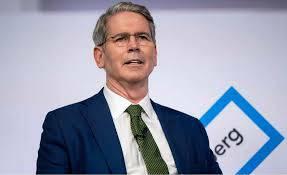 is departure intensifies the management turmoil that has plagued the agency since Mr. Trump took office. Mr. Bessent, left, will serve as the acting head of the I.R.S. while the Trump administration finds and confirms a new commissioner, a senior administration official said, making the Treasury secretary the seventh individual to lead the tax agency this year.
Mr. Long wrote on social media that he would be nominated to become the next U.S. ambassador to Iceland. “It is a honor to serve my friend President Trump and I am excited to take on my new role as the ambassador to Iceland,” Mr. Long wrote. “I am thrilled to answer his call to service and deeply committed to advancing his bold agenda. Exciting times ahead.”
In another post on Friday afternoon, Mr. Long clarified that filing season would not start late next year. “Rest assured tax filing season will start at the customary time,” he wrote.
Mr. Long had remarked to some colleagues that he had to ask Mr. Bessent for permission for everything he did at the I.R.S., two of the people familiar with the decision to remove him said. Others added that the Trump administration officials had been considering moving Mr. Long to a new position for several weeks.
One person familiar with the decision maintained that Mr. Bessent had been supportive of Mr. Long and had pushed the Senate to confirm him, which it did in June along party lines.
In a statement, the Treasury Department thanked Mr. Long “for his commitment to public service and the American people,” and said a new commissioner would be announced “at an appropriate time.”
The I.R.S. is at the center of one of the Trump administration’s top priorities, carrying out the huge tax cut Republicans passed into law last month. The agency, along with the Treasury Department, is responsible for writing the rules for and disseminating information about several tricky issues in the law, including who can claim new tax breaks for tipped income and overtime pay.
That is a tall task that former I.R.S. officials said would only become more challenging amid the internal turbulence. More than 25,000 people have left the agency under Mr. Trump, roughly a quarter of the staff it had at the start of January, according to the Treasury’s inspector general for tax administration. Congress is also eyeing steep budget cuts to the I.R.S.
“It has to have some impact on the agency’s ability to deliver this major piece of legislation,” said Terry Lemons, who led the I.R.S.’s communication efforts before retiring this year. “The people who are left, are they going to be able to handle this high volume with fewer staff and the potential for more budget cuts hanging over their heads?”
Mr. Trump had broken from recent precedent when he said would nominate Mr. Long last year. For decades, I.R.S. commissioners served five-year terms, an attempt to insulate the technocratic yet powerful position from partisan politics. Daniel Werfel, President Joseph R. Biden Jr.’s choice to lead the I.R.S., stepped down in January.
A string of acting commissioners then led the agency, several of whom quit earlier this year as the Trump administration leaned on the I.R.S. to abandon its longstanding protections of taxpayer information and share data with immigration officials. One of the previous acting commissioners, an I.R.S. agent named Gary Shapley, was replaced within just a few days this spring after Mr. Bessent protested to Mr. Trump that Elon Musk had installed the I.R.S. leader without consulting him, The New York Times previously reported.
“In just a handful of months, Trump and his crew have already gutted taxpayer service, weaponized IRS data against innocent taxpayers and set us up for disaster when next year’s filing season comes around,” Senator Ron Wyden, Democrat of Oregon, said in a statement.
Aug. 8

The Contrarian, Opinion: Undaunted in defense of academic freedom, Jennifer Rubin, right, Aug. 8, 2025. Harvard’s president Alan Garber apparently is not considering caving to outrageous demands from the Trump regime to sacrifice its academic independence, despite a story in the New York Times that now reads more like spoon-fed propaganda from the Trump regime. (The Times stood by its reporting.)
Garber told Harvard faulty that “a deal with the Trump administration is not imminent and denied that the University is considering a $500 million settlement, according to three faculty members familiar with the matter,” the Harvard Crimson reported. Instead, the faculty members say Garber is looking to the courts, not a negotiated settlement.
Let’s hope that version is the accurate one. Courage has never been more needed from civil society, universities in particular. Whether it is CBS/Paramount or a batch of law firms or Ivy League schools, too many elites have chosen the path of least resistance in the face of authoritarian threats.
To settle Trump’s cooked-up claims, Columbia University agreed to a jaw-dropping set of  requirements, including restrictions on hiring and administration of key departments, a curb on admission of foreign students, and vague rules that curtail First Amendment-protected activities. Columbia and Brown, another university that folded, also agreed to give the Trump regime “access to the standardized test scores and grade point averages of all applicants, including information about their race, a measure that could profoundly alter competitive college admissions.” Prospective students looking at the Ivy League schools should consider whether they want to attend an institution that cannot bear the obligation to defend academic freedom.
Fortunately, many voices are weighing in to encourage Garber not to fold. Nine prominent professors recently wrote to urge him to refuse to “cede authority to the government” to dictate personnel, hiring and admissions decisions.
The threat to American democracy is mounting. The Trump administration has assaulted democratic institutions—arresting opposition politicians, investigating critics, abducting people off the street, flouting due process, and politicizing the military—more aggressively than Hugo Chávez, Viktor Orban, or Recep Tayyip Erdogan did in their first year in office. To cede academic freedom at such a moment would be a historic error.
Earlier this summer, the esteemed American Association of University Women (AAUW) sent out a more generalized appeal berating the Trump regime for attacking higher education. (“AAUW urges Congress, the higher education community, and civil rights advocates to push back forcefully against these political overreaches. Our nation’s future depends on higher education that is accessible, inclusive, and free from political interference.”)
New York Times, Trump to require universities to submit data on applicants’ race, Michael C. Bender, Aug. 8, 2025 (print ed.). President Trump is expected to sign a memorandum on Thursday requiring colleges to submit admissions data to the federal government to verify compliance with a 2023 Supreme Court decision that ended race-conscious policies, according to a senior White House official.
 The presidential action also requires Linda McMahon, right, the education secretary, to increase the number of accuracy checks on the data provided by the schools and to take action against universities that submit untimely or inaccurate information.
The memorandum will also require the Education Department to revamp its process for collecting higher education data, known as the Integrated Postsecondary Education Data System, which includes details about admissions, enrollment and financial aid. That information will be made more accessible to the public, according to a fact sheet.
Admissions data has increasingly become a focus of the Trump administration as part of its effort to change the ideological balance of the higher education system, which the president views as hostile to conservatives.
 The government’s recent agreements with Brown and Columbia gave the Trump administration access to the standardized test scores and grade point averages of all applicants, as well as information about their race, a measure that could profoundly alter the competitive college admissions process.
Harvard’s compliance with the Supreme Court decision is also a major focus of the Trump administration’s negotiations to release billions of dollars in halted research funding for the university.
The release of such data has been on the wish list of conservatives who are searching for evidence that universities are dodging the Supreme Court decision, which barred the consideration of race in college admissions.
Politico, Newsom blasts Trump’s $1 billion settlement proposal to UCLA as ‘extortion,’ Juliann Ventura, Aug. 8, 2025. The president’s proposal targets one of the nation’s largest public university systems.
California Gov. Gavin Newsom on Friday blasted Donald Trump’s demand for $1 billion from UCLA over antisemitism allegations in return for millions of dollars in frozen federal research grants, describing the president’s move as an attempt to “silence academic freedom.”
“He has threatened us through extortion with a billion-dollar fine unless we do his bidding,” Newsom said at a news conference, vowing to push back” against the move as UCLA risks losing more than half a billion dollars in federal research funds.
“We will not be complicit in this kind of attack on academic freedom on this extraordinary public institution. We are not like some of those other institutions that have followed a different path,” Newsom said, seemingly referencing other universities like Brown and Columbia, which both reached separate settlements with the Trump administration in recent weeks.
Trump’s proposal targets one of the nation’s largest public university systems — a major move in the Trump administration’s battle against higher education institutions. The $1 billion settlement, which would be paid in installments over three years, would resolve alleged civil rights violations and force the school to adopt major changes to how it operates, according to a person familiar with the matter and a draft of the proposal viewed by POLITICO.
Newsom’s remarks come as Trump has been withholding funding from universities around the country over alleged antisemitism claims, and is currently in negotiations with some, including Cornell and Harvard.
Newsom, who has previously expressed disapproval for Trump’s freezing of funding to UCLA, on Thursday said that he believes the university will “do the right thing.”
“I’ll do everything in my power to encourage them to do the right thing and not to become another law firm that bends on their knees, another company that sells their soul, or another institution that takes a shortcut and takes the easy wrong versus the hard right,” said Newsom, who holds an ex-officio seat on the university system’s Board of Regents.
New York Times, Trump Directs Military to Target Foreign Drug Cartels, Helene Cooper, Maggie Haberman, Charlie Savage and Eric Schmitt, Aug. 8, 2025. The president has ordered the Pentagon to use the armed forces to carry out what in the past was considered law enforcement.
President Trump has secretly signed a directive to the Pentagon to begin using military force against certain Latin American drug cartels that his administration has deemed terrorist organizations, according to people familiar with the matter.
The decision to bring the American military into the fight is the most aggressive step so far in the administration’s escalating campaign against the cartels. It signals Mr. Trump’s continued willingness to use military forces to carry out what has primarily been considered a law enforcement responsibility to curb the flow of fentanyl and other illegal drugs.
The order provides an official basis for the possibility of direct military operations at sea and on foreign soil against cartels.
U.S. military officials have started drawing up options for how the military could go after the groups, the people familiar with the conversations said, speaking on the condition of anonymity to discuss the sensitive internal deliberations.
But directing the military to crack down on the illicit trade also raises legal issues, including whether it would count as “murder” if U.S. forces acting outside of a congressionally authorized armed conflict were to kill civilians — even criminal suspects — who pose no imminent threat.
It is unclear what White House, Pentagon and State Department lawyers have said about the new directive or whether the Justice Department’s Office of Legal Counsel has produced an authoritative opinion assessing the legal issues.
Already this year Mr. Trump has deployed National Guard and active duty troops to the southwest border to choke off the flow of drugs as well as immigrants, and has increased surveillance and drug interdiction efforts.
When he returned to office in January, Mr. Trump signed an order directing the State Department to start labeling drug cartels as foreign terrorist organizations.
Mr. Trump has particularly targeted Venezuelan and Mexican organizations. In February, the State Department designated Tren de Aragua, Mara Salvatrucha (known as MS-13) and several other organizations as foreign terrorist organizations, saying that they constituted “a national-security threat beyond that posed by traditional organized crime.”
Two weeks ago, the Trump administration added the Venezuelan Cartel de los Soles, or Cartel of the Suns, to a list of specially designated global terrorist groups, asserting that it is headed by President Nicolás Maduro of Venezuela and other high-ranking officials in his administration.
On Thursday, the Justice and State Departments announced that the United States government is doubling a reward — to $50 million — for information leading to the arrest of Mr. Maduro, who has been indicted on drug trafficking charges. The administration again described him as a cartel head, and Attorney General Pam Bondi said he “will not escape justice and he will be held accountable for his despicable crimes.”
New York Times, Trump Administration Updates: Federal Appeals Panel Overrules Judge in Dispute Over Deportation Flights, Mattathias Schwartz, Aug. 8, 2025.
- Immigration ruling: A federal appeals panel terminated a district-court judge’s plan to assess
 whether Trump administration officials were guilty of criminal contempt for sending flights of Venezuelan migrants to El Salvador. The judge, James E. Boasberg, right, had ruled in April that there was probable cause to believe the administration had ignored his order to recall the planes. Read more ›
 - Mexican reaction: President Claudia Sheinbaum of Mexico, below, said her country would “collaborate” with the United States against drug cartels but denied that the U.S. military would operate in Mexican territory. Ms. Sheinbaum was responding to news that President Trump had directed the Pentagon to target drug cartels that the United States considers terrorist organizations. Read more ›
- Peace summit: Mr. Trump is scheduled to host the leaders of Azerbaijan and Armenia at the White House on Friday for what he described as a peace summit. The South Caucasus neighbors have clashed for decades over the disputed Nagorno-Karabakh region. Read more ›
Regarding the immigration contempt of court ruling: A federal appeals panel on Friday terminated a district-court judge’s plan to assess whether Trump administration officials were guilty of criminal contempt for sending flights of Venezuelan migrants to El Salvador, despite the judge’s verbal order that they turn around and return to the United States.
The ruling by the three-judge panel of the U.S. Court of Appeals for the District of Columbia will make it far more difficult for Judge James E. Boasberg to determine the details of who was made aware of his order in March, and why the planes continued on to El Salvador.
Judge Boasberg had ruled in April that there was probable cause to believe the administration had committed criminal contempt by ignoring his order. But the administration appealed.
The brief order was accompanied by 57 pages of concurrences by Judges Gregory G. Katsas and Neomi Rao. It represents a victory for Mr. Trump and a brushback of a judge who had sought to curb Mr. Trump’s second-term agenda, earning his ire.
Judge Katsas wrote that any order to turn planes around midair would be “indefensible,” comparing it to a district-court judge who had ordered President Richard M. Nixon’s administration to stop bombing Cambodia during the Vietnam War, which was quickly stayed.
In a 49-page dissent, Judge Cornelia Pillard wrote that government officials “appear to have disobeyed” Judge Boasberg’s order and that she would have let Judge Boasberg move forward with criminal contempt proceedings. “The rule of law depends on obedience to judicial orders,” she wrote.
Judge Katsas and Judge Rao were nominated by Mr. Trump. Judge Pillard was nominated by President Barack Obama. Judge Boasberg was nominated first by President George W. Bush to the D.C. Superior Court and then to the Federal District Court bench by President Barack Obama.
Judge Boasberg’s initial order was issued on March 15, shortly after he received an urgent request from lawyers representing five Venezuelan migrants to block Mr. Trump if he invoked a wartime authority, the Alien Enemies Act, to deport them and others without notice or a hearing.
When Judge Boasberg convened a hearing at 5 p.m., the government was in the process of loading more than 200 other Venezuelans onto planes. At 6:48 p.m., the judge verbally ordered the government not to deport anyone under the Alien Enemies Act and to bring back any planes that had taken off. Shortly after, he ordered the government not to remove the Venezuelan detainees but left out the explicit requirement for airborne planes to turn around.
Despite Judge Boasberg’s order, the planes flew to El Salvador, where the Venezuelans were taken to a maximum-security prison. When the judge asked why on March 17, the government argued it had complied with his written order, which they claimed superseded the verbal one.
New York Times, U.S. Tariffs Take Effect, a New Step in Trump’s Trade War, Tony Romm and River Akira Davis, Aug. 8, 2025 (print ed.). Few major trading partners have been spared the import taxes, which have already disrupted supply chains and are expected to drive up prices for Americans.
President Trump’s new tariffs on virtually every U.S. trading partner are a significant step forward in his attempt to reorder global trade, leaving some of the hardest hit governments scrambling to respond on Thursday.
Major U.S. trade partners, including the European Union, Japan and South Korea, will face a 15 percent tariff on their exports to the United States — rates that were settled in recent trade deals. Other governments that were not able to secure agreements were hit with higher tariffs. In Taiwan’s case, this amounted to a 20 percent levy. Brazil and Canada were also subjected to above-market penalties. Mr. Trump followed through on his threat to double tariffs on India, to 50 percent, as punishment for the country’s continued purchase of Russian oil.
The imposition of punishing tariffs for roughly 90 countries on Thursday signified the latest evolution of Mr. Trump’s tariff agenda, a plan that has seen many twists and turns since he first proclaimed “Liberation Day” this spring. The president’s latest long list of import taxes are expected to drive up prices for American consumers and businesses.
New York Times, News Analysis: Netanyahu, Aiming to Capture Gaza City, Reverts to a Risky Military Strategy, Patrick Kingsley, Aug. 8, 2025. Time and again, Prime Minister Benjamin Netanyahu of Israel has pledged to defeat Hamas by force. His cabinet’s decision to capture Gaza City risks ending in a familiar deadlock.Aug. 7
Paul Krugman via Substack, Political-Economy Commentary: The Emperor’s New Trade Deal, Paul Krugman, right, Aug. 7, 2025. Tariffs are bad. A deluded president is worse.
On Tuesday Donald Trump went on CNBC to explain why the European Union is facing a tariff of “only” 15 percent. But what he said was simply delusional — and the delusion should be even more concerning than the tariffs.
The Europeans, Trump asserted, had agreed to cough up $600 billion, which he described as a “gift,” not a loan. And he emphasized that this is “$600 billion to invest in anything I want. Anything. I can do anything I want with it.”
So Trump apparently believes that the European Union has agreed to provide him with a personal $600 billion slush fund.
In fact, as I pointed out after the “deal” was announced, the EU agreed to no such thing. In fact, it literally couldn’t have made such an agreement. European nations aren’t command economies in which government can tell the private sector where to invest, and in any case the European Commission, which negotiated with Trump, can’t tell the governments of member states what to do.
So think of it as the emperor’s new trade deal: Trump is strutting around, feeling very impressed with himself, but in substantive terms he’s stark naked.
Does it matter? I’ve seen some commentary to the effect that it doesn’t. Hey, it’s just another Trumpian self-aggrandizing fantasy, like his belief that we have zero inflation, he has a 71 percent approval rating and “people love the tariffs.”
But I don’t think we should feel reassured about Trump’s trade delusions because he’s lost touch with reality across the board.
What will happen if and when Trump realizes that Europe hasn’t actually promised what he thinks it has — or, as he’s likely to see it, that the EU has gone back on its promise? He’s already given us an answer: He’s going to put the tariff on Europe back up to 35 percent.
He may not be able to carry out that threat. In fact, there’s a very real possibility that the courts will rule many of the tariffs Trump has already imposed illegal (which they surely are) and order the administration to refund the money it has already collected.
But assume that the Supreme Court does its usual thing and decides that the Constitution allows Trump to do whatever he wants. How afraid should Europe be of the possibility that Trump will put the tariffs back up, higher than before?
Well, I’ve been trying to do the math, and as far as I can tell putting U.S. tariffs up from 15 to 35 percent would do less damage to Europe than many people imagine. Yes, it would hurt, but not all that much.
However, Trump will be the last person to recognize that there are limits to his ability to bully the world, on trade or anything else. And that lack of awareness should worry us all.
New York Times, Trump Administration Updates: President Orders New Census That Excludes Undocumented Immigrants, Sui-Lee Wee, Aug. 7, 2025.
- New census: President Trump said on Thursday that he told the Commerce Department to begin work on a new census that does not include undocumented immigrants. The order is a significant departure for a process stipulated by the Constitution, with potential consequences for the allotment of both congressional seats and federal money to states. A similar move during Mr. Trump’s first term was found to be illegal. Read more ›
- F.B.I. moves: The F.B.I. is forcing out at least two agents, continuing a purge of staff members who worked on politically sensitive cases that drew the ire of Mr. Trump and other conservatives. The F.B.I. is also said to have agreed to a Republican senator’s request to help track down Texas legislators who left the state amid a redistricting fight.
- War in Ukraine: President Vladimir V. Putin of Russia has agreed to meet with Mr. Trump “in the coming days,” a top Kremlin aide said, as Mr. Trump pushes for an end to the war in Ukraine. Many Ukrainians said they doubted that a Trump-Putin summit would lead to an acceptable peace proposal.
- Trade war: As Mr. Trump’s array of sweeping new tariffs took effect on more than 90 countries, those hardest hit by double-digit taxes rushed to respond. Follow live coverage ›
New York Times, As Trump Administration Plans to Burn Contraceptives, Europeans Are Alarmed, Jeanna Smialek and Stephanie Nolen, Aug. 7, 2025. The U.S. government intends to incinerate $9.7 million in already-purchased birth control in Belgium after U.S.A.I.D shut down. Destruction may have already started.
The Trump administration’s plans to incinerate $9.7 million in birth control pills and other contraceptives stored in a Belgian warehouse have left European governments struggling as they try to prevent the destruction.
When the Trump administration abruptly defunded and dismantled the United States Agency for International Development, or U.S.A.I.D., earlier this year, millions of contraceptives it had purchased were stuck in Geel, Belgium. The pills, intrauterine devices and hormonal implants were destined for clinics in the poorest countries in Africa.
With the contraceptives in limbo, the contractor managing the supply explored selling it to outside organizations, including the United Nations’ main sexual and reproductive health agency, the U.N. Population Fund. The nonprofit MSI Reproductive Choices offered to take over the warehousing and redistribute the contraceptives at no cost to the United States.
But last month it emerged that the U.S. government had instead decided to burn the supplies, at a cost to the government of more than $160,000 in transport and incineration fees.
“U.S.A.I.D. was allegedly dismantled to prevent future wastage and to deliver value for money for the American people,” said Sarah Shaw, the associate director of advocacy at MSI Reproductive Choices. “It’s just egregious that they’re willing to waste $9 million worth of contraceptives that are so desperately needed.”
New York Times, After Donations, Trump Sided With Health Firms on Medicare Funds for Pricey Wound Care, Kenneth P. Vogel, Sarah Kliff and Katie Thomas, Aug. 7, 2025. The president posted talking points provided by one firm that donated millions, and his administration delayed a change that could have hurt the company and others like it.
Oliver Burckhardt came prepared for the dinner that President Trump hosted for a small group of major donors at his private Mar-a-Lago resort in South Florida on March 1.
A week earlier, one of Mr. Burkhardt’s biotech companies had donated $5 million to MAGA Inc., a pro-Trump political committee, that paved the way for him to attend the event.
At the dinner, Mr. Burckhardt got a chance to speak briefly to the president and other guests about himself and the work of his company, Extremity Care, which makes pricey medical products including paper-thin bandages made of dried bits of placenta, according to three people who spoke on the condition of anonymity to describe the private event. He also brought copies of a flier urging the Trump administration to reverse a plan to restrict Medicare reimbursement for the bandages and criticizing former President Joseph R. Biden Jr. for having “rammed through a policy that would create more suffering and death for diabetic patients on Medicare.”
The next morning, Mr. Trump posted the flier on his social media site.
It was not just symbolic.
About one month later, the Trump administration announced it would delay until next year the Biden administration plan to limit Medicare’s coverage of the bandages, known as skin substitutes, saying that it was reviewing its policies.
It was the culmination of an expensive influence campaign by Extremity Care that underscored Mr. Trump’s willingness to grant access and preferential treatment to people and companies that fill the coffers of his political groups.
The February donation by Mr. Burckhardt’s company, which was revealed in a report filed late last week with the Federal Election Commission, was among dozens of seven- and eight-figure contributions to MAGA Inc. from donors, many of whom were rewarded with presidential face time to plead for their causes.
New York Times, Trump and Putin to Meet in ‘Coming Days,’ Kremlin Aide Confirms, Nataliya Vasilyeva, Aug. 7, 2025. A summit between President Trump and President Vladimir V. Putin, above, would come as the United States has urged Russia to agree to a cease-fire in Ukraine or face new sanctions.
President Vladimir V. Putin of Russia has agreed to meet with President Trump “in the coming days,” a top Kremlin aide said on Thursday, as the White House pushes for a cease-fire in Ukraine.
The aide, Yuri Ushakov, Mr. Putin’s foreign policy adviser, confirmed reports on Wednesday that Mr. Trump said he planned to meet the Russian leader in person as soon as next week and to follow up with a meeting with Mr. Putin and President Volodymyr Zelensky of Ukraine.
“The American side has suggested, and we have agreed in principle, to hold a high-level bilateral meeting, that is, a meeting between presidents Vladimir Putin and Donald Trump,” Mr. Ushakov told Russian news agencies on Thursday. He declined to discuss the idea of a three-way summit with Mr. Zelensky.
Mr. Ushakov did not give an exact date for the meeting, saying only that it was “hard to say how much time the preparations for such an important meeting would take.” Russia and the United States have agreed on the place to meet but will not be disclosing it at this time, Mr. Ushakov added.
The confirmation of a potential sit-down between the American and Russian leaders comes a day after Steve Witkoff, Mr. Trump’s envoy, held talks with Mr. Putin at the Kremlin.
It was the latest in a flurry of diplomatic activity since the White House issued an ultimatum for Russia: Either agree to a cease-fire in Ukraine or face new sanctions.
New York Times, News Analysis: For Putin, Trump Summit Is Key to Securing Ukraine Goals, Paul Sonne and Anton Troianovski, Aug. 7, 2025. The Russian leader sees direct talks with Trump as essential to achieving his ultimate aims in Ukraine.
President Vladimir V. Putin has long said he wants to sit down with President Trump.
The reason: He believes that such a meeting, rather than just progress on the battlefield, is his best chance for securing a victory in his war against Ukraine.
Analysts who study Mr. Putin, as well as people who know him, have said since the early days of the war that the Russian leader’s overarching goal is primarily to secure a peace deal that achieves his geopolitical aims — and not necessarily conquering a certain amount of territory on the battlefield.
New York Times, She Survived a 9-Story Fall After a Russian Missile Hit Her Building, Maria Varenikova, Photographs by Oksana Parafeniuk, Aug. 7, 2025. Veronika Osintseva’s story has captivated a war-weary Ukraine.
She went to sleep in her bed on the ninth floor of an apartment building in Kyiv and woke up on a pile of rubble outside. She saw her leg covered in blood and cried out for help, thinking only of the pain, she would later say, and not how she had survived.
A rescuer climbed atop the debris and carried Veronika Osintseva, 23, to the pavement below. There she sat and waited for medical assistance in the aftermath of a Russian missile strike last week that killed 28 people, five of them children. It was one of the deadliest nights in Kyiv, the Ukrainian capital, during more than three years of war, with 32 people killed in all.
Only later would Ms. Osintseva learn that her parents, who had been sleeping in another room of the apartment when the missile destroyed giant portions of the building, were among the dead.
As Russia’s relentless missile and drone attacks inflict a growing civilian toll across Ukraine, Ms. Osintseva’s unlikely survival has captivated Ukrainians and highlighted the element of luck that often determines who lives and who dies.
New York Times, Cornyn Says F.B.I. Will Help Find Texas Lawmakers Who Fled State, J. David Goodman, Aug. 7, 2025. The senator said the federal agency had agreed to help locate Democratic state lawmakers who left the state to try to block a vote on new congressional district maps (shown above in a New York Times map).
Senator John Cornyn, a Texas Republican, said on Thursday that the F.B.I. had agreed to his request to help track down dozens of Democratic Texas state lawmakers who left the state to prevent a vote on a redistricting plan.
The activation of federal agents could create a standoff between the Trump administration and state leaders in Illinois, where many of the absent Democrats have taken refuge.
It was not clear on Thursday morning whether federal agents had actually taken action in the case, or what role they might eventually play.
The whereabouts of the Texas lawmakers are widely known, but until now at least, they had considered themselves safe from arrest because they were far from the jurisdiction of Texas law enforcement agencies.
New York Times, News Analysis: How a Pro-Palestinian Group Fell Foul of a Long Unused U.K. Terrorism Law, Lizzie Dearden, Aug. 7, 2025. The protest group Palestine Action does not promote violence against people. But after it damaged military property, the British government banned it as a terrorist organization.
Days before the American-led invasion of Iraq, five protesters broke into a British military base, intent on disabling aircraft that were set to be deployed in bombing missions.
It was March 2003, and the group said it wanted to prevent war crimes and protect civilians. Among those who later defended them in court was a 43-year-old human rights lawyer.
His name was Keir Starmer.
In a strange echo, 22 years later, Mr. Starmer would face a similar case, but now as prime minister of Britain.
 In June, activists from a group called Palestine Action broke into a Royal Air Force base, sprayed red paint into aircraft engines and damaged the planes with crowbars. Like the 2003 group, the protesters argued that their actions were a justified response to mass civilian harm — this time in Gaza.
Both cases raised serious concerns about the security of Britain’s military bases. But a very different result ensued. While the protesters in 2003 were prosecuted under criminal laws against property damage, in June, Mr. Starmer’s government announced that Palestine Action would be added to its list of banned terrorist organizations, alongside groups including Al Qaeda, Hezbollah and Atomwaffen Division, a neo-Nazi group.
It was the first time in modern British history, according to the government’s adviser on counterterrorism laws, that a protest group that does not call for violence against people had been proscribed as a terrorist organization. The decision has fueled an intense debate over the Starmer government’s attitude toward protest and free speech.
The home secretary, Yvette Cooper, who is responsible for law enforcement and national security, said that Palestine Action had put national security at risk and that it met the government’s legal definition of terrorism because those terms included “serious damage to property.” The group has repeatedly damaged facilities linked to military companies, including Elbit Systems, an Israeli weapons manufacturer, and also vandalized President Trump’s Turnberry golf resort in Scotland in March.
Hands gripping a scooter that is near an airplane on a runway.An image provided by Palestine Action showed a person on a British air base in June. Activists from the group broke in and damaged aircraft with paint and crowbars in what they said was a protest against Britain’s military support for Israel.Credit…Palestine Action, via Reuters
But the United Nations’ human rights chief, Volker Türk, publicly called for the British government to drop the ban, which he called a “disproportionate and unnecessary” move that stretched counterterrorism powers beyond “clear boundaries.”
The origins of this moment can be traced back a quarter-century, when the legislation used to ban Palestine Action was introduced.Want to stay updated on what’s happening in Israel, the United Kingdom, and the West Bank and Gaza Strip? Sign up for Your Places: Global Update, and we’ll send our latest coverage to your inbox.
The Terrorism Act of 2000 was drawn up to replace years of piecemeal security laws that had largely targeted dissident Irish republican groups like the Irish Republican Army. In a 1998 document outlining its proposals, the government of Prime Minister Tony Blair said it wanted a future-proof definition that could apply to “all forms of terrorism,” voicing concerns about potential violence from Islamist extremists, nationalists and animal rights groups.
New York Times, Japan’s Auto Giants Are Expecting Pain Despite Trump Trade Deal, River Akira Davis, Aug. 7, 2025. Toyota, Honda and Nissan forecast big hits to their profits despite a trade deal that cut auto levies to 15 percent. The reduced rate has yet to be implemented.
Letters from an American, Historical Commentary: August 6, 2025 [Congressional Town Hall, Angry Constituents], Heather Cox Richardson, right, Aug. 7, 2025.  Members of the House of Representatives are back in their districts for August, and on Monday, Republican Mike Flood of Nebraska held a town hall in Lincoln.
A woman asked what she called a fiscal question. She said: “With 450 million FEMA dollars being reallocated to open Alligator Alcatraz, and 600 million taxpayer FEMA dollars being used to now open more concentration camps, and ICE burning through $8.4 million a day to illegally detain people—How much does it cost for fascism? How much do the taxpayers have to pay for a fascist country?” The crowd cheered wildly. Nicholas Wu, Cassandra Dumay, and Mia McCarthy of Politico reported today that by the end of Flood’s town hall, “chants of ‘Vote him out!’ threatened to drown out his closing comments.”
The Politico reporters also said that Republicans maintain they aren’t worried about their angry constituents and dismiss the town hall pushback as astroturfed and not reflective of real voter sentiment.
Maybe. But with the political tide running strong against the administration, that position sounds like posturing.
Aug. 6

New York Times, Stanford Newspaper Challenges Legal Basis for Student Deportations, Zach Montague, Aug. 6, 2025. A new lawsuit brought by a First Amendment watchdog group argues that the use of a rarely invoked immigration law to target pro-Palestinian demonstrators is unconstitutional.
A new lawsuit filed on Wednesday by a free speech watchdog takes aim at the key legal foundations that the Trump administration has relied on to arrest and attempt to deport foreign students over their criticism of the Israeli government.
The challenge, filed in California, goes further than other lawsuits that have targeted the student arrests. The new suit focuses on a section of immigration law that allows the secretary of state to determine that a non-citizen poses a threat to the country’s foreign policy and can be removed from the country for that reason. It argues that it is unconstitutional to invoke the provisions for speech and other activities protected by the First Amendment.
Lawyers from the free speech group, the Foundation for Individual Rights and Expression, brought the lawsuit on behalf of the student newspaper at Stanford University, The Stanford Daily, arguing that several of its staff members have been forced to self-censor or quit the paper out of fear that the government could retaliate for what it publishes.
The lawsuit says that the newspaper, which is open to all students and has more than 150 members, according to the complaint, has weathered resignations and withdrawn stories by noncitizens who were concerned that publishing content about Israel or the conditions in Gaza could leave them vulnerable to deportation.
The climate of fear the lawsuit cites at Stanford follows a spate of arrests earlier this year, when the Trump administration began targeting prominent student activists in March, including Mahmoud Khalil and Rumeysa Ozturk, over their activism in speaking out against the Israeli government and the mounting death toll in Gaza.
“They are going after lawfully present non-citizens for bedrock speech, like authoring an op-ed and going to protest,” said Conor Fitzpatrick, the supervising senior attorney at the foundation. “And unless you have a blue passport with an eagle on it that says United States of America, they think they can throw you out of the country for it.”
In those and other cases, immigration agents arrested the students after Secretary of State Marco Rubio, left, invoked the provision, deeming the students a threat to U.S. foreign policy interests. In each case, Mr. Rubio personally signed off on the decision to revoke a student visa or render a lawful permanent resident deportable after determining that those interests were at stake.
“Secretary of State Marco Rubio and the Trump administration are trying to turn the inalienable human right of free speech into a privilege contingent upon the whims of a federal bureaucrat, triggering deportation proceedings against non-citizens residing lawfully in this country for their protected political speech regarding American and Israeli foreign policy,” the lawsuit says.
The new lawsuit mirrored many elements of a case brought by another group, the American Association of University Professors, which is seeking to block the Trump administration from pursuing what it describes as a policy of “ideological deportations” — using the law to target activists based on their shared criticism of Israel and its conduct in the war.That case was argued before a federal judge during a two-week trial in Boston in July, and he is expected to decide this month whether to block the deportations on First Amendment grounds. The case raised similar concerns about chilled speech on college campuses, with testimony from faculty at several universities about how dramatically non-citizen academics had withdrawn from public life.
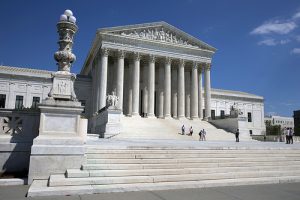
New York Times, Guest Essay: The Supreme Court Has Finally Found a President It Likes, Thomas B. Edsall, Aug. 6, 2025 (print ed.). The six-member conservative majority on the Supreme Court has become a key enabler of President Trump’s agenda.
“Since May, federal district courts have ruled against the administration 94.3 percent of the time,” Adam Bonica, a political scientist at Stanford, wrote in a June 25 Substack essay. “The Supreme Court, however, has flipped that outcome, siding with the administration in 93.7 percent of its cases. The Supreme Court is now in open conflict with the lower courts over cases involving the Trump administration.”
District court judges “who see the evidence firsthand and hear directly from those affected,” Bonica added, “overwhelmingly find the administration’s actions unlawful. Circuit (Appeals) courts split more evenly (68.2 percent against Trump, 31.8 percent for Trump) but still lean against the administration. Then the Supreme Court — furthest from facts, closest to power — reverses almost automatically.”
Mark Graber, a law professor at the University of Maryland, described the situation, writing by email, “Both Republican and Democratic judicial appointees have found numerous constitutional and statutory flaws with Trump administration policies.”
Faced with this surge of lower-court rulings against Trump and his appointees, Graber continued, the Supreme Court, under Chief Justice John Roberts, almost without exception has been braking the lower federal courts rather than the Trump administration. This has been done largely through rulings without accompanying reasons explaining why the lower federal courts were so wrong. The result is, in some cases, all lower federal courts have to guide them is a sense that the Roberts court majority does not want lower federal courts interfering with the Trump administration.
“Universities,” Graber wrote, “fear being tied up in litigation for years. Even if they eventually win every case in the Supreme Court, the costs are likely to be substantial. If the Supreme Court permits Trump to implement his version of the law for two to three years, universities that oppose him will be damaged significantly.”Sign up for the Opinion Today newsletter Get expert analysis of the news and a guide to the big ideas shaping the world every weekday morning. Get it sent to your inbox.
In addition, Graber said, “The Roberts court’s pro-Trump series of decisions creates reason for thinking that you might lose, even as every professor in your law school tells you the law is on your side.”
The court’s conservative majority appears to have adopted what is known as the unitary executive theory, which amounts to the empowerment of the president as the chief executive officer of the executive branch of government — as a chief executive sometimes would be in the private sector, as opposed to the top official of an executive branch fulfilling mandates specifically financed and authorized by Congress.
In another Substack essay, “How to Dismantle a Democracy, Legally: The Unitary Executive Theory Is a Masterclass in Autocratic Legalism,” Bonica argued that for the six conservative justices on the Supreme Court, the unitary executive theory is not a principled theory of constitutional law being applied in good faith. It is a political weapon, wielded with partisan selectivity, designed to achieve a concentration of power that is fundamentally at odds with American democracy. It is the American face of autocratic legalism.
New York Times, Kennedy Cancels Nearly $500 Million in mRNA Vaccine Contracts, Apoorva Mandavilli, Aug. 6, 2025 (print ed.). That kind of shot was first used during the Covid-19 pandemic, but the health secretary has been sharply critical of the technology.
Health Secretary Robert F. Kennedy Jr. has canceled nearly $500 million of grants and contracts for developing mRNA vaccines, the Department of Health and Human Services announced on Tuesday.
It is the latest blow to research on this technology. In May, the Department of Health and Human Services revoked a nearly $600 million contract to the drugmaker Moderna to develop a vaccine against bird flu.
The new cancellations dismayed scientists, many of whom regard mRNA shots as the best option for protecting Americans in a pandemic.
“This is a bad day for science,” said Scott Hensley, an immunologist at the University of Pennsylvania who has been working to develop an mRNA vaccine against influenza.
The health department said in its release that the cancellations affected 22 projects managed by the Biomedical Advanced Research and Development Authority, or BARDA.More on Covid-19
Efforts to Thwart mRNA Therapies: The therapies, a key to Covid vaccines, hold great potential in treating several diseases, but some lawmakers want to ban them and the government is cutting funding. We asked experts about how the technology works, its safety and its potential in medicine.
With this move, the department is “undermining our ability to rapidly counter future biological threats,” said Rick Bright, a flu expert who was ousted as chief of BARDA during the first Trump administration and resigned from a lesser position in protest.
“We’re weakening our frontline defense against fast‑moving pathogens — a huge strategic failure that will be measured in lives lost during times of crisis,” he added.
Chris Meekins, an assistant secretary for pandemic preparedness in the first Trump administration, said that ending BARDA’s mRNA work created a “national security vulnerability.”
“These tools serve as a deterrent to prevent other nations from using certain biological agents,” Mr. Meekins said in an email and on social media. “The speed of the technology to create new biodefense capabilities is a national security asset.”
First used during the Covid-19 pandemic by Pfizer-BioNTech and Moderna, mRNA shots instruct the body to produce a fragment of a virus, which then sets off the body’s immune response.
Unlike traditional vaccines, which can take years to develop and test, mRNA shots can be made within months and quickly altered as the virus changes.
Mr. Kennedy has been sharply critical of the technology. In a video posted on social media on Tuesday, he claimed incorrectly that mRNA vaccines do not protect against respiratory illnesses like Covid and the flu, that they drive viruses to evolve and that a single mutation in a virus renders the vaccine ineffective.
“As the pandemic showed us, mRNA vaccines don’t perform well against viruses that infect the upper respiratory tract,” he says in the video.
“By issuing this wildly incorrect statement, the secretary is demonstrating his commitment to his long-held goal of sowing doubts about all vaccines,” said Jennifer Nuzzo, director of the Pandemic Center at the Brown University School of Public Health.
“Had we not used these lifesaving mRNA vaccines to protect against severe illness, we would have had millions of more Covid deaths,” she said.
Letters from an American, Historical Commentary: Aug. 5, 2025 [Voting Rights], Heather Cox Richardson, right, Aug. 6, 2025. Sixty years ago tomorrow, on August 6, 1965, President Lyndon B. Johnson signed the Voting Rights Act. The need for the law was explained in its full title: “An Act to enforce the fifteenth amendment to the Constitution, and for other purposes.”
In the wake of the Civil War, Americans tried to create a new nation in which the law treated Black men and white men as equals. In 1865 they ratified the Thirteenth Amendment to the Constitution, outlawing enslavement except as punishment for crimes. In 1868 they adjusted the Constitution again, guaranteeing that anyone born or naturalized in the United States—except certain Indigenous Americans—was a citizen, opening up suffrage to Black men. In 1870, after Georgia legislators expelled their newly seated Black colleagues, Americans defended the right of Black men to vote by adding that right to the Constitution.
All three of those amendments—the Thirteenth, Fourteenth, and Fifteenth—gave Congress the power to enforce them. In 1870, Congress established the Department of Justice to do just that. Reactionary white southerners had been using state laws, and the unwillingness of state judges and juries to protect Black Americans from white gangs and cheating employers, to keep Black people subservient. White men organized as the Ku Klux Klan to terrorize Black men and to keep them and their white allies from voting to change that system. In 1870 the federal government stepped in to protect Black rights and prosecute members of the Ku Klux Klan.
With federal power now behind the Constitutional protection of equality, threatening jail for those who violated the law, white opponents of Black voting changed their argument against it.
In 1871, they began to say that they had no problem with Black men voting on racial grounds; their objection to Black voting was that Black men, just out of enslavement, were poor and uneducated. They were voting for lawmakers who promised them public services like roads and schools, and which could only be paid for with tax levies.
Southern states always held elections: it was just foreordained that Democrats would win them.
Black Americans never accepted this state of affairs, but their opposition did not gain powerful national traction until after World War II.
Black Americans and people of color who had fought for the nation overseas brought home their determination to be treated equally, especially as the financial collapse of European nations loosened their grip on their former African and Asian colonies and launched new nations.
Those interested in advancing Black rights turned, once again, to the federal government to overrule discriminatory state laws.
White reactionaries responded with violence, but Black Americans continued to stand up for their rights. In 1957 and 1960, under pressure from Republican president Dwight Eisenhower, Congress passed civil rights acts designed to empower the federal government to enforce the laws protecting Black voting.
Donald Trump, Melania Kraus (the future First Lady Melania Trump) and sex traffickers of underage girls Jeffrey Epstein and Ghislaine Maxwell enjoy a party together (Getty Images).
Lev Remembers via Substack, Political Commentary: Trump Officials Meeting Today to Finalize Epstein Cover-Up Strategy, Lev Parnas, right, Aug. 6, 2025. My sources confirm: Trump’s inner circle is gathering at VP J.D. Vance’s residence to launch the next phase of Epstein narrative control—including edited tapes of Ghislaine Maxwell and Todd Blanche.
Overnight, I received several phone calls from trusted sources—people inside the room—warning me about today’s meeting between Trump’s inner circle.
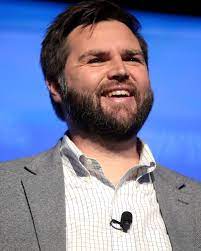 Trump’s hierarchy is assembling in secret at the residence of Vice President J.D. Vance, left, in Washington, D.C. Not for a policy summit. Not to serve the American people. No—this is about power, protection, and the ultimate erasure of Donald Trump’s involvement in one of the darkest scandals in modern history.
According to multiple sources, Susie Wiles, right, Todd Blanche, Pam Bondi, left, and other top  Trump operatives are expected to be in attendance. The goal? Coordinate the narrative. Edit the tapes. Rewrite the past.
I’m told that Todd Blanche has finalized the official storyline. And it’s not the truth—it’s the illusion of truth. They’re preparing to release a manipulated audio recording between Ghislaine Maxwell and Blanche himself. What we’re  going to get is an edited version—surgically cut to remove Trump’s name and refocus attention on others. They want to make it look like transparency. But it’s deceit, weaponized.
I told you it was coming—and here it is: Trump has activated Comer. This is coordinated. Calculated. The subpoenas, the Oversight Committee drama, it’s all part of the show. And while the press focuses on the chaos, the real operation is happening behind closed doors—at J.D. Vance’s home.
 They think they can get away with it. They think the circus act Congressman James Comer is rolling out—waving around subpoenas and distractions—is enough to keep the public entertained while they try to pull off one of the biggest cover-up’s in American history—erasing Trump from the Epstein files like he was never there.
But I won’t let them. You won’t let them. And together, we won’t let them. For the truth. For the victims. For those who no longer have a voice and for those too afraid to speak—we will not back down. We will speak truth to power. We will shine a light on every dark corner they try to hide in. Because history doesn’t get rewritten on our watch.
I’m risking everything to bring you this, and when Trump sees this letter, he is going to flip. There’ll be ketchup all over the White House walls—because the truth is out. Because you have it. And because I won’t stop speaking it.
Let me be crystal clear: they are scrubbing Trump out of the Epstein files. Blanche and Vance are laying the groundwork. The tapes are being doctored. The subpoenas are distractions. And all of this is to keep one man protected—no matter how many victims get erased in the process.
That’s why I need you.
Lev Parnas, right, is an entrepreneur, political activist, and author. Born in Odessa, Ukraine under the Soviet Union, he emigrated with his family to the United States in 1976 to escape antisemitic persecution. When Lev and his sister won a green card lottery, the family went first to Detroit and then settled in Brooklyn. Though Lev studied briefly at Brooklyn College and Baruch College, life led him to more unconventional routes. He worked in real estate and on Wall Street before moving to Florida in 1995 to start his own brokerage firm. In Fall 2019, Lev became an internationally-recognized figure when he was arrested for participating in the Ukraine scandal orchestrated by Donald Trump and Rudy Giuliani. A father of seven, Lev currently lives in Florida with his wife Svetlana and five of his children. Lev testified in front of Congress on March 20th, 2024 as a witness for the Democratic Oversight Committee in the Impeachment of Joe Biden. Lev is an author of the book “Shadow Diplomacy” about his time in as a Trump insider.
New York Times, Uber’s Festering Sexual Assault Problem, Emily Steel, Aug. 6, 2025. The company has tested tools that make rides safer, court records show. Measures to stem the violence have been set aside in favor of protecting the company’s business.
Uber received a report of sexual assault or sexual misconduct in the United States almost every eight minutes on average between 2017 and 2022, sealed court records show, a level far more pervasive than what the company has disclosed.
Publicly, the ride-sharing service proclaimed it was one of the safest options for travel, with aggressive media campaigns and polished reports on its website about the rarity of serious attacks.
Inside Uber, teams of data scientists and safety experts spent years studying the problem. The company tested tools that proved effective at making trips safer, including sophisticated matching algorithms, mandatory video recording and pairing female passengers with female drivers.
New York Times, Officials Move to Open Inquiry on Trump’s ‘Russia Hoax’ Grievance, Glenn Thrush, Devlin Barrett and Maggie Haberman, Aug. 6, 2025 (print ed.). Such an investigation would have to overcome a number of legal and practical hurdles, but an order by Attorney General Pam Bondi asking for a grand jury inquiry in Florida accomplishes political objectives.
President Trump has urged and browbeaten supporters to shift their obsession from the Jeffrey Epstein files to the investigation and potential prosecution of Democratic officials he accuses of persecuting him, a cardinal grievance that bonds him to his base.
The Justice Department under Mr. Trump, reeling from the angry backlash over its handling of the Epstein case, is now taking its most concrete — if still murky — investigative steps against Trump targets, starting with officials he blames for what he sees as the plot against him: the investigation of his 2016 campaign’s connections to Russia.
New York Times, Trump Threatens Federal Takeover of D.C. After Member of DOGE Assaulted, Nicholas Nehamas and Campbell Robertson, Aug. 6, 2025 (print ed.). President Trump shared a photograph that appeared to show a 19-year-old software engineer shirtless and bloodied, after an attempted carjacking.
A prominent member of the Department of Government Efficiency was beaten in an attempted carjacking in Washington this week, prompting President Trump to renew his threat of a federal takeover of the city.
The victim was Edward Coristine, a 19-year-old software engineer known by his online sobriquet, Big Balls, according to the police, who said he was surrounded and attacked by 10 young assailants outside his car.
In a social media post on Tuesday afternoon, Mr. Trump shared a photograph that appeared to show Mr. Coristine lying in the street bleeding, battered and shirtless, writing that crime in the nation’s capital was “totally out of control,” though the city’s crime rates have been falling.
“If D.C. doesn’t get its act together, and quickly, we will have no choice but to take Federal control of the City,” he said.
The president argued that young people in the city do not fear consequences if they commit crimes, tapping into a thorny local issue. Youth crime remains a trouble spot for D.C., with young people making up a majority of the arrests for robbery and carjacking. In April, Mayor Muriel E. Bowser announced the creation of a special police unit specifically dedicated to preventing and responding to juvenile crime.
“The Law in D.C. must be changed to prosecute these ‘minors’ as adults, and lock them up for a long time, starting at age 14,” Mr. Trump said in his social media post on Tuesday.
The episode marked the latest twist in the saga of DOGE and the young Elon Musk acolytes who came to Washington to reshape the federal government and have remained even after Mr. Musk’s public falling out with the president.
Mr. Coristine, who did not respond to a request for comment, is now working at the Social Security Administration after stints across the federal government. He played a role in dismantling the U.S. Agency for International Development.
Police officers arrested two 15-year-old suspects, a boy and a girl, both from Maryland, at the scene, according to authorities. Officials said the episode happened in the early morning hours on Sunday in an upscale neighborhood less than two miles from the White House. The two teenagers were charged with unarmed carjacking. The police said they were seeking additional suspects.
Mr. Coristine was with his “significant other” when the 10 young people approached them, according to a police report. He told officers that he pushed his girlfriend into the car “for her safety” and then “turned to deal with the suspects” before being attacked. Police officers patrolling the area interrupted the assault.
The president has floated the idea of a federal takeover since the earliest weeks of his second term, a threat bolstered by legislation introduced by congressional Republicans who want to impose their policy agenda on the city’s Democrat-led government. The city has had a limited degree of self-government since the Home Rule Act of 1973.
So far, Congress and the Trump administration have taken a series of smaller bites out of D.C.’s autonomy, including handing the city an unexpected $1.1 billion budget hole and creating a federal “D.C. Safe and Beautiful” task force to work with local police officers.
Aug. 5
New York Times, Columbia and Brown to Disclose Admissions and Race Data in Trump Deal, Sharon Otterman and Anemona Hartocollis, Aug. 5, 2025. A widely overlooked part of a settlement with the two universities could profoundly alter how elite schools determine who gets accepted.
As part of the settlements struck with two Ivy League universities in recent weeks, the Trump administration will gain access to the standardized test scores and grade point averages of all applicants, including information about their race, a measure that could profoundly alter competitive college admissions.
The release of such data has been on the wish list of conservatives who are searching for evidence that universities are dodging a 2023 Supreme Court decision barring the consideration of race in college admissions, and will probably be sought in the future from many more of them.
But college officials and experts who support using factors beyond test scores worry that the government — or private groups or individuals — will use the data to file new discrimination charges against universities and threaten their federal funding.
The Trump administration is using every lever it can to push elite college admissions offices toward what it regards as “merit-based” processes that more heavily weigh grades and test scores, arguing that softer measures, such as asking applicants about their life challenges or considering where they live, may be illegal proxies for considering race.
The additional scrutiny is likely to resonate in admissions offices nationwide. It could cause some universities to reconsider techniques like recruitment efforts focused on high schools whose students are predominantly people of color, or accepting students who have outstanding qualifications in some areas but subpar test scores, even if they believe such actions are legal.
“The Trump administration’s ambition here is to send a chill through admissions offices all over the country,” said Justin Driver, a Yale Law School professor who just wrote a book about the Supreme Court and affirmative action and who said he believed that the administration’s understanding of the Supreme Court’s affirmative action decision was wrong. “They are trying to get universities to depress Black and brown enrollment.”
The Trump administration has celebrated getting this data as part of its war on “woke” university policies such as affirmative action and diversity, equity and inclusion programs that it says discriminate based on race.
New York Times, E.P.A. Moves to Cancel $7 Billion in Grants for Solar Energy, Maxine Joselow, Aug. 5, 2025. If finalized, the move would escalate the Trump administration’s efforts to claw back billions of dollars in climate grants awarded under President Biden.
The Trump administration is preparing to terminate $7 billion in federal grants intended to help low- and moderate-income families install solar panels on their homes, according to two people briefed on the matter.
The Environmental Protection Agency is drafting termination letters to the 60 nonprofit groups and state agencies that received the grants under the “Solar for All” program, with the goal of sending the letters by the end of this week, according to the two people, who spoke on the condition of anonymity because they were not authorized to comment publicly.
If finalized, the move would escalate the Trump administration’s efforts to claw back billions of dollars in grants awarded under the 2022 Inflation Reduction Act, President Joseph R. Biden Jr.’s signature climate law. And it would be certain to draw legal challenges from the grant recipients, many of whom have pursued projects in Republican-led states.
Already, the E.P.A. has sought to cancel $20 billion out of the $27 billion in climate grants authorized by the Inflation Reduction Act. That move has prompted a drawn-out legal battle and a widening controversy involving the E.P.A., the Justice Department, the Federal Bureau of Investigation and Citibank, where the funds are being held.
Under the Biden administration, the E.P.A. awarded all $7 billion under the Solar for All program. It is unclear how much of the money has been spent so far.
The Solar for All program was not only intended to help low- and moderate-income homeowners go solar. It was also meant to expand community solar initiatives, which bring solar power to people
New York Times, With Democrats Gone, a Texas Gerrymander Is Stymied for Now, J. David Goodman, Grace Ashford, Julie Bosman and David W. Chen, Aug. 5, 2025 (print ed.). The speaker of the Texas House issued civil arrest warrants for lawmakers who fled the state to deny Republicans a quorum, but the scattered Democrats remained defiant.
The largest number camped out in a secluded conference center outside of Chicago, appearing remotely for cable television and radio interviews and defying threats from Gov. Greg Abbott of Texas and Republican state lawmakers back home.
Texas Republicans could only fume that without a quorum present in the state House of Representatives, they could not do any legislative work, including a planned vote on a new map of the state’s congressional districts that they hope will flip five that are now held by Democrats to G.O.P. control.
“I believe they have forfeited their seats in the State Legislature because they’re not doing the job they were elected to do,” Mr. Abbott said about the absent Democrats Monday in an interview on Fox News. He promised to begin a legal process to remove them from office.
The legislators’ departure was a last-ditch effort to stop Republicans from adopting a redrawn congressional map that would flip five Democratic congressional districts to favor Republicans.
“The tool they’re using is a racist, gerrymandered map. A map that seeks to use racial lines to divide hard-working communities, who have spent decades building up their power and strengthening their voices. And Governor Abbott is doing this in submission to Donald Trump.” “While Texans are waiting for relief, Republican leaders are redrawing maps to silence voters, hijack our democracy and this doesn’t stop with Texas. This isn’t just about the people who voted for us. It’s about every
New York Times, Trump’s Demand to Trading Partners: Pledge Money or Get Higher Tariffs, Alan Rappeport, Aug. 5, 2025 (print ed.). President Trump is using an “Art of the Deal” approach to get other nations to hand over cash to lower their tariffs.
President Trump’s tariff threats have turned into a play for cold, hard cash as he tries to leverage U.S. economic power to cajole other nations to make multibillion-dollar investments in order to maintain access to America’s market.
The president’s second-term trade agenda has clear echoes of his “Art of the Deal” approach, essentially demanding that trading partners show him the money in the form of investment pledges or else face astronomically high tariffs.
The tactic was on display last week as Mr. Trump and his team rolled out a blitz of new trade agreements before a self-imposed Aug. 1 deadline.
“South Korea is right now at a 25% Tariff, but they have an offer to buy down those Tariffs,” Mr. Trump wrote on social media on Wednesday. “I will be interested in hearing what that offer is.”
The next day, Mr. Trump agreed to impose a tariff of 15 percent on imports from South Korea. The lower rate came after South Korea agreed to make $350 billion in investments in the United States and purchase $100 billion of liquefied natural gas.
Letters from an American, Historical Commentary: August 4, 2025 [Assault on Democracy], Heather Cox Richardson, right, Aug. 5, 2025. President Donald J. Trump’s firing of the commissioner of labor statistics on Friday for announcing that job growth has slowed dramatically has drawn a level of attention to Trump’s assault on democracy that other firings have not.
Famously, authoritarian governments make up statistics to claim their policies are working well, even when they quite obviously are not.
Yesterday former Treasury Secretary Larry Summers told George Stephanopoulos of This Week on ABC News: “This is the stuff of democracies giving way to authoritarianism…. [F]iring statisticians goes with threatening the heads of newspapers. It goes with launching assaults on universities. It goes with launching assaults on law firms that defend clients that the elected boss finds uncongenial. This is really scary stuff.”
In The Bulwark, Bill Kristol called out the open assault “on the truth, on the rule of law, on a free society” as “part of the broader pattern of the transformation of government information into pure propaganda.”
New York Times, Switzerland Rushes to Give Trump ‘More Attractive’ Offer to Cut Tariffs, Liz Alderman, Aug. 5, 2025 (print ed.). The Swiss government said it had “no indication” the country would be hit with a 39 percent tariff, which is set to take effect this week.

A group of resistance fighters at Lemvig Church. One of them has a Madsen machine gun over his shoulder (The Museum of Danish Resistance).
The Nation, Pro-Democracy Advocacy: The Danes Resisted Fascism, and So Can We, Sarah Sophie Flicker, Aug. 5, 2025. Danish resistance didn’t arrive all at once during World War II. But taken as a whole, the Danes’ actions are a testament to what’s possible when we work together to fight fascism.
As a child, I was regaled with stories of my great-grandfather Prime Minister Thorvald Stauning of Denmark. A tall, bearded, righteous man, he was the first working-class prime minister, and he paved the foundation for the Danish welfare state of today. He unimpeachably deserves all the laurels.
But truth be told, it turns out my favorite story—the one of Great Grandfather Stauning and King Christian X leading the country in mass resistance—was not true.
As the story went: During World War II, the occupying Germans demanded that Jews in Denmark wear the yellow star. In defiance, my great grandfather and the beloved king donned the star and rode on horseback through the cobbled streets of Copenhagen, rallying every last Dane—the entire police force included—until all wore the accursed symbol in a profound act of solidarity.
This was a myth, popularized by a Swedish cartoon at the time, depicting Stauning and the king discussing what action to take if such a demand were made. But the myth led me to discover an even greater truth about Danish resistance to Nazism.
Aug. 4

Paul Krugman via Substack, Political-Economy Commentary: Trump is Getting Desperate, Paul Krugman, right, Aug. 4, 2025. We’re in an extremely dangerous moment Last week’s big non-Epstein news was Friday’s very bad jobs report and Donald Trump’s immediate reaction — which was not to rethink his policies but to fire the head of the Bureau of Labor Statistics.
What will he do when his tariffs and deportations start showing up in inflation numbers? I don’t know how much we’ll see in the next release, coming Aug. 12. But anecdotal evidence suggests that companies, which have been holding back on passing tariff costs on to consumers in the hope that Trump would back down, are getting ready to raise prices. And private surveys, like the S&P Global Purchasing Managers’ Index, suggest that a significant inflation bump is just around the corner: The thing is, official economic data are basically starting to confirm what mainstream economists have been saying all along. Erratic policy that creates uncertainty depresses growth and job creation; tariffs raise prices. Trump has been betting that he’s smarter than economists warning about the downsides of his policies. After all, they’re all at Marxist institutions like … Goldman Sachs. And he may try to order the statistical agencies to report better news. But nobody will believe it.
All of this takes place against a political background in which Trump faces massive public disapproval, not just overall but on every issue:
So does this mean that Trump is done — that a weak economy will sap his political support, leading to big Democratic wins in this year’s gubernatorial elections and next year’s midterms? I wish I were sure of that. Unfortunately, one possible effect of the bad economic news may be to induce MAGA to put the real Project 2025 — the plot to destroy American democracy — on an accelerated schedule.
Trump and MAGA don’t have the luxury of time. Trump’s approval has already cratered. He inherited an economy with low unemployment and subdued inflation, but is now presiding over a weakening job market and will soon face a burst of inflation, with nobody but himself to blame. He may manage to bully government statisticians into cooking the books and making the numbers look good, but that’s harder than it looks. And even if the official numbers say everything is great, nobody will believe it.
So if Trump and MAGA want to hold on to power, they’ll have to do so in the face of low public approval and poor economic performance. This, unfortunately, doesn’t necessarily mean that they can’t demolish democracy. It does mean that they’ll have to do it quickly and blatantly.
Indeed, as CNN reported the other day, Republicans are trying in multiple ways to, in effect, rig the midterm elections. Their actions include a plan for an extreme, mid-decade gerrymandering in Texas that could cost Democrats multiple House seats; attempts to interfere in voting procedures, for example by banning states from accepting mail-in ballots after election day and forcing states to require proof of citizenship. Much of this is clearly unconstitutional, but that doesn’t mean it won’t happen.
And what if these actions aren’t enough? Remember, Trump supporters, with his clear encouragement, already tried to overturn the results of the 2020 election.
The important point is that right now Trump has immense power, thanks in large part to the cowardice of many of the institutions that should be holding him in check. But he’s also rapidly bleeding support, in large part because he’s completely failing to deliver on his economic promises.
That combination makes this an extremely dangerous moment. And if authoritarianism does come to America, don’t count on it being soft.
New York Times, Trump’s Deal-Making With Other Elite Schools Scrambles Harvard Negotiations, Michael S. Schmidt, Alan Blinder and Michael C. Bender, Aug. 4, 2025. The university was open to spending $500 million, but a $50 million settlement with Brown has prompted new debates in Cambridge.
By the start of last week, Harvard University had signaled its readiness to meet President Trump’s demand that it spend $500 million to settle its damaging, months-long battle with the administration and restore its critical research funding.
Then, two days after The New York Times reported that Harvard was open to such a financial commitment, the White House announced a far cheaper deal with Brown University: $50 million, doled out over a decade, to bolster state work force development programs.
The terms stunned officials at Harvard, who marveled that another Ivy League school got away with paying so little, according to three people familiar with the deliberations. But Harvard officials also bristled over how their university, after months of work to address antisemitism on campus and with a seeming advantage in its court fight against the government, was facing a demand from Mr. Trump to pay 10 times more.
The people who discussed the deliberations spoke on the condition of anonymity because they did not want to be identified discussing talks that are supposed to remain confidential.
White House officials are dismissive of the comparison between Brown and Harvard, arguing that their grievances against Harvard are more far-reaching, including assertions that the school has yet to do enough to ensure the safety of Jewish students and their claim that the school is flouting the Supreme Court’s ruling on race-conscious admissions.
“If Harvard wants the Brown deal, then it has to be like Brown, and I just think it’s not,” May Mailman, the top White House official under Stephen Miller who has served as the architect of the administration’s crusade against top schools, said in an interview in the West Wing last week.
Ms. Mailman, who graduated from Harvard Law School, pointed out that Brown, unlike Harvard, did not sue the administration. She challenged Harvard to reach an agreement that included terms that would allow the government to more closely scrutinize its behavior.
“If Harvard feels really good about what it’s already doing, then great,” she said. “Let’s sign this deal tomorrow.”
Harvard said on Monday that it had no comment.
But the White House’s recent record of deal-making threatens to complicate the settlement talks, according to the people familiar with the talks.
University officials were already sensitive to the possibility that a deal with the government — after Harvard spent months waging a public fight against Mr. Trump — would be seen as surrendering to the president and offering him a political gift.
The terms of the Brown agreement, though, added new complexity to Harvard’s internal debates about the size of a potential financial settlement. For many people close to those discussions, spending $500 million is less of a concern than what forking that money over would signal on the Cambridge, Mass., campus and beyond.
For those close to the discussions, Mr. Trump’s demand is far too large and they argue that acquiescing to it would be seen as the university scrambling to buy its way out of Mr. Trump’s ire. They contend that Harvard has taken far more aggressive steps than Columbia University — which agreed to a $200 million fine last month — to combat antisemitism. They also note that Harvard, unlike Brown, did not publicly agree to consider divesting from Israel as a condition of ending campus protests last year. (Brown’s board ultimately voted not to divest.)
Others at Harvard regard Mr. Trump’s proposal as a bargain for the school to get back billions of dollars in funding that make much of its society-shaping research possible.
Before the Brown deal, Harvard leaders and the school’s sprawling team were studying settlement structures that could insulate the nation’s oldest and wealthiest university from accusations that it caved to Mr. Trump.
In their stop-and-start talks with the White House, they are expected to maintain their insistence on steps to shield the university’s academic freedom. To that end, they are also likely to remain equally resistant to a monitoring arrangement that some fear would invite intrusions and stifle the school’s autonomy.
But Harvard has been exploring a structure in which any money the university agrees to spend will go to vocational and work force training programs instead of the federal government, Mr. Trump, his presidential library or allies, according to the three people briefed on the matter.
Harvard officials believe that such an arrangement would allow them to argue to their students, faculty, alumni and others in academia that the funds would not be used to fill Mr. Trump’s coffers.
Harvard’s consideration of putting money toward work force programs aligns with some of what Mr. Trump himself has espoused. In a social media post in May, the president talked up the prospect of taking $3 billion from Harvard and “giving it to TRADE SCHOOLS all across our land. What a great investment that would be for the USA, and so badly needed!!!”
But no matter the structure, White House officials have made clear that an extraordinary sum will be required to reach a settlement. Last week, after The Times reported the $500 million figure, a journalist asked Mr. Trump whether that amount would be enough to reach a deal.
Letters from an American, Historical Commentary: Aug. 3, 2025 [Democratic Texas legislators flee, face threats], Heather Cox Richardson, right, Aug. 4, 2025. Today, Democratic lawmakers from the Texas House of Representatives left the state to deny Republican lawmakers the quorum—the number of legislators required to pass legislation—they need in order to push through a new district map that would take five seats currently held by Democrats and give them to Republicans.
President Donald J. Trump has demanded this rare mid-decade redistricting in an attempt to hold control of the House of Representatives in 2026. He is urging all Republican-dominated states to make a similar change to guarantee Republican dominance regardless of the will of voters.
Republicans in the Texas legislature rushed a bill that would make the new map law through committee on Saturday morning after the one public hearing they held on it showed overwhelming opposition. Sophia Beausoleil of NBC 5 in Dallas–Fort Worth reports that the Texas House is scheduled to vote on the bill Monday.

New York Times, Guest Essay: This Attack on a Federal Judge Is Preposterous, Nancy Gertner (right, a  law professor and retired Federal District Court judge) and Stephen I. Vladeck (a professor at Georgetown University Law Center), Aug. 4, 2025.
Last week, in a post on social media, Attorney General Pam Bondi, below left, announced that the Justice Department filed a misconduct complaint against James Boasberg, the chief judge of the Federal District Court in Washington, claiming he made “improper public comments about President Trump” and his administration.
The essence of the complaint is that Judge Boasberg, below right,, in talking with John Roberts, the chief justice of the Supreme Court, and other federal judges, said things “that have undermined the integrity and impartiality of the judiciary,” and that as a result he should be subjected to an investigation, temporary reassignment of some of his cases and, potentially, public reprimand and “consideration of impeachment-related recommendations.”
The complaint misrepresents both what Judge Boasberg said and the nature of the setting in which he spoke, and it misapplies the law and the rules governing judicial conduct. Worse, it is a dangerous escalation in a mounting list of assaults by the current administration on the legitimacy of the federal courts.
It is, in a word, preposterous.
According to the complaint, the comments took place on March 11 at “a session” of the Judicial Conference of the United States, the national policymaking body of the federal courts. In that session, the Justice Department claims, Judge Boasberg, “straying from the traditional topics” of the conference, expressed “his belief that the Trump administration would ‘disregard rulings of federal courts’ and trigger ‘a constitutional crisis.’” The Justice Department claims that Judge Boasberg tried to “push a wholly unsolicited discussion” to “persuade the chief justice and other federal judges of his preconceived belief that the Trump administration would violate court orders.”

Prince Andrew, Virginia Giuffre, née Roberts, center, and Ghislaine Maxwell in 2001. (Uncredited / Giuffre photo.) Giuffre is shown below in a separate photo at St. Tropaz, with Maxwell and “Super-Model” Naomi Campbell also identified.
Meidas Touch Network, Political Commentary: Trump’s Mar-a-Lago Spa Was Tailor-Made for Epstein, MeidasTouch Network and Jonathan Larsen, Aug. 4, 2025. The Trump Spa sought “young, attractive” college students to wear mini-skirts and “skin-tight” tops.
Mini-skirts weren’t allowed at Mar-a-Lago, the employee handbook said.
But Virginia Giuffre, née Roberts — who killed herself in April — said The Trump Spa at Mar-a-Lago had a uniform for its female workers: “White miniskirt and a skin-tight white polo top.”
Job listings from the local paper at the time encouraged college students to apply. Trump’s human-resources manager said Trump wanted “young, attractive people.”
These and other unearthed details about Mar-a-Lago during Trump’s friendship with Jeffrey Epstein may address a question Trump hasn’t been asked: Why did Epstein and Ghislaine Maxwell make Trump’s club one of the spots where they hunted for victims?Subscribed
Even the club knew what Epstein was doing. A Mar-a-Lago source in 2007 told the New York Post that Epstein “would use the spa to try to procure girls.” Poring through decades-old depositions,  lawsuits, and even help-wanted ads, it’s not hard to see why.
When Giuffre applied for work at Mar-a-Lago around or shortly after her 17th birthday, her lack of previous work experience wasn’t a barrier. Neither was the fact she hadn’t finished high school.
Giuffre wasn’t even in school at the time of her job interview. In fact, her lawyers later said, she was “a troubled teen” living with her boyfriend. The slender, long-haired blonde was hired.
Her new duties included making tea. And keeping the women’s locker and rest rooms neat (not mopping floors; more like decorative folding of toilet paper). It’s not clear how demanding Giuffre’s work was. When Epstein’s partner in crime showed up and spotted her, Giuffre was sitting outside. Reading a book. On the clock.
These and other forgotten details about Trump’s young female workers don’t just raise troubling questions about the past. They also cast doubt on Trump’s new claims about what he really knew at the time about Epstein and his predation on children.
Trump, for instance, claimed last week that Epstein poached Giuffre and other young female spa employees and that Trump told him to stop.
But if Trump knew about Giuffre being recruited, and truly admonished Epstein about it, why would Epstein just months later take Giuffre to Trump’s Atlantic City casino, and alert Trump that they were coming?
And if Trump was aware of Epstein’s proclivity for girls — which he was, at least by 2002 — it’s hard to explain Trump’s failure to help them. He said this week that he knew about Giuffre and, assuming she was the first Trump knew about, “not too long after that, he did it again and I said, out of here.”
And yet, he and Epstein were still in touch as of late 2004. And it took Trump until October 2007 to close Epstein’s Mar-a-Lago account. And Trump and the White House now claim he found Epstein creepy, even though he showed no sign of distaste in 2002 when discussing Epstein’s preference for women “on the younger side.”
To the contrary, Trump in the same breath called Epstein “a lot of fun to be with.” A “terrific guy.”
Now Trump says he knew about Epstein recruiting Giuffre in 2000 — two years prior to his praise of Epstein. In fact, allegedly, Epstein introduced Trump at Mar-a-Lago to an even younger girl (whom Epstein was abusing) even earlier: In 1998.
Now grown, she testified in Maxwell’s 2021 trial that Epstein drove her in a dark green car to Mar-a-Lago, where Epstein introduced her to Trump. She was 14. “This line of questioning is not explored much further,” journalist Adam Klasfield reported from the trial.
In a 2010 deposition, Epstein was asked whether he and Trump ever socialized together with girls (“females under the age of 18”). Epstein said, “Though I’d like to answer that question, at least today I’m going to have to assert my Fifth, Sixth, and 14th Amendment rights.”
It’s well known that Maxwell recruited Giuffre at Mar-a-Lago. But in light of Trump’s statement last week that Epstein recruited multiple unidentified young “women” (Giuffre was a minor) from Mar-a-Lago, some forgotten details may help explain why Epstein and Maxwell considered Mar-a-Lago fertile hunting ground. Dec. 7, 1997, Palm Beach Post ad. (Screengrab / Newspapers.com.)“THE TRUMP SPA AT MAR-A-LAGO”
How did an inexperienced, troubled 17-year-old high-school dropout get a public-facing job at a high-end, luxury resort like Mar-a-Lago in the first place?
Giuffre’s dad testified later that she didn’t apply for an open position. He got her the job. He had started working there in April 2000. Later that year, he asked if his daughter could get a job, too. Something fun for the summer.
New York Times, News Analysis: From Triumph in Iran to Starvation in Gaza: Netanyahu Squanders His Moment to Halt the War, Patrick Kingsley, Aug. 4, 2025. Six weeks after Benjamin Netanyahu, above, scored a victory over Iran, the Israeli leader is now pushing for an “all or nothing” deal with Hamas. But he has not made the compromises needed to make it happen.
When Benjamin Netanyahu, the Israeli prime minister, led the country to a military victory over Iran in June, both his allies and rivals portrayed it as his finest achievement. Flush with newfound confidence and authority, Mr. Netanyahu seemed finally to have gained the political capital he needed to override opposition from his far-right government allies to reach a truce in Gaza.
Six weeks later, the prime minister has squandered that moment. The talks between Hamas and Israel are, once again, stuck. Israel is now pushing for a deal to end the war in one go, instead of in phases. But like Hamas, Mr. Netanyahu has refused to make the compromises needed for such a deal to work — and the credit that he accrued in June has evaporated, both domestically and overseas.
International condemnation of the growing starvation in Gaza, which aid agencies and many foreign government have largely blamed on Israel’s 11-week blockade on the territory this year, is at its peak. Partly to protest Israel’s responsibility for that situation, several longstanding allies of Israel have pledged to recognize a Palestinian state in the near future.
New York Times, A Weakened Hezbollah Resists Pressure to Give Up Its Weapons, Neil MacFarquhar and Hwaida Saad, Aug. 4, 2025. The Lebanese militant group has lost much of its power since the recent war with Israel. But it is balking at demands to surrender whatever is left of its once formidable arsenal.
New York Times, What’s It Like to Deal With Brutal U.S. Tariffs? Ask Malaysia, Alexandra Stevenson and Zunaira Saieed, Aug. 4, 2025. Once a cog in the Malaysian economy, the solar industry profited from Chinese investment. Now it’s becoming a case study of what happens when the United States closes its markets.
It’s become a familiar strategy in Southeast Asia. Companies from China, coveting the American market but blocked by tariffs, do an end run. They pour into a country, opening factories and filling supply chains. They invest billions of dollars and create jobs and business opportunities. The local economy prospers.
President Trump wants to stop that trade. On Friday he unveiled a new layer of tariffs — set at a global rate of 40 percent — on all goods that move through a third country before they get to the United States. The tariffs are aimed at stopping transshipment, a practice the administration says has allowed Chinese-made goods to skirt punitive tariffs.
The policy landed with a thunderbolt in Southeast Asia, where Chinese investment has helped the economies of poorer neighbors grow more quickly. A crackdown on transshipment will be an economic blow. It also complicates the supply chain in Southeast Asia, which depends heavily on Chinese raw materials and components. From Vietnam to Cambodia to Indonesia, officials and executives are rushing to assess the consequences.
The new tariffs raise hard questions for countries that have long used Chinese components to make the final products they ship to the United States. Does the Trump administration, which has yet to detail how it would enforce the new transshipment tariffs, want to tax it all?
One country offers a case study others could follow for what to do next: Malaysia.
Popular Information, Accountability Journalism: Days after $5 million donation to MAGA Inc., Trump freezes Medicare waste crackdown, Judd Legum, right, Aug. 4, 2025. Trump pledged to root out “waste, fraud and abuse.” Then a big contribution to his Super PAC came in.
On February 24, 2025, Extremity Care LLC, a company that sells very expensive bandages made from discarded placentas and other substances, donated $5 million to MAGA Inc., President Trump’s Super PAC.
Six days later, on Truth Social, Trump blasted a pending Biden administration rule that would have barred Medicare from covering Extremity Care’s products — which can cost thousands of dollars per square inch and lack scientifically proven benefits. “‘Crooked Joe’ rammed through a policy that would create more suffering and death for diabetic patients on Medicare,” Trump posted. “The hardest hit: veterans and minorities.”
The Biden rule was initially scheduled to go into effect in February 2025, but was previously delayed by the Trump administration until April 13 as part of a blanket regulatory freeze. On April 11, 40 days after Trump’s post, the Centers for Medicare & Medicaid Services (CMS) announced the rule would be delayed until at least January 1, 2026, allowing Extremity Care to continue to charge Medicare for its products.
The February 24 donation was not made public until July 31, when MAGA Inc. filed its 96-page mid-year report. The Extremity Care donation appears on page 18: The Biden rule was designed to crack down on a significant source of waste and abuse in Medicare. “Skin substitute” products went from a negligible source of Medicare spending in 2014 to $256 million in 2019, and then surged to more than $10 billion in 2024. One of Extremity Care’s products, Coll-e-Derm, costs $11,051.10 per square inch. Another Extremity Care product, CompleteFT, costs $7,812.38 per square inch. The products are generally used on “diabetic foot and venous leg ulcers.”
Trump’s March Truth Social post claimed that Biden’s rule would result in 431,429 lost limbs annually and 187,286 additional deaths. There is no evidence to support these claims. The Biden rule would preserve Medicare patients’ access to skin substitutes, which are generally not covered by private insurance. Under the Biden rule, however, coverage would be limited to products “that are supported by evidence” that they are effective.
CMS, in preparation for implementing the Biden rule, determined that 17 products have proven their effectiveness in scientifically valid studies. The agency found that Coll-e-Derm, CompleteFT, and other Extremity Care products are not backed by scientific literature. Medicare now spends more on skin substitutes than “ambulance rides, anesthesia or CT scans.”
Many of the products with scientific backing are much less expensive than those offered by Extremity Care. Oasis wound matrix, a product that has proved effective in scientific research, charges Medicare $75.51 per square inch. Another scientifically-proven product, Apligraf, charges $195.58 per square inch.
Trump pledged to root out “waste, fraud, and abuse” in government programs, including Medicare. Billions are being spent on products that have not been proven beneficial to patients, and cheaper, more efficacious substitutes are available. But, after receiving a $5 million check to his Super PAC, Trump has gone the opposite direction, delaying a Biden rule that would have curbed wasteful spending.
Trump administration proposes a new rule that is more favorable to Extremity Care
On July 14, the Trump administration announced a new proposed Medicare rule for skin substitutes. The new proposal would cap payments for skin substitutes at $806 per square inch. This is lower than many companies, including Extremity Care and Legacy, currently charge, but it would not limit coverage to products that are scientifically proven to be effective. Further, many of those proven products are available for far less than $806 per square inch.
Although the new proposal is opposed by the MASS Coalition, it would be far more favorable than the Biden rule. That means, under the rule, doctors could continue to get reimbursed for products purchased from Extremity Care and Legacy.
It is far from clear, however, that either rule will ever go into effect. Both are now delayed until January 2026. Meanwhile, the owners of Extremity Care hired Brian Ballard, a Trump fundraiser and widely regarded as the lobbyist with the most influence in the Trump administration, $320,000 per year. Susie Wiles, who is Trump’s Chief of Staff, was previously Ballard’s employee.
Aug. 3
New York Times, News Analysis: Trump’s Efforts to Control Information Echo an Authoritarian Playbook, Peter Baker, Aug. 3, 2025. In firing the head of the agency that collects employment statistics, the president underscored his tendency to suppress facts he doesn’t like and promote his own version of reality.
An old rule in Washington holds that you are entitled to your own opinions but you are not entitled to your own facts. President Trump seems determined to prove that wrong.
Don’t like an intelligence report that contradicts your view? Go after the analysts. Don’t like cost estimates for your tax plan? Invent your own. Don’t like a predecessor’s climate policies? Scrub government websites of underlying data. Don’t like a museum exhibit that cites your impeachments? Delete any mention of them.
Mr. Trump’s war on facts reached new heights on Friday when he angrily fired the Labor Department official in charge of compiling statistics on employment in America because he did not like the latest jobs report showing that the economy isn’t doing as well as he claims it is. Mr. Trump declared that her numbers were “phony.” His proof? It was “my opinion.” And the story he told supposedly proving she was politically biased? It had no basis in fact itself.
The message, however, was unmistakable: Government officials who deal in data now fear they have to toe the line or risk losing their jobs. Career scientists, longtime intelligence analysts and nonpartisan statisticians who serve every president regardless of political party with neutral information on countless matters, such as weather patterns and vaccine efficacy, now face pressure as never before to conform to the alternative reality enforced by the president and his team.
Meidas Touch Network, Exclusive: Trump Now Personally Calling People to Say He ‘Didn’t Kill Epstein,’ Ben Meiselas, Aug. 3, 2025. Trump biographer Michael Wolff reveals disturbing new details Trump doesn’t want you to hear.
This is the kind of story the legacy media won’t touch—but we will.
I’ve been bringing you exclusive, jaw-dropping revelations from Michael Wolff, Donald Trump’s former biographer and the man who spent hours interviewing Jeffrey Epstein before his death. But what you’re about to hear is unlike anything we’ve shared before.
 According to Wolff, right, Donald Trump has spent recent days making desperate phone calls to his closest allies. And what is he saying on those calls? Not policy. Not campaign strategy. But this:
“You know I didn’t kill Epstein, right?”
Yes, really.
Wolff tells us this comes directly from someone who just spoke to Trump. And when that person asked Trump if he believed Epstein was killed, Trump’s response? “A lot of people wanted him dead.”
That’s chilling.
According to Wolff, Trump’s history with Epstein is far darker and deeper than Trump publicly admits. Epstein, Wolff says, had Polaroids of Trump, some with young topless women on his lap of indeterminate age. One of them reportedly shows a stain on Trump’s pants while the girls laughed and pointed.
Wolff says he urged Epstein to release information he had on Trump, but Epstein appeared worried about what Trump would do to him.
Epstein told him, “I may be a pervert, but I’m not crazy.” Epstein continued, “”Trump is a man without any scruples.”
This isn’t just salacious gossip. This is about power, corruption, and the a cover-up of historic proportions at the hands of the President of the United States.
Wolff makes clear that Epstein was a threat to Trump, especially once Trump entered the White House. But Epstein also knew the dirt, the finances, the accusations, the real estate games with organized crime.
This is why we fight to keep independent journalism alive. We need to spread these stories far and wide.
You can watch the full exclusive clip with Michael Wolff above — and listen to more coverage of this, and more, on the MeidasTouch Podcast.

Lincoln Square Media, Guest Opinion: We’re Missing the Point on the Epstein Scandal, Ryan N. Wiggins, Aug. 3, 2025. We are spending our time talking about the wrong people.
 Last month, the Deputy U.S. Attorney General met with Ghislaine Maxwell and her attorney in Tallahassee, Florida. The private meeting was unprecedented. Todd Blanche, the former personal attorney for the President of the United States, who was given a top ranking role at the Department of Justice, met with the convicted child predator on behalf of the administration.
The DOJ didn’t meet with the victims, mind you — they met with the assailant. And on Friday, news broke that Maxwell had been transferred to a minimum-security prison in Texas, which could signal that Trump is on the verge of issuing a pardon.
According to a poll out last week from the Economist and YouGov, the majority of Americans are outraged about the Epstein coverup. MAGA and Trump are trying to say this is a partisan witch hunt. The talking heads keep talking about Trump and Epstein, flight logs, photographs, and Epstein Island. And in the process of all of this, we are all becoming desensitized to the term “pedophile” and we are losing the point.∙
Last month, the Deputy U.S. Attorney General met with Ghislaine Maxwell and her attorney in Tallahassee, Florida. The private meeting was unprecedented. Todd Blanche, the former personal attorney for the President of the United States, who was given a top ranking role at the Department of Justice, met with the convicted child predator on behalf of the administration.
The DOJ didn’t meet with the victims, mind you — they met with the assailant. And on Friday, news broke that Maxwell had been transferred to a minimum-security prison in Texas, which could signal that Trump is on the verge of issuing a pardon.
According to a poll out last week from the Economist and YouGov, the majority of Americans are outraged about the Epstein coverup. MAGA and Trump are trying to say this is a partisan witch hunt. The talking heads keep talking about Trump and Epstein, flight logs, photographs, and Epstein Island. And in the process of all of this, we are all becoming desensitized to the term “pedophile” and we are losing the point.Subscribed
Back in 2009, I joined the Office of the Florida Attorney General as then-AG Bill McCollum’s press secretary. For some history, Pam Bondi, left, was elected to the seat vacated by McCollum in 2011. When I started with that office back in 2009, I had no idea how much that job would change me and shape my worldview going forward.
McCollum had one major priority when he was Attorney General of Florida — he wanted to save and protect children from online predators. McCollum started a cybersecurity unit in his office that investigated child pornography and the sexual solicitation of minors online. This office worked closely with the Florida Department of Law Enforcement (FDLE), the FBI, and local law enforcement to investigate, arrest, and prosecute those who abused children.
(It is prudent to share here that Bondi removed this unit from the oversight of the Attorney General’s office and moved it to the FDLE. It is also important to note here that Epstein’s arrest coincided with Bill McCollum’s term as Attorney General, but the case was handled by DOJ, not the state. McCollum’s office had no involvement with the Epstein prosecution or his sweetheart deal).
At the time I started my job, I was a new mom. I had just given birth to my precious first son a year before I joined the AG’s office. The cybercrime mission was one I felt passionately about.
Obviously, when there is an investigation into child pornography and sexual abuse of a minor, the information isn’t widely shared around the office. The number of people involved with that level of sensitive information is incredibly small to protect the victims, but also because viewing child pornography is a crime in itself and is traumatizing to see. The only people with awareness of these investigations were the investigators, the prosecutor, law enforcement, the Attorney General, the chief of staff, and the communications team.
As the press secretary, I was unfortunately part of all of those briefings because I had to write up the press release and brief the media. Going into work, I never knew what I was going to be exposed to on any given day.
One day, I came into the office to learn that we had arrested a man for creating child pornography involving a two-year-old — A. TWO. YEAR. OLD. — hogtied in bondage. Another day, I arrived to learn that law enforcement, acting on a warrant for child pornography, accidentally entered the wrong house and caught a grown man in bed with his daughter who was pre-pubescent. There was a case of a mother who drugged her own children and brought them to Alabama to have sex with a grown man she met online. Thank GOD that man was law enforcement and it was a trap.
One morning I walked in, my cell phone was taken from me, and I was brought into a room with our team while a warrant was executed at the house of the Commanding Officer of Pensacola Naval Air Station’s home. His son had been trading child pornography online.
These are just a handful of the hundreds of stories that happened over my tenure at the Office of the Attorney General. After every day where I would have to hear these stories and answer questions about them to the media, I would come home from work drained, depleted, and emotional. I would take my own precious, innocent, tiny little human I created in my arms and hold him, rock him and cry for hours. How do you do such devastating things to such innocent beings?
THAT is the point. THAT is what we are missing in the Epstein discussion. The victims and the horrid things that were done to them should be the focus of this conversation. This shouldn’t be about politics or partisanship. We shouldn’t care about protecting donors, politicians, the wealthy, or the powerful. We are spending our time talking about the wrong people. The victims, what happened to them, and how we can ensure this never happens again are who and what we should be discussing.
Democracy Docket, Pro-Democracy Advocacy: I’m not panicking. I’m outraged, Marc Elias, right, Aug. 3, 2025. I have been the subject of many spurious accusations and politically motivated attacks, but this one is in a class by itself.
According to Tulsi Gabbard — the nation’s top intelligence official — my refusal to post on Twitter is being reviewed by the Department of Justice as evidence of wrongdoing. If that sounds preposterous, it is. If you don’t believe it’s true, neither do I.
The question is: why did she say it, and what does it mean for the Trump administration’s weaponization of government?
I became aware of the latest conspiracy theory in an unusual way: as a question on a pro-democracy podcast. Within minutes of sitting down with Tim Miller for The Bulwark podcast last Thursday, he asked about the right wing’s latest attack on me: “I don’t know if you’ve seen this. Glenn Beck says that ‘Marc Elias has stopped posting on X, John Kerry privated his account and Peter Strzok deleted his account. Is the deep state panicking?’” Miller asked jokingly, “Are you the deep state, and are you panicking?”
I responded with a laugh: “Do I look panicked?” Sadly, over the last several years, I’ve become accustomed to the attacks and laughing them off. As far back as 2018, Donald Trump described me on social media as the Democratic Party’s “best election-stealing lawyer.”
Earlier this year, he told officials at the Department of Justice that another lawyer and I were “bad people, really bad people” and “radicals” trying “to turn America into a corrupt, communist, third-world country.” Even worse than Trump himself? His prominent (and vocal) supporters.
In 2023, Kash Patel, left — who is now the FBI Director — called me “the enemy of the Republican Party.” Steven Bannon has said I am “pure evil.” Earlier this year, in February, Elon Musk — who at the time was still palling around with Trump — used his social media platform to proclaim that I was “undermining civilization.” He wondered if I had suffered “childhood trauma.”
I wrote an open letter in response. Some of the attacks have been threatening. Others are simply bizarre. Shortly before the November 2024 election, a group I later learned was funded in part by Musk took out a full-page ad in The Washington Post, accusing me of being involved in “racist voter suppression lawsuits” and trying to “disenfranchise tens of thousands of voters.” The same group rented mobile billboards to drive around Washington, D.C., displaying my photo with a similar message.
Each time I’m targeted, the volume of hate I receive — online and in correspondence — spikes. Some of it is deranged. Much of it is antisemitic. And it’s deeply conspiratorial. Like Beck, many of the purveyors of these lies accuse me of being part of the “deep state.”
I’ve never worked in government and have no ties to U.S. national security agencies. Another common theme is that I’m a “globalist.” That, too, is a strange claim. All my work is domestic. I don’t work in financial services, and I don’t particularly like to travel. Over time, I’ve come to understand that terms like “deep state,” “globalist,” and “elites” are often coded language for “Jewish Democrat.” There was a time when I engaged with — and even mocked — those who posted these absurd theories. But as Twitter descended into a cesspool of hate, I disengaged.
I no longer post regularly on the platform, and I routinely block trolls on Bluesky. I’ve accepted that this is the price of being a prominent critic of Trump in 2025. After my podcast interview with Miller, I looked up the social media post he had referenced. That’s when I realized the full scope of the accusation being leveled against me. Beck was interviewing Tulsi Gabbard, the director of national intelligence. His question about the “deep state” was posed to the very person who coordinates the most sensitive classified information for the U.S. government. If anyone runs the deep state, it’s Gabbard. One might expect a person in her position to correct Beck — or at least resist fueling a false narrative. Instead, Gabbard agreed: “That’s the only way I can read this situation. Those who are truly innocent would not be taking those kinds of actions.” She went on to suggest that the Department of Justice is reviewing the matter “to bring about accountability to those involved.” Taken literally, the nation’s top intelligence official announced — on a right-wing podcast — that my decision to stop posting on Twitter is evidence that I am not “innocent” and am therefore being reviewed by the DOJ, with the aim of holding me “accountable.”
What Gabbard said is almost certainly untrue. I have no reason to believe I am under investigation, nor that my refusal to post on Twitter is evidence of guilt. That brings us back to my original question: why did she say it? Since Trump took office, we’ve become accustomed not only to his lies, but to his entire administration promoting false conspiracy theories. Gabbard knows the script. She knows what a right-wing audience likes to hear. That’s why she leaned in — and leaned in hard.
Sure, my lack of Twitter activity is under criminal investigation, why not! Who cares what’s true or not true anymore? This is obviously not normal, and it’s very dangerous. Since Trump stepped back into the Oval Office, we have quickly developed a warped sense of what is acceptable conduct from government officials. It goes without saying: if Joe Biden’s director of national intelligence had made a similar claim about a Republican lawyer, it would have been treated as a scandal. Now, it’s largely shrugged off. T
hese accusations are also dangerous because it allows conspiracy theories to be weaponized against Trump’s political opponents. What if Pam Bondi did decide to open an investigation into why I stopped posting on Twitter? Would the legacy media treat it with outrage or with skeptical bemusement? Would any Republican in Congress criticize the attorney general for such a blatant abuse of power? Would Big Law issue statements of condemnation? Or would everyone just look away and hope it doesn’t happen to them next?
In retrospect, I wish I had answered Tim Miller’s question differently. So, here’s my revised answer: No, I am not panicking. I am outraged. I am outraged that our government is run by people with no regard for the Constitution or the rule of law. I am outraged that the sycophants who run this administration are loyal only to Trump. I am outraged that so few people in positions of power are willing to speak up when they see abuses — people dragged off the street and put into foreign gulags, government agencies illegally dismantled and the military on our city streets. I am outraged that the entire Republican Party is filled with cowards.
I am outraged that our institutions — major media companies, law firms and universities — would rather bend a knee than stand tall and fight.And I am outraged that the price of standing up to Trump — of standing for democracy — is to be subjected to endless lies, attacks and false accusations by people who know better. I enjoy Tim’s podcast — both as a guest and a regular listener. Perhaps next time he has me on, we can start here.
The Real Michael Cohen, Political Opinion: They Govern Like Day Traders, Michael Cohen, right, Aug. 3, 2025. When a sitting Congressman admits he’ll go broke without insider trading, it’s not a gaffe; it’s a glimpse into how broken Washington truly is.
Thomas Jefferson, a man of contradictions and brilliance, once warned, “If once [public office] becomes a job, it will become a corrupt job.” Now, Jefferson also believed some pretty damn warped things; but on this one, he was spot-on. And if you’re wondering how prophetic that warning really was, just look at Congress today. You’ll find a bunch of grifters playing dress-up as public servants, looting the system while waving the Constitution like a shield.
These aren’t public officials. They’re portfolio managers with voting privileges.
Let’s talk about the absolute audacity of it all. This week, Congressman John Rose, Republican of Tennessee; who, mind you, is supposed to be representing his district, was asked about a proposed stock trading ban for members of Congress. His response? “I’d go broke if I couldn’t trade.”
 Let me say that again. A sitting member of Congress, whose entire job is to serve you, straight-up admitted that he relies on stock trades to stay afloat. Not his salary. Not a side hustle. Not even a second job flipping burgers. Nope. Insider-flavored Wall Street bets. That’s the lifeline.
And they wonder why the public thinks they’re all crooks.
It’s not just disgusting; it’s disqualifying. These people aren’t in office to govern. They’re in it to profit, and they’re not even hiding it anymore. They exploit confidential briefings, sector-specific regulations, and taxpayer funded travel to pump their portfolios. They enrich themselves on our dime, with the shamelessness of a pickpocket blaming you for leaving your wallet in your back pocket.
Meanwhile, average Americans are drowning under increased costs of goods, student loans, medical debt, and rent hikes; but these guys are worried about not being able to buy Boeing stock after a closed-door Pentagon meeting?
Let me be blunt: they never want to leave because leaving means giving up access. Giving up the perks. Giving up the ability to move markets with a whisper and make a killing with a click. You think they cling to power because of some sacred duty to the republic? Get real. They’re clinging to the cash flow.
Jefferson saw it coming. He feared that once elected office became a career path instead of a call to service, the republic would rot from the inside. Today, that rot isn’t just visible; it’s metastasized. These people write laws with one hand and place trades with the other. And when we catch them, they offer nothing but smug shrugs and weak excuses. “I’d go broke” isn’t just a confession, it’s a damn indictment.
If you can’t survive in Congress without gambling on your own legislation, you don’t belong there. Period.
This is legalized corruption wrapped in a flag and sold to the public as patriotism. They’re not building a better future. They’re rigging the present for personal gain.
So when you see them resist basic ethics rules, remember: they’re not protecting democracy. They’re protecting their bank accounts. And if that doesn’t make your blood boil, check your pulse; or your portfolio. Because if they’re getting rich, someone’s getting screwed.
And spoiler alert: the people getting screwed; it’s us. Let’s be so loud, they wish we were just angry tweets.Let’s be unshakable.Unignorable. Un-fucking-breakable.
New York Times, Texas Democrats to Leave State to Block G.O.P. From Redrawing Political Map, David Goodman and Julie Bosman, Aug. 3, 2025. The move would be a sharp escalation in the bitterly partisan clash over a congressional redistricting requested by President Trump. At least two-thirds of the Texas House’s 150 members must be present for the chamber to conduct business.
Democratic members of the Texas House of Representatives said they’re leaving the state on Sunday, in what would amount to a last-ditch attempt to stop Republicans from adopting an aggressively redrawn congressional map. Their absence would prevent the House from reaching the quorum needed to hold a vote this week.
The move to walk out was a sharp escalation in the bitter partisan clash over a mid-decade redistricting in Texas that was requested by President Trump. Republicans in the State Legislature were rapidly moving forward, with the map — drawn to flip five Democratic congressional districts to favor Republicans — being passed out of two committees over the weekend.
A floor debate on the map, and a potential vote of the full House, was scheduled for Monday.
The ultimate outcome would be far from certain: a walkout by the Democrats could delay action in the Legislature for several weeks or more, but comparable past attempts to block Republican legislation and redistricting in Texas have eventually failed.
It was not clear if they were still in Texas on Sunday afternoon or had already left.
Most of the Democratic lawmakers who took part were aiming to head to Chicago. Gov. JB Pritzker of Illinois has been weighing whether his state would respond to the move in Texas by redrawing its own congressional map in the Democrats’ favor.
The Texas Democrats planned to hold a news conference with Mr. Pritzker at 7:15 p.m. Central time at a local Democratic Party office near the city.
A smaller group of Tex
New York Times, Until Trump Fired Her, She Was an Economist With Bipartisan Support, Ashley Ahn, Aug. 3, 2025. Erika McEntarfer led the agency that produced key data on jobs and inflation. Then July’s report showed a weakening economy, and President Trump accused her of “rigging” the numbers.
 Nearly the entire Senate supported Erika McEntarfer, left, in 2024 to lead the agency that produces key data on jobs and inflation. The widely respected economist was confirmed on a bipartisan 86-8 Senate vote, with support from Vice President JD Vance, who was then an Ohio senator, and Secretary of State Marco Rubio, then a Florida senator.
But Dr. McEntarfer was suddenly caught in the political crossfire on Friday when President Trump lashed out over the agency’s most recent jobs report and fired her for releasing monthly jobs data showing surprisingly weak hiring. He called the data “rigged” without offering any evidence, and he accused Dr. McEntarfer of manipulating the job numbers “for political purposes.”
Dr. McEntarfer was nominated to her most recent post by President Joseph R. Biden Jr. Before that, she earned her stripes at the Census Bureau, where she worked for over two decades under both Republican and Democratic presidents.
She graduated from Bard College with a bachelor’s degree in social sciences, and she obtained a Ph.D. in economics at Virginia Tech.

A view of the U.S. Military Academy at West Point looking north up the Hudson River in New York State (U.S. Government photo).
New York Times, A Fight Over a West Point Job Reveals Two Visions of America Under Trump, Greg Jaffe, Aug. 3, 2025. Jen Easterly, who had served in Republican and Democratic administrations, was headed to the academy. Then a right-wing activist stepped in.
Hours after West Point pulled its offer to have her teach cadets, Jen Easterly posted a short essay in which she laid out what happened to her and what it meant for the country.
“This isn’t about me,” she wrote last week. “This is about something larger.”
Over three decades, Ms. Easterly, 57, right, had compiled an impeccable résumé as a West Point  graduate, a Rhodes Scholar and an Afghanistan war veteran. She had served as a key aide on President George W. Bush’s National Security Council and led a critical cybersecurity agency under President Joseph R. Biden Jr.
Now she was blackballed — in her own words, “a casualty of casually manufactured outrage that drowned out the quiet labor of truth and the steady pulse of integrity.”
 The source of the casual outrage arrayed against her was Laura Loomer, a right-wing agitator and self-described “Islamophobe,” who has become a powerful and largely unaccountable enforcer in President Trump’s Washington.
“Wow @PeteHegseth! Looks like some of your underlings are trying to screw you,” Ms. Loomer wrote on X on July 29. She accused Ms. Easterly of using her position leading a cybersecurity agency in the Biden administration to “silence Trump supporters” who questioned the integrity of U.S. elections.
The next day, Army Secretary Daniel Driscoll, an Iraq war veteran and Yale Law School classmate of Vice President JD Vance, announced that Ms. Easterly would no longer serve as the Robert F. McDermott Distinguished Chair in the department of social sciences at West Point.
Ms. Easterly’s rise in elite policy circles over three decades and her sudden fall at the hands of Ms. Loomer, 32, tell the story of how Washington is changing during Mr. Trump’s second term and why it might never be the same.
And it raises big questions about the ways power and influence are currently wielded in Washington; what it means to be a patriot; and whether loyalty to Mr. Trump or any sitting president should be a prerequisite for government service.
New York Times, Trump Administration Live Updates: Hassett Defends Firing of Top Labor Official Over Weak Jobs Numbers, Staff Reports, Aug. 3, 2025. Where Things Stand.
Economist fired: Kevin Hassett, the director of the White House National Economic Council, on Sunday defended President Trump’s decision to fire the top labor official in charge of compiling statistics on employment and insisted that the administration was not shooting the messenger over weakness in the labor market. The official, Erika McEntarfer, was appointed with bipartisan support and had worked for decades as an economist for the U.S. government until she released a dour jobs report last week.
U.S. attorney for D.C.: The former Fox News host Jeanine Pirro, whose false statements about the 2020 election were part of a lawsuit against the network, has been confirmed as the U.S. attorney for Washington, D.C. Ms. Pirro had been serving as interim U.S. attorney before the Senate voted 50 to 45 on Saturday to formalize her role, with all Democrats present opposed. Read more ›
White House renovation: Historic preservation experts are raising concerns over the feasibility of President Trump’s plans to complete large-scale renovations to add a new $200 million ballroom to the White House by the end of his term. They also note that there is little that can be done to stop or modify the project.
Letters from an American, Historical Commentary: August 2, 2025 [Extreme GOP Gerrymander in  Texas], Heather Cox Richardson, right, Aug. 3, 2025. Republicans in the Texas legislature are working to redistrict the state before the 2026 midterm elections.
Although state legislatures normally redraw district lines every ten years after the census required by the Constitution, President Donald J. Trump has asked Texas Republicans to redistrict now, mid-decade, in order to cut up five districts that tend to vote Democratic and create districts Republicans will almost certainly win. Five additional seats will help the Republicans hold control of the House of Representatives despite their growing unpopularity.
Trump is urging other Republican-dominated state legislatures—those in Florida, Indiana, Missouri, New Hampshire, and Ohio, for example—to do the same thing. “We’re going to get another three or four or five, in addition,” Trump said to reporters about House seats. “Texas would be the biggest one, and that’ll be five.”
Shane Goldmacher and Nick Corasaniti of the New York Times note that “[v]oters are…reduced almost to bystanders as Republicans essentially admit to trying to determine the outcome of Texas races long before the elections are held.”
A person close to the president told Goldmacher and Corasaniti that the White House strategy is “Maximum warfare, everywhere, all the time.”
Trump and the Republicans would not be trying to rig the system if they thought they could win a majority of voters.
Carving districts to either “crack” political opponents into different districts or “pack” them into a single district is called “gerrymandering,” after Elbridge Gerry, an early governor of Massachusetts who signed off on such a scheme (even though he didn’t like it). Parties have always engaged in gerrymandering, but computers make it possible to carve up districts with surgical precision.
The extreme gerrymander Texas Republicans are attempting is coming on top of partisan gerrymanders already in place. As journalist David Daley explained in his book Ratf**cked: The True Story Behind the Secret Plan to Steal America’s Democracy, after Democrat Barack Obama won the presidency in 2008, Republican operatives worked to make sure he had a hostile Congress that would keep him from passing legislation.
To push a plan they dubbed Operation REDMAP, which stood for Redistricting Majority Project, they raised $30 million, mostly from corporations, to buy ads and circulate literature that would convince voters to elect Republican state legislators in 2010. The legislatures elected in 2010 would get to redistrict their states with maps that would last for a decade.
The plan worked. After the 2010 election, Republicans controlled the key states of Florida, Wisconsin, North Carolina, Ohio, and Michigan, as well as other, smaller states, and they redrew congressional maps using precise computer models. In the 2012 election, Democrats won the White House decisively, the Senate easily, and a majority of 1.4 million votes for House candidates. But Republicans came away with a thirty-three-seat majority in the House of Representatives.
Gerrymandering doesn’t just weight the scales of an election toward one political party, it also depresses turnout for the opposing party: if you know your candidate is going to lose, why bother to vote? (In one heavily gerrymandered North Carolina district in 2024, Democratic candidate Kate Barr worked to call attention to gerrymandering by using the campaign slogan: “Kate Barr Can’t Win.”) Sometimes the opposing party doesn’t even bother to run a candidate.
Meanwhile, the party with a lock on the district gets more radical, as candidates have to worry about being primaried by someone more extreme than they are, rather than about attracting centrist voters that in a fair district they might lose to an opposing party’s candidate.
Trump is also confronting his unpopularity by trying to cement his power in the federal courts. Republicans began working to cement their power by stacking the courts during Ronald Reagan’s presidency. Reagan’s attorney general, Edwin Meese, deliberately politicized the Department of Justice in an attempt, as he said, to “institutionalize the Reagan revolution so it can’t be set aside no matter what happens in future presidential elections.”
On July 20, Trump demanded the Senate abandon its longstanding tradition of so-called blue slips, an informal process by which a senator from the minority party can effectively block a judicial nominee proposed for their state. While this system can be abused by senators holding seats open for a president of their party—as Senator Josh Hawley (R-MO) did during the Biden administration—it is designed to prevent a president from stashing unqualified or bad appointees in their states.
Benjamin S. Weiss of Courthouse News noted that Democratic New Jersey senators Cory Booker and Andy Kim used the system to prevent Trump’s lawyer and advisor Alina Habba from consideration to be the U.S. attorney for the District of New Jersey.
After posting on social media that the practice means “the president of the United States will never be permitted to appoint the person of his choice,” Trump demanded that Senator Chuck Grassley (R-IA), the chair of the Senate Judiciary Committee, end the system “IMMEDIATELY, and not let the Democrats laugh at him and the Republican Party for being weak and ineffective.” Trump then reposted other posts calling Grassley a “RINO”—or Republican In Name Only—and “sneaky” and suggesting he hates America.
Ending the practice would effectively cut senators in the minority from any influence at all on judicial appointments, and Grassley, who has gotten Trump’s many controversial appointees through Senate confirmation, has refused to agree. He said: “I was offended by what the president said, and I’m disappointed it would result in personal insults.”
In July, Trump demanded the Senate cancel its scheduled August break and long weekends to confirm his “incredible nominees.” Democrats have deployed the same techniques Republicans used to slow the confirmation of Democratic presidents’ nominations. According to Manu Raju and Victoria Stracqualursi of CNN, Senate minority leader Chuck Schumer (D-NY) said he would agree to let some nominees go through quickly in batches so the senators could go home, but only if the administration unfroze the federal funds Congress appropriated for agencies like the National Institutes of Health and programs like foreign aid, and only if Trump agreed he would not push for another rescissions package clawing back appropriations Congress passed.
Tonight, Trump posted: “Tell Schumer, who is under tremendous political pressure from within his own party, the Radical Left Lunatics, to GO TO HELL! Do not accept the offer, go home and explain to your constituents what bad people the Democrats are, and what a great job the Republicans are doing, and have done, for our Country. Have a great RECESS and, MAKE AMERICA GREAT AGAIN!!!”
Schumer reposted Trump’s rant and commented: “The Art of the Deal.”
Meanwhile, Democrats say they will fight back against Republican gerrymandering. They will challenge any Republican redistricting in court, but after standing firm on democratic institutionalism in the past, they now say they are willing to fight fire with fire and redistrict their own states to create Democratic districts.
What the Republicans are doing “is so un-American, and it’s a constant threat to our democracy,” Wisconsin governor Tony Evers said. “So I’m really pissed, frankly, and we are going to do whatever we can do to stop this from happening.” Governors Kathy Hochul of New York and J.B. Pritzker of Illinois are weighing options for redrawing maps in their own states. This will be more difficult for them than for Republican states because Democratic states tend to use independent citizen-led redistricting commissions rather than partisan systems.
California governor Gavin Newsom posted on social media: “[Trump] is so scared of the American people holding him accountable for his catastrophic actions, he wants Republicans to rig the 2026 elections for him.” Newsom pointed out that it would be easy for California to eliminate its Republican-leaning districts altogether, getting rid of nine Republican seats.
He posted on social media: “Game on.”
New York Times, News Analysis: Trump’s Tariffs Are Making Money. That May Make Them Hard to Quit, Andrew Duehren, Aug. 3, 2025. The tariffs are a substantial new source of revenue for the federal government. The budget may start to depend on it.
President Trump’s extensive tariffs have already started to generate a significant amount of money for the federal government, a new source of revenue for a heavily indebted nation that American policymakers may start to rely on.
As part of his quest to reorder the global trading system, Mr. Trump has imposed steep tariffs on America’s trading partners, with the bulk of those set to go into effect on Aug. 7. Even before the latest tariffs kick in, revenue from taxes collected on imported goods has grown dramatically so far this year. Customs duties, along with some excise taxes, generated $152 billion through July, roughly double the $78 billion netted over the same time period last fiscal year, according to Treasury data.
New York Times, Analysis: 109-Year-Old Pact Looms Over European Moves to Recognize Palestinian State, Mark Landler, Aug. 3, 2025. The Sykes-Picot Agreement was a secret treaty Britain and France signed more than a century ago. Many see it as having seeded a legacy of Middle Eastern strife.
 When Britain’s foreign secretary declared last week that his government would recognize the state of Palestine if Israel did not agree to a cease-fire with Hamas, he said the British were doing so with the “hand of history on our shoulders.”
His French counterpart also invoked history in explaining why France had taken the same step a week earlier. French leaders going back to Charles de Gaulle, he said, had called for an end to the Israeli-Palestinian conflict based on “the recognition by each of the states involved of all the others.”
Neither man mentioned the Sykes-Picot Agreement, the secret treaty between Britain and France in 1916, under which the European colonial powers carved up the Levantine territories of the crumbling Ottoman Empire into spheres of British and French control. And why would they?
Sykes-Picot is cited by historians as an enduring example of Western imperial arrogance — a cynical exercise in drawing borders that cut across religious, ethnic and tribal communities in what is today Israel, Lebanon, Syria and the Palestinian territories. To many Arabs, who view it as a great betrayal, it seeded a legacy of strife and bloodshed in the Middle East.
The real-time crisis unfolding in Gaza — the starving children, the Israeli restrictions on aid, the Palestinians killed as they try to collect food — undoubtedly had a greater impact on Prime Minister Keir Starmer of Britain and President Emmanuel Macron of France than the stains of the past. Yet their momentous decisions have cast a light on the shadowy roles of both countries in a region where they once vied for influence.
“The history is so relevant,” said Eugene L. Rogan, a professor of modern Middle Eastern history at the University of Oxford. “It shows there’s always a chance for historical actors who screwed up in the past to make up for their mistakes.”Want to stay updated on what’s happening in the Middle East, Northern Europe and Western Europe? Sign up for Your Places: Global Update, and we’ll send our latest coverage to your inbox.
Professor Rogan praised the moves toward recognition for reasons both past and present. On its current course, he said, Israel was opening the door to unthinkable treatment of the Palestinians: expulsion from Gaza or worse. Recognizing a Palestinian state does Israel a favor by opening the way to “a form of cohabitation that is sustainable,” he said.
Speaking at the United Nations, the British foreign secretary, David Lammy, cited another century-old document in arguing that recognition would redress a historical injustice: the Balfour Declaration, issued a year after the signing of Sykes-Picot, which endorsed “the establishment in Palestine of a national home for the Jewish people.” It had a proviso that “nothing shall be done which may prejudice the civil and religious rights of existing non-Jewish communities in Palestine.”
After 21 months of relentless Israeli attacks in Gaza, with the specter of famine across the enclave, Mr. Lammy said that Britain had a responsibility to act on behalf of its long-oppressed population, the Palestinians.
Aug. 2
Letters from an American, Historical Commentary: Aug. 1, 2025 [Are U.S. Econonic Statistics Accurate?], Heather Cox Richardson, right, Aug. 2, 2025. Economists have been expressing concern about the accuracy of economic statistics coming out of the Trump administration for months. Cuts to the staff at agencies that collect data have meant that the consumer price index from the Bureau of Labor Statistics, for example, contains far more estimates of values than it did before the cuts.
With that warning, today’s jobs report packed a one-two punch.
The numbers showed that employers added only 73,000 jobs in July, way below the 115,000 economists had predicted. The numbers also showed that the jobs reports for May and June had significantly overestimated the new jobs added in  those months. The department revised May’s original estimate of 144,00 down to 19,000, and June’s original estimate of 147,000 down to just 14,000. As Julien Berman of the Washington Post noted, that’s a decrease of almost 90%.
The numbers show that while the job numbers have looked good, in fact the economy has been weakening for months. Trump’s high tariffs and the chaos surrounding them appear to have slowed growth almost immediately. The only sector adding a lot of new jobs is healthcare, which is not as exposed to trade policy as other sectors. In contrast, hiring in manufacturing fell to a 9-year low in May.
Predictably, Trump lashed out.
Although U.S. statistics have been widely seen as the nonpartisan gold standard, Trump claimed that the commissioner of labor statistics, Dr. Erika McEntarfer, had manipulated the jobs report. “In my opinion, today’s Jobs Numbers were RIGGED in order to make the Republicans, and ME, look bad,” he wrote. He fired her.
Trump also insisted the head of the Federal Reserve, his own appointee Jerome Powell, should be “put ‘out to pasture.’” Powell has steadfastly refused to lower interest rates to pump money into the economy as Trump wants. Trump has no legal power to fire the Federal Reserve chair without cause, and lately has appeared to be trying to manufacture a cause by suggesting a remodeling of the agency’s headquarters has been wasteful.
“But,” he wrote, “the good news is, our Country is doing GREAT!”
That assurance sounded a little desperate. Today’s job numbers showing that Trump’s tariff war is hurting the economy arrived just hours after Trump announced the new tariff rates he will be imposing on other countries, although he pushed the start of the levies off until August 7 so Customs and Border Protection can prepare.
Tonight, Trump wrote that Powell “should resign.”
The jobs report seems to have come as a shock to Trump, who appears to have been absorbed by the growing scandal of his connections to convicted sexual assaulter Jeffrey Epstein.
News broke today that officials from the Federal Bureau of Prisons had quietly moved Epstein’s associate Ghislaine Maxwell from the Florida prison where she was being held while she served a 20-year sentence for sex trafficking to a new minimum-security prison camp in Texas. According to Michael Kosnar and Raquel Coronell Uribe of NBC News, the Bureau of Prisons’s own designation policy makes Maxwell ineligible for transfer to a minimum-security prison camp because she is a convicted sex offender. The only person who can grant a waiver to that policy is the administrator of the Bureau of Prisons Designation and Sentence Computation Center.
Trump’s attempts to draw attention away from the news might have raised awareness of another issue, though. Chris Truax, an appellate lawyer who served as Southern California chair for John McCain’s 2008 primary campaign, noted that Trump’s wild stories, inability to understand numbers, and inability to place events correctly into a timeline are key signs of dementia. Truax published an article in The Hill today, titled: “Trump’s mental decline is undeniable—so what now?”
New York Times, Appeals Court Allows Trump Order That Ends Union Protections for Federal Workers, Chris Cameron, Aug. 2, 2025 (print ed.). A famously liberal circuit court ruled in President Trump’s favor, authorizing a component of his sweeping effort to assert more control over the federal bureaucracy.
A federal appeals court on Friday allowed President Trump to move forward with an order instructing a broad swath of government agencies to end collective bargaining with federal unions.
The ruling authorizes a component of Mr. Trump’s sweeping effort to assert more control over the federal work force to move forward, for now, while the case plays out in court.
Mr. Trump had framed his order stripping workers of labor protections as critical to protect national security. But the plaintiffs — a group of affected unions representing over a million federal workers — argued in a lawsuit that the order was a form of retaliation against those unions that have participated in a barrage of lawsuits opposing Mr. Trump’s policies.
The unions pointed to statements from the White House justifying the order that said “certain federal unions have declared war on President Trump’s agenda” and that the president “will not tolerate mass obstruction that jeopardizes his ability to manage agencies with vital national security missions.”
New York Times, News Analysis: Lashing Out Over Russia and Jobs Data, Trump Displays His Volatile Side, Zolan Kanno-Youngs, Aug. 2, 2025. The president had been on something of a winning streak. But when faced with facts and foes that wouldn’t bend to his will, he responded with impatience and disproportionate intensity.
Despite slowing over the first half of the year, the U.S. economy has remained reasonably healthy. Yet when the jobs report for July was released on Friday, showing a substantial slowdown in hiring, President Trump lashed out, claiming the figures were rigged and firing the head of the government agency that produces them.
Dmitri Medvedev was once president of Russia but now is little more than the Kremlin’s favorite online troll. Yet when he got under Mr. Trump’s skin with provocative posts about nuclear war, Mr. Trump, already increasingly infuriated by President Vladimir V. Putin’s unwillingness to work with him to end the war in Ukraine, responded on Friday as if a real superpower conflict could be brewing, ordering submarines into position to guard against any threat.
Just days earlier, Mr. Trump had returned to the United States from a golf trip happily flexing his political and diplomatic power.
A capitulating Congress had passed his signature domestic policy legislation, despite concerns over its deep cuts to the social safety net. The European Union caved to Mr. Trump and his threat of tariffs by announcing a trade deal during the president’s trip to Scotland. Emboldened, Mr. Trump moved ahead with sweeping tariffs that could reshape the world economy.
But on Friday, Mr. Trump, confronted with foes and facts that he could not easily control, displayed another side of himself, responding with disproportionate intensity and a distinct impatience.
New York Times, Trump Administration: Donor List Suggests Scale of Trump’s Pay-for-Access Operation, Kenneth P. Vogel and David Yaffe-Bellany, Aug. 2, 2025. A new disclosure shows how corporations and individuals, including many in the crypto business, wrote big checks while seeking favor from the president.
When the cryptocurrency entrepreneur Eric Schiermeyer heard that President Trump was holding small group dinners with major donors, he saw opportunity.
Mr. Schiermeyer reached out to a lobbyist with connections in Mr. Trump’s orbit, who arranged for him to attend a dinner with the president at his private Mar-a-Lago club on March 1 in exchange for donations to a pro-Trump PAC called MAGA Inc. totaling $1 million.
The personal and corporate donations were among dozens of seven- and eight-figure contributions to MAGA Inc. from crypto and other interests revealed in a campaign finance filing on Thursday night that hinted at the access Mr. Trump accords those willing to pay.
New York Times, Appeals Court Allows Trump Order That Ends Union Protections for Federal Workers, Chris Cameron, Aug. 2, 2025 (print ed.). A famously liberal circuit court ruled in President Trump’s favor, authorizing a component of his sweeping effort to assert more control over the federal bureaucracy.
A federal appeals court on Friday allowed President Trump to move forward with an order instructing a broad swath of government agencies to end collective bargaining with federal unions.
The ruling authorizes a component of Mr. Trump’s sweeping effort to assert more control over the federal work force to move forward, for now, while the case plays out in court.
It is unclear what immediate effect the ruling will have: The appeals court noted that the affected agencies had been directed to refrain from ending any collective bargaining agreement until “litigation has concluded,” but also noted that Mr. Trump was now free to follow through with the order at his discretion.
Mr. Trump had framed his order stripping workers of labor protections as critical to protect national security. But the plaintiffs — a group of affected unions representing over a million federal workers — argued in a lawsuit that the order was a form of retaliation against those unions that have participated in a barrage of lawsuits opposing Mr. Trump’s policies.
The unions pointed to statements from the White House justifying the order that said “certain federal unions have declared war on President Trump’s agenda” and that the president “will not tolerate mass obstruction that jeopardizes his ability to manage agencies with vital national security missions.”
But a three-judge panel of the United States Court of Appeals for the Ninth Circuit, a famously liberal jurisdiction, ruled in Mr. Trump’s favor, writing that “the government has shown that the president would have taken the same action even in the absence” of the union lawsuits. Even if some of the White House’s statements “reflect a degree of retaliatory animus,” they wrote, those statements, taken as a whole, also demonstrate “the president’s focus on national security.”
The unions had also argued that the order broadly targeted agencies across the government, some of which had no obvious national security portfolio — including the Department of Health and Human Services and the Environmental Protection Agency — using national security as a pretext to strip the unions of their power.
The panel sidestepped that claim, writing in the 15-page ruling that “we question whether we can take up such arguments, which invite us to assess whether the president’s stated reasons for exercising national security authority — clearly conferred to him by statute — were pretextual.”
The order, they continued, “conveys the president’s determination that the excluded agencies have primary functions implicating national security.”
Kate Woodsome via Substack, Commentary: Meet the woman so “dangerous” they named a mental health condition after her, Kate Woodsome, right, Aug. 2, 2025. Martha Mitchell, the conservative  whistleblower who exposed Nixon, shows who gets to be ‘credible’ — and how we can build a world where truth-tellers survive.
If you don’t know who Martha Mitchell was, it’s time you did.
A conservative Republican insider who loved her party enough to risk everything when she saw it being corrupted, Mitchell’s experience shows us how truth-tellers are often dismissed not because they’re wrong, but because their truth is inconvenient to those in power.
I spent last week getting to know Mitchell’s story at her childhood home, where a group of whistleblowers, journalists and cultural preservationists waved paper fans for relief during an Arkansas heatwa ve that broke air conditioners across the state.
To get there, I rode from Little Rock, down Martha Mitchell Highway, to her birthplace, Pine Bluff, once the fastest shrinking town in America. City planners are angling to use its seat at the bittersweet crossroads of history and culture to help bring Pine Bluff back to life. A key stop on the trail is Mitchell’s past and what it portends for the country’s future.
Mitchell, right, was a southern segregationist born in 1918 who became one of democracy’s bravest defenders during the Watergate scandal that eventually brought down President Richard Nixon. It’s that second contribution that moved Pine Bluff Mayor Vivian L. Flowers to proclaim July 30, 2025, as “Martha Elizabeth Beall Mitchell Day.”
To understand why, we need to go back in time for a moment to 1972. A woman calls a reporter to expose government corruption, but a security guard rips the phone cord from the wall and holds the caller captive for 24 hours — drugging her, denying her food and physically restraining her. When she finally escapes and tells her story, the response is swift and brutal: She’s dismissed as a “crazy drunk” with a “wild imagination.”
That woman was Martha Mitchell, and she was trying to expose the Nixon re-election campaign members who’d illegally broken into their rivals’ headquarters to spy on them.
Mitchell wasn’t supposed to be a whistleblower. She was supposed to be a loyal political wife, standing quietly behind her husband John N. Mitchell, Nixon’s attorney general. Instead, she became something unprecedented: a conservative media pundit who could command headlines with her fiery defense of Republican politics.
Think of her as the prototype for every political commentator who followed — she was Rush Limbaugh before Rush Limbaugh existed. People loved her brash, unapologetic style when she was attacking Democrats and defending Nixon. She was the “Mouth of the South,” the woman from Arkansas who wasn’t afraid to say exactly what she thought.
As the wife of the U.S. attorney general, and living in the Watergate apartment complex in Washington, DC, Mitchell had a good perch for gossip. It was relatively low stakes until she began eavesdropping on her husband’s phone calls, slowly piecing together a conspiracy that would bring down a presidency.
On June 17, 1972, five men were caught breaking into the Democratic National Committee headquarters at the Watergate. Within days, Mitchell knew her husband was involved. She knew about the “dirty tricks,” the illegal surveillance, the abuse of power happening right under her nose.
But Mitchell didn’t want her husband to take the fall for others involved, so she did what she knew best: She called a reporter. That’s when things got dark for Mitchell and the country.
When Mitchell tried to tell UPI reporter Helen Thomas what she knew, Nixon campaign security guard Stephen B. King — a former FBI agent who later became Donald Trump’s ambassador to the Czech Republic — walked into her hotel room and yanked the phone cord from the wall. For the next 24 hours, according to Mitchell, King held her prisoner, using violence to restrain her…
Aug. 1
New York Times, Trump Says He’s Firing Labor Statistics Chief After Weak Jobs Report: Live Updates, Tony Romm, Ben Casselman, Sydney Ember, River Akira Davis and Lydia DePillis, Aug. 1, 2025. Hours after disappointing jobs data reflected cracks in the U.S. economy, President Trump said Friday that he planned to fire the commissioner of the Bureau of Labor Statistics, Erika McEntarfer, and implied on social media that she had manipulated the monthly data for political reasons.
Mr. Trump offered no evidence to support his claim. He and his top aides have made a habit of attacking government agencies, researchers and watchdogs when they have produced findings that the president personally does not like. That has led to concerns that he could seek to interfere with the operations of the bureau and other statistical agencies, particularly if the economy begins to take a turn for the worse.
Shortly after the president post, Lori Chavez-DeRemer, the Labor secretary, echoed Mr. Trump’s concerns about Dr. McEntarfer on social media and said that William Wiatrowski, the deputy commissioner, would serve as acting commissioner during the search for Dr. McEntarfer’s replacement.
New York Times, Tariffs and Trade: Live Updates: Markets Drop After Trump Announces New Tariffs on Dozens of Nations, River Akira Davis and Lydia DePillis, Aug. 1, 2025. Stocks fell worldwide after President Trump’s latest move to remake the global trading system. Investors also awaited the monthly jobs report, which will offer a fresh snapshot of the health of the U.S. economy.
Here is the latest.
Stocks fell on Friday as America’s trading partners grappled with President Trump’s announcement of new tariffs on more than five dozen countries if they do not reach deals with the United States within a week.
Mr. Trump’s directive, issued Thursday evening, continued his drive to upend global commerce by setting new tariff rates, ranging from 10 to 41 percent, for imports from those countries starting Aug. 7. The news came hours before the release of the latest monthly jobs report on Friday morning, which will offer a fresh snapshot of the health of the U.S. economy six months into the Trump presidency.
The tariff announcement, made in an executive order Mr. Trump signed just hours before a negotiating deadline he had set for early Friday, is the president’s latest aggressive effort to deliver on a campaign promise to transform the global trading system, which the United States has shaped over more than half a century but which he derides as unfair. Critics say his tactics have strained longstanding American alliances, injected uncertainty into world markets and left the United States increasingly isolated diplomatically and economically.
Switzerland was stunned by a 39 percent tariff, among the highest in the world. All countries not issued new tariff rates would be subject to a base line 10 percent rate, the order said. Japan, South Korea and the European Union, which recently secured trade agreements with the United States, received the rates they had negotiated.
Mr. Trump has vowed to use stiff import taxes to rebalance American trade by reducing imports and increasing exports. The president and his advisers believe that tariffs will bolster the American manufacturing sector and create more prosperity, while filling government coffers.
Economists remain deeply skeptical that the approach will work as Mr. Trump intends. While tariffs can protect nascent industries, modern manufacturing often depends on imported parts and materials that are difficult if not impossible to produce domestically.
New York Times, Tariffs and Trade: Trump Gives Mexico a Reprieve but Slams Canada With Higher Tariffs, Ian Austen, Aug. 1, 2025. The imbalance in President Trump’s treatment of America’s closest trading partners may come from his desire to make Canada the 51st state, some Canadians believe.
As President Trump rolled out his latest round of tariffs on Thursday, he fell again into what has become a familiar, if surprising, pattern — favoring Mexico and stiffing Canada.
Even as he announced sweeping tariffs for much of the world, Mr. Trump offered Mexico a 90-day reprieve, pending further negotiations. Then for Canada, America’s largest export market, he raised general tariffs to 35 percent from 25 percent.
Even worse for Canada, its new rate went into effect shortly after midnight, while new tariffs against other nations will take effect in a week.
The reasons for the imbalance in the president’s treatment of America’s two closest trading partners were not immediately apparent. But many Canadians believe that it is part of Mr. Trump’s campaign to force Canada’s annexation as the 51st state through economic chaos.
Prime Minister Mark Carney of Canada said in a statement on Friday that his government would continue negotiations with the United States while remaining “laser focused on what we can control: building Canada strong.”
He added: “Canadians will be our own best customer.”
But the president’s decision to go ahead with higher tariffs on Canada is a blow to the Canadian leader, a political neophyte who was elected to office for the first time just over three months ago.
In June, when Mr. Carney hosted the meeting of leaders of industrialized nations known as the Group of 7, he announced that a trade deal would be reached with Mr. Trump by July 21. And not just any deal. Mr. Carney said that his objective was to eliminate all U.S. tariffs against Canada and return to the free-trade system created by the United States, Mexico and Canada in an agreement Mr. Trump signed during his first term as president.
Mr. Carney’s goal never materialized. On July 10, Mr. Trump upended that plan by announcing his intention to impose the 35 percent tariff that will begin on Friday, effectively resetting the timetable for negotiations.
New York Times, With New 40% Tariff, Trump Takes Aim at U.S. Dependence on China’s Factories, Alexandra Stevenson and Keith Bradsher, Aug. 1, 2025. President Trump’s executive order carved out a special tariff on goods shipped indirectly to the United States by way of other countries.
Ever since President Trump began raising tariffs on goods from China during his first term, Chinese companies have raced to set up warehouses and factories in Southeast Asia, Mexico and elsewhere to bypass U.S. tariffs with indirect shipments to the American market via other countries.
But on Thursday, Mr. Trump took aim at all indirect American imports, which he blames for part of the $1.2 trillion U.S. trade deficit. The president imposed 40 percent tariffs on so-called trans-shipments, which will take effect in a week. And a senior administration official who briefed reporters said work was underway that could broaden considerably the definition of indirect shipments.
The new rules cover indirect shipments from anywhere, not just China. But China, with its massive factory infrastructure and expansive manufacturing ambition, has been the main country to develop a global network for such shipments. Trade experts were quick to predict that China would be the most affected — and the most annoyed.
“The trade provisions are a thinly veiled attempt to box in China — China will view them as such, and this will inevitably spill over into trade discussions with the United States,” said Stephen Olson, a former American trade negotiator who is now a senior fellow at the ISEAS-Yusof Ishak Institute, a research group in Singapore.
Mr. Trump’s executive order Thursday created a new category of imports: goods that are transshipped through other countries instead of coming straight from the country of origin. The 40 percent tariffs on these goods will be on top of whatever tariffs would have applied if the goods had come directly from the country where they were originally made.
The legal definition of transshipment is quite narrow: a good that did not undergo a “substantial transformation” in the country through which it was indirectly shipped. Countries in Southeast Asia like Vietnam have long denied that they allow a lot of transshipment, and they have been tightening inspections to prevent it.
New York Times, How Did Hunger Get So Much Worse in Gaza? Aaron Boxerman, Samuel Granados, Bora Erden and Elena Shao, Aug. 1, 2025. Over the past several weeks, obtaining food in Gaza has been more than difficult — it has been deadly.
Hundreds of Palestinians have been killed while heading toward aid sites, many of them by Israeli forces. Many others have serious malnutrition, which Gazan health officials say has caused scores of deaths.
According to Israel’s own data, less food is going into Gaza now than during most other times in the war, when deliveries were generally far below what aid agencies said was necessary and people often went hungry.
How did it get so much worse?
After a total aid blockade, an Israeli plan created fewer and farther aid sites
In March, Israel imposed an aid blockade on Gaza in an effort to squeeze concessions from Hamas; it also said, without providing evidence, that the militant group was systematically stealing the supplies. That didn’t force the group to accept Israel’s terms, but it did cause widespread hunger among Gazans.
Amid growing international pressure, Israel established a new aid system in May in southern and central Gaza that would allow it greater control over aid deliveries.
Much of the aid used to go in through a system coordinated by the United Nations, which distributed it at hundreds of sites across the Gaza Strip.
Israel’s new system, run by the Gaza Humanitarian Foundation (G.H.F.), had just four sites. At times, only one would be open per day. And none were in northern Gaza.
The result: Gazans would often have to walk for hours through a war zone to get food from the sites.
New York Times, ‘Clinton Plan’ Emails Were Likely Made by Russian Spies, Declassified Report Shows, Charlie Savage and Adam Goldman, Aug. 1, 2025 (print ed.). An annex to a report by the special counsel John H. Durham was the latest in a series of disclosures about the Russia inquiry, as the Trump team seeks to distract from the Jeffrey Epstein files.
The Trump-era special counsel who scoured the Russia investigation for wrongdoing gathered evidence that undermines a theory pushed by some Republicans that Hillary Clinton’s campaign conspired to frame Donald J. Trump for colluding with Moscow in the 2016 election, information declassified on Thursday shows.
The information, a 29-page annex to the special counsel’s 2023 report, reveals that a foundational document for that theory was most likely stitched together by Russian spies. The document is a purported email from July 27, 2016, that said Mrs. Clinton had approved a campaign proposal to tie Mr. Trump to Russia to distract from the scandal over her use of a private email server.
The release of the annex adds new details to the public’s understanding of a complex trove of 2016 Russian intelligence reports analyzing purported emails that Russian hackers stole from Americans. It also shows how the special counsel, John H. Durham, went to great lengths to try to prove that several of the emails were real, only to ultimately conclude otherwise.
The declassification is the latest disclosure in recent weeks concerning the Russia investigation. The wave has come as the administration is seeking to change the subject from its broken promise to release files related to the disgraced financier Jeffrey Epstein.
Even as the releases shed more light on a seismic political period nearly a decade ago, Mr. Trump and his allies have wildly overstated what the documents show, accusing former President Barack Obama of “treason.”
The release of the annex was no exception. John Ratcliffe, the C.I.A. director, said in a statement that the materials proved that suspicions of Russian collusion stemmed from “a coordinated plan to prevent and destroy Donald Trump’s presidency.”
And Kash Patel, the F.B.I. director, who has a long history of pushing false claims about the Russia investigation, declared on social media that the annex revealed “evidence that the Clinton campaign plotted to frame President Trump and fabricate the Russia collusion hoax.”
In reality, the annex shows the opposite, indicating that a key piece of supposed evidence for the claim that Mrs. Clinton approved a plan to tie Mr. Trump to Russia is not credible: Mr. Durham concluded that the email from July 27, 2016, and a related one dated two days earlier were probably manufactured.
Paul Krugman via Substack, Political-Economy Commentary: The Meaning of a Weak Jobs Report, Paul Krugman, right, Aug. 1, 2025. It’s (probably) the tariff uncertainty. This morning’s jobs report shocker needs a comment.
It’s highly likely that what we’re seeing is the effect of Trump’s tariffs — or more precisely the uncertainty that his erratic tariff policy has created.
Contrary to myth, tariffs don’t necessarily cause high unemployment. They make the economy less efficient and poorer, but don’t necessarily reduce the total number of jobs. For example, Britain in the 1950s had high tariffs and import controls, but also full employment. The claim that Smoot-Hawley caused the Great Depression is a myth, one fostered in part by anti-Keynesians who didn’t want to admit that the problem was inadequate demand and the answer fiscal stimulus.
But Trump has brought something special to the mix: Not just high tariffs, but unpredictable tariffs. Since April 2 nobody (probably Trump included) has had no idea what tariff rates will be for the next few months, let alone for the long term.
As many of us pointed out, this uncertainty was a huge deterrent to business investment. Build a factory based on the assumption that tariffs will go back down to more normal levels, and you risk having a stranded investment if 20-25 percent tariffs are here to stay. Build a factory based on the assumption that high tariffs are the new normal, and you’ll have a stranded investment if Trump chickens out.
So many of us predicted an economic slowdown caused not by the level of tariffs but by uncertainty. Yet the predicted slowdown, while visible in “soft” data like surveys, kept not showing up in the hard data, making these predictions look all wrong.
Hard data, however, aren’t as hard as we’d like. Payroll numbers, in particular, rely a lot on assumptions and interpolations, and are often revised.
And the revised numbers now show exactly the kind of uncertainty-induced slowdown I and many others predicted.
These numbers don’t show the long-run damage from Trump’s tariffs, which are really a completely different story. In fact, the short-run jobs picture may improve now that it’s clear that there won’t be any real trade deals, just Smoot-Hawley redux as far as the eye can see.
One thing is clear: The previously reported good numbers were proof of Trump’s brilliance. Now that they’ve been revised away, the bad numbers are clearly Biden’s fault, or maybe Jerome Powell’s, or Barack Obama’s.